Hydrapres 20 mg powder for injection solution
Spain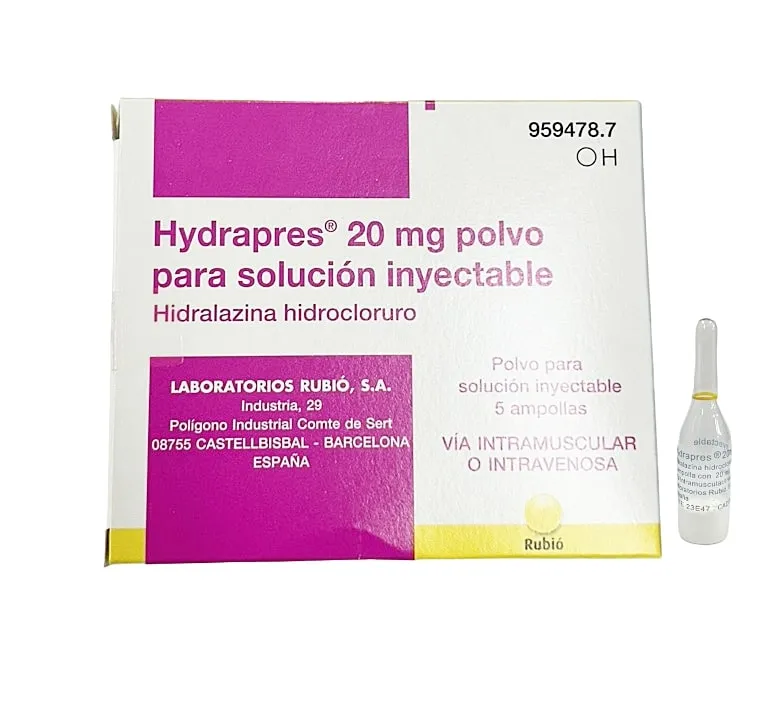
Table of Contents
Package leaflet: Information for the user
Introduction
PACKAGE LEAFLET: INFORMATION FOR THE USER
HYDRAPRES 20 mg powder for solution for injection
Hydralazine hydrochloride
Read this entire leaflet carefully before you start using this medicine, as it contains important information for you.
- Keep this leaflet, as you may need to read it again.
- If you have any questions, ask your doctor or pharmacist.
- This medicine has been prescribed only for you; do not give it to others, even if they have the same symptoms as you, as it may harm them.
- If you experience any adverse effects, consult your doctor, pharmacist, or nurse, even if the effects are not listed in this leaflet.
Leaflet contents:
- What Hydrapres is and what it is used for
- What you need to know before using Hydrapres
- How to use Hydrapres
- Possible side effects
- How to store Hydrapres
- Contents of the pack and other information
1. What Hydrapres is and what it is used for
Hydrapres belongs to a group of medicines known as antihypertensives that act on arteriolar smooth muscle to reduce blood pressure.
Hydrapres is used to treat:
- Hypertensive emergencies, when oral administration is not possible or a rapid reduction in blood pressure is urgently required. Preeclampsia and eclampsia (high blood pressure during pregnancy).
2. What you need to know before using Hydrapres
Do not use Hydrapres
- If you are allergic (hypersensitive) to hydralazine or to any of the other ingredients of this medicine (listed in section 6).
- If your heart beats rapidly (tachycardia).
- If you have heart diseases.
If you think you fall into any of the above situations, consult your doctor or pharmacist.
Warnings and precautions
See section “Use with other medicines”.
Use of Hydrapres with other medicines
Inform your doctor or pharmacist if you are taking, have recently taken, or might need to take any other medicines.
In particular, inform your doctor if you are taking any of the following medicines:
- other potent antihypertensives (e.g. diazoxide), administered by intravenous or intramuscular route.
- monoamine oxidase inhibitors (medicines used to treat depression, such as fluoxetine, citalopram).
Pregnancy and breastfeeding
Pregnancy
Inform your doctor if you are pregnant or may become pregnant. Your doctor will decide whether Hydrapres can be administered to you.
Breastfeeding
Inform your doctor if you are breastfeeding or plan to breastfeed. Your doctor will advise you on the benefits and risks of taking Hydrapres while breastfeeding.
Consult your doctor or pharmacist before taking any medicine.
Driving and using machines
The injectable form of Hydrapres has no influence on the ability to drive or operate machinery.
3. How to use Hydrapres
This medicine will always be administered by a healthcare professional.
Follow exactly the administration instructions for Hydrapres given by your doctor. If in doubt, consult your doctor or pharmacist again.
The usual doses are indicated below.
Adults
The usual therapeutic dose in adults is half an ampoule to 2 ampoules (10 mg to 40 mg) administered by intramuscular route, slow intravenous injection, or intermittent infusion, which may be repeated if necessary.
Blood pressure must be monitored frequently.
In preeclampsia and eclampsia, the normal initial intravenous dose for adults is 5 mg, followed by intravenous doses of 5–10 mg (range 5–20 mg) every 20–30 minutes.
Use in patients with impaired renal function
Certain patients (especially those with severe renal impairment) may require a lower dose.
Use in children
Safety and efficacy have not been established in children, although there is experience with its use in pediatric patients. In children, doses of 1.7–3.5 mg/kg/day or 50–100 mg/m²/day, divided into 4–6 doses, are recommended.
An initial dose higher than 20 mg is not recommended. Generally, most patients can switch to oral treatment within the first 24–48 hours.
If you use more Hydrapres than you should
The following may occur: decrease in blood pressure (hypotension), increased heart rate (tachycardia), skin redness (generalized cutaneous flushing), and severe headache (intense cephalalgia). It may also lead to irregular heartbeats (cardiac arrhythmias) and heart attack (myocardial ischemia). In severe cases, profound shock (coma) may occur.
In case of overdose or accidental ingestion, contact your doctor or pharmacist immediately or call the Toxicology Information Service at telephone number 91 562 04 20, indicating the medicine and the amount ingested.
Information for the physician: treatment will be symptomatic. The most important aspect is cardiovascular support. Shock may be treated with a plasma volume expander and, if possible, without using vasopressors. If vasopressors are required, one that does not precipitate or worsen cardiac arrhythmias should be used. Digitalization may be necessary. Renal function should be monitored and managed as needed. There is no experience with extracorporeal or peritoneal dialysis.
4. Possible adverse effects
Like all medicines, Hydrapres may produce adverse effects, although not everyone will experience them.
Hydralazine may cause in certain patients a clinical condition resembling systemic lupus erythematosus. Adverse reactions are usually reversible when the dose is reduced, and treatment needs to be discontinued only in a few cases.
The most frequent adverse reactions are: severe headache, palpitations, increased heart rate, decreased appetite, nausea, vomiting, and diarrhoea. In cardiac patients, it may also trigger chest pain.
Less frequent adverse reactions include: sudden drop in blood pressure, fluid retention, nasal congestion, skin redness, conjunctivitis, numbness, sensation of spinning (vertigo), peripheral neuritis (cramps, pain in hands and feet), tremor, muscle cramps, anxiety, depression, and allergic reactions such as urticaria, itching, fever, and eosinophilia (a blood disorder).
Rarely, the following may occur: hepatitis, blood disorders, enlargement of the spleen (splenomegaly), swelling of lymph nodes in the neck, armpit, or groin (lymphadenopathy), difficulty urinating, constipation, and difficulty breathing (dyspnea).
If you consider any of the adverse effects you experience to be severe, or if you notice any adverse effects not listed in this leaflet, inform your doctor or pharmacist.
5. Storage of Hydrapres
Keep this medicine out of the sight and reach of children.
Do not store above 30°C.
Store in the original packaging to protect from light.
Do not use this medicine after the expiry date stated on the packaging after EXP. The expiry date refers to the last day of the month indicated.
6. Package contents and other information
Composition of Hydrapres
-
The active substance is hydralazine hydrochloride.
-
The other components are: mannitol (E-421), hydrochloric acid to adjust pH to 3.5–4.2.
Appearance of the product and contents of the pack
Type I neutral glass ampoule according to the European Pharmacopoeia, containing 20 mg of hydralazine hydrochloride.
Marketing Authorization Holder and Manufacturer
Laboratorios Rubió, S.A.
Industria, 29
Polígono Industrial Comte de Sert
08755 Castellbisbal – Barcelona
Spain
Date of the most recent revision of this leaflet:
June-2008
Detailed and up-to-date information on this medicine is available on the website of the Spanish Agency for Medicines and Health Products (AEMPS) http://www.aemps.gob.es/
This information is intended for healthcare professionals only:
INSTRUCTIONS FOR CORRECT ADMINISTRATION OF THE PREPARATION
Hydrapres powder for injectable solution must be reconstituted before use.
Reconstitute the contents of the ampoule in 1.1 ml of an appropriate solvent and inject immediately after reconstitution.
The administered volume should not exceed 1 ml (concentration of the reconstituted solution: 20 mg hydralazine hydrochloride/ml).
Administration in solutions containing glucose, fructose, lactose, and maltose is not recommended.
Because hydralazine reacts with metals, the injectable solution should be prepared using a non-metallic filter and used rapidly after being drawn into a syringe with a needle.
It is compatible with conventional intravenous infusion fluids; however, intravenous administration of hydralazine in glucose-containing solutions is not recommended.
Continuous infusion is not recommended.
Blood pressure should be monitored during treatment.