Hycamtin 4 mg powder for concentrate for infusion solution
Spain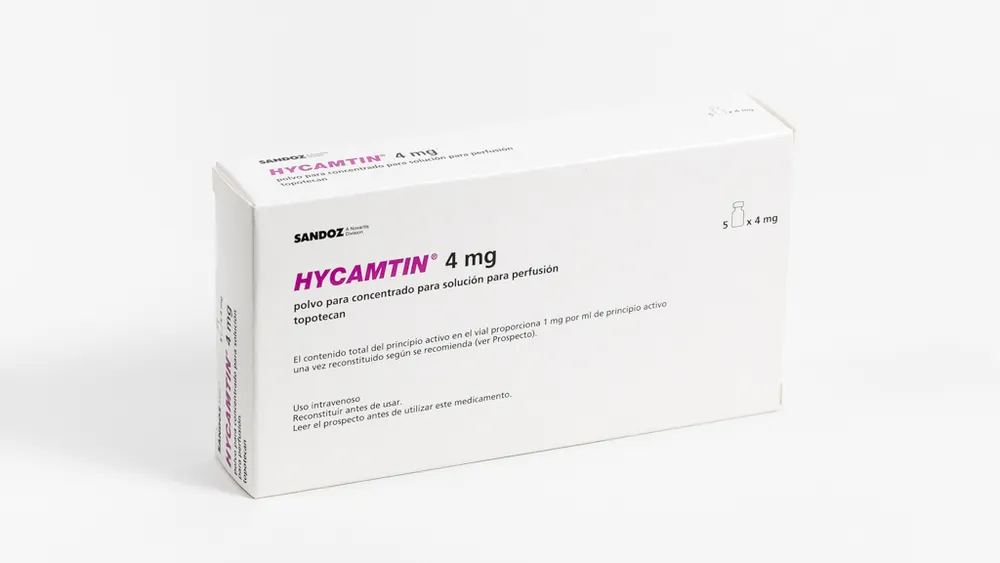
Table of Contents
Package leaflet: Information for the user
Introduction
Package leaflet: information for the user
Hycamtin 1mg powder for concentrate for solution for infusion
Hycamtin 4mg powder for concentrate for solution for infusion
topotecan
Read the entire leaflet carefully before you start using this medicine, because it contains important information for you.
- Keep this leaflet, as you may need to read it again.
- If you have any questions, consult your doctor or pharmacist.
- If you experience any adverse reactions, consult your doctor, even if they are adverse reactions not listed in this leaflet. See section 4.
Contents of the leaflet
- What Hycamtin is and what it is used for
- What you need to know before being administered Hycamtin
- How to use Hycamtin
- Possible adverse effects
- How to store Hycamtin
- Contents of the pack and other information
1. What Hycamtin is and what it is used for
Hycamtin helps to destroy tumors. A doctor or nurse will administer your medication as an intravenous infusion in the hospital.
Hycamtin is used to treat:
- ovarian cancer or small cell lung cancer that has recurred after receiving chemotherapy
- advanced cervical cancer, when surgery or radiotherapy is not possible. When used to treat cervical cancer, Hycamtin is given in combination with another medicine called cisplatin.
Your doctor will decide with you whether treatment with Hycamtin is preferable to your initial chemotherapy treatment.
2. What you need to know before Hycamtin is administered to you
Do not receive Hycamtin
- if you are allergic to topotecan or to any of the other ingredients of this medicine (listed in section 6).
- if you are breastfeeding.
- if your blood cell count is very low. Your doctor will tell you if this applies to you, based on the results of your most recent blood test.
Tell your doctor if you are in any of these situations.
Warnings and precautions
Before you are given this medicine, your doctor needs to know:
- if you have liver or kidney problems. Your dose of Hycamtin may need to be adjusted.
- if you are pregnant or planning to become pregnant. See the section “Pregnancy and breastfeeding” below.
- if you are planning to father a child. See the section “Pregnancy and breastfeeding” below.
Tell your doctor if you are in any of these situations.
Other medicines and Hycamtin
Tell your doctor if you are taking, have recently taken, or might need to take any other medicines, including those obtained without a prescription or any herbal medicines.
Remember to inform your doctor if you start taking any new medicine while undergoing treatment with Hycamtin.
Pregnancy and breastfeeding
The use of Hycamtin is not recommended in pregnant women. It may cause harm to the fetus, before, during, or after treatment. You must use an effective method of contraception. Do not attempt to become pregnant or father a child until your doctor tells you it is safe to do so.
Men who wish to father children should seek advice from their doctor regarding family planning. If your partner becomes pregnant during your treatment, inform your doctor immediately.
Avoid breastfeeding if you are being treated with Hycamtin. Do not restart breastfeeding until your doctor advises it is safe to do so.
Driving and using machines
Hycamtin may cause tiredness. If you feel fatigued or weak, do not drive or operate machinery.
Hycamtin contains sodium
This medicine contains less than 1 mmol of sodium (23 mg) per dose; hence, it is essentially “sodium-free”. If your doctor uses a common salt solution to dilute Hycamtin, the amount of sodium you receive would be higher.
3. How to use Hycamtin
The dose of Hycamtin you will receive will be calculated by your doctor based on:
- your body size (body surface area measured in square meters)
- the results of blood tests performed before treatment
- the type of disease being treated.
The usual dose is
- Ovarian cancer and small cell lung cancer: 1.5 mg per square meter of body surface area per day. You will receive treatment once daily for 5 days. This treatment schedule is usually repeated every 3 weeks.
- Cervical cancer: 0.75 mg per square meter of body surface area per day. You will receive treatment once daily for 3 days. This treatment schedule is usually repeated every 3 weeks.
When treating cervical cancer, Hycamtin is combined with another medicine called cisplatin. Your doctor will determine the appropriate dose of cisplatin.
This treatment may vary depending on the results of your periodic blood tests.
How Hycamtin is administered
A doctor or nurse will administer Hycamtin to you as an intravenous infusion into your arm, lasting approximately 30 minutes.
4. Possible adverse effects
Like all medicines, this medicine can cause adverse effects, although not everyone experiences them.
Serious adverse effects: tell your doctor
These very common adverse effects may affect more than 1 in 10 people treated with Hycamtin.
- Signs of infection: Hycamtin can reduce the number of white blood cells and lower your resistance to infections. This may be life-threatening. Some signs of infection include:
- fever
- severe deterioration in your general condition
- local symptoms such as sore throat or urinary problems (for example, burning sensation when urinating, which may be due to a urinary tract infection)
- Occasionally, the presence of severe stomach pain, fever, and possible diarrhea (rarely with blood) may be signs of intestinal inflammation (colitis).
This rare adverse effect may affect up to 1 in 1,000 people treated with Hycamtin:
- Lung inflammation (interstitial lung disease): You are at higher risk if you already have a lung disease, have received radiation treatment to your lungs, or have previously taken medicines that caused lung damage. Signs include:
- difficulty breathing
- cough
- fever.
Tell your doctor immediately if you notice any of these symptoms, as hospitalization may be required.
Very common adverse effects
May affect more than 1 in 10 people treated with Hycamtin:
- General feeling of weakness and tiredness (transient anemia). In some cases, a blood transfusion may be necessary.
- Unexplained bruising or bleeding, caused by a decrease in the number of cells involved in blood clotting. This may lead to serious bleeding from relatively minor wounds such as small cuts. Rarely, this may result in more severe bleeding (haemorrhage). Talk to your doctor for advice on how to minimize the risk of bleeding.
- Weight loss and loss of appetite (anorexia); tiredness; weakness.
- Nausea, vomiting; diarrhea; stomach pain; constipation.
- Inflammation and ulcers in the mouth, tongue, and gums.
- Rise in body temperature (fever).
- Hair loss.
Common adverse effects
May affect up to 1 in 10 people treated with Hycamtin:
- Allergic reactions or hypersensitivity reactions (including skin rash).
- Yellowing of the skin.
- Malaise.
- Itching sensation.
Rare adverse effects
May affect up to 1 in 1,000 people treated with Hycamtin:
- Severe allergic reactions or anaphylactic reactions.
- Swelling caused by fluid retention (angioedema).
- Mild pain and inflammation at the injection site.
- Itchy skin rash (or hives).
Adverse effects with unknown frequency
The frequency of some adverse effects is unknown (effects from spontaneous reports and frequency cannot be estimated from the available data):
- Severe stomach pain, nausea, vomiting with blood, black or bloody stools (possible symptoms of gastrointestinal perforation).
- Mouth sores, difficulty swallowing, abdominal pain, nausea, vomiting, diarrhea, bloody stools (possible signs and symptoms of inflammation of the inner lining of the mouth, stomach, and/or intestine [mucositis]).
If you are being treated for cervical cancer, you may experience adverse effects related to the other medicine (cisplatin) that will be administered together with Hycamtin. These effects are described in the cisplatin package leaflet.
Reporting of adverse effects
If you experience any type of adverse effect, consult your doctor or pharmacist, even if they are possible adverse effects not listed in this leaflet. You can also report them directly through the national reporting system described in Appendix V. By reporting adverse effects, you can help provide more information on the safety of this medicine.
5. Storage of Hycamtin
Keep this medicine out of the sight and reach of children.
Do not use this medicine after the expiry date stated on the container.
Store the vial in the outer packaging to protect it from light.
This medicine is for single use only. It should be used immediately after opening. If not used immediately, the storage time and conditions prior to use are the responsibility of the user. If reconstitution and dilution are carried out under strict aseptic conditions (e.g. in a laminar flow cabinet), the product should be used within 24 hours (infusion completed) if stored at 2°C–8°C after the first puncture of the vial.
Any unused product or waste material must be disposed of in accordance with local requirements for cytotoxic materials.
6. Contents of the container and other information
Composition of Hycamtin
- The active substance is topotecan. Each vial contains 1 mg or 4 mg of topotecan (as hydrochloride).
- The other components are: tartaric acid (E334), mannitol (E421), hydrochloric acid (E507), and sodium hydroxide.
Appearance of the product and contents of the container
Hycamtin is presented as a powder for concentrate for solution for infusion.
It is available in packs containing 1 or 5 glass vials; each vial contains 1 mg or 4 mg of topotecan.
The powder must be reconstituted and diluted before infusion.
The powder in the vial provides 1 mg per ml of active substance when reconstituted as recommended.
Marketing Authorization Holder
Sandoz Pharmaceuticals d.d.
Verovškova ulica 57
1000 Ljubljana
Slovenia
Manufacturer
Novartis Farmacéutica S.A.
Gran Via de les Corts Catalanes, 764
08013 Barcelona
Spain
Novartis Pharma GmbH
Roonstrasse 25
90429 Nuremberg
Germany
GlaxoSmithKline Manufacturing S.p.A.
Strada Provinciale Asolana 90
43056 San Polo di Torrile
Parma
Italy
Salutas Pharma GmbH
Otto-von-Guericke-Allee 1
39179 Barleben
Germany
More information on this medicinal product is available upon request by contacting the local representative of the Marketing Authorization Holder:
Belgium/Belgium/Belgium Sandoz N.V. Telecom Gardens Medialaan 40 B-1800 Vilvoorde Tél/Tel: +32 (0)2 722 97 97 | Lithuania Sandoz Pharmaceuticals d.d Branch Office Lithuania Seimyniskiu 3A LT – 09312 Vilnius Tel: +370 5 2636 037 |
| Luxembourg/Luxembourg Sandoz N.V. Telecom Gardens Medialaan 40 B-1800 Vilvoorde Tél/Tel: +32 (0)2 722 97 97 |
Czech Republic Sandoz s.r.o. Na Pankráci 1724/129 CZ-140 00, Praha 4 Tel: +420 225 775 111 office.cz@ sandoz.com | Hungary Sandoz Hungária Kft. Bartók Béla út 43-47 H-1114 Budapest Tel: +36 1 430 2890 |
Denmark Sandoz A/S Edvard Thomsens Vej 14 DK-2300 København S Tlf: +45 6395 1000 | Malta Sandoz Pharmaceuticals d.d. Verovskova 57 SI-1000 Ljubljana Slovenia Tel: +356 21222872 |
Germany Hexal AG Industriestr. 25 D-83607 Holzkirchen Tel: +49 8024 908-0 | Netherlands Sandoz B.V. Veluwezoom 22 NL-1327 AH Almere Tel: +31 (0)36 5241600 |
Estonia Sandoz d.d. Eesti filiaal Pärnu mnt 105 EE – 11312 Tallinn Tel: +372 6652405 | Norway Sandoz A/S Edvard Thomsens Vej 14 DK-2300 København S Denmark Tlf: +45 6395 1000 |
Greece SANDOZ HELLAS MONOPROSOPI A.E. Tel: +30 216 600 5000 | Austria Sandoz GmbH Biochemiestr. 10 A-6250 Kundl Tel: +43(0)1 86659-0 |
Spain Bexal Farmacéutica, S.A. Centro Empresarial Parque Norte Edificio Roble C/ Serrano Galvache, 56 28033 Madrid Tel: +34 900 456 856 | Poland Sandoz Polska Sp. z o.o. ul. Domaniewska 50 C 02 672 Warszawa Tel.: +48 22 209 7000 |
France Sandoz SAS 49, avenue Georges Pompidou F-92300 Levallois-Perret Tél: +33 1 49 64 48 00 | Portugal Sandoz Farmacêutica Lda. Avenida Professor Doutor Cavaco Silva, n.º10E Taguspark P-2740−255 Porto Salvo Tel: +351 21 196 40 42 |
Croatia Sandoz d.o.o. Maksimirska 120 10 000 Zagreb Tel : +385 1 235 3111 | Romania Sandoz S.R.L. Strada Livezeni Nr. 7a 540472 Târgu Mureș Tel: +40 21 407 51 60 |
Ireland Sandoz Pharmaceuticals d.d. Verovškova ulica 57 1000 Ljubljana Slovenia | Slovenia Lek farmacevtska družba d.d. Verovškova 57 SI-1526 Ljubljana Tel: +386 1 580 21 11 |
Iceland Sandoz A/S Edvard Thomsens Vej 14 DK-2300 Copenhagen S Denmark Tlf: +45 6395 1000 | Slovakia Sandoz d.d. - organizacná zložka Žižkova 22B 811 02 Bratislava Tel: +421 2 48 200 600 |
Italy Sandoz S.p.A. Largo Umberto Boccioni, 1 I-21040 Origgio / VA Tel: +39 02 96 54 1 | Finland Sandoz A/S Edvard Thomsens Vej 14 DK-2300 Helsinki S Finland Tel: +358 010 6133 400 |
Cyprus Sandoz Pharmaceuticals d.d. Verovskova 57 SI-1000 Ljubljana Slovenia Tel: +357 22 69 0690 | Sweden Sandoz A/S Edvard Thomsens Vej 14 DK-2300 Stockholm S Sweden Tel: +45 6395 1000 |
Latvia Sandoz d.d. Latvia filiale K.Valdemara 33 – 29 LV-1010 Riga Tel: +371 67892006 | United Kingdom (Northern Ireland) Sandoz Pharmaceuticals d.d. Verovskova 57 SI-1000 Ljubljana Slovenia Tel: +43 5338 2000 |
Date of the most recent review of this summary:
Other sources of information
Detailed information on this medicine is available on the European Medicines Agency website: http://www.ema.europa.eu/.
This information is intended for healthcare professionals only:
Instructions for reconstituting, storing, and disposing of Hycamtin
Reconstitution
Hycamtin 1 mg powder for concentrate for solution for infusion must be reconstituted with 1.1 ml of water for injections to provide a solution containing 1 mg per ml of topotecan.
Hycamtin 4 mg powder for concentrate for solution for infusion must be reconstituted with 4 ml of water for injections to provide a solution containing 1 mg per ml of topotecan.
These solutions must then be further diluted. The appropriate volume of the reconstituted solution should be diluted either with 0.9% w/v sodium chloride for intravenous infusion or with 5% w/v glucose for intravenous infusion, to achieve a final concentration between 25 and 50 micrograms/ml.
Storage of the prepared solution
The product should be used immediately after preparation for infusion. If reconstitution is carried out under strict aseptic conditions, Hycamtin infusion may be completed within a maximum of 12 hours at room temperature (or 24 hours if stored at 2–8°C).
Handling and disposal
Standard procedures for handling and disposal of cytotoxic anticancer drugs should be followed:
- Personnel should be trained in the reconstitution of the medicinal product.
- Healthcare personnel should not handle this medicine during pregnancy.
- Healthcare personnel handling this drug during reconstitution must wear protective clothing, including mask, protective goggles, and gloves.
- All materials used for administration or cleaning, including gloves, must be placed in disposable high-risk biological waste bags for high-temperature incineration.
- Accidental contact with skin or eyes should be immediately rinsed thoroughly with plenty of water.