Higrotona 50 mg tablets
Spain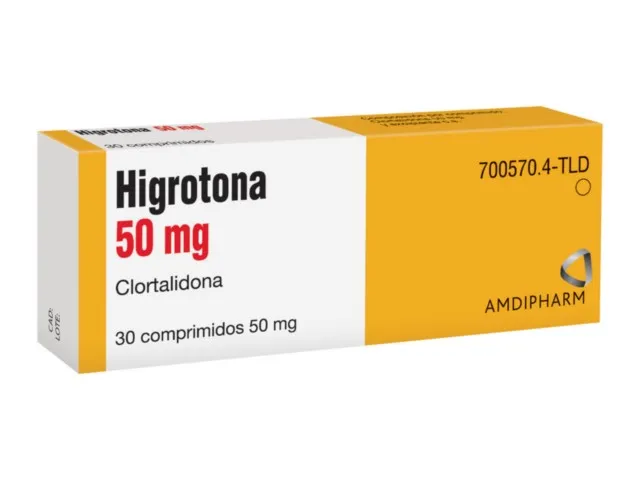
Table of Contents
Package leaflet: Information for the user
Introduction
Package leaflet: Information for the patient
Higrotona 50 mg tablets
Chlorthalidone
Read all of this leaflet carefully before you start taking this medicine, because it contains important information for you.
- Keep this leaflet. You may need to read it again.
- If you have any questions, ask your doctor or pharmacist.
- This medicine has been prescribed for you only. Do not pass it on to other people, even if they have the same symptoms as you, because it may harm them.
- If you experience any adverse effects, consult your doctor or pharmacist, even if they are effects not listed in this leaflet. See section 4.
Contents of this leaflet
- What Higrotona is and what it is used for
- What you need to know before taking Higrotona
- How to take Higrotona
- Possible adverse effects
- How to store Higrotona
- Contents of the pack and other information
1. What Higrotona is and what it is used for
Higrotona belongs to a group of medicines called thiazide diuretics. It contains one active substance: clortalidone.
Thiazide diuretics help reduce the amount of fluid in your body. They do this by stimulating the production of urine, thereby lowering blood pressure.
This medicine is indicated for the treatment of the following conditions:
- Hypertension (high blood pressure), either alone or in combination with other antihypertensive medicines.
- Edema (excessive fluid retention in the tissues) due to kidney or liver disease.
- Nephrogenic diabetes insipidus (a disorder in which a defect in the kidney's small ducts (tubules) causes a person to excrete large amounts of urine).
2. What you need to know before taking Higrotona
Do not take Higrotona:
- If you are allergic to chlorthalidone or to any of the other ingredients of this medicine
(listed in section 6), or to any other medicine that increases urine production (ask your doctor or pharmacist which products contain these ingredients)
- If you are not passing urine at all
- If you have severe kidney problems or severe liver disease
- If your blood potassium or sodium levels are too low, or your blood calcium level is too high
- If you have ever had gout or kidney stones, or currently suffer from gout
- If you are pregnant (see section "Pregnancy, breastfeeding and fertility")
- If you have Addison's disease (also known as primary adrenal insufficiency or hypoadrenalism): a rare disorder of the adrenal glands
affecting the production of two essential hormones called cortisol and aldosterone
.
Warnings and precautions
Talk to your doctor or pharmacist before taking Higrotona.
- If you have a kidney disorder or liver disease
- If you have circulation problems or heart disease
- If you have diabetes
- If your blood levels of potassium, sodium, or magnesium are too low, or your blood calcium levels are too high
o Low blood potassium levels may cause muscle weakness, muscle cramps, or abnormal heartbeats
o Low blood sodium levels may cause tiredness, confusion, muscle spasms, seizures, or coma
o High blood calcium levels may cause loss of appetite, tiredness, or muscle weakness
- If your blood cholesterol level is too high
- If your blood uric acid levels have increased
- If you are taking any other medicine, also read the section "Other medicines and Higrotona"
- If you experience a decrease in vision or eye pain, these could be symptoms of fluid accumulation in the vascular layer of the eye (choroidal effusion) or increased eye pressure, which may occur within hours to a week after taking Higrotona. If untreated, this may lead to permanent vision loss. If you have ever had an allergy to penicillin or sulfonamides, you may be at higher risk of this adverse effect.
Caution is advised when undergoing blood tests while taking Higrotona, as it may alter test results.
Athletes should be aware that this medicine contains a component that may result in a positive doping test.
Children and adolescents
Higrotona may cause dizziness and affect concentration, especially at the beginning of treatment. Parents/caregivers should ensure that children/adolescents do not drive or operate machinery until these effects have disappeared.
Other medicines and Higrotona
Tell your doctor or pharmacist if you are taking, have recently taken, or might need to take any other medicines. It may be necessary to adjust the dose, or in some cases, stop treatment with one of the medicines. This particularly applies to:
- Medicines that lower blood pressure or treat heart problems such as:
o ACE inhibitors (e.g., lisinopril)
o beta-blockers (e.g., propranolol hydrochloride)
o methyldopa
o vasodilators (e.g., bosentan)
o calcium channel blockers (e.g., amlodipine)
o guanethidine, diazoxide
o ketanserin
-
Adrenocorticotropic hormone (ACTH): used to treat a range of conditions, including ulcerative colitis, Crohn's disease, and rheumatoid arthritis
-
Corticosteroids such as prednisolone or betamethasone: used to treat allergic and inflammatory diseases and immune reactions
-
Cytotoxic agents such as cyclophosphamide or methotrexate: used to treat cancer
-
Treatments for asthma such as formoterol or salbutamol
-
Medicines to treat infections (amphotericin)
-
Medicines to treat ulcers (carbenoxolone)
-
Medicines to treat certain mental disorders (lithium)
-
Anticholinergics such as atropine sulfate or hyoscine butylbromide: for abdominal or stomach spasms or cramps
-
Medicines used to reduce cholesterol levels and prevent heart disease (cholestyramine)
-
Medicines to treat Parkinson's disease or viral infections (amantadine)
-
Medicines to treat gout (allopurinol)
-
Painkillers or anti-inflammatory medicines such as aspirin or indomethacin: used to relieve pain or rheumatism
-
Medicine to treat irregular heart rhythm (digoxin)
-
Medicines to treat diabetes (insulin and other diabetes treatments such as chlorpropamide or glibenclamide; dose adjustment may be needed)
-
Medicines to treat skin diseases, rheumatic conditions, or used after organ transplantation (cyclosporine)
-
vitamin D and calcium salts used in replacement therapy
-
anticoagulant medicines
Taking Higrotona with food, drink, and alcohol
Avoid alcohol. Alcohol may cause a severe drop in blood pressure and/or increase the risk of dizziness or fainting.
Pregnancy, breastfeeding, and fertility
If you are pregnant, breastfeeding, think you may be pregnant, or are planning to become pregnant, consult your doctor before using this medicine.
Pregnancy
Do not take Higrotona if you are pregnant or trying to become pregnant (see section "Do not take Higrotona"). Inform your doctor immediately if you become pregnant during treatment with Higrotona.
Breastfeeding
Do not take Higrotona if you are breastfeeding, as the active substance in Higrotona passes into breast milk and could harm your baby.
For safety reasons, breastfeeding is not recommended while undergoing treatment with Higrotona.
Fertility
Higrotona is not recommended for women of childbearing age who are not using contraceptive methods, unless the woman's clinical condition requires treatment with chlorthalidone.
Driving and using machines
It is unlikely that Higrotona will affect your ability to drive or use machines. However, like other medicines used to treat high blood pressure, Higrotona may cause dizziness or drowsiness in some people, especially at the beginning of treatment, when changing doses, or if alcohol is consumed. If you experience dizziness or drowsiness, consult your doctor before engaging in such activities.
Higrotona contains sodium
This medicine contains less than 1 mmol of sodium (23 mg) per tablet; this is essentially "sodium-free".
3. How to take Higrotona
Follow exactly the instructions for use of this medicine as given by your doctor. If in doubt, please consult your doctor or pharmacist again.
Doses should always be individually adjusted. It is recommended to take the medicine in  a single dose, in the morning with breakfast.
In long-term treatments, the lowest dose producing an optimal effect should be used, especially in elderly patients.
- Edema of other origin: The administered dose should not exceed 50 mg/day. If an adequate response is not achieved, positive inotropes or an angiotensin-converting enzyme inhibitor should be administered.
- Hypertension (adults): in mild hypertension, a daily dose of 25 mg or 50 mg three times a week is often sufficient. If necessary, the dose may be increased to 50 mg daily. If the reduction in blood pressure is insufficient, combination with other antihypertensives is recommended (e.g. beta-blockers, vasodilators, calcium antagonists, ACE inhibitors, reserpine), which generally allows low dosages of each component to be maintained.
- Diabetes insipidus (adults): initial dose, 100 mg of Higrotona twice daily. For maintenance dose, 50 mg daily is usually sufficient.
Use in children
Your doctor will choose an appropriate dose according to the child's age and weight.
Use in elderly patients or patients with kidney problems
Your doctor may prescribe a lower dose, as your body may not eliminate Higrotona as quickly as usual.
If you take more Higrotona than you should
Chlorthalidone poisoning may cause dizziness, nausea (feeling of discomfort), somnolence (excessive daytime sleepiness), hypovolemia (shock), hypotension (low blood pressure), and electrolyte disturbances associated with cardiac arrhythmias (irregular heartbeat) and muscle spasms.
In case of overdose or accidental ingestion, consult your doctor or pharmacist immediately or call the Toxicology Information Service at telephone number: 91 562 04 20, indicating the medicine and the amount ingested.
Information for the patient You should follow your doctor's recommendations. Higrotona 50 mg is generally well tolerated, even during long-term treatment. It is advisable to follow a diet rich in potassium (fruit and vegetables) during treatment. A completely salt-free diet is not recommended. If you experience skin disorders, gastrointestinal disturbances, fatigue, muscle weakness, irregular pulse, or any other discomfort during medication, inform your doctor immediately. |
If you forget to take Higrotona
Do not take a double dose to make up for missed doses.
If you forget to take a dose, take it as soon as possible, unless it is almost time for your next dose. Never take two doses at the same time.
If you stop taking Higrotona
Signs of illness expected when stopping treatment with Higrotona
There are no known signs of illness.
If you have any further questions about the use of this medicine, ask your doctor or pharmacist.
If you have any further questions about the use of this medicine, ask your doctor or pharmacist.
4. Possible adverse effects
Like all medicines, this medicine can cause adverse effects, although not everyone experiences them.
If you experience any of the following reactions, stop taking Higrotona tablets immediately. Inform your doctor right away or go to the nearest hospital emergency department:
- Allergic reactions: skin rash, swelling of the face, lips, tongue and/or throat which may cause difficulty breathing or swallowing. (frequency unknown)
- Sore throat, fever or chills (signs of a blood disorder) (uncommon)
- Yellowing of the eyes or skin (jaundice) (uncommon: may affect up to 1 in 100 people)
- Stomach pain associated with nausea, vomiting or fever (signs of pancreatitis) (very rare: may affect up to 1 in 10,000 people)
- Decreased vision or eye pain due to increased pressure (possible signs of fluid accumulation in the vascular layer of the eye [choroidal effusion], acute angle-closure glaucoma or acute myopia) (frequency not known)
Inform your doctor as soon as possible if you experience any of the following adverse effects:
Very common (may affect more than 1 in 10 people):
- Low blood potassium levels (hypokalaemia)
- High blood uric acid levels (hyperuricaemia)
- Increased blood cholesterol levels (hyperlipidaemia)
Common (may affect up to 1 in 10 people):
- Tingling sensation
- Low blood sodium levels (hyponatraemia)
- Low blood magnesium levels (hypomagnesaemia)
- High blood sugar levels (hyperglycaemia)
- Loss of appetite
- Dizziness
- Low blood pressure (hypotension)
- Vomiting
- Nausea
- Diarrhoea
- Stomach pain
- Constipation
- Erectile problems and loss of libido (erectile dysfunction)
Rare (may affect up to 1 in 1,000 people):
- Stiffness or tingling sensation in the hands, feet or lips (paraesthesia)
- Bruising or abnormal bleeding (signs of thrombocytopenia)
- Decreased number of white blood cells (leucocytes) in the blood (leucopenia)
- Very low white blood cell count (agranulocytosis)
- Increased number of eosinophils in the blood (eosinophilia)
- Joint pain (signs of gout)
- Headache
- Visual disturbances
- Impairment in the release of a digestive fluid from liver cells called bile (intrahepatic cholestasis)
- Irregular heartbeat (arrhythmias)
- Sugar in the urine (glucosuria) (would be detected in a urine test performed by your doctor or nurse)
- Worsening of diabetes
- Increased blood calcium levels (hypercalcaemia)
- Hives (urticaria)
- Increased sensitivity of the skin to sunlight (photosensitivity reaction)
Very rare (may affect up to 1 in 10,000 people):
- Fluid accumulation in the lungs (pulmonary oedema)
- Low blood chloride levels (hypochloraemic alkalosis)
- Inflammation of blood vessels (vasculitis)
- Inflammation of the kidney tubules in the kidney (interstitial nephritis)
Reporting of adverse effects
If you experience any adverse effect, consult your doctor or pharmacist, even if it is a possible adverse effect not listed in this leaflet. You may also report them directly via the Spanish Pharmacovigilance System for Human Medicines: https://www.notificaram.es. By reporting adverse effects, you can help provide more information on the safety of this medicine.
5. Storage of Higrotona
Keep this medicine out of the sight and reach of children. Store in the original packaging to protect it from moisture.
Do not use this medicine after the expiry date stated on the packaging after EXP. The expiry date is the last day of the month indicated.
Medicines must not be disposed of via wastewater drains or household waste. Dispose of unused medicines and their containers at the SIGRE collection point at your pharmacy. If you are unsure, ask your pharmacist how to properly dispose of unused medicines and their containers. This will help protect the environment.
6. Contents of the pack and other information
Composition of Higrotona
The active substance is chlorthalidone. Each tablet contains 50 mg of chlorthalidone.
The other components are corn starch, colloidal anhydrous silica, magnesium stearate, microcrystalline cellulose, yellow iron oxide (E-172), sodium carboxymethylcellulose.
Appearance of the product and contents of the pack
Flat, round, pale yellow tablets with bevelled edges, scored and bearing the imprint Z/A on one side. The tablet can be divided into equal doses.
Each pack contains 30 tablets, packed in a blister.
Marketing Authorisation Holder and Manufacturer
Marketing Authorisation Holder:
Amdipharm Limited
Unit 17, Northwood House,
Northwood Crescent
Northwood, Dublin 9
D09 V504, Ireland
Manufacturer:
CENEXI SAS
52, Rue Marcel et Jacques Gaucher,
94120 Fontenay-Sous-Bois, France
For further information on this medicinal product, please contact the local representative of the Marketing Authorisation Holder:
Local representative:
Advanz Pharma Spain S.L.U.
Paseo de la Castellana 135, 7th floor
28046 Madrid (Spain)
Tel. +34 900 834 889
Date of the most recent review of this leaflet: November 2020
Detailed and up-to-date information on this medicinal product is available on the website of the Spanish Agency for Medicines and Health Products (AEMPS) http://www.aemps.gob.es/