Hidonac Antidoto 200 mg/ml concentrate for solution for infusion
Spain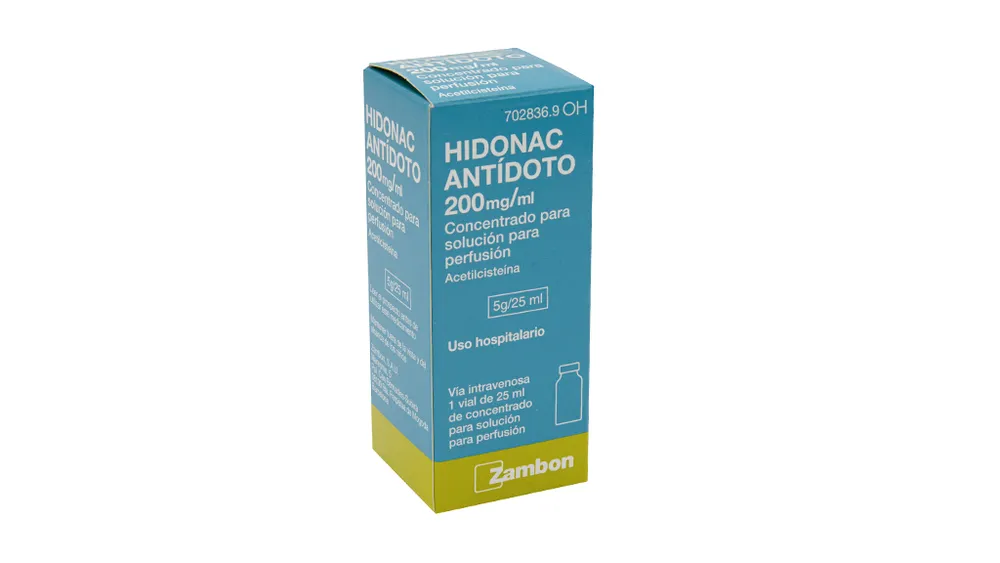
Table of Contents
- Package leaflet: Information for the user
- Introduction
- 1. What Hidonac Antidote is and what it is used for
- 2. What you need to know before starting to use Hidonac antidote
- 3. How to use Hidonac antidote
- 4. Possible adverse effects
- 5. Storage of Hidonac Antidote
- 6. Contents of the container and additional information
- **Adults and adolescents (> 40 kg body weight)**
- **Children**
Package leaflet: Information for the user
Introduction
Package leaflet: information for the user
Hidonac Antidote 200 mg/ml concentrate for solution for infusion
Acetylcysteine
Read all of this leaflet carefully before you start using this medicine, because it contains important information for you.
- Keep this leaflet, as you may need to read it again.
- If you have any questions, ask your doctor, pharmacist or nurse.
- If you experience any adverse reactions, consult your doctor, pharmacist or nurse, even if they are adverse reactions not listed in this leaflet. See section 4.
Contents of the leaflet
- What Hidonac Antidote is and what it is used for
- What you need to know before using Hidonac Antidote
- How to use Hidonac Antidote
- Possible side effects
- How to store Hidonac Antidoto
- Contents of the pack and other information
1. What Hidonac Antidote is and what it is used for
Hidonac Antidote is used in the treatment of paracetamol overdose.
This medicine contains a derivative of cysteine (acetylcysteine) which is used in the synthesis of glutathione. Glutathione removes free radicals that can cause tissue damage and which are released during inflammatory processes.
In paracetamol overdose, a relative deficiency of glutathione occurs in the liver. Glutathione can bind to the toxic metabolites of paracetamol. If acetylcysteine is administered in time after a paracetamol overdose, it can prevent liver damage.
2. What you need to know before starting to use Hidonac antidote
Before starting treatment, blood samples must be taken to analyze paracetamol levels in your blood.
Warnings and precautions
Consult your doctor before starting to use this medicine
- if you have asthma or suffer from a serious respiratory disease, as this medicine may cause breathing difficulties (bronchospasm).
- if you have previously had an adverse reaction to acetylcysteine.
- if you are pregnant or breastfeeding.
- high doses of acetylcysteine may cause disturbances in blood coagulation, prolonging bleeding.
The possible sulfurous odor (like rotten eggs) of the medicine is characteristic of the active substance and does not indicate that the medicine is spoiled.
Children and adolescents
The same precautions and warnings apply to children and adolescents.
Interference with laboratory tests
- acetylcysteine may interfere with the determination of salicylates.
- acetylcysteine may interfere with the determination of ketones in urine.
Use of Hidonac antidote with other medicines
Inform your doctor or pharmacist if you are using or have recently used any other medicines, including those obtained without a prescription.
- nitroglycerin, as its blood pressure-lowering effect (hypotension) may be increased, possibly causing headache.
- carbamazepine, a drug used to treat epileptic seizures, as it may increase the risk of seizures.
Use of Hidonac antidote with food and drink
The intake of food and beverages does not affect the effectiveness of the medicine.
Pregnancy, breastfeeding and fertility
Consult your doctor or pharmacist before using any medicine.
There is no information available on the use of this medicine during pregnancy or breastfeeding; therefore, its use during these periods is not recommended.
There are no data regarding the effect of acetylcysteine on fertility in humans. Animal studies do not indicate harmful effects on human fertility at the recommended doses.
Driving and use of machines
There is no evidence of effects on the ability to drive or operate machinery.
Hidonac antidote contains sodium
This medicine contains 748 mg of sodium (main component of table salt) in each 25 ml vial. This corresponds to 37.4% of the maximum recommended daily sodium intake for an adult.
3. How to use Hidonac antidote
Follow exactly the instructions for administration of this medicine as given by your doctor. If in doubt, consult your doctor or pharmacist again.
This medicine is administered by intravenous infusion under strict medical supervision.
Use in adults and adolescents (body weight over 40 kg)
Your doctor will determine the treatment to be followed (see detailed information in the section for healthcare professionals at the end of this leaflet).
The recommended dose is 300 mg of acetylcysteine per kilogram of body weight, equivalent to 1.5 ml/kg of Hidonac antidote within a 21-hour interval, according to the following three-step regimen:
- 150 mg/kg, equivalent to 0.75 ml/kg, administered slowly by intravenous infusion diluted in 200 ml of 5% glucose solution over 60 minutes.
- 50 mg/kg, equivalent to 0.25 ml/kg, in 500 ml of 5% glucose solution administered by slow infusion over 4 hours.
- 100 mg/kg, equivalent to 0.50 ml/kg, in 1000 ml of 5% glucose solution administered by slow infusion over 16 hours.
Use in children
In children, the volume of 5% glucose solution for infusion must be adjusted according to age and body weight to avoid the risk of pulmonary vascular congestion. Your doctor will calculate the amounts to be administered.
For effective treatment, it must be started as soon as possible, generally no later than 8–10 hours after ingestion of the paracetamol overdose; beyond this time, the protective effect of acetylcysteine progressively and rapidly diminishes, and after 15 hours from intoxication it may no longer be effective.
Administration of the medicine may be discontinued when blood test results show paracetamol blood levels below 200 micrograms/ml.
If you use more Hidonac antidote than you should
If you have used more Hidonac antidote than you should, contact your doctor, pharmacist, or call the Toxicology Information Service immediately at telephone number 91.562.04.20, indicating the medicine and the amount used.
If you have any further questions about the use of this medicine, ask your doctor, pharmacist, or nurse.
4. Possible adverse effects
Like all medicines, this medicine can cause adverse effects, although not everyone will experience them.
Adverse reactions to acetylcysteine usually occur between 15 and 60 minutes after starting the infusion, and in many cases, symptoms improve when the infusion is stopped. Antihistamine treatment may be required, and sometimes corticosteroids. Once an adverse reaction is under control, the infusion can usually be restarted at the lowest infusion rate (100 mg/kg in 1 liter over more than 16 hours).
The following adverse effects have been reported, although their frequency cannot be established from the available information:
Immune system disorders: Anaphylactic shock, anaphylactic reaction, anaphylactoid reaction, hypersensitivity.
Cardiac disorders: Tachycardia, bradycardia.
Respiratory, thoracic and mediastinal disorders: Bronchospasm, dyspnea, stridor, cough.
Gastrointestinal disorders: Vomiting, nausea.
Skin and subcutaneous tissue disorders: Angioedema, urticaria, flushing, rash, pruritus.
General disorders and administration site conditions: Facial swelling, malaise.
Investigations: Decreased blood pressure, prolonged prothrombin time.
In very rare cases, the occurrence of severe skin reactions such as Stevens-Johnson syndrome and Lyell syndrome has been reported in temporal association with acetylcysteine administration. In most cases, at least one other drug suspected of triggering the mucocutaneous syndrome could also be identified. If any new changes in the skin or mucous membranes occur, administration of acetylcysteine must be stopped immediately. The specialist physician will determine the appropriate course of treatment.
In some cases, a reduction in blood coagulation (decreased platelet aggregation) has been reported.
Reporting of adverse effects
If you experience any type of adverse effect, consult your doctor, pharmacist, or nurse, even if it is a possible adverse effect not listed in this leaflet. You may also report them directly via the Spanish Pharmacovigilance System for Human Medicinal Products: https://www.notificaram.es. By reporting adverse effects, you can help provide more information on the safety of this medicine.
5. Storage of Hidonac Antidote
Keep this medicine out of the sight and reach of children.
Do not use this medicine after the expiry date stated on the packaging after the abbreviation EXP. The expiry date refers to the last day of the month indicated.
Medicines must not be disposed of via wastewater or household waste. Ask your pharmacist how to dispose of medicines and packaging you no longer need. This will help protect the environment.
6. Contents of the container and additional information
Composition of Hidonac antidote
The active substance is acetylcysteine. Each 25 ml vial contains 5 g of acetylcysteine.
The other components are: disodium edetate, sodium hydroxide (E524) (for pH adjustment) and water for injections.
Appearance of the product and contents of the container
Appearance: clear, colorless glass vials containing 25 ml of clear, colorless solution, fitted with a rubber stopper and an aluminum seal.
Each package contains 1 vial.
Marketing Authorization Holder and Manufacturer
Marketing Authorization Holder
Zambon S.A.U.
Maresme, 5. Pol. Can Bernades-Subirà
08130 Sta. Perpètua de Mogoda (Barcelona)
Manufacturer
Alfasigma S.p.A.
Via Enrico Fermi, 1
65020 Alanno (PE) Italy
Date of the most recent review of this leaflet: October 2019
Detailed and up-to-date information on this medicinal product is available on the website of the Spanish Agency of Medicines and Health Products (AEMPS) http://www.aemps.gob.es/.
This information is intended for healthcare professionals only:
Acetylcysteine is administered by intravenous infusion, preferably using 5% glucose solution as the infusion fluid, although 0.9% sodium chloride solution may be used if 5% glucose solution is not advisable.
The infusion must be administered slowly to reduce the risk of adverse effects.
Dosage
The dose should be calculated using the patient's actual body weight to determine the total volume of solution.
For further information, refer to the Summary of Product Characteristics, which includes dosage tables for both adults and children, detailing dose, volume to be infused, and infusion rate according to weight ranges.
Adults and adolescents (> 40 kg body weight)
The complete acetylcysteine treatment cycle consists of 3 consecutive intravenous infusions:
First infusion: Initial dose of 150 mg/kg body weight in 200 ml solution over 1 hour.
Second infusion: 50 mg/kg body weight in 500 ml over the following 4 hours.
Third infusion: 100 mg/kg body weight in 1 litre over the following 16 hours.
Thus, the patient should receive a total of 300 mg/kg body weight over a period of 21 hours.
Children
Children should be treated with the same doses and regimen as adults. However, the volume of solution to be infused should be adjusted according to the patient's age and body weight due to the potential risk of pulmonary vascular congestion from fluid overload.
The complete treatment cycle with acetylcysteine consists of 3 consecutive intravenous infusions:
First infusion:
Initial dose of 150 mg/kg body weight administered by infusion over 1 hour (150 mg/kg/h), given as a 50 mg/ml solution at a rate of 3 ml/kg/h.
Second infusion:
Dose: 50 mg/kg body weight administered by infusion over 4 hours (12.5 mg/kg/h), given as a 6.25 mg/ml solution at a rate of 2 ml/kg/h.
Third infusion:
Dose: 100 mg/kg body weight administered by infusion over 16 hours (6.25 mg/kg/h), given as a 6.25 mg/ml solution at a rate of 1 ml/kg/h.
Preparation of the solution
1st dose
Prepare a 50 mg/ml solution. Dilute 10 ml of acetylcysteine (200 mg/ml) with 30 ml of 5% glucose or 0.9% sodium chloride to obtain a total volume of 40 ml.
2nd dose
Prepare a 6.25 mg/ml solution. Dilute 10 ml of acetylcysteine (200 mg/ml) with 310 ml of 5% glucose or 0.9% sodium chloride to obtain a total volume of 320 ml.
3rd dose
Prepare a 6.25 mg/ml solution. Dilute 10 ml of acetylcysteine (200 mg/ml) with 310 ml of 5% glucose or 0.9% sodium chloride to obtain a total volume of 320 ml.
- Incompatibilities :
Concomitant administration of acetylcysteine with other medicinal products is not recommended; in particular, it must not be mixed with drugs used to treat infections (antibiotics), due to the possible inactivation of the antibiotic (primarily β-lactam antibiotics).