Hibor 5.000 UI anti-Xa/0.2 ml solution for injection in pre-filled syringes
Spain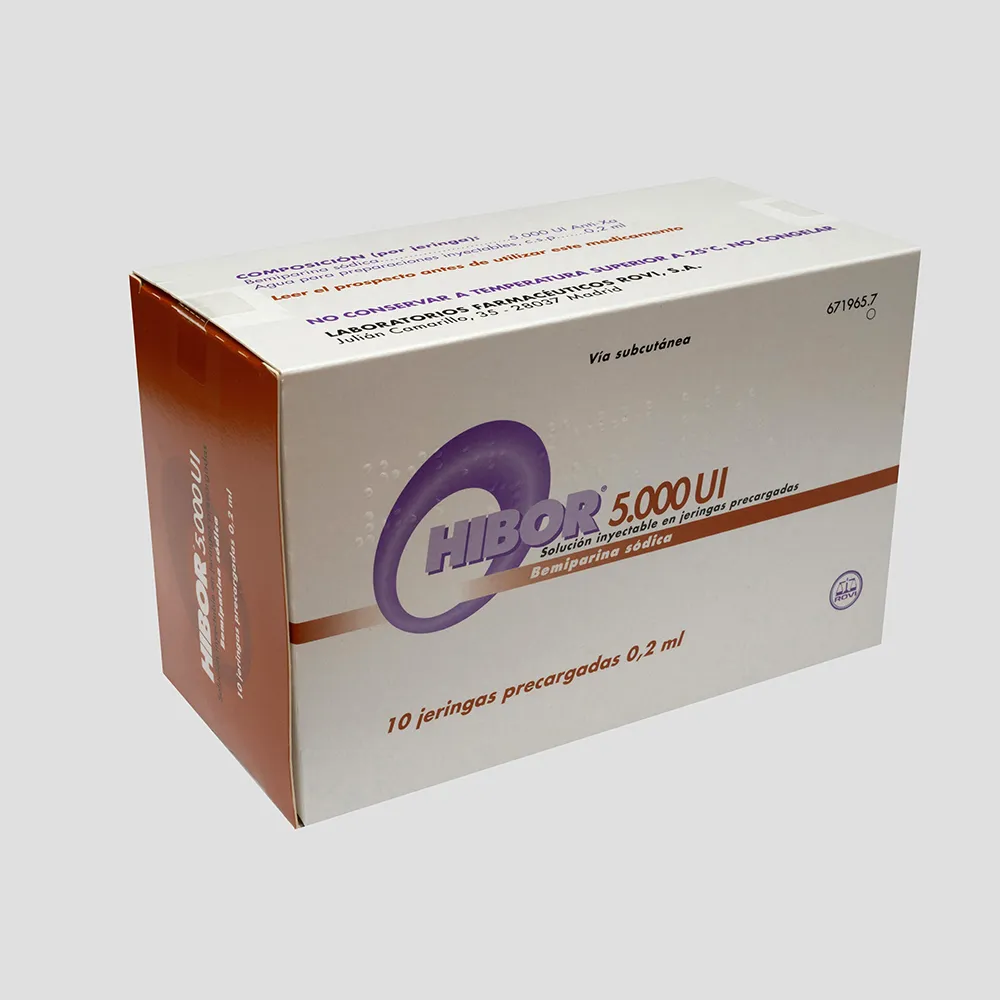
Table of Contents
- Package leaflet: Information for the user
- Introduction
- 1. What HIBOR 5,000 IU is and what it is used for
- 2. What you need to know before using HIBOR 5,000 IU
- **Driving and operating machinery**
- 3. How to use HIBOR 5.000 IU
- 4. Possible adverse effects
- 5. Storage of HIBOR 5,000 IU
- 6. Contents of the pack and other information
Package leaflet: Information for the user
Introduction
Package leaflet: information for the user
HIBOR 5,000 IU anti Xa/0.2 ml
solution for injection in pre-filled syringes
Bemiparin sodium
Read all of this leaflet carefully before you start using this medicine, because it contains important information for you.
- Keep this leaflet. You may need to read it again.
- If you have any further questions, ask your doctor, pharmacist or nurse.
- This medicine has been prescribed for you only and must not be given to other people. It may harm them even if their symptoms are the same as yours.
- If you get any side effects, talk to your doctor, pharmacist or nurse. This includes any side effects not listed in this leaflet. See section 4.
Contents of the leaflet:
- What HIBOR 5,000 IU is and what it is used for
- What you need to know before using HIBOR 5,000 IU
- How to use HIBOR 5,000 IU
- Possible side effects
- How to store HIBOR 5,000 IU
- Contents of the pack and other information
1. What HIBOR 5,000 IU is and what it is used for
The active substance in HIBOR is bemiparine sodium, which belongs to a group of medicines called anticoagulants. These medicines help prevent blood from clotting in the veins.
HIBOR 5,000 IU is used to treat dangerous blood clots that form, for example, in the veins of the legs and/or lungs (deep vein thrombosis with/without pulmonary embolism).
2. What you need to know before using HIBOR 5,000 IU
Do not use HIBOR 5,000 IU
-
If you are allergic to bemiparin sodium, heparin, or a similar product (such as enoxaparin, dalteparin, nadroparin) or to any of the other ingredients of this medicine (listed in section 6).
-
If you have had an allergic reaction after being treated with a medicine containing heparin.
-
If you are allergic to any substance derived from pork.
-
If you have Heparin-Induced Thrombocytopenia (HIT), a condition that causes a significant drop in your platelet count, or if, as a result of HIT, you have developed another condition called Disseminated Intravascular Coagulation (DIC), in which your platelets would clump together if you used HIBOR.
-
If you have a disease called endocarditis (inflammation of the heart walls and heart valves).
-
If you have any disorder that causes you to bleed excessively.
-
If you have a severe liver or pancreas disorder.
-
If you have any internal organ injury or damage that could pose a high risk of internal bleeding (for example, active stomach ulcer, cerebral aneurysms [inflammation of the walls of brain arteries], or brain tumors).
-
If you have had cerebral hemorrhage.
-
If you have had or currently have an injury or are scheduled for surgery on the brain, spinal cord, eyes, and/or ears within the past 2 months.
-
If you are using HIBOR, you must not be given epidural or spinal anesthesia (an anesthetic injected into the spinal canal) as this could be dangerous. Therefore, make sure your doctor knows you are using HIBOR before any surgery.
Warnings and precautions
Talk to your doctor before using HIBOR 5,000 IU.
- If you have liver disease.
- If you have kidney disease. Your doctor may consider special monitoring. If your condition is severe, your doctor may consider adjusting your dose.
- If you have high blood pressure and/or blood pressure that is difficult to control.
- If you have ever had a stomach ulcer that is no longer active.
- If you have thrombocytopenia, a condition in which there are fewer platelets than normal in the blood, leading to bruising and easy bleeding.
- If you have kidney or bladder stones.
- If you have any condition that causes you to bleed easily.
- If you have eye problems due to blood vessel disorders.
- If you have diabetes.
- If your blood tests have shown that you have high levels of potassium in your blood.
- Double-check that your doctor knows you are using HIBOR if you are to undergo a lumbar puncture (a needle insertion into the lower part of the spine for blood or cerebrospinal fluid testing).
Use of HIBOR 5,000 IU with other medicines
Tell your doctor if you are taking, have recently taken, or might need to take any other medicines.
Consult your doctor if you think you may be taking:
- Any medicine that is injected into the muscle, as such injections should be avoided while you are being treated with HIBOR.
- Other anticoagulants such as warfarin and/or acenocoumarol (vitamin K antagonists), used to treat and/or prevent blood clots.
- Non-steroidal anti-inflammatory drugs (NSAIDs), such as ibuprofen, for example, used for arthritis.
- Corticosteroids such as prednisolone, used to treat inflammatory conditions such as arthritis.
- Platelet inhibitors such as aspirin, ticlopidine, or clopidogrel, used to prevent blood clots.
- Medicines that may increase potassium levels in the blood, such as certain diuretics and antihypertensives (used to lower blood pressure).
- Medicines to increase blood volume, such as dextran.
- An injectable medicine for heart problems called nitroglycerin.
Special tests you may need
- Some patients may need to have their platelet levels monitored in the blood. Your doctor will decide whether this is necessary and when (for example, before starting treatment, on the first day of treatment, then every 3 to 4 days during treatment).
- If you have certain conditions (diabetes, kidney disease) or if you are taking medicines that prevent potassium loss, your doctor may monitor the levels of potassium in your blood.
Pregnancy and breastfeeding
If you are pregnant or breastfeeding, think you may be pregnant, or plan to become pregnant, consult your doctor or pharmacist before using this medicine.
Driving and operating machinery
HIBOR does not affect the ability to drive and operate machinery.
3. How to use HIBOR 5.000 IU
Follow exactly the instructions for administering this medicine as given by your doctor, pharmacist, or nurse. If in doubt, ask your doctor, pharmacist, or nurse.
HIBOR is injected under the skin, usually into a skin fold on one side of the waist (abdomen) or in the upper part of the hip. Usually, your doctor or nurse will administer the injection in the hospital. You may need to continue receiving HIBOR when you return home.
This medicine must never be injected into a muscle or mixed with any other injection. It is usually administered once daily.
Your doctor will tell you how long you should receive this medicine.
If your doctor has instructed you to self-inject this medicine, carefully follow your doctor's instructions (see section “How to self-inject HIBOR”).
Recommended dose:
Adults (18-64 years)
The daily dose depends on your body weight. If you weigh:
- Less than 50 kg, the dose will be 0.2 millilitres (= 5,000 IU).
- Between 50 and 70 kg, the dose will be 0.3 millilitres (= 7,500 IU).
- Between 71 and 100 kg, the dose will be 0.4 millilitres (= 10,000 IU).
- Between 101 and 120 kg, the dose will be 0.5 millilitres (= 12,500 IU).
- More than 120 kg, the dose will be adjusted according to your exact weight to the equivalent of 115 IU daily per kilogram of body weight.
IU: The potency of this medicine is expressed in international anti-Xa activity units.
Elderly (65 years and older)
Generally receive the same dose as other adult patients. If you have liver or kidney problems, please inform your doctor, as they may decide to monitor you very closely. If you have mild or moderate kidney disease, dose adjustment is not considered necessary.
Patients with renal impairment
If you have severe kidney disease, your doctor may consider a dose adjustment to 75% (approximately 85 anti-Xa IU/kg once daily).
If you have mild or moderate kidney disease, no dose adjustment is necessary.
Patients with hepatic impairment
There are insufficient data for your doctor to recommend a dose adjustment.
Use in children and adolescents
HIBOR is not recommended for use in children.
How to self-inject HIBOR
HIBOR must never be injected into a muscle, as this could cause bleeding into the muscle. Before administering your first injection, you must receive instructions on the correct way to use this medicine and on the proper technique for self-injection. These instructions must be provided by a doctor or another suitably qualified healthcare professional.
Follow these steps:
- Wash your hands thoroughly and sit or lie down in a comfortable position.
- Choose an area on the waist at least 5 cm away from the navel and from any scars or bruises, and clean the skin thoroughly in that area.
- Use different injection sites each day, for example, first on the left side and next time on the right side.
- Remove the cap covering the needle of the HIBOR syringe.
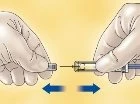
- To keep the needle sterile, ensure it does not touch anything.
- The pre-filled syringe is ready to use.
- Before injection, do not push the plunger to remove air bubbles, as this may result in loss of medication.
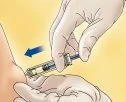
- Hold the syringe in one hand and, with the other hand, use your index finger and thumb to pinch a fold of the cleaned skin area.
- Insert the entire needle into the skin fold, holding the syringe as upright as possible on the body surface at a 90º angle.
- Push the plunger, ensuring you maintain the skin fold in position until the plunger is fully depressed.
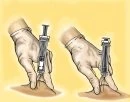
- Remove the syringe from the injection site while keeping your finger on the plunger rod and holding the syringe upright. Release the skin fold.
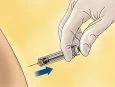
- For syringes with a safety device: Point the needle away from yourself and anyone nearby. Activate the safety system by firmly pressing on the plunger rod. The protective cover will automatically cover the needle, and you will hear an audible click confirming activation of the safety mechanism.
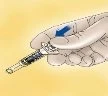
- Immediately dispose of the syringe by placing it into the nearest sharps container (needle pointing inward), close the container securely with the lid, and keep it out of the reach of children.

Warnings:
-
The safety system can only be activated once the syringe has been emptied.
-
The safety system should only be activated after removing the needle from the patient's skin.
-
Do not reuse the needle shield after injection.
-
Activation of the safety system may cause a small amount of liquid to splash. For maximum safety, activate the safety system pointing downward and away from yourself and anyone nearby.
-
Do not rub the skin where the injection was given. This will help prevent bruising.
If you think the effect of HIBOR 5.000 IU is too strong (for example, if you experience unexpected bleeding) or too weak (for example, if the dose does not seem effective), inform your doctor or pharmacist.
If you use more HIBOR 5.000 IU than you should
This may cause bleeding. In such a case, consult your doctor immediately or go to the nearest hospital emergency department, taking this leaflet with you.
In case of overdose or accidental administration, call the Toxicology Information Service at telephone number 91 562 04 20, indicating the medicine and the amount administered.
If you forget to use HIBOR 5.000 IU
Do not use a double dose to make up for missed doses. If this happens, consult your doctor as soon as possible for advice on what to do.
If you stop using HIBOR
Always consult your doctor before stopping this medicine.
If you have any further questions about the use of this medicine, ask your doctor, pharmacist, or nurse.
4. Possible adverse effects
Like all medicines, this medicine may cause adverse effects, although not everyone gets them.
Stop using HIBOR and consult your doctor or nurse immediately (or go immediately to the nearest hospital emergency department) if you experience any of the following adverse effects:
Common (may affect between 1 and 10 out of 100 patients):
- Unusual or unexpected bleeding, for example, blood in urine or stools, possibly leading to hemorrhagic anemia.
Rare (may affect between 1 and 10 out of 1,000 patients):
- Severe decrease in platelet count (Type II thrombocytopenia), which may lead to bruising, bleeding from gums, nose, or mouth, and skin rashes.
- Skin damage (necrosis) at injection sites.
- If you have undergone a lumbar puncture or have received epidural or spinal anesthesia, HIBOR may cause bleeding in the spinal cord and formation of hematomas. This could result in loss of strength or sensation in your legs and lower body and/or fecal and urinary incontinence. These hematomas may lead to varying degrees of disability, including prolonged or permanent paralysis. If this occurs, stop using HIBOR 5,000 IU and inform your doctor or nurse immediately.
- Severe allergic reactions (fever, shaking, difficulty breathing, swelling of the vocal cords, dizziness, sweating, hives, rash, itching, low blood pressure, hot flushes, redness, fainting, bronchial constriction, laryngeal swelling).
Other adverse effects:
Very common (affects more than 1 in 10 patients):
- Bruising, skin spots, itching, and mild pain at the injection sites.
Common (may affect between 1 and 10 out of 100 patients):
- A mild and transient increase in certain liver enzymes (transaminases), which may be detected in blood tests.
Uncommon (may affect at least 10 out of 1,000 patients):
- Mild allergic skin reactions (rash, skin eruption, urticaria, pruritus, hives).
- Mild and transient decrease in platelet count (Type I thrombocytopenia), which may be detected in blood tests.
Frequency not known (cannot be estimated from available data):
- Hyperkalemia (increased blood potassium levels).
- Bone fragility (osteoporosis) associated with long-term heparin treatment.
Reporting of adverse effects:
If you experience any adverse effect, talk to your doctor, pharmacist, or nurse, even if it is a possible adverse effect not listed in this leaflet. You can also report them directly through the Spanish Pharmacovigilance System for Human Medicines: https://www.notificaRAM.es. By reporting adverse effects, you can help provide more information on the safety of this medicine.
5. Storage of HIBOR 5,000 IU
Keep this medicine out of the sight and reach of children.
Do not store above 25°C. Do not freeze.
Do not use this medicine if you observe:
- The protective packaging is open.
- The protective packaging is damaged.
- The medicine contained in the syringe is cloudy.
- Small particles in the medicine.
Once the blister containing the syringe has been opened, the medicine must be used immediately.
Expiry date
Do not use this medicine after the expiry date stated on the packaging after EXP.
The expiry date refers to the last day of the month indicated.
Disposal
This medicine is supplied in single-use syringes.
Place used syringes in a hazardous waste container.
Do not keep them after use.
Medicines must not be disposed of via wastewater or household waste. Return any unused medicines and their containers to the SIGRE point at your pharmacy. If you are unsure, ask your pharmacist how to dispose of medicines and containers you no longer need. This will help protect the environment.
6. Contents of the pack and other information
Composition of HIBOR 5,000 IU
The active substance is: Bemiparin sodium 5,000 IU.
The other component is: Water for injections.
Appearance of the product and contents of the container
The medication contained in the syringes is a clear, colourless or slightly yellowish solution, free from visible particles.
HIBOR 5,000 IU is available in packs of 2, 10, 30 and 50 pre-filled syringes. Each syringe contains 0.2 ml of solution. Each 0.2 ml syringe provides a dose of 5,000 IU of bemiparin sodium.
Marketing Authorization Holder and Manufacturer
Marketing Authorization Holder
LABORATORIOS FARMACÉUTICOS ROVI, S.A.
C/ Julián Camarillo, 35
28037 MADRID
Spain
Manufacturer
ROVI Pharma Industrial Services, S.A.
C/ Julián Camarillo, 35
28037 MADRID
Spain
LABORATORIOS FARMACÉUTICOS ROVI, S.A.
C/ Julián Camarillo, 35
28037 MADRID
Spain
Date of the most recent revision of this leaflet: 05/2023
Detailed information on this medicine is available on the website of the Spanish Agency of Medicines and Medical Devices (AEMPS) http://www.aemps.gob.es/