Hiberix powder and solvent for injection solution
Spain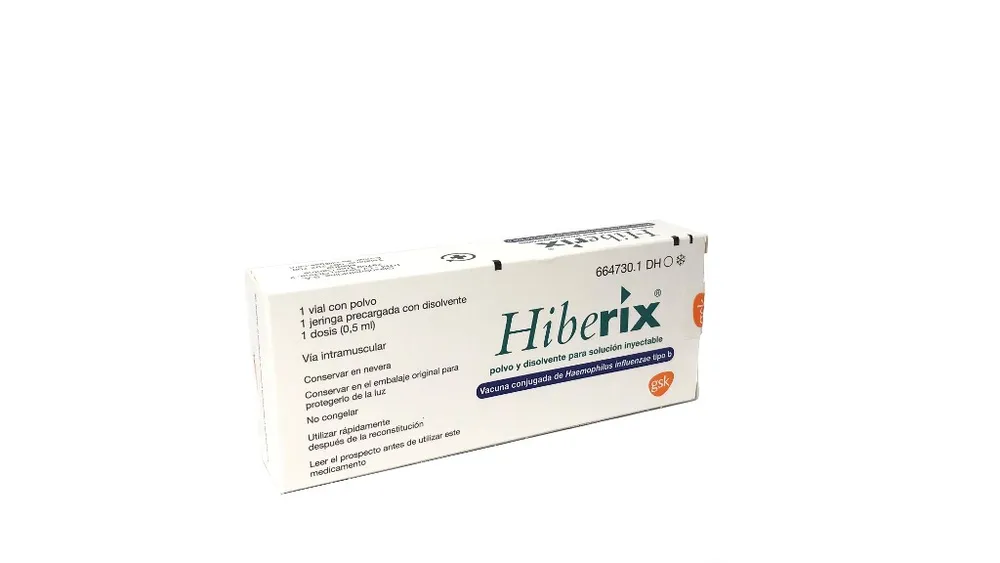
Table of Contents
Package leaflet: Information for the user
Introduction
Package leaflet: information for the user
Hiberix powder and solvent for solution for injection
Haemophilus influenzae type b conjugate vaccine
Read all of this leaflet carefully before your child is given this vaccine, because it contains important information for your child.
- Keep this leaflet, as you may need to read it again.
- If you have any questions, ask your doctor or pharmacist.
- This vaccine has been prescribed for your child only and must not be given to other people.
- If your child experiences any adverse reactions, talk to your doctor or pharmacist, even if they are not listed in this leaflet. See section 4.
Contents of the leaflet
- What Hiberix is and what it is used for
- What you need to know before your child is given Hiberix
- How Hiberix is given
- Possible side effects
- How to store Hiberix
- Contents of the pack and other information
1. What Hiberix is and what it is used for
Hiberix is a vaccine used to protect your child against disease caused by Haemophilus influenzae type b.
Haemophilus influenzae type b (Hib) can cause brain inflammation. This may lead to serious problems such as mental retardation, cerebral palsy, deafness, epilepsy, or partial blindness. It can also cause throat inflammation that may result in death by suffocation. Less frequently, the bacteria can also infect the blood, heart, lungs, bones, joints, and the tissues of the eyes and mouth.
Hiberix is indicated for primary vaccination of children from the age of 2 months included in certain of the following groups:
- Children with asplenia, sickle cell anemia, or immunodeficiency.
- Children infected with HIV who are asymptomatic or symptomatic.
- In those situations determined by the relevant Health Authorities.
Hiberix helps your child's body to produce its own protection (antibodies). This will protect him/her against the disease.
As with all vaccines, Hiberix may not fully protect all vaccinated children.
Hiberix protects only against infections caused by Haemophilus influenzae type b, for which the vaccine was developed.
Children with a weakened immune system (due, for example, to HIV infection) may not be fully protected by Hiberix.
The vaccine cannot cause the disease it protects against.
2. What you need to know before your child receives Hiberix
Hiberix must not be given
- If your child is allergic (hypersensitive) to the active substances or to any of the other components of the vaccine (listed in section 6). At the end of the leaflet there is a list of the active substances and other components of Hiberix. Signs of an allergic reaction may include itchy rash, difficulty breathing, and swelling of the face or tongue.
Warnings and precautions
Talk to your doctor or pharmacist before your child receives Hiberix if:
- your child has a serious infection with high fever. In such cases, vaccination will be postponed until your child recovers. A minor infection, such as a cold, should not be a problem, but check with your doctor first.
- your child has difficulty breathing, inform your doctor. This may be more common during the first three days after vaccination if your child was born prematurely (born at 28 weeks of pregnancy or earlier).
Fainting may occur before or after any injection, so inform your doctor or nurse if your child has previously fainted following an injection.
Use of Hiberix with other medicines
- Tell your doctor or pharmacist if your child is taking, has recently taken, or might need to take any other medicines, including those obtained without a prescription, or if they have recently received any other vaccines.
- Inform your doctor or pharmacist especially if your child is taking any medicines or has an infection that affects the immune system (the body's natural defence system), as your child may not be fully protected by Hiberix.
- Hiberix can be given at the same time as other childhood vaccines. Different injection sites will be used for each vaccine.
Hiberix must not be mixed in the same syringe with other vaccines except Tritanrix HepB.
Hiberix contains sodium
This medicine contains less than 23 mg (1 mmol) of sodium per 0.5 ml, i.e. essentially "sodium-free".
3. How Hiberix is administered
Follow exactly the administration instructions for this medicine given by your doctor or pharmacist. If in doubt, consult your doctor or pharmacist again.
- Your doctor or nurse will administer the recommended dose for your child. This will depend on official recommendations.
- Normally, the primary vaccination schedule consists of administering 3 doses of Hiberix, each separated by an interval of 1–2 months during the first 6–7 months of life, and vaccination may start from the age of 2 months.
- An additional dose (booster) may be necessary during the second year of life, for example, in children who have not completed the primary vaccination. If needed, your doctor or nurse will inform you.
- Hiberix is administered into the muscle.
- The vaccine must never be administered into a vein.
- You will be informed when your child should receive the next dose.
If more Hiberix is administered than should be
There have been no reported cases of overdose. Since the container contains only one dose, overdose is unlikely.
If your child does not receive a dose of Hiberix
- If your child misses a scheduled dose, it is important that you arrange another appointment. If administration of a dose is not performed according to the planned schedule, the dose can be delayed, provided that the 3 doses are administered during the first year of life, maintaining an interval of 1–2 months between doses.
- If the complete cycle of three injections is not finished, your child may not achieve the optimal immune response or protection against the disease.
4. Possible adverse effects
Like all medicines, Hiberix can cause adverse effects, although not everyone will experience them.
The adverse effects observed during clinical trials were as follows:
Allergic reactions
As with all injectable vaccines, your child may experience an allergic reaction, although these are very rare (less than 1 in every 10,000 vaccine doses).
Signs of an allergic reaction may include:
- skin rashes that may cause itching or blisters
- swelling of the eyes, face, or mouth
- difficulty breathing or swallowing
- sudden drop in blood pressure
- loss of consciousness
These symptoms usually occur immediately after the injection. If any of these symptoms begin after leaving the clinic, take your child to a doctor immediately.
Seek medical help immediately if your child experiences any of the following serious adverse effects
Very common (may occur in more than 1 in every 10 doses of the vaccine):
- irritability
- drowsiness
- fever
- swelling, pain, and redness at the injection site
- loss of appetite
- crying
- restlessness
- diarrhoea
Common (may occur in up to 1 in every 10 doses of the vaccine):
- vomiting
Rare (may occur in up to 1 in every 1,000 doses of the vaccine):
- seizures (including febrile seizures)
Additionally, other effects not observed during clinical trials but reported after marketing of Hiberix include:
Very rare (may occur in less than 1 in every 10,000 doses of the vaccine):
- fainting due to the injection
- collapse (sudden loss of muscle tone), periods of unconsciousness or loss of awareness, and paleness or bluish skin discoloration
- temporary interruption of breathing
- hives, localized skin rash in one or more areas, or generalized rash
- swelling of the limb where the vaccine was injected
- hard lump at the injection site
Reporting of adverse effects
If you notice any adverse effects, consult your doctor or pharmacist, even if they are possible adverse effects not listed in this leaflet. You can also report them directly via the Spanish Pharmacovigilance System for Human Medicines:
www.notificaRAM.es. By reporting adverse effects, you can help provide more information on the safety of this medicine.
5. Storage instructions for Hiberix
- Keep this medicine out of the sight and reach of children.
- Store in a refrigerator (between 2 °C and 8 °C).
- Do not freeze.
- Keep in the original packaging to protect from light.
- Do not use Hiberix after the expiry date stated on the container. The expiry date is the last day of the month indicated.
- Medicines must not be disposed of via wastewater or household waste. Dispose of empty containers and unused medicines at a SIGRE point at your pharmacy. If in doubt, ask your pharmacist how to dispose of unused containers and medicines. This will help protect the environment.
6. Contents of the pack and other information
Composition of Hiberix
- The active substances are:
Polysaccharide of Haemophilus influenzae type b 10 micrograms
conjugated to tetanus toxoid as carrier protein approx. 25 micrograms
- The other components are:
Powder: lactose
Solvent: sodium chloride and water for injections
Presentation of the product and contents of the pack
Hiberix is supplied as a powder in a glass vial and a solvent (liquid) in a pre-filled syringe.
The powder is white and the solvent is clear and colourless.
Pack size: 1 vial + 1 syringe or 10 vials + 10 syringes.
Only certain pack sizes may be marketed.
Marketing Authorization Holder
GlaxoSmithKline, S.A.
P.T.M. C/ Severo Ochoa, 2
28760 Tres Cantos (Madrid)
Tel: +34 900 202 700
Manufacturer
GlaxoSmithKline Biologicals S.A.
Rue de L’Institut 89; 1330 Rixensart
Belgium
or
SMITHKLINE BEECHAM, S.A.
Ctra. de Ajalvir Km. 2.5 (Alcalá de Henares (Madrid)) – 28806
Spain
Date of the most recent review of this leaflet: 04/2026
Detailed and up-to-date information on this medicine is available on the website of the Spanish Agency of Medicines and Health Products (AEMPS) http://www.aemps.gob.es/.
This information is intended for healthcare professionals only:
Before reconstitution or administration, the solvent and the reconstituted vaccine should be visually inspected for the presence of any foreign particles and/or physical changes. If either is observed, the solvent or reconstituted vaccine must not be used.
Instructions for reconstituting the vaccine with solvent in pre-filled syringe
Hiberix must be reconstituted by adding the entire contents of the pre-filled syringe containing the solvent to the vial containing the powder, using an appropriate needle (21G to 25G).
For instructions on how to attach the needle to the syringe, please read the instructions carefully.
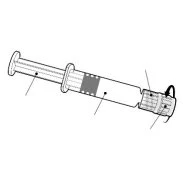
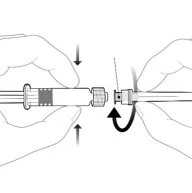
| Hold the syringe by the barrel, not by the plunger or the luer-lock adapter. Unscrew the syringe cap by turning it counterclockwise. |
| To insert the needle, gently connect the base to the luer-lock adapter and turn it a quarter turn clockwise until you feel it lock into place. Keep the needle aligned with the syringe axis. Failure to do so may deform the luer-lock adapter and cause leakage. If the luer-lock adapter becomes detached during syringe assembly, use a new vaccine dose (new syringe and new vial). Reconstitute the vaccine as described below. Do not remove the syringe plunger from the barrel. If this occurs, do not administer the vaccine. |




- Add the solvent to the powder. Shake well until the powder is completely dissolved in the solvent. Use the vaccine promptly after reconstitution.
- Withdraw all the contents from the vial.
- Use a new needle to administer the vaccine. Unscrew the needle from the syringe and attach the injection needle, repeating the previous steps.
The reconstituted vaccine is a solution ranging from transparent to opalescent and colorless.
Disposal:
Any unused medicine and materials that have come into contact with it should be disposed of in accordance with local regulations.