Hexvix 85 mg powder and solvent for intravesical solution
Spain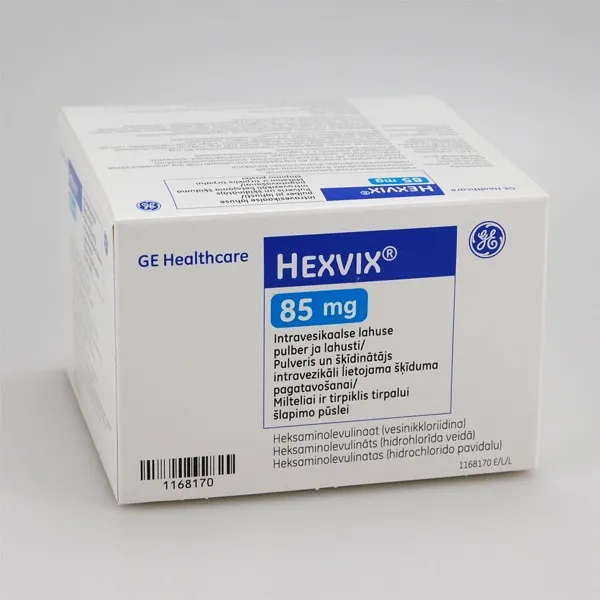
Table of Contents
- Package leaflet: Information for the user
- Introduction
- 1. What hexvix is and what it is used for
- 2. What you need to know before you are given HEXVIX
- 3. How to use Hexvix
- 4. Possible adverse effects
- 5. Storage of Hexvix
- 6. Contents of the pack and other information
- **Composition of Hexvix**
- ? The active substance is hexaminolevulinate in the form of hydrochloride.
- ? The other ingredients are disodium phosphate, potassium dihydrogen phosphate, sodium chloride, hydrochloric acid, sodium hydroxide, and water for injections.
- ***Appearance of the product and contents of the pack***
Package leaflet: Information for the user
Introduction
Package leaflet: information for the patient
HEXVIX 85 mg powder and solvent for intravesical solution
Hexaminolevulinate
Read all of this leaflet carefully before you start using this medicine, because it contains important information for you.
- Keep this leaflet. You may need to read it again.
- If you have any questions, ask your doctor or nurse.
- If you experience any side effects, talk to your doctor or nurse, even if it is a side effect not listed in this leaflet. See section 4.
Leaflet contents:
- What Hexvix is and what it is used for
- What you need to know before Hexvix is administered to you
- How to use Hexvix
- Possible side effects
- How to store Hexvix
- Contents of the pack and other information
1. What hexvix is and what it is used for
This medicine is for diagnostic use only.
This medicine is used to help detect bladder cancer. It is administered before your doctor uses a special device called a "cystoscope" that allows visualization of the inside of your bladder. A cystoscope helps to identify possible tumours, and thus remove abnormal cells, which glow under blue light after administration of Hexvix.
2. What you need to know before you are given HEXVIX
Do not use Hexvix:
- If you are allergic (hypersensitive) to the active substance or to any of the other ingredients of Hexvix, including the liquid used to dissolve it (see Section 6 Additional information).
- If you have porphyria (a rare, inherited blood disorder)
Warnings and precautions:
Talk to your doctor or nurse before starting to use Hexvix.
- If you have a urinary tract infection or experience burning/stinging when passing urine.
- If you have recently undergone BCG therapy in the bladder.
- If you have recently had bladder surgery.
These conditions may cause local reactions in your bladder, which could make it difficult for your doctor to interpret what is observed during the examination.
Other medicines and Hexvix:
Tell your doctor if you are taking, have recently taken, or might take any other medicines, including those obtained without a prescription.
Fertility, pregnancy and breastfeeding
If you are pregnant or breastfeeding, think you may be pregnant or are planning to become pregnant, consult your doctor before using this medicine.
Driving and use of machinery
Consult your doctor about driving and using machines after administration of Hexvix.
3. How to use Hexvix
Hexvix must be prepared and administered by qualified personnel. Hexvix is usually administered in a hospital or clinic.
Your doctor will administer it to you in the following manner:
- A small tube called a catheter will be inserted into your bladder.
- Your bladder will be emptied through this tube.
- Hexvix will be introduced into your bladder through this tube.
- Hexvix will remain in your bladder for 60 minutes.
- After this time, the bladder will be emptied through the catheter.
- Your doctor will use a device called a cystoscope to examine your bladder.
If you are given more Hexvix than you should
Adverse effects are not expected to occur if the duration of Hexvix in the bladder exceeds 60 minutes or if the amount of Hexvix used is increased. If you are concerned about this, please consult your doctor or nurse.
4. Possible adverse effects
Like all medicines, Hexvix can cause adverse effects, although not everyone will experience them. There is a risk of possible adverse effects related to the technique (cystoscopy) used to examine your bladder. In general, the use of Hexvix as an adjunct to standard cystoscopy for more accurate diagnosis of bladder cancer is well tolerated. If adverse effects occur, they are typically those associated with the examination technique and are usually not serious or long-lasting. The following adverse effects may occur after the examination procedure using this medicine:
Frequent (may affect up to 1 in 10 people):
- Feeling of nausea, vomiting
- Diarrhea
- Constipation
- Muscle cramps or pain in and around the stomach (abdomen)
- Pain or difficulty when urinating
- Inability to empty the bladder (urinary retention)
- Blood in the urine
- Pain after the examination (procedure)
- Fever (elevated temperature)
Uncommon (may affect up to 1 in 100 people):
- Headache
- Burning sensation during urination (caused by infection or inflammation of the bladder)
- Frequent need to urinate
- Blood poisoning (septicemia)
- Inability to sleep or difficulty falling asleep
- Pain in the tube called the urethra, through which urine passes
- Persistent feeling of needing to urinate (and urgently)
- Increase in white blood cell count, increase in bilirubin concentrations (a yellowish pigment in bile), or increase in liver enzymes, all of which would be observed in blood test results
- Decrease in the number of red blood cells in the body (anemia)
- Inflammation of the glans penis (balanitis)
- Back pain
- Gout
- Rash (skin eruption)
- Itching (pruritus)
Frequency not known (cannot be estimated from available data):
- Anaphylactoid shock (drop in blood pressure, increased heart rate, skin rash)
Reporting of adverse effects
If you experience any type of adverse effect, consult your doctor, even if it is a possible adverse effect not listed in this leaflet. You may also report them directly via the Spanish Pharmacovigilance System for Human Medicines: www.notificaRAM.es. By reporting adverse effects, you can help provide more information on the safety of this medicine.
5. Storage of Hexvix
Keep this medicine out of the sight and reach of children.
Do not use this medicine after the expiry date stated on the outer packaging. The expiry date refers to the last day of the month.
Powder and solvent: the product does not require special storage conditions.
Solution (after reconstitution): store between 2 °C and 8 °C (in a refrigerator) for a maximum period of 2 hours.
Hospital staff must ensure that the product is stored and disposed of appropriately and is not used after the expiry date printed on the outer packaging.
6. Contents of the pack and other information
Composition of Hexvix
? The active substance is hexaminolevulinate in the form of hydrochloride.
? The other ingredients are disodium phosphate, potassium dihydrogen phosphate, sodium chloride, hydrochloric acid, sodium hydroxide, and water for injections.
Appearance of the product and contents of the pack
- Each pack contains one vial of powder, white to off-white or pale yellow in colour, containing 85 mg of the active substance hexaminolevulinate (as hydrochloride), and one pre-filled syringe containing 50 mL of a clear, colourless liquid for dissolving the powder.
- The Hexvix powder is dissolved in 50 mL of the solution provided in the pack. Once the powder is mixed with the solvent, a solution is obtained containing 1.7 mg/mL of hexaminolevulinate, corresponding to 8 mmol/L of hexaminolevulinate solution.
Marketing Authorisation Holder and Manufacturer:
Photocure ASA
Hoffsveien, 4
NO-0275 Oslo,
Norway
Further information on this medicinal product is available upon request to the Marketing Authorisation Holder.
This medicinal product has been authorised under the trade name Hexvix in the following European Economic Area (EEA) Member States and in the United Kingdom (Northern Ireland): Austria, Belgium, Czech Republic, Denmark, Estonia, Finland, France, Germany, Greece, Hungary, Ireland, Iceland, Italy, Latvia, Lithuania, the Netherlands, Norway, Poland, Portugal, Slovenia, Spain, Sweden, and the United Kingdom (Northern Ireland).
Date of most recent review of this leaflet: January 2022
Detailed and up-to-date information on this medicinal product is available on the website of the Spanish Agency of Medicines and Health Products (AEMPS) http://www.aemps.gob.es
This information is intended for healthcare professionals only:
Handling instructions
Hexaminolevulinate may cause sensitisation through skin contact.
All steps must be performed using sterile equipment and under aseptic conditions.
Reconstitution procedure: Hexvix powder and Hexvix solvent in pre-filled syringe
|
|
|
|
|
|
|
|
|
|
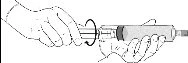
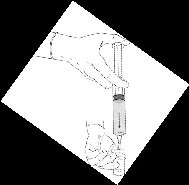
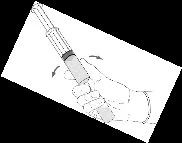
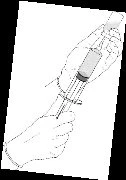
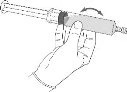
Hexvix is now reconstituted and ready to use. The appearance of the reconstituted solution is a clear or slightly opalescent solution, ranging from colorless to pale yellow.
Add two hours to the current time and write the resulting expiry time and date on the syringe label.
This product is for single use only. Any remaining product should be discarded. No special requirements for disposal.
The solution has been shown to maintain its chemical and physical stability for a period of 2 hours at 2 °C – 8 °C. From a microbiological standpoint, the product should be used immediately. If not used immediately, the duration and conditions of storage prior to use are the responsibility of the user and should normally not exceed 2 hours at 2 °C – 8 °C.