Hetronifly 10 mg/ml concentrate for infusion solution
Spain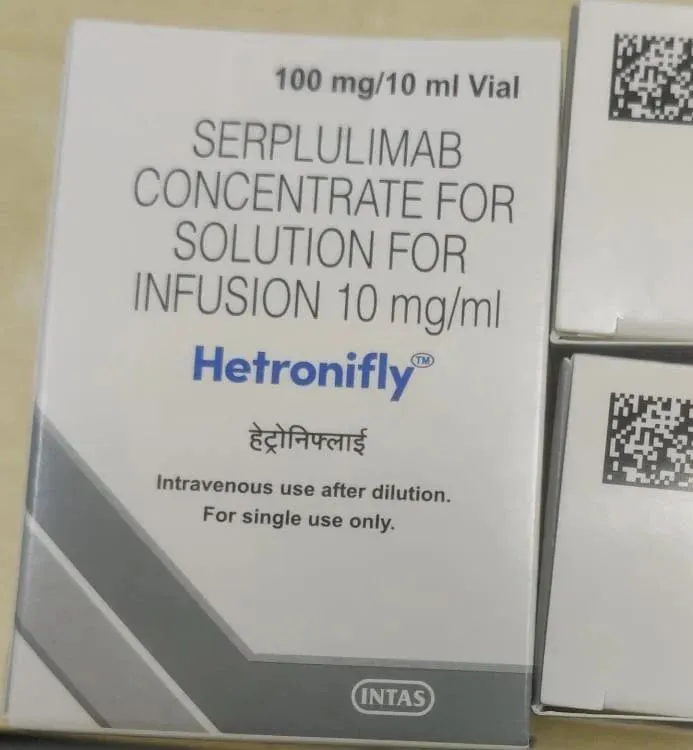
Table of Contents
Package leaflet: Information for the patient
Introduction
Package leaflet: information for the patient
HETRONIFLY 10 mg/ml concentrate for solution for infusion
serplulimab
This medicinal product is subject to additional monitoring, which will allow for faster identification of new safety information. You can help by reporting any adverse reactions you may experience. Section 4 at the end of this leaflet contains information on how to report adverse reactions.
Read this entire leaflet carefully before you start using this medicine, as it contains important information for you.
- Keep this leaflet as you may need to read it again.
- It is important that you carry the patient card with you during treatment.
- If you have any questions, consult your doctor.
- If you experience any adverse reactions, consult your doctor, even if they are adverse reactions not listed in this leaflet. See section 4.
Leaflet contents
- What Hetronifly is and what it is used for
- What you need to know before using Hetronifly
- How to use Hetronifly
- Possible adverse reactions
- How to store Hetronifly
- Contents of the pack and other information
1. What Hetronifly is and what it is used for
Hetronifly is a cancer medicine that contains the active substance serplulimab. It is a monoclonal antibody, a type of protein designed to recognise and attack a specific target in the body called programmed death receptor 1 (PD-1), which is found on the surface of T and B lymphocytes (types of white blood cells that are part of the immune system, the body's natural defence). When PD-1 is activated by cancer cells, it can inhibit the activity of T lymphocytes. By blocking PD-1, Hetronifly prevents the inhibition of your T lymphocytes, helping your immune system to fight cancer.
Hetronifly is used to treat adult patients with a type of lung cancer called extensive-stage small cell lung cancer (ES-SCLC). It is used when the cancer:
- has spread within the lungs (or to other parts of the body) and
- has not previously received treatment.
If you have any questions about how Hetronifly works or why this medicine has been prescribed for you, please consult your doctor or pharmacist.
Hetronifly will be administered in combination with chemotherapy. It is important that you also read the package leaflets for the specific chemotherapy you will receive. If you have any doubts about these medicines, please consult your doctor.
2. What you need to know before using Hetronifly
Do not use Hetronifly
If you are allergic to serplulimab or to any of the other ingredients of this medicine.
If you are not sure whether you are allergic, consult your doctor or nurse before using Hetronifly.
Warnings and precautions
Talk to your doctor before starting Hetronifly if you have:
- an autoimmune disease (a condition in which the immune system attacks your own cells)
- liver problems
- kidney damage
- lung problems or breathing difficulties
- have undergone an organ transplant
- have had an allergic reaction to other cancer medicines that work in the same way (monoclonal antibody treatments)
If any of the above apply to you (or you are unsure), consult your doctor before using Hetronifly.
When you are given Hetronifly, you may experience some serious adverse effects (see section 4).
If you develop any of the following conditions, call or see your doctor immediately. Your doctor may give you other medicines to prevent more serious complications and help reduce your symptoms. Your doctor may delay the next dose of Hetronifly or stop your treatment with Hetronifly.
Contact your doctor immediately if you notice any of the following symptoms:
- inflammation of the lungs: symptoms may include new or worsening cough, shortness of breath, or chest pain
- inflammation of the liver or bile ducts: symptoms may include nausea or vomiting, decreased appetite, stomach pain on the right side, yellowing of the skin or whites of the eyes, numbness, dark urine, or bleeding or bruising more easily than usual
- inflammation of the intestines: symptoms may include diarrhea or more frequent bowel movements, or black, tarry, sticky stools containing blood or mucus, severe stomach pain or tenderness
- inflammation of the kidneys: symptoms may include reduced amount of urine passed
- skin inflammation: symptoms may include rash, itching, blistering of the skin, or mouth ulcers or ulcers on other moist surfaces
- inflammation of glands (especially thyroid, adrenal, pituitary, and pancreas): symptoms may include rapid heartbeat, extreme tiredness, weight gain or weight loss, dizziness or fainting, hair loss, feeling cold, constipation, persistent headache or unusual headaches, abdominal pain, nausea, and vomiting
- type 1 diabetes: symptoms may include high blood sugar, increased hunger or thirst, urinating more often than usual, deep and rapid breathing, confusion, sweet-smelling breath, a sweet or metallic taste in the mouth, or a different smell to urine or sweat
- infusion-related reactions: symptoms may include chills or shaking, itching or rash, flushing, shortness of breath or wheezing, dizziness, or fever
- inflammation of the heart muscle: symptoms may include chest pain, shortness of breath, or irregular heartbeat
- inflammation or problems with muscles: symptoms may include muscle pain, muscle weakness, or rapid fatigue
- inflammation of the brain (encephalitis): symptoms may include seizures, headache, fever, chills, vomiting, confusion, and memory problems
- eye inflammation, which may include changes in vision
- low platelet count: symptoms may include bleeding (nosebleeds or bleeding gums) and/or bruising
Children and adolescents
Hetronifly is not recommended for people under 18 years of age. This is because there is no available information on how it works in this age group.
Other medicines and Hetronifly
Tell your doctor if you are taking, have recently taken, or might need to take any other medicines. This includes herbal medicines and over-the-counter medicines.
Inform your doctor if you are taking any medicine that suppresses your immune system, for example corticosteroid derivatives such as prednisone. These medicines may interfere with how Hetronifly works. However, once you are being treated with Hetronifly, your doctor may give you corticosteroids to reduce any possible adverse effects of Hetronifly.
You may also be given cortisone derivatives before receiving Hetronifly in combination with chemotherapy to prevent and/or treat nausea, vomiting, and other adverse effects caused by chemotherapy.
Pregnancy and breastfeeding
If you are pregnant or breastfeeding, think you may be pregnant, or plan to become pregnant, consult your doctor before using this medicine.
Pregnancy
Do not use Hetronifly if you are pregnant, unless specifically recommended by your doctor. Hetronifly may harm your unborn baby.
Breastfeeding
It is unknown whether serplulimab passes into breast milk. You and your doctor will decide whether you should breastfeed after receiving serplulimab.
Driving and using machines
Hetronifly may cause fatigue and other adverse reactions. Do not drive or operate machinery after receiving Hetronifly unless you are sure you feel well.
Hetronifly contains sodium
This medicine contains 22.5 mg of sodium (a main component of table/cooking salt) in each 10 ml vial. This corresponds to 1.1% of the maximum daily recommended sodium intake for an adult.
Hetronifly contains polysorbate 80
This medicine contains 2.0 mg of polysorbate 80 in each 10 ml vial. Polysorbates may cause allergic reactions. Inform your doctor if you have any known allergies.
3. How to use Hetronifly
You will receive Hetronifly treatment in a hospital or clinic, under the supervision of an experienced doctor.
The recommended dose is 4.5 mg per kg of body weight every 3 weeks.
Your doctor will administer Hetronifly to you as an intravenous infusion (drip). The first infusion will last approximately 1 hour. Subsequent infusions will last approximately 30 minutes.
If you use more Hetronifly than you should
There is no information available on overdose with serplulimab. This medicine is administered by an experienced healthcare professional, so the likelihood of overdose is low. In the event of an overdose, you will be closely monitored for signs and symptoms of adverse reactions. Your doctor will initiate appropriate treatment.
If you miss an appointment to receive Hetronifly
It is very important that you do not miss any doses of this medicine. If you miss an appointment, contact your doctor immediately to reschedule.
If you stop treatment with Hetronifly
Stopping treatment may interrupt the medicine's effect. Do not discontinue treatment with Hetronifly unless you have discussed it with your doctor.
If you have any further questions about the use of this medicine, ask your doctor.
4. Possible adverse effects
Like all medicines, this medicine can cause adverse effects, although not everyone will experience them.
Be aware of the importance of inflammation symptoms.
Hetronifly acts on your immune system and could cause inflammation in some part of your body. This could cause serious harm to your body. Some inflammatory conditions could be potentially life-threatening and may require treatment or discontinuation of Hetronifly (see section 2).
Serious adverse effects
Contact your doctor immediately if you notice any of the following serious symptoms. These may be signs of a serious, possibly life-threatening condition. Receiving immediate medical treatment may help prevent these problems from worsening.
- inflammation of the lungs (common): symptoms may include new onset or worsening cough, shortness of breath, or chest pain.
- inflammation of the liver or bile ducts (common): symptoms may include nausea or vomiting, decreased appetite, pain on the right side of the stomach, yellowing of the skin or whites of the eyes, numbness, dark urine, or bleeding or bruising more easily than usual.
- inflammation of the intestines (uncommon): symptoms may include diarrhea or more frequent bowel movements than usual, or black, tarry, sticky stools containing blood or mucus, severe stomach pain, or tenderness.
- inflammation of the pancreas (uncommon): symptoms may include abdominal pain, nausea, and vomiting.
- inflammation of the heart muscle (uncommon): symptoms may include chest pain, shortness of breath, or irregular heartbeat.
- myasthenia gravis and myasthenic syndromes (rare): symptoms may include muscle weakness and tiring easily.
Other adverse effects
Inform your doctor if you experience any of the following adverse effects reported in clinical trials in patients receiving Hetronifly in combination with chemotherapy:
Very common (may affect more than 1 in 10 patients)
- lung infection (pneumonia)
- decreased white blood cell count (leukocytes, neutrophils, and lymphocytes), red blood cells (anemia), or platelets (thrombocytopenia)
- reduced activity of the thyroid gland (may cause fatigue or weight gain) or overactivity of the thyroid gland
- blood tests showing elevated glucose levels (hyperglycemia or type 1 diabetes mellitus)
- blood tests showing elevated levels of uric acid (hyperuricemia) or lipids (hyperlipidemia)
- blood tests showing abnormal electrolyte levels (potassium, sodium, calcium, magnesium, phosphate, or chloride)
- blood tests showing low protein levels (hypoproteinemia)
- decreased appetite
- sleep disturbances
- abnormal heart rhythm
- cough
- nausea
- constipation
- abdominal pain
- diarrhea
- vomiting
- elevated liver enzymes in blood (alanine aminotransferase, aspartate aminotransferase, gamma-glutamyl transferase)
- rash
- hair loss
- muscle and bone pain
- fever
- weakness
- elevated alkaline phosphatase levels in blood
Common (may affect up to 1 in 10 patients)
- urinary tract infection
- upper respiratory tract infection
- abnormal results in coagulation function tests
- infusion-related reaction
- inflammation of the thyroid gland, abnormal thyroid function test
- weight loss
- low blood sugar level
- peripheral nervous system damage causing numbness, dizziness, headache, altered sensations (paresthesia)
- a regular heart rhythm with faster than normal heartbeat, slow heartbeat, conduction defects, heart failure, increased levels of substances in the brain (natriuretic peptide) which may be a sign of heart failure
- hypertension, inflammation of blood vessels
- inflammation of the oral mucosa, indigestion, difficulty swallowing, abdominal distension, gastrointestinal disorder
- elevated bilirubin in blood (a breakdown product of hemoglobin), liver damage
- itching, skin inflammation, excessive sweating
- joint pain (arthralgia), pain in arms or legs, musculoskeletal discomfort
- presence of glucose in urine, presence of protein in urine, presence of red or white blood cells in urine, kidney damage
- elevated blood urea or creatinine levels
- feeling of fatigue, general malaise, swelling
- elevated levels of myocardial necrosis marker (troponin), myoglobin, or creatine phosphokinase in blood
Uncommon (may affect up to 1 in 100 patients)
- severe infection, skin infection, intestinal infection, lip infection, brain and cerebral cortex infection caused by herpes simplex virus
- lymph node inflammation
- anaphylactic reaction
- decreased secretion of hormones produced by the adrenal glands, other thyroid disorders, overactivity of the adrenal gland, inflammation of the pituitary gland located at the base of the brain
- abnormal lipoproteins in blood
- brain inflammation, neurotoxicity, motion dizziness, motor dysfunction
- blurred vision
- heart muscle disease, reduced blood flow to the heart muscle (myocardial ischemia), tissue myocardial ischemia, fluid accumulation in the pericardium, myocarditis, elevated levels of myocardial necrosis marker
- dry mouth, intestinal inflammation, stomach inflammation, pancreas inflammation, gingival bleeding
- thick, sometimes scaly skin growths, changes in skin color, dry skin
- autoimmune muscle inflammation (autoimmune myositis), joint inflammation
- chills
Rare (may affect up to 1 in 1,000 patients)
- a condition in which muscles become weak and tire easily (myasthenia gravis and myasthenic syndrome)
Other adverse effects reported with unknown frequency (cannot be estimated from available data)
- inflammation of the muscles (myositis)
Reporting of adverse effects
If you experience any type of adverse effect, consult your doctor, even if it is a possible adverse effect not listed in this leaflet. You may also report them directly through the national reporting system listed in Appendix V. By reporting adverse effects, you can help provide more information on the safety of this medicine.
5. Storage of Hetronifly
Keep this medicine out of the sight and reach of children.
Do not use this medicine after the expiry date which is stated on the carton and on the label of the vial after CAD and EXP. The expiry date refers to the last day of the month indicated.
Store in a refrigerator (between 2 °C and 8 °C).
Do not freeze.
Keep in the original packaging to protect from light.
Once reconstituted, the product must be used immediately. The diluted solution must not be frozen. If not used immediately, the diluted solution has been shown to be stable for 24 hours in a refrigerator (between 2 °C and 8 °C), including up to 6 hours at room temperature (equal to or below 25 °C).
Do not use this medicine if visible particles are observed.
Medicines must not be disposed of via wastewater or household waste. Ask your pharmacist how to dispose of containers and medicines no longer required. This will help protect the environment.
6. Contents of the container and other information
Composition of Hetronifly
The active substance is serplulimab.
Each ml of concentrate contains 10 mg of serplulimab. A 10 ml vial contains 100 mg of serplulimab.
The other components are citric acid monohydrate, sodium citrate, sodium chloride (see section 2: Hetronifly contains sodium), mannitol, polysorbate 80, water for injections.
Appearance of the product and contents of the pack
Hetronifly is a concentrate for solution for intravenous infusion, supplied in a glass vial with a rubber stopper. The vial contains 10 mg/ml of serplulimab. The concentrate is a liquid ranging from clear to opalescent, colourless to pale yellow. Each carton contains 1 vial.
Marketing Authorisation Holder
Accord Healthcare S.L.U.
World Trade Center, Moll de Barcelona, s/n
Edifici Est, 6th Floor
08039 Barcelona
Spain
Manufacturer
Accord Healthcare Polska Sp.z o.o.,
ul. Lutomierska 50, Pabianice, 95-200, Poland
Accord Healthcare Single Member S.A.,
64th Km National Road Athens Lamia, Schimatari, 32009, Greece
Date of the most recent revision of this leaflet:
Other sources of information
Detailed information on this medicine is available on the website of the European Medicines Agency: https://www.ema.europa.eu.
This package leaflet is available on the European Medicines Agency website in all languages of the European Union/European Economic Area.
This information is intended for healthcare professionals only:
Preparation and administration of the infusion
Aseptic handling must be ensured during the preparation of the infusion.
- Do not shake the vial.
- Allow the vial to reach room temperature (≤ 25 °C).
- The product should be inspected visually for particulate matter or discoloration prior to administration. The concentrate is a solution ranging from clear to opalescent, colourless to pale yellow. Discard the vial if visible particles are observed.
- Confirm the product dose and calculate the required volume of Hetronifly.
- Using a sterile syringe, withdraw and discard the volume of 9 mg/ml (0.9%) sodium chloride injection solution corresponding to the volume of product to be added to the target intravenous infusion bag.
- Use a syringe to withdraw the required volume of Hetronifly from the vial and inject it into the 9 mg/ml (0.9%) sodium chloride injection solution to prepare a diluted solution with a final concentration of 1.0 to 8.0 mg/ml. Gently mix the infusion by manual rotation.
- Administer the infusion solution intravenously using a sterile, non-pyrogenic infusion set with low protein binding of 0.2 to 5.0 μm or by adding an in-line filter.
- Set the initial infusion rate at 100 ml per hour (a rate of 25 drops per minute is recommended). The infusion rate may be adjusted if infusion-related reactions occur. If no infusion-related adverse reactions occur during the first infusion, the duration of subsequent infusions may be reduced to 30 minutes (± 10 minutes).
- From a microbiological standpoint, the product should be used immediately after dilution. The diluted solution must not be frozen. If not used immediately, the diluted solution may be stored for up to 24 hours at 2 °C to 8 °C. This 24-hour period may include up to 6 hours at room temperature (≤ 25 °C). If refrigerated, allow vials and/or intravenous bags to reach room temperature before use.
- After administration of the infusion, flush the line with 9 mg/ml (0.9%) sodium chloride solution according to the hospital's routine operating procedure.
- Do not administer other medicinal products simultaneously through the same intravenous line.
- To improve traceability of biological medicinal products, the name and batch number of the administered product should be clearly recorded in the patient's medical record.
Disposal of unused medicine and of all materials that have been in contact with it must be carried out in accordance with local regulations.