Heparin sodium Rovi 1000 IU/ml solution for injection
Spain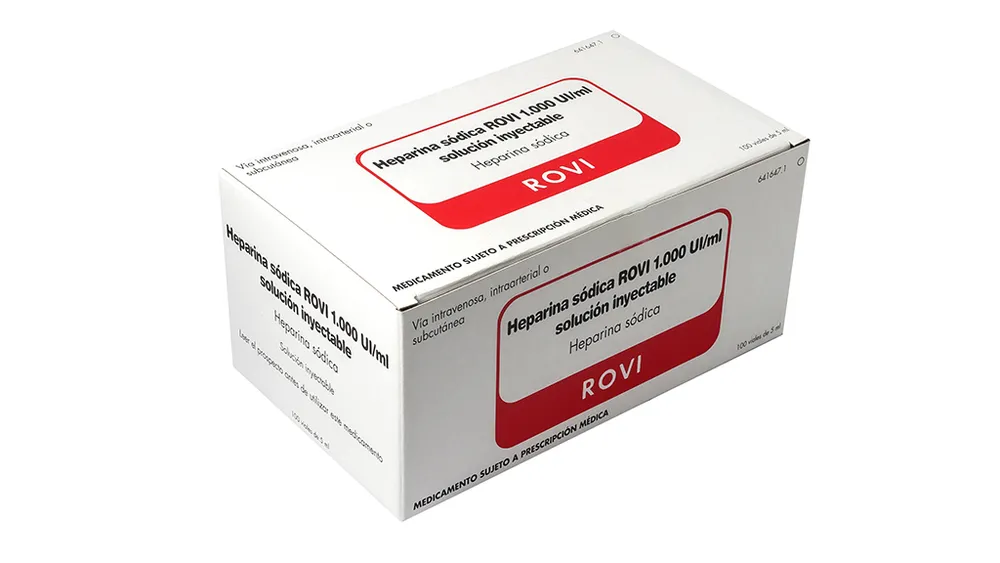
Table of Contents
- Package leaflet: Information for the user
- Introduction
- 1. What Heparina sódica ROVI 1,000 IU/ml solution for injection is and what it is used for
- 2. What you need to know before using Heparina sódica ROVI 1,000 UI/ml solution for injection
- 3. How to use Heparina sódica ROVI 1,000 IU/ml solution for injection
- 4. Possible adverse effects
- 5. Storage of Heparin Sodium ROVI 1,000 IU/ml solution for injection
- 6. Pack contents and additional information
Package leaflet: Information for the user
Introduction
Package leaflet: information for the user
Heparina sódica ROVI 1,000 IU/ml solution for injection
Sodium heparin
Read all of this leaflet carefully before you start using this medicine, because it contains important information for you.
- Keep this leaflet, as you may need to read it again.
- If you have any questions, ask your doctor or pharmacist.
- This medicine has been prescribed for you only, and must not be given to other people, even if they have the same symptoms as you, because it could harm them.
- If you experience any adverse reactions, consult your doctor or pharmacist, even if they are adverse reactions not listed in this leaflet. See section 4.
Leaflet contents
- What Heparina sódica ROVI 1,000 IU/ml solution for injection is and what it is used for
- What you need to know before using Heparina sódica ROVI 1,000 IU/ml solution for injection
- How to use Heparina sódica ROVI 1,000 IU/ml solution for injection
- Possible side effects
- How to store Heparina sódica ROVI 1,000 IU/ml solution for injection
- Contents of the pack and other information
1. What Heparina sódica ROVI 1,000 IU/ml solution for injection is and what it is used for
Heparin sodium belongs to a group of medicines called antithrombotics, that is, those used to prevent and treat the formation of blood clots (thrombi).
This medicine is presented as an injectable solution, with a heparin sodium concentration of 1,000 IU/ml, in 5 ml vials.
This medicine is indicated for:
- Treatment and prevention of venous thromboembolic disease: deep vein thrombosis, pulmonary embolism.
- Treatment and prevention of peripheral arterial thromboembolism.
- Treatment of coronary artery disease: unstable angina and acute myocardial infarction.
- Prevention of thrombosis in the extracorporeal circuit during cardiac and vascular surgery and hemodialysis.
Heparina sódica ROVI is indicated in the paediatric population from 28 days of age onwards and in adults (see section 2).
2. What you need to know before using Heparina sódica ROVI 1,000 UI/ml solution for injection
Do not use Heparina sódica ROVI 1,000 UI/ml solution for injection
- If you are allergic to sodium heparin, substances of porcine origin, or any of the other ingredients of this medicine (listed in section 6).
- If you have a history of, or suspect, a decrease in platelet count (thrombocytopenia).
- If you have a disease or condition that carries a risk of bleeding, such as a significant blood coagulation disorder, vascular fragility, or injuries that may bleed, including active gastroduodenal ulcer, cerebral hemorrhage, aneurysms, or brain tumors.
- If you have a severe disorder affecting liver or pancreas function.
- If you are due to undergo surgery or have sustained damage to the central nervous system, eyes, or ears.
- If you have an infection of the heart called acute bacterial endocarditis.
- If you have a condition called Disseminated Intravascular Coagulation (DIC) due to heparin-induced reduction in platelet count.
- If you have received heparin for therapeutic purposes, regional anesthesia is contraindicated during scheduled surgical procedures.
- In premature infants and newborns, due to the presence of benzyl alcohol in this medicine.
- If you are actively bleeding or have a high risk of bleeding due to problems with blood coagulation.
Warnings and precautions
Consult your doctor or pharmacist before starting to use Heparina sódica ROVI 1,000 UI/ml solution for injection
- If you have a disease or injury that could lead to bleeding, such as uncontrolled high blood pressure, history of gastroduodenal ulcer, ocular vascular disease (choroid or retina), kidney or urethral stones, or if you have recently undergone surgery.
- If you have liver or kidney disease.
- If you have elevated potassium levels in the blood, which may occur if you have diabetes, chronic kidney disease, blood acidosis, or if you are taking medications that affect potassium levels, such as certain diuretics. Your doctor may recommend monitoring of potassium levels.
- If you have or have had low platelet counts (thrombocytopenia). Your doctor may recommend monitoring of platelet levels.
- If you are scheduled to undergo a procedure involving spinal or epidural anesthesia, or lumbar puncture.
- If skin necrosis occurs at the injection site when administered subcutaneously.
- If administered to elderly patients, special caution is required due to increased risk of bleeding.
- If administered to low-birth-weight neonates, special caution is required due to risk of intracranial hemorrhage.
- If administered to women who are breastfeeding, special caution is required due to risk of bone-related abnormalities.
- If you are to receive other intramuscular injections, due to the risk of hematomas during heparin administration.
Other medicines and Heparina sódica ROVI 1,000 UI/ml solution for injection
Inform your doctor or pharmacist if you are currently taking, have recently taken, or might need to take any other medicines.
It is especially important that you inform your doctor if you are taking any of the following medicines:
-
Anticoagulants, antiplatelet agents (ticlopidine), fibrinolytics, non-steroidal anti-inflammatory drugs (NSAIDs), such as acetylsalicylic acid, paracetamol, or ibuprofen, glucocorticoids, dextrans, high-dose penicillin, and certain cephalosporins (cefamandole, cefoperazone), certain contrast media, asparaginase, and epoprostenol, as these drugs enhance the effect of heparin and thereby increase the risk of bleeding.
-
Alprostadil, as it may potentiate the anticoagulant effect of heparin and increase the risk of hemorrhage, and may also interfere with laboratory test results.
-
Oral antidiabetic agents (sulfonylureas), medications containing benzodiazepines (chlordiazepoxide, diazepam, oxazepam), or propranolol, as their effects may be enhanced in the presence of heparin.
-
Intravenous epoetin or nitroglycerin, as they may reduce the anticoagulant effect of heparin, and dosage adjustment may be necessary.
-
Medications that increase blood potassium concentration.
Pregnancy and breastfeeding
Pregnancy:
If you are pregnant or breastfeeding, think you may be pregnant, or plan to become pregnant, consult your doctor or pharmacist before using this medicine.
Heparin should be administered with caution and under continuous monitoring, especially during the third trimester of pregnancy, and should be discontinued one or two days before the expected delivery date due to the risk of feto-maternal hemorrhage.
Breastfeeding:
Before starting treatment with Heparina sódica ROVI 1,000 UI/ml solution for injection, inform your doctor if you are breastfeeding. Heparina sódica ROVI 1,000 UI/ml solution for injection is not excreted in breast milk.
Use in the elderly
If this medicine is administered to elderly patients, there is an increased risk of bleeding (particularly in women), especially if the patient also has hepatic and/or renal insufficiency.
Driving and using machines
Heparina sódica ROVI 1,000 UI/ml solution for injection does not affect the ability to drive vehicles or operate dangerous or precision machinery.
Heparina sódica ROVI 1,000 UI/ml solution for injection contains benzyl alcohol
This medicine must not be administered to premature infants or newborns because it contains 10 mg/ml of benzyl alcohol. It may cause toxic reactions and allergic reactions in children under 3 years of age.
3. How to use Heparina sódica ROVI 1,000 IU/ml solution for injection
Follow exactly the administration instructions for this medicine given by your doctor or pharmacist. If in doubt, consult your doctor or pharmacist again.
The vials containing Heparina sódica ROVI 1,000 IU/ml solution for injection are ready for immediate use by intravenous route (continuous infusion with an infusion pump or as a bolus), intra-arterial or subcutaneous route. It must not be administered by intramuscular route, and intramuscular injection of other agents should be avoided due to the risk of hematoma development during treatment with sodium heparin.
Your doctor will perform regular monitoring to control the dosage. Follow the instructions unless your doctor has given you different directions.
Your doctor will inform you of the duration of your treatment with Heparina sódica ROVI 1,000 IU/ml solution for injection. Do not stop treatment prematurely.
The dose of sodium heparin must be individualized according to the patient's weight and clinical condition. It must also be adjusted based on coagulation time or activated partial thromboplastin time (APTT).
The doses to be used for different populations are detailed in the section "Information intended exclusively for healthcare professionals" at the end of this leaflet.
Adults:
Your doctor will adjust the dose according to coagulation times.
Paediatric population:
Children from 28 days of age
The doctor will adjust the dose according to weight and required APTT levels.
Elderly patients:
Your doctor will adjust the dose according to weight and required APTT levels.
Patients with renal and hepatic impairment:
A lower dose may be required. Your doctor will adjust the dose according to weight and required APTT levels.
Pregnant women:
Your doctor will adjust the dose according to required APTT levels.
Instructions for correct administration of the medicinal product:
Deep subcutaneous route:
Grasp a skin fold gently, without pressing, between the thumb and index finger of one hand. While maintaining this skin fold, insert the needle perpendicularly into the skin fold with the other hand, i.e., at a right angle to the skin. Carefully insert the needle and slowly inject the required dose into the fatty tissue under the skin. Remove the needle after injection, applying pressure to the injection site for a few minutes. Rotation of injection sites is recommended to avoid the formation of edema.
If you use more Heparina sódica ROVI 1,000 IU/ml solution for injection than you should
You may experience some type of bleeding. In such a case, contact your doctor immediately or go to the nearest hospital emergency department, taking this leaflet with you.
Bleeding can be reversed with protamine sulfate 1%.
In case of overdose or accidental administration, contact the Toxicology Information Service. Telephone: 91 562 04 20.
If you forget to use Heparina sódica ROVI 1,000 IU/ml solution for injection
Do not administer a double dose to make up for the missed dose. Contact your doctor as soon as possible for advice on what to do in such cases.
If you have any further questions about the use of this product, ask your doctor or pharmacist.
4. Possible adverse effects
Like all medicines, this medicine may produce adverse effects, although not everyone will experience them.
The following adverse effects have been observed:
Frequent effects (affect between 1 and 10 out of every 100 patients):
- Bleeding complications, especially when high doses are administered. If you notice nosebleeds, blood in urine or stool, or any other type of bleeding, consult your doctor immediately or go to the nearest hospital emergency department, taking this leaflet with you. Bleeding can be reversed with 1% Protamine Sulfate.
- Abnormal liver function test results (increased serum levels of hepatic transaminases).
Uncommon effects (affect between 1 and 10 out of every 1,000 patients):
- Allergic skin reactions (redness, itching).
- Hair loss (alopecia) during long-term treatment.
- Osteoporosis.
- Decreased platelets in the blood (thrombocytopenia).
- Increased serum potassium levels in patients with kidney disease or diabetes.
- Suppression of aldosterone synthesis (hyperkalemia).
Rare effects (affect between 1 and 10 out of every 10,000 patients):
- Skin degeneration at the injection site when administered subcutaneously.
- Severe generalized allergic reactions (nausea, vomiting, fever, difficulty breathing, bronchospasm, throat swelling, decreased blood pressure).
- Prolonged penile erection (priapism).
- Severe immune-mediated decrease in blood platelets (type II heparin-induced thrombocytopenia).
Very rare effects (affect fewer than 1 out of every 10,000 patients):
- Very rarely, if you have been treated with anticoagulant medicines and undergo epidural or spinal anesthesia, bleeding may occur in the spinal canal. This may damage nerves, resulting in loss of strength or sensation in the legs or lower half of the body.
If this occurs, stop treatment immediately and consult your doctor immediately or go to the nearest hospital emergency department, taking this leaflet with you.
Effects with unknown frequency:
- Irregular red skin lesions with blisters.
If you experience any adverse effects, consult your doctor, pharmacist, or nurse, even if these are adverse effects not listed in this leaflet.
Reporting of adverse effects
If you experience any type of adverse effect, consult your doctor or pharmacist, even if it is a possible adverse effect not listed in this leaflet. You may also report them directly via the Spanish Pharmacovigilance System for Human Medicines: www.notificaRAM.es. By reporting adverse effects, you can help provide more information on the safety of this medicine.
5. Storage of Heparin Sodium ROVI 1,000 IU/ml solution for injection
Keep this medicine out of the sight and reach of children.
Do not store above 30°C.
After opening the vial, administer the product immediately.
Do not use this medicine after the expiry date stated on the packaging after EXP. The expiry date refers to the last day of the month indicated.
Medicines should not be disposed of via wastewater or household waste. Ask your pharmacist how to dispose of medicines and containers you no longer need. This will help protect the environment.
6. Pack contents and additional information
Composition of Heparin sodium ROVI 1,000 IU/ml solution for injection
- The active substance is sodium heparin.
- The other components are sodium chloride, benzyl alcohol (10 mg/ml), sodium hydroxide and water for injections.
Appearance of the medicinal product and contents of the container
Colourless, transparent solution, free from visible particles.
Containers containing 1 or 50 vials of 5 ml of injectable solution.
Only certain pack sizes may be marketed.
Marketing Authorization Holder and Manufacturer
Marketing Authorization Holder
LABORATORIOS FARMACÉUTICOS ROVI, S.A.
Julián Camarillo, 35
28037-Madrid
Spain
Manufacturer
ROVI PHARMA INDUSTRIAL SERVICES, S.A.
Julián Camarillo, 35
28037-Madrid
Spain
LABORATORIOS FARMACÉUTICOS ROVI, S.A.
Julián Camarillo, 35
28037-Madrid
Spain
Date of the most recent revision of this leaflet: October 2025
Detailed information on this medicinal product is available on the website of the Spanish Agency of Medicines and Health Products (AEMPS): http://www.aemps.gob.es/
This information is intended for healthcare professionals only:
The recommended dose varies depending on the indication, as follows:
Adults:
Treatment of thromboembolic disease: deep vein thrombosis, pulmonary embolism and peripheral arterial embolism:
An initial intravenous bolus of 80 IU/kg of sodium heparin should be administered, which may be increased up to 120 IU/kg in cases of severe pulmonary embolism. This initial dose should be followed by a maintenance dose administered as a continuous intravenous infusion of 18 IU/kg/h. Subsequently, the dose should be individualized and adjusted according to the activated partial thromboplastin time (aPTT), which should be maintained between 1.5 and 2.5 times the control value. Monitoring should be performed 4–6 hours after starting the infusion and at similar intervals each time a dose adjustment is required. A treatment duration of 5–10 days is recommended.
In prevention of venous thromboembolic disease, 5,000 IU should be administered subcutaneously every 8–10 hours for 7 days or until the patient is ambulatory.
In surgical patients, the first injection should be given 1–2 hours before surgery.
In non-surgical patients, the duration of treatment should coincide with the duration of thromboembolic risk.
Unstable angina or acute myocardial infarction without thrombolytic therapy:
An initial intravenous bolus of 5,000 IU of sodium heparin is recommended, followed by a continuous intravenous infusion of 32,000 IU/24 hours, adjusted according to aPTT.
Acute myocardial infarction following thrombolytic therapy:
An initial intravenous bolus of 5,000 IU of sodium heparin is recommended, followed by a continuous intravenous infusion of 24,000 IU/24 hours, adjusted according to aPTT.
Prevention of thrombosis in the extracorporeal circuit during cardiac surgery and hemodialysis:
Cardiac surgery: The patient should be heparinized with 150–300 IU/kg, adjusting the dose according to coagulation tests performed to monitor anticoagulation levels.
Hemodialysis: Prior to starting dialysis, a bolus injection of 25–30 IU/kg should be administered, followed by a continuous infusion of 1,500–2,000 IU/hour throughout the hemodialysis session. Heparin infusion should be stopped approximately 30 minutes before the end of dialysis to allow recovery of hemostasis before catheter removal.
Paediatric population:
Children from 28 days of age: Dose should be adjusted according to body weight and required aPTT levels. In general, for anticoagulation, 80 IU/kg as a bolus followed by 18 IU/kg/hour is recommended, with dose adjustments to maintain aPTT between 1.5 and 2.5 times the control value.
Due to the presence of benzyl alcohol in the formulation, the maximum daily dose of Heparin sodium ROVI in children under 3 years of age must be less than 9 ml of injectable solution/kg/day.
Elderly patients: Dose adjustment should be based on body weight and required aPTT levels.
Renal and hepatic impairment:
A lower dose may be required. Dose should be adjusted according to body weight and required aPTT levels.
Pregnant women:
Prevention of venous thromboembolic disease: Administration of 5,000 IU subcutaneously every 8–12 hours is usually adequate during the first months of pregnancy; however, doses up to 10,000 IU every 12 hours may be required during the third trimester.
Careful monitoring according to aPTT is advised.
Treatment of venous thromboembolic disease: Intravenous bolus administration of heparin followed by continuous infusion to maintain aPTT within the therapeutic range for at least 5 days is recommended, followed by subcutaneous doses every 12 hours adjusted to therapeutic aPTT values for the remainder of the pregnancy.
Prophylaxis in pregnant women with heart valves: Subcutaneous administration of heparin every 12 hours at adjusted doses to maintain aPTT within the therapeutic range is recommended.