Hemoal rectal ointment
Spain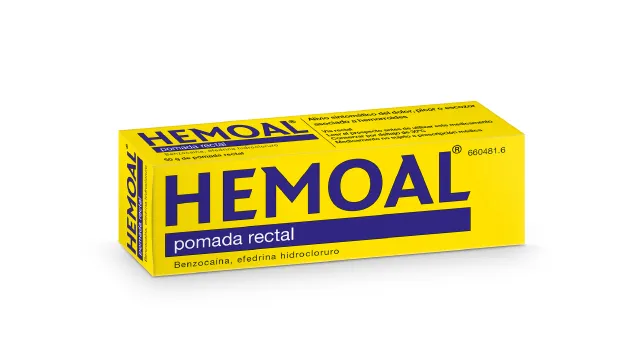
Table of Contents
Package leaflet: Information for the user
Introduction
Package leaflet: information for the user
Hemoal rectal ointment
Benzocaine, Ephedrine Hydrochloride Please read the entire leaflet carefully before you start using this medicine, as it contains important information for you. Always follow exactly the instructions for administration provided in this leaflet or those given by your doctor or pharmacist.
Leaflet contents 1.- What Hemoal is and what it is used for. 2.- What you need to know before using Hemoal. 3.- How to use Hemoal. 4.- Possible side effects. 5.- How to store Hemoal. 6.- Package contents and additional information. |
1. What Hemoal is and what it is used for
It is a local anesthetic due to the action of benzocaine and a vasoconstrictor due to the action of ephedrine.
It is indicated for the symptomatic relief of pain, itching, or burning associated with hemorrhoids in adults.
2. What you need to know before using Hemoal
Do not use Hemoal:
- if you are allergic (hypersensitive) to benzocaine, ephedrine hydrochloride, or any of the other components of this medicine (listed in section 6), to other local anesthetics derived from para-aminobenzoic acid, parabens, paraphenylenediamine, or commercial hair dyes
- if you have had an allergic reaction to local anesthetics
- if you have experienced, suspect you may have, or are at increased risk of elevated methemoglobin levels in the blood (methemoglobinemia)
- if you are being treated with sulfonamides
- if you are being treated with cholinesterase inhibitors (medicines for Alzheimer's disease) or have reduced cholinesterase activity
- if you are being treated with sympathomimetic agents
- if you have severe coronary heart disease or cardiovascular disorders
- if you have hypertension
- if you have hyperthyroidism
- if you are currently being treated or have been treated within the last two weeks with medicines for depression such as monoamine oxidase inhibitors (MAOIs)
- on large areas of skin, eczematous skin, sunburned skin, infected or cracked skin
Warnings and precautions
Talk to your doctor or pharmacist before using Hemoal.
This medicine should not be used if you have serious heart problems (complete heart block).
This medicine should be used with caution if you have diabetes, closed-angle glaucoma, Raynaud's phenomenon, pheochromocytoma, or benign prostatic hyperplasia.
Maintain normal bowel function through an appropriate diet (fruits, vegetables, adequate fluid intake, and regular exercise). It may be helpful to take a laxative, bulk-forming agent, or stool softener at the same time. Avoid excessive use of laxatives, as this could lead to lazy bowel syndrome.
Use of other medicines
Tell your doctor or pharmacist if you are taking, or have recently taken, any other medicines, including those obtained without a prescription.
This medicine may interact with:
-
Phenothiazines (antipsychotics) or antidepressant MAOIs, which may cause increased blood pressure, cardiac arrhythmia, or even death.
-
Cardiac glycosides: using cardiac glycosides (e.g., digoxin) together with ephedrine may increase the risk of irregular heartbeat or heart attack.
-
Antidepressants: tricyclic antidepressants (e.g., amitriptiline) and noradrenergic-serotonergic antidepressants may increase the risk of cardiovascular side effects with ephedrine.
-
Sympathomimetic agents: using ephedrine with other sympathomimetic agents may increase the risk of hypertension and other cardiovascular effects.
-
Beta-blocking antihypertensive agents: using this medicine together with beta-blockers or other antihypertensives may reduce their effectiveness.
-
Sulfonamides (medicines to treat infections): should not be used together with benzocaine, as this may reduce the effect of sulfonamides.
-
Cholinesterase inhibitors (medicines for Alzheimer's disease): should not be used together with benzocaine, as this may increase the effect of benzocaine.
-
Ergot alkaloids: risk of vasoconstriction and/or increased blood pressure (hypertension) when used in combination with ephedrine.
-
Linezolid (an antibiotic for the treatment of serious bacterial infections): risk of increased blood pressure (hypertension) when used with ephedrine.
-
Adrenergic neuron-blocking agents: ephedrine may reduce or nullify the antihypertensive effects of guanethidine.
-
Appetite suppressants and amphetamine-type psycho-stimulants: risk of hypertension and increased heart rate with concomitant use of ephedrine and sibutramine.
-
Halogenated anesthetics: ephedrine should be used with caution if undergoing anesthesia with halogenated anesthetics, as it may induce cardiac rhythm disturbances (ventricular fibrillation).
-
Other local anesthetics of the benzocaine type: cross-sensitivity may occur between benzocaine and other ester-type local anesthetics.
-
Theophylline (anti-asthmatic, bronchodilator): increased risk of adverse reactions following concomitant administration of theophylline and ephedrine.
-
Dexamethasone (glucocorticoid): ephedrine increases the elimination of dexamethasone.
-
Doxapram (respiratory stimulant): risk of hypertension when used in combination with ephedrine.
-
Oxytocin: risk of hypertension when used in combination with ephedrine.
Interactions with diagnostic tests:
Do not use Hemoal within 72 hours before undergoing a pancreatic function test with bentiromide, as it may interfere with the test results.
Pregnancy, breastfeeding, and fertility
If you are pregnant or breastfeeding, think you may be pregnant, or plan to become pregnant, consult your doctor or pharmacist before using this medicine.
Consult your doctor or pharmacist before using any medicine.
You should not use this medicine during pregnancy or breastfeeding unless specifically recommended by your doctor, as systemic absorption may occur.
Use in patients over 65 years of age and debilitated patients:
Patients over 65 years of age and debilitated patients may be more sensitive to benzocaine; therefore, the dose should be reduced.
Use in children
Not recommended due to lack of data on efficacy and safety.
Driving and use of machines
No effects on the ability to drive or operate machinery have been reported.
Hemoal contains acetylated lanolin alcohols
This medicine may cause local skin reactions (such as contact dermatitis) because it contains acetylated lanolin alcohols.
3. How to use Hemoal
Follow exactly the instructions for use of this medicine given by your doctor or pharmacist. If in doubt, consult your doctor or pharmacist again.
This medicine is administered rectally.
Personal hygiene is essential to control haemorrhoidal symptoms. Therefore, the area should be kept clean by washing it, especially after each bowel movement, with a little mild soap, and drying it gently without rubbing using a clean towel.
Apply a thin layer of ointment (approximately 1 cm) to the clean and dry affected anal area, in the morning, at night, and after each bowel movement. Generally, 3 to 4 times a day.
Apply using a finger, using the fingertip to overcome sphincter resistance.
To use inside the anal canal, remove the protective cap from the nozzle, screw the nozzle onto the tube, lubricate it with a small amount of ointment, and carefully insert it into the anal canal. Then, apply a small amount of ointment by gently pressing the tube. If resistance is encountered during application, stop immediately, as it may be harmful and damaging.
After application, unscrew the nozzle from the tube and wash it before storing.
Wash your hands before and after each application. For hygiene reasons and to avoid infections, the nozzle must be used by only one patient.
Treatment should not last longer than 7 days. If anorectal symptoms (pain, itching, burning) do not improve within this time or if bleeding occurs, consult your doctor.
Patients over 65 years of age and debilitated patients: the dose should be reduced; see "Use in patients over 65 years of age and debilitated patients".
If you use more Hemoal than you should:
If you have used more Hemoal than you should, consult your doctor or pharmacist or contact the Toxicology Information Service. Telephone 91 562.04.20, indicating the medicine and the amount applied.
Symptoms that may occur due to overdose include anxiety, nervousness, palpitations, headache, and insomnia.
If you forget to use Hemoal:
Do not apply a double dose to make up for missed doses.
If you have any further questions about the use of this product, ask your doctor or pharmacist.
4. Possible adverse effects
Like all medicines, this medicine may cause adverse effects, although not everyone experiences them.
Rare adverse effects (may affect up to 1 in 1,000 people):
- reduction in blood flow to the area where the ointment is applied (ischaemia)
Very rare adverse effects (affect fewer than 1 in 10,000 people):
- hypersensitivity reactions
- anxiety
- headache, nervousness, insomnia
- palpitations
Adverse effects of unknown frequency: (cannot be estimated from available data)
- increased methaemoglobin in the blood (methaemoglobinaemia), causing bluish discoloration of the skin and mucous membranes (cyanosis)
- decreased appetite, decreased potassium levels in blood (hypokalaemia)
- confusion, depression, psychotic states, fear, irritability
- restlessness, tremor
- increased heart rate (tachycardia), irregular heartbeat (cardiac arrhythmia), angina-like chest pain, slow heart rate (bradycardia), cardiac arrest
- high blood pressure (hypertension), cerebral haemorrhage, low blood pressure (hypotension)
- fluid accumulation in the lungs (pulmonary oedema)
- nausea, vomiting, excessive salivation
- urinary retention
- weakness, increased sweating (hyperhidrosis)
- changes in blood glucose levels
- allergic dermatitis
Others:
Allergic contact reactions, anal burning sensation may occur.
Dehydration of the skin area where the product is applied (epithelium), and hardening of mucous membranes.
Reporting of adverse effects
If you experience any type of adverse effect, consult your doctor or pharmacist, even if it is a possible adverse effect not listed in this leaflet. You may also report them directly via the Spanish Pharmacovigilance System for Human Medicines (www.notificaram.es). By reporting adverse effects, you can help provide more information on the safety of this medicine.
5. Storage of Hemoal
Keep this medicine out of sight and reach of children.
Store below 30 °C.
Do not use after the expiry date stated on the container. The expiry date refers to the last day of the month indicated.
Medicines must not be disposed of via wastewater drains or household waste. Dispose of unused containers and medicines at a SIGRE collection point at your pharmacy. If in doubt, ask your pharmacist how to dispose of containers and medicines you no longer need. This will help protect the environment.
6. Contents of the pack and other information
Composition of Hemoal:
Per gram:
The active substances are: benzocaine 30 milligrams and ephedrine (hydrochloride) 2 milligrams.
The other components (excipients) are: zinc oxide, white vaseline, and acetylated lanolin alcohols.
Appearance of the product and contents of the pack
Flexible aluminum tube with epoxy inner coating and polyethylene screw cap, containing 30 g and 50 g of rectal ointment. Each pack contains an applicator nozzle for rectal administration.
Marketing Authorization Holder
Reckitt Benckiser Healthcare, S.A.
Paseo de Gracia, 9, 08007, Barcelona, Spain
Manufacturer
INDUSTRIA QUIMICA Y FARMACEUTICA VIR, S.A.
Laguna, 66-68-70. Poligono Industrial Urtinsa II (Alcorcón)
28923 – Spain
or
ALCALA FARMA, S.L.
Carretera M-300 Km 29,920 (Alcalá de Henares) - 28802 - Spain
Date of the most recent revision of this leaflet: June 2025
Detailed information on this medicine is available on the website of the Spanish Agency for Medicines and Health Products (AEMPS) (http://www.aemps.gob.es/).