Helicobacter Test Infai 75 mg powder for oral solution
Spain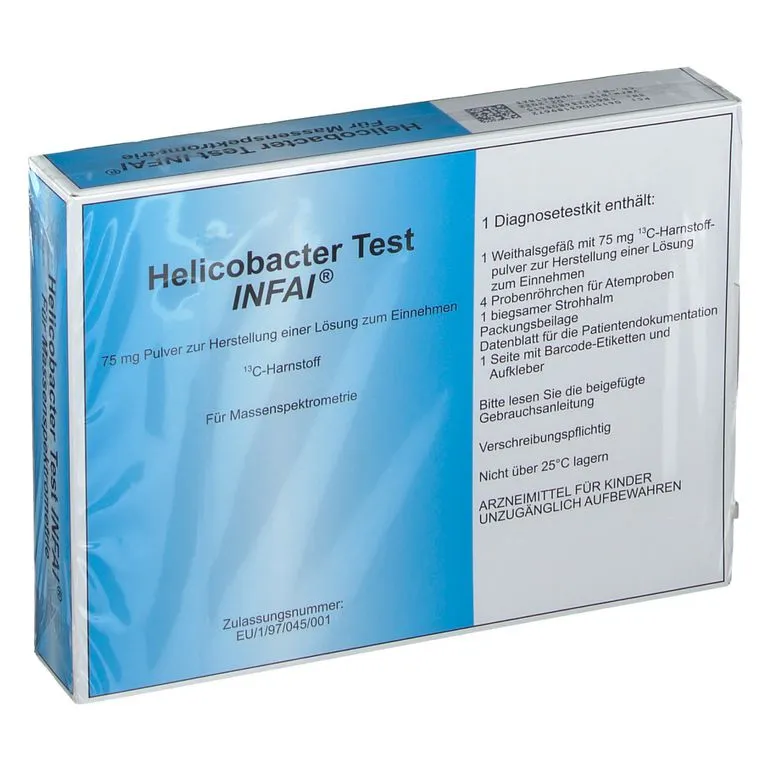
Table of Contents
- Package leaflet: Information for the user
- Introduction
- 1. What Helicobacter Test INFAI is and what it is used for
- 2. What you need to know before starting to take Helicobacter Test INFAI
- 3. How to take Helicobacter Test INFAI
- 4. Possible adverse effects
- 5. Storage of Helicobacter Test INFAI
- 6. Contents of the pack and other information
Package leaflet: Information for the user
Introduction
Package leaflet: information for the user
Helicobacter Test INFAI 75 mg powder for oral solution
13C-urea
Read the entire leaflet carefully before starting to take this medicine, because it contains important information for you.
- Keep this leaflet, as you may need to read it again.
- If you have any questions, ask your doctor or pharmacist.
- This medicine has been prescribed for you only and must not be given to other people, even if they have the same symptoms as you, because it could harm them.
- If you experience any adverse reactions, consult your doctor or pharmacist, even if they are adverse reactions not listed in this leaflet. See section 4.
Contents of the leaflet:
- What Helicobacter Test INFAI is and what it is used for
- What you need to know before taking Helicobacter Test INFAI
- How to take Helicobacter Test INFAI
- Possible side effects
- How to store Helicobacter Test INFAI
- Contents of the pack and other information
1. What Helicobacter Test INFAI is and what it is used for
Helicobacter Test INFAI is for diagnostic use only. It is a breath test for adolescents aged 12 years and older, and adults, to determine the presence of a stomach infection caused by the bacterium Helicobacter pylori.
Why should you take Helicobacter Test INFAI?
You may have a gastric infection caused by the bacterium Helicobacter pylori. Your doctor has recommended that you undergo the Helicobacter INFAI test for one of the following reasons:
-
Your doctor wishes to confirm whether you have an infection with Helicobacter pylori in order to diagnose your condition.
-
You have previously been diagnosed with an Helicobacter pylori infection and have received treatment to eradicate it. Now your doctor wants to know whether the treatment has been effective.
How does this test work?
All food contains a substance called carbon-13 (13C). This carbon-13 can be detected in the carbon dioxide exhaled from the lungs. The actual amount of carbon-13 present in exhaled breath depends on the type of food that has been ingested.
The test involves ingesting the "test meal". Then, breath samples are collected. See "Special instructions for use". These samples will be analyzed to measure the "normal" level of carbon-13 content in the carbon dioxide of your breath.
Next, you will be required to drink a solution of carbon-13-urea. After 30 minutes, further breath samples are collected, and the carbon-13 content in these samples is measured again as described above. The results are compared. If a significant increase in carbon-13 content is detected in the second set of samples, this indicates to your doctor the presence of the bacterium Helicobacter pylori.
2. What you need to know before starting to take Helicobacter Test INFAI
Do not take Helicobacter Test INFAI
- if you have or suspect you have a stomach infection or a specific inflammation of the inner lining of the stomach (atrophic gastritis).
This inflammation of the inner stomach lining may lead to incorrect positive results in the breath test. Additional investigations may be required to confirm the presence of Helicobacter pylori.
Warnings and precautions
Consult your doctor or pharmacist before starting Helicobacter Test INFAI if you have any condition that may affect or be affected by the test.
Even if the result of the Helicobacter INFAI test is positive, other tests may be necessary before initiating treatment for Helicobacter pylori infection. These are required to check for the presence of other complications, such as:
- stomach ulcer
- infection of the inner stomach lining caused by the immune system
- tumors
There is insufficient data on the reliability of Helicobacter Test INFAI to recommend its use in patients who have had part of the stomach surgically removed.
If the patient vomits during the test procedure, the test must be repeated. The repeat test must be performed on an empty stomach and not earlier than the following day.
Use of Helicobacter Test INFAI with other medicines
Medicines that affect
- Helicobacter pylori (see section 3, second paragraph under "How to use")
- the urease enzyme, which catalyzes the breakdown of urea
may influence the Helicobacter Test INFAI.
Inform your doctor or pharmacist if you are taking or have recently taken, or might need to take, any other medicines.
Pregnancy and breastfeeding
If you are pregnant or breastfeeding, think you might be pregnant, or plan to become pregnant, consult your doctor or pharmacist before using this medicine.
The breath test is not expected to have harmful effects during pregnancy or breastfeeding.
Driving and use of machines
The influence of Helicobacter Test INFAI on the ability to drive and use machines is none or negligible.
3. How to take Helicobacter Test INFAI
Follow exactly the instructions for administration of this medicine as given by your doctor. If in doubt, consult your doctor or pharmacist again.
The test must be performed in the presence of your doctor or another qualified person.
Recommended dose
Patients aged 12 years and older must take the contents of 1 bottle per test.
Method of administration
The patient must fast for at least 6 hours before administration, preferably overnight. Consult your doctor if fasting poses a problem, for example in diabetic patients.
The procedure lasts approximately 40 minutes.
The test must be performed at least:
- 4 weeks after any treatment against a bacterial infection
- 2 weeks after the last administration of any medication to reduce stomach acid secretion
Both groups of medications may influence the results of the Helicobacter Test INFAI. Especially after a treatment to eradicate Helicobacter pylori. It is important to follow the instructions for use exactly, particularly after a Helicobacter eradication therapy; otherwise, the result may be questionable.
Essential components not included in Helicobacter Test INFAI
Before performing the breath test, a test meal must be ingested to delay gastric emptying. This test meal is not included in the kit. The following are suitable test meals:
- 200 ml of pure orange juice
- 1 g of citric acid dissolved in 200 ml of water
If there is a reason why you should not take one of these test meals, inform your doctor so that an alternative can be suggested. You will need a glass and water to dissolve the 13C-urea powder. If the test needs to be repeated, it should not be repeated before the following day.
Special instructions for use (for mass spectrometry)
This medicine must only be administered by a medical professional and under appropriate medical supervision. Patient data must be documented on the provided data sheet. It is recommended to perform the test while the patient is at rest.
- The patient must fast for at least 6 hours before administration, preferably overnight. If the test is performed later in the day, it is recommended to consume only a light meal, such as a cup of tea and a slice of toast.
- The test begins with the collection of samples to determine baseline values.
- Remove from the kit the flexible tube and the two containers labeled: “sampling time: 00-minute value”.
- Remove the cap from one of the containers and place the flexible tube (without its wrapper) into the container.
- Now gently exhale through the tube into the sample container.
- Continue exhaling while removing the tube, and immediately close the container with its cap. If the sample tube remains open for more than 30 seconds, the result may be inaccurate.
- Keep the sample container in an upright position and affix the barcode label marked “00-minute value” around the container so that the barcode is horizontal.
- Now fill the second sample container (labeled “sampling time: 00-minute value”) by exhaling in the same manner as described above.
- The patient should now drink the test meal (200 ml of pure orange juice or 1 g of citric acid in 200 ml of water).
- Now prepare the test solution as follows:
- Remove from the kit the bottle labeled “13C-urea powder”, open it, and fill it to about three-quarters full with tap water.
- Close the bottle and shake carefully until all the powder is dissolved.
- Pour the contents into a glass of water, then refill the bottle with water a second and third time, adding each portion to the same glass, to obtain approximately 30 ml of test solution.
- The patient must drink this test solution immediately. The time of ingestion must be recorded.
- 30 minutes after administration of the test solution (step 6), collect the “30-minute value” samples into both remaining containers in the test kit (labeled “sampling time: 30-minute value”) as described in steps 2 and 3.
Use the barcode labels marked “30-minute value” for these samples.
- Attach the corresponding barcode label to the patient’s data sheet. All four breath sample containers must be returned to the original packaging. This packaging must be sealed with the blue adhesive label.
- The package must be sent to a qualified laboratory for analysis.
Medical or healthcare professionals can find detailed information on breath sample analysis and laboratory assay specifications in section 6.6 of the Summary of Product Characteristics.
If you take more Helicobacter Test INFAI than you should
Since only 75 mg of 13C-urea is supplied, overdose is not expected.
If you have any further questions about the use of this medicine, ask your doctor or pharmacist.
4. Possible adverse effects
No adverse effects are known.
Reporting of adverse effects
If you experience any type of adverse effect, consult your doctor or pharmacist. You can also report them directly through the national reporting system listed in Annex V. By reporting adverse effects, you can help provide more information on the safety of this medicine.
5. Storage of Helicobacter Test INFAI
Keep this medicine out of the sight and reach of children.
Do not use this medicine after the expiry date stated on the packaging after EXP. The expiry date refers to the last day of the month indicated.
Do not store above 25°C.
Medicines should not be disposed of via wastewater drains or household waste. Ask your pharmacist how to properly dispose of unused medicines and their packaging. This will help protect the environment.
6. Contents of the pack and other information
Composition of Helicobacter Test INFAI
- The active substance is 13C-urea.
One vial contains 75 mg of 13C-urea.
- It contains no other ingredients.
Presentation of the product and contents of the pack
The Helicobacter INFAI test is a white, crystalline powder for oral solution.
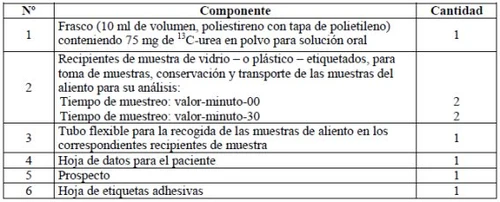
One test kit contains the following components:
Marketing Authorization Holder
INFAI GmbH
Riehler Str. 36
D-50668 Köln
Germany
Manufacturer responsible for batch release
INFAI GmbH
An der Kohlenbahn 39
D-58135 Hagen
Germany
Further information on this medicinal product is available upon request from the local representative of the Marketing Authorization Holder.
AT, BE, BG, CZ, DE, DK, EE, ES, FI, IS, IT, LT, LU, LV, MT, NL, NO, RO, SE
INFAI GmbH, Tel / Tél / Te?. / Τηλ / Puh / Sími / Tlf.: +49 221 880 443
Deutschland / Allemagne / ???????? / Nemecko / Tyskland / Saksamaa / Alemania / Saksa / Þýskaland / Germania / Vokietija / Vacija / Il-Germanja / Duitsland
CY, EL ANGELINI PHARMA HELLAS SA, Τηλ: +30 210 626 9200, Ελλ?δα
FR INFAI FRANCE SARL, Tél: +33 389 2043 82
HR POLIKLINIKA LABPLUS, Tel: +385 1 299 3595, E-Mail: [email protected]
IE, UK INFAI UK Ltd., Tel: +44 1904 435 228, United Kingdom
PL Dr Piktel Medic@l Systems, Tel: +48 85 744 7770
PT Sermail Logística Integrada Lda., Tel: +351 21 973 9120
SL PLIVA LJUBLJANA d.o.o., Tel: +386 1 5890 390
HU, SK ALLMEDICAL s.r.o, Tel: +421 903 654 103, Szlovákia / Slovenská republika
Date of the most recent revision of this leaflet: {MM/YYYY}.
Detailed information on this medicinal product is available on the website of the European Medicines Agency: http://www.ema.europa.eu.