Gutron 5 mg tablets
Spain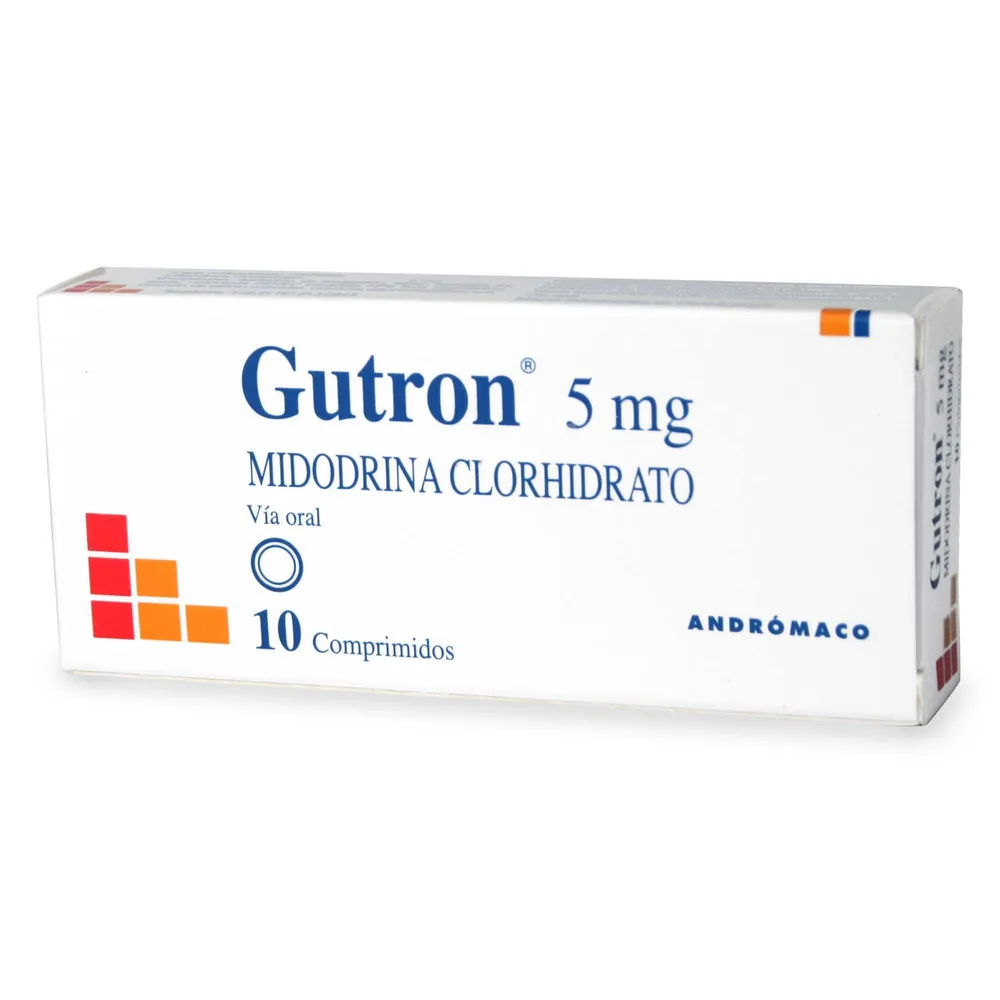
Table of Contents
Package leaflet: Information for the user
Introduction
Package leaflet: information for the user
Gutron 5 mg tablets
midodrine hydrochloride
Read the entire leaflet carefully before you start taking this medicine because it contains important information for you.
-
Keep this leaflet as you may need to read it again.
-
If you have any questions, ask your doctor or pharmacist.
-
This medicine has been prescribed for you only, and you should not give it to others, even if they have the same symptoms as you, because it could harm them.
-
If you experience any adverse effects, consult your doctor or pharmacist, even if they are adverse effects not listed in this leaflet. See section 4.
Contents of the leaflet:
-
What Gutron is and what it is used for
-
What you need to know before taking Gutron
-
How to take Gutron
-
Possible side effects
-
How to store Gutron
-
Contents of the pack and other information
1. What Gutron is and what it is used for
Gutron is a cardiac stimulant containing the active substance midodrine hydrochloride.
Gutron is a medicine used for the treatment of severe low blood pressure when other treatments have not been satisfactory.
2. What you need to know before starting to take Gutron
Do not take Gutron:
- if you are allergic to midodrine hydrochloride or to any of the other ingredients of this medicine (listed in section 6).
- if you have high blood pressure
- if you have a slow pulse
- if you have difficulty urinating
- if you suffer from any type of heart or vascular disease
- if you have high intraocular pressure (glaucoma) and vision problems due to diabetes
- if you have overactivity of the thyroid gland
- if you have hormonal disorders due to a tumor of the adrenal medulla (pheochromocytoma)
- if you have severe renal insufficiency
- if you have an enlarged prostate gland
Warnings and precautions
Consult your doctor or pharmacist before starting to take Gutron:
- if you have high blood pressure when lying down, your blood pressure will be monitored while standing and sitting due to the risk of elevated blood pressure in the lying position, for example at night.
If you have high blood pressure while lying down and this does not improve when the dose is reduced, treatment with Gutron must be discontinued.
This is important when taking Gutron.
Avoid administration at night. The risk of increased blood pressure can also be reduced by sleeping with the head elevated.
Patients should be monitored due to possible hypertensive side effects.
- if you have severe dysfunction of the autonomic nervous system, as Gutron may lead to a greater decrease in blood pressure upon standing. In such cases, treatment with midodrine should be stopped.
- if you have circulatory disorders in the arteries.
- if you have prostate disorders, as it may cause difficulty in urinating.
It is recommended that your kidney function and blood pressure be checked before starting treatment with Gutron. During treatment with Gutron, your doctor should periodically monitor your blood pressure to adjust your dose if necessary.
It is important that you immediately report symptoms related to elevated blood pressure, such as increased heart rate, headache, and blurred vision. Your doctor will decide whether the dose should be adjusted or treatment with Gutron discontinued.
Consult your doctor if any of the above-mentioned conditions have ever occurred in your case.
Children
Gutron must not be used in children due to limited information available on the use of midodrine hydrochloride in this population.
Taking Gutron with other medicines
- Midodrine may affect how some medicines work. These include perfenazine (used to treat psychosis [altered sense of reality] and manic episodes [extremely elevated mood]), amiodarone (used to treat irregular heart rhythm), and metoclopramide (used to treat nausea and vomiting). Taking midodrine together with these medicines may increase their respective effects.
- Concomitant treatment with sympathomimetics (substances that have a stimulating effect on certain parts of the nervous system) and other vasoconstrictors (agents that cause narrowing of blood vessels), such as reserpine, guanethidine, tricyclic antidepressants (substances used for depression), antihistamines (substances for hypersensitivity reactions), thyroid hormones, and monoamine oxidase (MAO) inhibitors (which inhibit the enzyme monoamine oxidase, thereby increasing neurotransmitter levels and reducing depression) should be avoided, as they may cause an increase in blood pressure.
- As with other medicines of the same class, the effect of midodrine is counteracted by drugs such as prazosin and phentolamine (medications for heart disease).
- Simultaneous use with digitalis preparations (medications used for heart disease) is not recommended, as it may cause disturbances in heart function.
- Midodrine may enhance the hypertensive effect of fluorocortisone acetate (a corticosteroid anti-inflammatory).
- If midodrine is combined with other medicines that directly or indirectly reduce heart rate, monitoring by your doctor is advised.
Inform your doctor or pharmacist if you are taking, have recently taken, or might need to take any other medicines.
Pregnancy and breastfeeding
If you are pregnant or breastfeeding, think you may be pregnant, or are planning to become pregnant, consult your doctor or pharmacist before using this medicine.
Gutron is not recommended during pregnancy.
You must not take Gutron while breastfeeding.
Driving and using machines
The effect of Gutron on driving ability is negligible; however, caution should be exercised when driving or operating machinery if you experience dizziness or mild drowsiness.
Gutron contains the colouring agent orange-yellow S
It may cause allergic-type reactions.
3. How to take Gutron
Follow exactly the instructions for use of this medicine as given by your doctor or pharmacist. If in doubt, consult your doctor or pharmacist again.
The initial dose is 2.5 mg three times daily. (Gutron can be divided into equal doses of 2.5 mg.) This dose may be increased weekly up to 10 mg three times daily, which is the normal maintenance dose of 30 mg per day.
The recommended total daily dose should be administered in three separate doses per day.
There is no information available regarding use in children, elderly patients, patients with renal impairment, or patients with impaired liver function.
Take the tablets with a small amount of water. The medicine may be taken with food.
The tablet can be divided into equal doses.
Avoid nighttime administration. The last dose should be taken 4 hours before going to bed. Elevating the head at night reduces the risk of increased blood pressure. More information is provided in this leaflet in the section “Warnings and precautions”.
Your doctor will determine the duration of treatment with Gutron. Treatment is usually long-term. If you feel that the effect of Gutron is too strong or too weak, speak to your doctor or pharmacist.
If you take more Gutron than you should
If you have taken too much Gutron, contact your doctor or pharmacist.
An overdose may cause:
- high blood pressure
- slow heart rate (bradycardia)
- difficulty urinating
- goosebumps
- cold sensation
In case of overdose or accidental ingestion, contact your doctor or pharmacist immediately or call the Toxicology Information Service at telephone number 91 562 04 20, indicating the medicine and the amount ingested.
If you forget to take Gutron
Do not take a double dose of Gutron to make up for a missed dose, due to the risk of high blood pressure when lying down.
Avoid nighttime administration.
If you stop taking Gutron
Stopping treatment will not cause a sudden drop in blood pressure.
If you have any further questions about the use of this medicine, ask your doctor or pharmacist.
4. Possible adverse effects
Like all medicines, this medicine can cause adverse effects, although not everyone will experience them.
Very common (may affect more than 1 in 10 people):
Goosebumps, itching of the head, and pain when urinating.
Common (may affect up to 1 in 10 people):
Tingling and itching, increased blood pressure when lying down, headache, nausea, heartburn, inflammation of the mouth mucosa, flushing, skin rash, chills, difficulty urinating.
Uncommon (may affect up to 1 in 100 people):
Sleep disorders, including difficulty sleeping, excitability, agitation, and irritability, slow heartbeats, urinary urgency.
Rare (may affect up to 1 in 1,000 people):
Heart palpitations, increased heart rate, altered liver function, including elevated liver enzymes.
Frequency not known (frequency cannot be estimated from the available data):
Anxiety, abdominal pain, vomiting, and diarrhea.
Reporting of adverse effects
If you experience any type of adverse effect, consult your doctor, pharmacist, or nurse, even if it is a possible adverse effect not listed in this leaflet.
You can also report them directly via the Spanish Pharmacovigilance System for Human Medicinal Products: www.notificaram.es
By reporting adverse effects, you can help provide more information on the safety of this medicine.
5. Storage of Gutron
Keep this medicine out of sight and reach of children.
Store below 25°C. Keep in the original container.
Keep the blister pack in its cardboard box.
Gutron has a shelf life of 3 years. Do not use Gutron after the expiry date stated on the packaging after "EXP". The expiration date refers to the last day of the indicated month.
Medicines must not be disposed of via wastewater or household waste. Dispose of unused medicines and their containers at the SIGRE Point at your pharmacy. If you are unsure, please ask your pharmacist how to dispose of medicines and containers you no longer need. This will help protect the environment.
6. Contents of the pack and other information
What Gutron contains
The active substance is midodrine hydrochloride.
The other components in Gutron are magnesium stearate, talc, colloidal anhydrous silica, microcrystalline cellulose, maize starch, E 110 Orange Yellow S.
Appearance of the product and contents of the container
Tablets
Orange, round, biconvex tablets with bevelled edges, scored, marked with “GU” above and “5” below the score on one side.
Pack sizes of 20, 30 or 50 tablets.
Glass bottle containing 100 tablets.
Only some pack sizes may be marketed.
Marketing Authorization Holder and Manufacturer
Marketing Authorization Holder:
CHEPLAPHARM Arzneimittel GmbH
Ziegelhof 24
17489 Greifswald
Germany
Manufacturer:
Takeda GmbH
Plant Oranienburg
Lehnitzstr., 70-98
DE-16514 Oranienburg
Germany
Local representative:
Laboratorios Rubió, S.A.
Industria, 29 - Pol. Ind. Comte de Sert
08755 Castellbisbal (Barcelona)
Spain
This medicinal product is authorized in the Member States of the European Economic Area under the following names:
Netherlands: Gutron 5, 5 mg tablets
Spain: Gutron 5 mg tablets
Date of the most recent review of this summary: February 2016.
Detailed and up-to-date information on this medicinal product is available on the website of the Spanish Agency for Medicines and Health Products (AEMPS) http://www.aemps.gob.es