Glypressin 1 mg solution for injection
Spain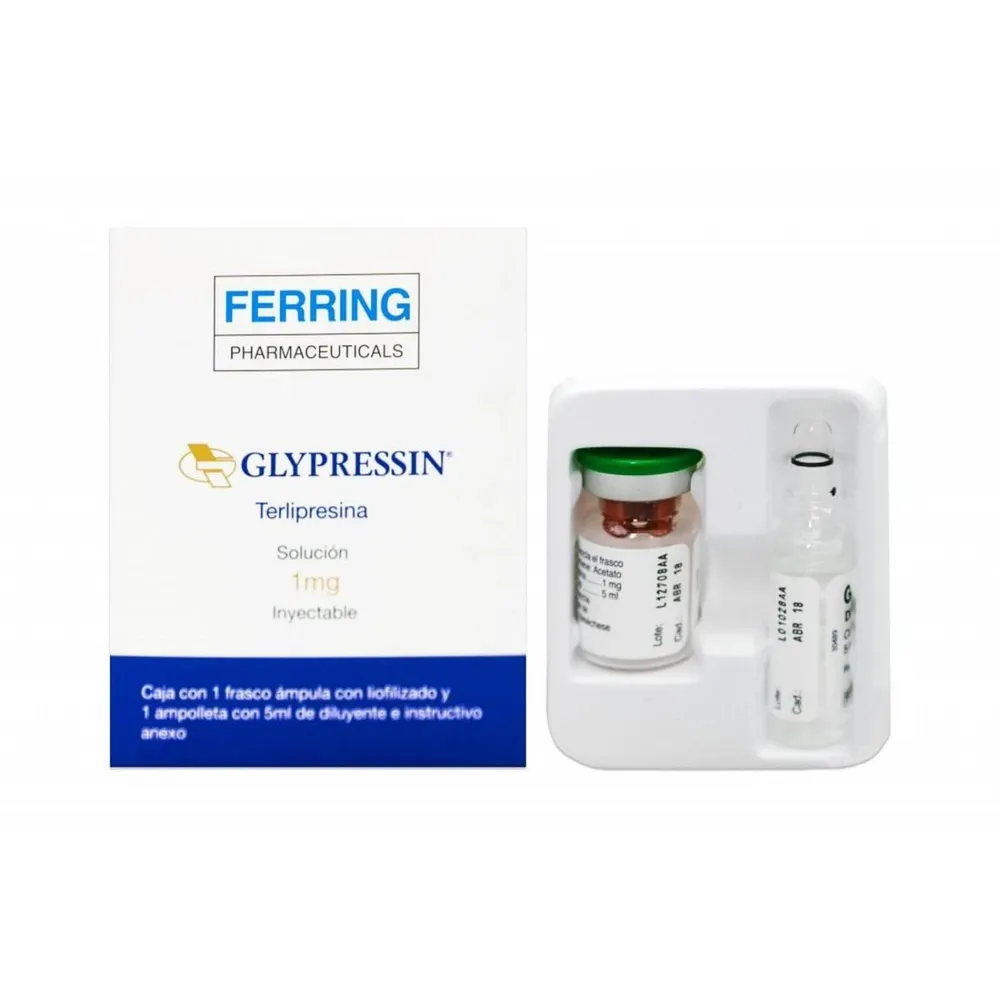
Table of Contents
Package leaflet: Information for the user
Introduction
PACKAGE LEAFLET: INFORMATION FOR THE USER
Glypressin 1 mg injection solution
Terlipressin acetate
Read the entire leaflet carefully before you start using this medicine.
- Keep this leaflet, as you may need to read it again.
- If you have any questions, ask your doctor or pharmacist.
- If you experience any adverse effects, consult your doctor or pharmacist, even if they are effects not listed in this leaflet. See section 4.
Leaflet contents:
- What Glypressin is and what it is used for
- What you need to know before using Glypressin
- How to use Glypressin
- Possible adverse effects
- How to store Glypressin
Pack contents and additional information
1. What Glypressin is and what it is used for
Glypressin is a solution for intravenous injection supplied in a glass vial of 8.5 ml containing 1 mg of terlipressin acetate (equivalent to 0.86 mg of terlipressin base). The concentration of the solution is 0.12 mg of terlipressin acetate/ml.
Glypressin (terlipressin) belongs to a group of medicines that reduce pressure in the liver veins (portal venous pressure) in patients with high blood pressure in the vein that carries blood to the liver (portal hypertension). Terlipressin works by narrowing the blood vessels (vasoconstriction) in this area, helping to control bleeding from oesophageal and gastric varices (oesophagogastric varices) when it occurs.
Glypressin also contributes to improving blood circulation in the kidney, helping to restore kidney function in patients with Hepatorenal Syndrome (a type of kidney failure occurring in patients with severe liver dysfunction).
Glypressin is indicated for the treatment of:
- Gastrointestinal bleeding due to rupture of oesophagogastric varices
- Emergency treatment of type 1 hepatorenal syndrome, as defined by the criteria of the International Ascites Club (IAC).
2. What you need to know before using Glypressin
Do not use Glypressin:
- if you are allergic (hypersensitive) to terlipressin acetate or to any of the other ingredients of this medicine (listed in section 6)
- if you are pregnant
Warnings and precautions:
Talk to your doctor or pharmacist before starting to use Glypressin:
- if you have high blood pressure (hypertension).
- if you have heart problems, such as irregular heartbeat (arrhythmias), reduced blood supply to the heart (coronary artery disease), or your heart pumps less blood than it should (heart failure), as you may have a higher risk of heart-related adverse effects.
- if you have reduced blood flow to the brain (cerebrovascular disease), poor blood circulation in the legs or arms (peripheral vascular disease), or intestinal blood vessel disease, as you may be at increased risk of adverse effects due to reduced blood flow in these areas.
- if you have leg swelling due to poor venous circulation or suffer from being overweight (obesity), as you may have an increased risk of reduced blood flow to the skin (ischaemia) and, in rare cases, skin cell death (cutaneous necrosis).
- if you have a severe systemic infection with low blood pressure (septic shock).
- if you have impaired kidney function (renal failure).
- if you have asthma or breathing problems (respiratory failure).
- in patients over 70 years of age with current or past cardiovascular disease.
- in children, as experience is limited in this age group.
Glypressin must be used under the supervision of a specialist in units equipped to regularly monitor blood pressure, cardiac function, blood parameters, and fluid balance.
The injection must be administered exclusively by intravenous route to avoid skin cell death (cutaneous necrosis) at the injection site due to leakage of the product into the skin.
Glypressin may increase the risk of developing respiratory failure, which can be fatal. If you experience difficulty breathing or symptoms of fluid overload before or during treatment with Glypressin, inform your doctor immediately.
If you are being treated for severe liver and kidney disease (hepatorenal syndrome type 1), your doctor must ensure that your cardiac function and fluid and electrolyte balance are monitored during treatment. Special care is required if you have pre-existing heart or lung disease, as Glypressin may induce cardiac ischaemia (reduced blood flow to the heart) and respiratory failure (severe breathing difficulties). Treatment with Glypressin should be avoided if you have liver failure with multiple organ dysfunction and/or renal failure with very high levels of creatinine (a waste product) in the blood, as this increases the risk of adverse outcomes.
If you are being treated for severe liver and kidney disease, Glypressin may increase the risk of developing sepsis (bacteria in the blood and an extreme bodily response to infection) and septic shock (a serious condition in which a major infection causes low blood pressure and reduced blood flow). Your doctor will take additional precautions in your case.
Use of Glypressin with other medicines
Inform your doctor or pharmacist if you are taking, have recently taken, or might need to take any other medicines.
It is very important to inform your doctor if you are being treated with:
- Beta-blockers (medicines to slow the heart rate), as their effects may be increased when used together with Glypressin.
- Antiarrhythmics (used to treat irregular heartbeats), such as quinidine or amiodarone.
- Diuretics (used to increase urine output, such as those in the furosemide group).
Inform your doctor if you have previously experienced a sudden slowing of the heartbeat with certain anaesthetics (propofol, sufentanil). Glypressin may enhance the effect of these drugs if they are administered again.
Pregnancy, breastfeeding and fertility
If you are pregnant or breastfeeding, think you may be pregnant, or are planning to become pregnant, consult your doctor or pharmacist before using this medicine.
Glypressin must not be given if you are pregnant, as it may cause harm to your baby.
Glypressin must not be administered during breastfeeding, as it is not known whether Glypressin passes into breast milk.
Driving and using machines
No studies have been conducted on the effects of Glypressin on the ability to drive or operate machinery.
Use in children and people over 65 years of age
Glypressin should be used with caution in patients over 70 years of age with current or past cardiovascular disease.
Particular caution should be taken when treating children, as experience is limited in this age group.
Use in patients with liver problems
In patients with liver problems, no dose adjustment of terlipressin is required.
Important information about some of the ingredients of Glypressin
Patients on low-sodium diets should be aware that this medicine contains 30.6 mg (1.33 mmol) of sodium per 1 mg of terlipressin acetate.
3. How to use Glypressin
Follow exactly the instructions for administration of Glypressin as given by your doctor. Consult your doctor or pharmacist if you have any doubts.
Method of administration and route
Administration of Glypressin must be performed by qualified healthcare personnel.
Remove one ampoule from the packaging and ensure that no liquid remains in the neck of the ampoule. Once the ampoule is opened, withdraw the solution with a syringe and administer strictly by intravenous injection.
The medicine should be used immediately after opening.
Glypressin is administered by intravenous injection or infusion.
The normal dose in adults is:
Gastrointestinal bleeding due to rupture of esophagogastric varices
The dose will be determined by the doctor, depending on the patient's body weight.
In general, if the patient's weight is less than 50 kilograms, 1 milligram (1 ampoule of 8.5 ml) should be administered every four hours. In patients with a body weight between 50 and 70 kilograms, 1.5 milligrams (1.5 ampoules of 8.5 ml) should be administered every four hours. In patients with a body weight over 70 kilograms, 2 milligrams (2 ampoules of 8.5 ml) should be administered every 4 hours.
Treatment should be continued for 24 consecutive hours until the bleeding has been controlled or for a maximum period of 48 hours. After the initial injection, subsequent doses may be reduced to 1 milligram (1 ampoule) of Glypressin when necessary, for example, due to the occurrence of adverse reactions.
Hepatorenal syndrome
Treatment should be initiated with 1 mg of terlipressin (1 ampoule) every 6 hours for at least 3 days. If after 3 days of treatment the reduction in serum creatinine is less than 30% compared to baseline, doubling the dose to 2 mg (2 ampoules) every 6 hours should be considered.
Treatment with terlipressin should be discontinued if there is no response to treatment (defined as less than a 30% reduction in serum creatinine by day 7 compared to baseline) or in patients who achieve a complete response (serum creatinine values below 1.5 mg/dl for at least two consecutive days).
In patients who show an incomplete response (a reduction in serum creatinine of at least 30% compared to baseline but without reaching values below 1.5 mg/dl by day 7), treatment with terlipressin may be continued for up to a maximum of 14 days.
In the case of recurrence of hepatorenal syndrome after a complete response, treatment with terlipressin may be restarted according to medical judgment.
The usual duration of treatment for hepatorenal syndrome is 7 days, and the maximum recommended duration is 14 days.
Hepatorenal syndrome type 1
Glypressin may also be administered as a continuous intravenous infusion, typically starting with 2 mg of terlipressin acetate per day, with stepwise increases up to a maximum of 12 mg of terlipressin acetate per day.
If you use more Glypressin than you should
If more Glypressin is administered than recommended, there is an increased risk of serious circulatory effects, including hypertensive crisis.
In case of overdose or accidental ingestion, contact your doctor, pharmacist, or call the Toxicology Information Service at telephone number 915 620 420, indicating the medication and the amount ingested.
If you have any further questions about the use of this medicine, ask your doctor or pharmacist.
4. Possible adverse effects
Like all medicines, this medicine can cause adverse effects, although not everyone experiences them.
Immediately inform your doctor or another healthcare professional:
- If you develop breathing difficulties or experience worsening respiratory function (signs or symptoms of respiratory failure). This adverse effect is very common in patients being treated for type 1 hepatorenal syndrome: it may affect more than 1 in 10 people.
- If you develop signs or symptoms of blood infection (sepsis/septic shock), which may include fever and chills or very low body temperature, pale and/or bluish skin, severe shortness of breath, urinating less than usual, rapid heartbeat, nausea and vomiting, diarrhea, fatigue and weakness, and dizziness. This adverse effect is common in patients being treated for type 1 hepatorenal syndrome: it may affect up to 1 in 10 people.
Other adverse effects may occur with varying frequency depending on the underlying disease.
Very common: may affect more than 1 in 10 people
If you have type 1 hepatorenal syndrome:
- Difficulty breathing (dyspnea)
Common: may affect up to 1 in 10 people
- Headache
- Bradycardia (very slow heart rate)
- Increased blood pressure (hypertension)
- Peripheral constriction of blood vessels (inadequate blood flow to tissues [ischemia]), resulting in paleness
- Transient stomach pain
- Transient diarrhea
If you have type 1 hepatorenal syndrome:
- Fluid in the lungs (pulmonary edema)
- Breathing difficulties (respiratory distress)
Uncommon: may affect up to 1 in 100 people
- Decreased sodium levels in the blood if fluid balance is not controlled
- Irregular heartbeat
- Increased heart rate
- Chest pain
- Myocardial infarction (heart attack)
- Pulmonary edema
- Torsade de pointes (serious cardiac event)
- Heart failure. Symptoms include shortness of breath, fatigue, and swelling of the ankles
- Inadequate blood flow to the intestines
- Peripheral cyanosis (bluish discoloration of the skin caused by lack of oxygen)
- Flushing
- Respiratory difficulty and respiratory failure (difficulty breathing)
- Transient nausea
- Transient vomiting
- Skin necrosis (tissue damage)
- Uterine contraction (contraction of the uterus)
- Decreased uterine blood flow
- Necrosis at the injection site (tissue damage)
If you have gastrointestinal bleeding due to rupture of esophagogastric varices:
- Fluid in the lungs (pulmonary edema)
- Breathing difficulties (respiratory distress)
Rare: may affect up to 1 in 1,000 people
If you have gastrointestinal bleeding due to rupture of esophagogastric varices:
- Difficulty breathing (dyspnea)
The drug's antidiuretic effect (reduction in urine output) may lead to decreased sodium levels in the blood (hyponatremia) unless fluid balance is controlled.
Patients with Hepatorenal Syndrome treated with Glypressin showed, during clinical trials, an increased risk of cardiovascular adverse effects such as reduced blood flow to the heart (myocardial ischemia), irregular heartbeat (arrhythmia), reduced blood flow to the intestine (intestinal ischemia), or circulatory overload (which may present as increased blood pressure, headache, difficulty breathing, or distended neck veins).
During clinical trials and post-marketing experience, several cases of serious irregular heartbeats (cardiac arrhythmias) have been reported.
During post-marketing experience, several cases of impaired blood supply to the skin (cutaneous ischemia) and death of skin cells (cutaneous necrosis) in areas of skin other than the Glypressin injection site have been reported.
Reporting of adverse effects:
If you experience any type of adverse effect, consult your doctor or pharmacist, even if it is a possible adverse effect not listed in this leaflet. You can also report them directly via the Spanish Pharmacovigilance System for Human Medicinal Products: http;//www.notificaram.es. By reporting adverse effects, you can help provide more information on the safety of this medicine.
5. Storage of Glypressin
Keep out of the sight and reach of children.
Do not use Glypressin after the expiry date stated on the container, following “EXP”.
The expiry date refers to the last day of the month indicated.
Store in a dry place, at a temperature of 2-8°C, protected from light. Do not freeze.
Medicines must not be disposed of via wastewater or household waste. Ask your pharmacist how to dispose of medicines and packaging you no longer need. This will help protect the environment.
6. Contents of the pack and other information
Composition of Glypressin 1 mg injectable solution:
The active substance is terlipressin acetate. Each 8.5 ml vial contains 1 mg of terlipressin acetate (equivalent to 0.86 mg of terlipressin base). The concentration of the solution is 0.12 mg/ml terlipressin acetate.
The other components are: sodium chloride, acetic acid, sodium acetate, and water for injections.
Appearance of the product and contents of the pack
Glypressin 1 mg injectable solution is a clear, colourless solution presented in glass vials.
It is supplied in packs of 5 vials, each containing 8.5 ml.
Marketing Authorisation Holder and Manufacturer
Marketing Authorisation Holder:
FERRING S.A.U.
C/ del Arquitecto Sánchez Arcas nº3, 1º
28040 Madrid
, SPAIN
Manufacturer:
FERRING-LECIVA, A.S.
K Rybniku 475 (Jesenice near Prague) –
252 42 - Czech Republic
FERRING GMBH
Wittland, 11-13 (Kiel) –
D-24109 – Germany
Date of the most recent revision of this leaflet
January 2023
Detailed and up-to-date information on this medicinal product is available on the website of the Spanish Agency for Medicines and Health Products (AEMPS) http://www.aemps.gob.es/