Glycophos 216 mg/ml concentrate for infusion solution
Spain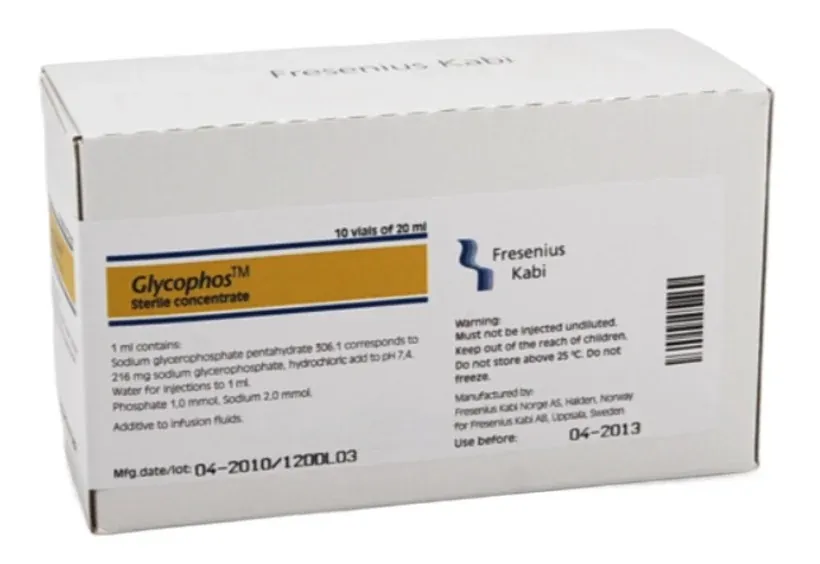
Table of Contents
Package leaflet: Information for the user
Introduction
Package leaflet: information for the user
Glycophos 216 mg/ml concentrate for solution for infusion
Sodium glycerophosphate
Read all of this leaflet carefully before you start using this medicine, as it contains important information for you:
|
Package leaflet contents:
- What Glycophos is and what it is used for
- What you need to know before using Glycophos
- How to use Glycophos
- Possible side effects
- How to store Glycophos
- Contents of the pack and other information
1. What Glycophos is and what it is used for
Glycophos is a concentrate for solution for infusion, belonging to the group of medicines called electrolyte solutions, additives for intravenous solutions.
Glycophos is indicated in adult and pediatric patients as a supplement in parenteral nutrition to meet phosphate requirements.
Glycophos is a medicine that will be administered to you by a doctor or healthcare professional.
2. What you need to know before using Glycophos
Do not use Glycophos:
- if you are allergic (hypersensitive) to sodium glycerophosphate or to any of the other components of this medicine.
- if you are dehydrated, have hypernatraemia (high levels of sodium in the blood), or hyperphosphataemia (high levels of phosphate in the blood).
- if you have severe renal impairment or are in a state of shock.
Warnings and precautions
Consult your doctor before starting to use this medicine. If you have renal impairment, your doctor will regularly monitor your blood phosphate levels.
Glycophos may only be added to or mixed with other medicinal products whose compatibility has been documented.
Glycophos must not be administered without prior dilution.
Use of other medicines:
No interactions with other medicines have been observed, although a moderate decrease in serum phosphate has been seen during carbohydrate infusions.
Please note that these instructions may also apply to medicines taken previously or those that may be taken in the future.
Inform your doctor or pharmacist if you are taking, have recently taken, or might need to take any other medicines, including those obtained without a prescription.
Pregnancy and breastfeeding:
If you are pregnant or breastfeeding, think you may be pregnant or plan to become pregnant, consult your doctor or pharmacist before using this medicine.
There are no data or the data are limited regarding the use of Glycophos in pregnant women.
The use of Glycophos during pregnancy may be considered in cases where it is clinically indicated.
Driving and using machines:
It is unknown whether Glycophos has any known effects on the ability to drive or use machines.
3. How to use Glycophos
Follow exactly the instructions for administration of this medicine as given by your doctor. If in doubt, consult your doctor or pharmacist again.
Adults:
The recommended dosage is individual. The recommended daily dose of phosphate during intravenous nutrition is approximately 10 – 20 mmol. This can be achieved by adding 10 – 20 ml of Glycophos to the infusion solution or to the compatible mixture.
Children:
The recommended dosage is individual. The recommended dose for children and newborns is 1.0–1.5 mmol/kg body weight/day.
The solution should be administered by intravenous infusion. Before use, check that the solution is homogeneous and that the vial is undamaged.
If you use more Glycophos than you should:
No adverse effects due to overdose have been observed. Most patients requiring intravenous nutrition have an increased capacity to tolerate glycerophosphates.
In case of overdose or accidental ingestion, consult your doctor or pharmacist or call the Toxicology Information Service. Telephone 915 620 420, indicating the medicine and the amount used.
If you have any further questions about the use of this medicine, ask your doctor or pharmacist.
4. Possible adverse effects
Like all medicines, Glycophos may produce adverse effects, although not everyone will experience them.
Adverse reactions related to glycerophosphates have not been reported.
Reporting of adverse effects
If you experience any type of adverse effect, consult your doctor or pharmacist, even if it is a possible adverse effect not listed in this leaflet. You can also report them directly through the Spanish Pharmacovigilance System for Human Medicines: https://www.notificaram.es. By reporting adverse effects, you can help provide more information on the safety of this medicine.
5. Storage of Glycophos
Keep out of sight and reach of children.
Store below 25°C. Do not freeze.
Do not use Glycophos after the expiry date stated on the container after EXP. The expiry date is the last day of the month indicated.
Do not use this medicine if you notice that the solution is not homogeneous or if the vial is damaged.
Medicines should not be disposed of via wastewater or household waste. Ask your pharmacist how to dispose of medicines and containers you no longer need. This will help protect the environment.
6. Contents of the container and other information
Composition of Glycophos
- The active substance is sodium glycerophosphate pentahydrate. One ml of Glycophos contains 306.1 mg of active substance (equivalent to 216 mg of anhydrous sodium glycerophosphate).
- The electrolytes in 1 ml are phosphate (1 mmol) and sodium (2 mmol).
- The other components are hydrochloric acid (for pH adjustment) and water for injections.
Appearance of the product and contents of the container
Concentrate for solution for infusion
Glycophos is a clear, colourless or pale yellow solution.
Glycophos is available in polypropylene vials and ampoules.
The pack sizes contain 10 vials of 20 ml and 20 ampoules of 20 ml.
Marketing Authorization Holder and Manufacturer
Marketing Authorization Holder
Fresenius Kabi España S.A.U.
Marina 16-18
08005 Barcelona (Spain)
Manufacturer
HP Halden Pharma AS
Svinesundveien 80
1788 Halden
Norway
Date of the most recent revision of this summary: March 2020
This information is intended solely for physicians or healthcare professionals:
Practical information on preparation and/or handling of the medicinal product
Glycophos must not be administered without prior dilution.
Before use, check that the solution is homogeneous and that the vial is undamaged.
Compatibility
Additions must be made aseptically.
- 120 ml of Glycophos and 48 mmol of calcium (CaCl₂) may be added to 1000 ml of Vamin Glucose, Vamin 14, Vamin 14 without electrolytes, and Vamin 18 without electrolytes.
- 10 ml of Glycophos and 10 mmol of calcium (CaCl₂) may be added to 1000 ml of Glucose 50 mg/ml.
- 20 ml of Glycophos and 20 mmol of calcium (CaCl₂) may be added to 1000 ml of Glucose 200 mg/ml.
- 60 ml of Glycophos and 24 mmol of calcium (CaCl₂) may be added to 1000 ml of Glucose 500 mg/ml.
Infusion time
The infusion time must not be less than 8 hours.
Stability
When additives are introduced into an infusion solution, the infusion should be administered within 24 hours after preparation to prevent microbial contamination. Any unused contents of opened bottles/vials/ampoules must be discarded and must not be stored for later use.