GlucoceMIN 50% concentrate for infusion solution
Spain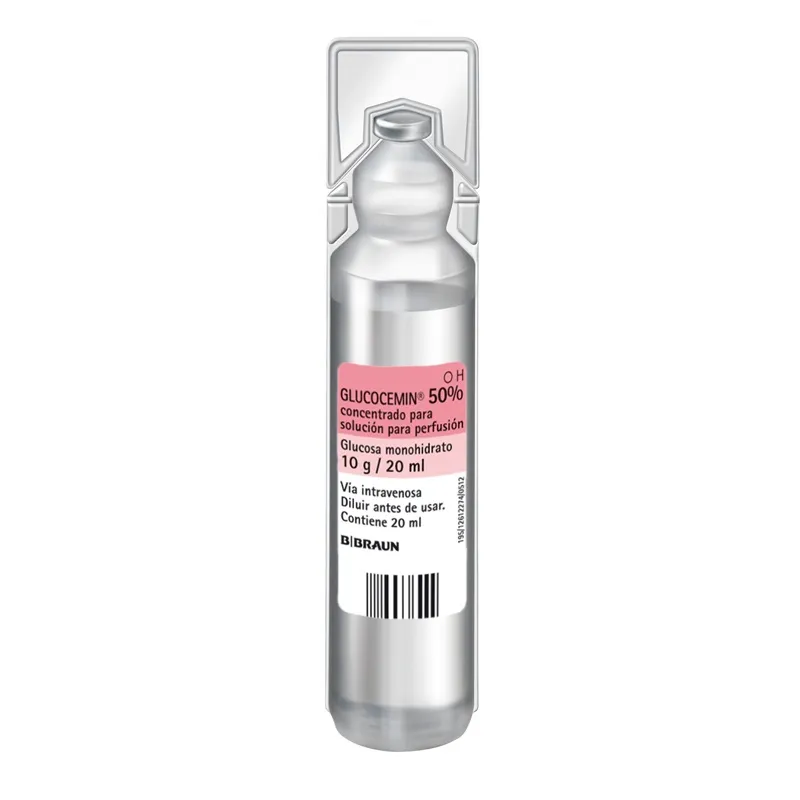
Table of Contents
- Package leaflet: Information for the user
- Introduction
- ***Read the entire leaflet carefully before starting to use the medicine***
- 1. What Glucocemin 50% is and what it is used for
- 2. What you need to know before using Glucocemin 50%
- 3. How to use Glucocemin 50%
- 4. Possible adverse effects
- 5. Storage of Glucocemin 50%
- 6. Contents of the container and additional information
Package leaflet: Information for the user
Introduction
Package leaflet: information for the user
Glucocemin 50%
Concentrate for solution for infusion
Glucose anhydrous, 500 mg/ml
Read the entire leaflet carefully before starting to use the medicine
- Keep this leaflet, as you may need to read it again.
- If you have any questions, consult your doctor or pharmacist.
- This medicine has been prescribed for you and you should not give it to other people, even if they have the same symptoms, as it may harm them.
- If you experience any adverse effects, consult your doctor or pharmacist, even if they are adverse effects not listed in this leaflet. See section 4.
Leaflet contents:
-
What GLUCOCEMIN 50% is and what it is used for
-
What you need to know before using GLUCOCEMIN 50%
-
How to use GLUCOCEMIN 50%
-
Possible adverse effects
-
Storage of GLUCOCEMIN 50%
-
Contents of the pack and other information
1. What Glucocemin 50% is and what it is used for
Glucocemin belongs to the group of parenteral nutrition solutions (administered directly into the vein) intended to provide sugar as an energy source.
Glucocemin is a concentrate for infusion solution (to be administered diluted via an infusion set) which is used:
-
to provide energy in parenteral nutrition (feeding directly into the vein) when oral intake of food is limited,
-
in glucose deficiency of any cause.
2. What you need to know before using Glucocemin 50%
Do not use GLUCOCEMIN 50%
- if you are allergic (hypersensitive) to glucose or to any of the other components of Glucocemin 50%,
- in conditions of excess blood glucose (hyperglycemia),
- if you have excess acid in the body (acidosis),
- if you have low potassium levels in the blood (hypokalemia).
Take special care with GLUCOCEMIN 50%
Inform your doctor if:
- you have diabetes. It may be used if appropriate insulin treatment has been initiated beforehand,
- you suffer from kidney or liver insufficiency.
GLUCOCEMIN must not be administered using the same infusion equipment (equipment used to deliver medications directly into the bloodstream), either simultaneously, before, or after a blood transfusion, due to possible incompatibilities.
Your blood glucose levels, electrolyte levels, and fluid balance should be monitored regularly.
An adequate supply of vitamins (particularly vitamin B1) must be ensured.
Potassium may be administered along with glucose solution to prevent hypokalemia (low potassium levels in blood) that may occur during parenteral (intravenous) nutrition.
Patients in critical conditions, experiencing pain, postoperative stress, infections, burns, nervous system disorders, cardiac, hepatic or renal diseases, and patients taking medications that enhance the effect of vasopressin (a hormone regulating body fluid levels), are at a certain risk of developing abnormally low blood sodium levels (acute hyponatremia) when receiving Glucocemin 50%, which may lead to cerebral edema (encephalopathy).
Acute hyponatremia may cause acute hyponatremic encephalopathy (cerebral edema), characterized by headache, nausea, seizures, lethargy, and vomiting. Patients with cerebral edema are at special risk of suffering severe, irreversible, and potentially fatal brain damage.
Children, women of childbearing age, and patients with severe brain disorders such as meningitis (infection of the membranes surrounding the brain) or brain injury are at a certain risk of developing severe and potentially fatal cerebral edema caused by acute reduction in blood sodium levels.
Use in elderly patients
Administration should be cautious in elderly patients, as they may have impaired liver and/or kidney function.
Use of other medicines
Inform your doctor or pharmacist if you are currently using, or have recently used, any other medicines, including those obtained without a prescription.
Taking certain medications simultaneously may be dangerous. The use of Glucocemin with other medicines may alter the effectiveness of both treatments.
In particular, it is important to inform your doctor if you are taking any of the following medicines:
-
Insulin or oral antidiabetics (biguanides, sulfonylureas): these drugs reduce the effect of glucose.
-
Corticosteroids (cortisol): due to the risk of increased blood glucose or the ability of these drugs to retain sodium and water.
-
Digitalis glycosides (digoxin): because of the risk of developing toxicity from these drugs.
-
Medications that increase the effect of vasopressin and the risk of low sodium levels (hyponatremia):
- Carbamazepine and oxcarbazepine used for the treatment of epilepsy.
- Vincristine and ifosfamide used for cancer treatment.
- Cyclophosphamide used for cancer and autoimmune diseases.
- Selective serotonin reuptake inhibitors (SSRIs) used to treat depression.
- Antipsychotics for mental disorders.
- Opioid analgesics for relief of severe pain.
- Non-steroidal anti-inflammatory drugs (NSAIDs) for relief of mild to moderate pain and treatment of body inflammation.
- Desmopressin for treatment of diabetes insipidus (extreme thirst and continuous production of large volumes of dilute urine).
- Oxytocin used during childbirth.
- Vasopressin and terlipressin used to treat bleeding esophageal varices (dilated veins in the esophagus caused by liver problems).
- Diuretics (medications that increase urine output).
Pregnancy and breastfeeding
Consult your doctor or pharmacist before using any medication.
Glucose solutions should be administered with caution in pregnant women, as glucose crosses the placenta. During pregnancy, your doctor will decide whether their use is appropriate.
Intravenous glucose administration during pregnancy may increase glucose and insulin levels, as well as acid components, in the fetal blood.
Glucose solutions should be administered with particular caution in pregnant women during labor, especially if administered in combination with oxytocin, due to the risk of hyponatremia.
There is no evidence suggesting that glucose solutions may cause adverse effects in the neonate during breastfeeding. Nevertheless, they are recommended to be used cautiously during this period as well.
3. How to use Glucocemin 50%
This medicine will always be administered by healthcare professionals.
Your doctor will decide the most appropriate dose in each case, and this will depend on the patient's condition (age, weight, clinical status, and metabolic state).
Your doctor will monitor fluid balance, blood glucose levels, and electrolyte levels (mainly sodium) in the blood before and during treatment, especially in patients with impaired vasopressin release (a hormone that regulates body fluids) and in patients taking medicines that enhance the action of vasopressin, due to the risk of abnormally low blood sodium levels (hyponatremia).
Glucocemin 50% may become extremely hypotonic after administration due to glucose metabolism in the body.
If you use more GLUCOCEMIN 50% than you should
This is unlikely to occur, as your doctor will determine your daily doses. However, if you were to receive more medicine than required, you might experience excess body water (hyperhydration), high blood glucose (hyperglycemia), and disturbances in blood electrolyte balance (hyperosmolality), which may be accompanied by altered consciousness, seizures, and coma.
If you have any further questions about the use of this product, ask your doctor or pharmacist.
In case of overdose or accidental ingestion, contact the Toxicology Information Service (telephone: 91.562 04 20) or consult your doctor or pharmacist. Take this leaflet with you.
4. Possible adverse effects
Like all medicines, GLUCOCEMIN 50% may produce adverse effects, although not everyone will experience them.
Adverse effects may occur if the solution is administered too rapidly or if the administered amount is excessive. In such cases, the following may appear:
Excess glucose in the blood (hyperglycemia), glucose excretion in urine (glucosuria), or disturbances in fluid and electrolyte levels.
Excess glucose in the blood (hyperglycemia) resulting from administration that is too rapid or from administration of a larger volume than necessary must be carefully monitored in severe cases of diabetes mellitus.
You may develop an imbalance in fluid levels and certain minerals in your body. You may develop low levels of sodium (hyponatremia), potassium, phosphate, and magnesium in the blood, hospital-acquired hyponatremia, and hyponatremic encephalopathy.
General disorders and administration site reactions:
Itching, pain, infection, inflammation of the vein wall (phlebitis).
Reporting of adverse effects
If you experience any type of adverse effect, consult your doctor or pharmacist, even if it is a possible adverse effect not listed in this leaflet. You may also report them directly through the Spanish Pharmacovigilance System for Human Medicines: www.notificaRAM.es. By reporting adverse effects, you can help provide more information on the safety of this medicine.
5. Storage of Glucocemin 50%
Keep this medicine out of the sight and reach of children.
No special storage conditions are required.
Do not use GLUCOCEMIN after the expiry date stated on the container (after EXP:). The expiry date refers to the last day of the month indicated.
Do not use GLUCOCEMIN if you notice that the solution is not clear, shows particles at the bottom (sedimentation), or if the container shows visible signs of deterioration.
Medicines must not be disposed of via wastewater or household waste. Ask your pharmacist how to dispose of medicines and packaging you no longer need. This will help protect the environment.
6. Contents of the container and additional information
Composition of Glucocemin 50%:
The active ingredient is: | 1 ml | 20 ml |
Glucose monohydrate | 0.55 g | 11 g |
(equivalent to anhydrous glucose) | 0.50 g | 10 g |
Energy Value: | 835 kJ/100 ml – 200 kcal/100 ml |
Theoretical Osmolarity: | 2770 mOsm/l |
Acidity (adjusted to pH 7.4): | < 1.5 mmol/l |
pH: | 3.5 – 5.5 |
The other components are: water for preparations for injection.
Appearance of the product and contents of the pack
GLUCOCEMIN 50% is a concentrate for infusion solution presented in packs of 20 ampoules of 20 ml of Miniplasco Classic or Miniplasco Connect.
Only certain pack sizes may be marketed.
Marketing Authorization Holder
B|BRAUN
- Braun Medical, S.A.
Ctra. de Terrassa, 121
08191-Rubí (Barcelona)
Spain
Manufacturer
- Braun Melsungen AG
Carl-Braun-Straße 1
34212 Melsungen
Postal address:
34209 Melsungen
This leaflet was approved in December 2024
Detailed information on this medicinal product is available on the website of the Spanish Agency of Medicines and Health Products (Agencia Española de Medicamentos y Productos Sanitarios).
This information is intended for healthcare professionals only:
The contents of each container are for single use only. Any unused portion must be discarded.
The solution should be visually inspected before use. The solution must be clear and free from precipitates, and the container must be intact. Do not administer if these conditions are not met.
Do not administer intramuscularly.
GLUCOCEMIN 50% must always be administered diluted, as an additive to infusion solution, to avoid venous irritation.
These solutions must not be administered using the same infusion sets currently in use, previously used, or intended for use for blood administration, due to the risk of pseudoagglutination.
In critically ill patients, the infusion rate must not exceed 6 mg of glucose per kilogram of body weight per minute. Only exceptionally may the infusion rate reach 9 mg of glucose per kilogram of body weight per minute.
Duration of use
The duration of administration may be as long as considered necessary.
Disposal of unused medicinal product and of all materials that have been in contact with it must be carried out in accordance with local regulations.