Gliolan 30 mg/ml powder for oral solution
Spain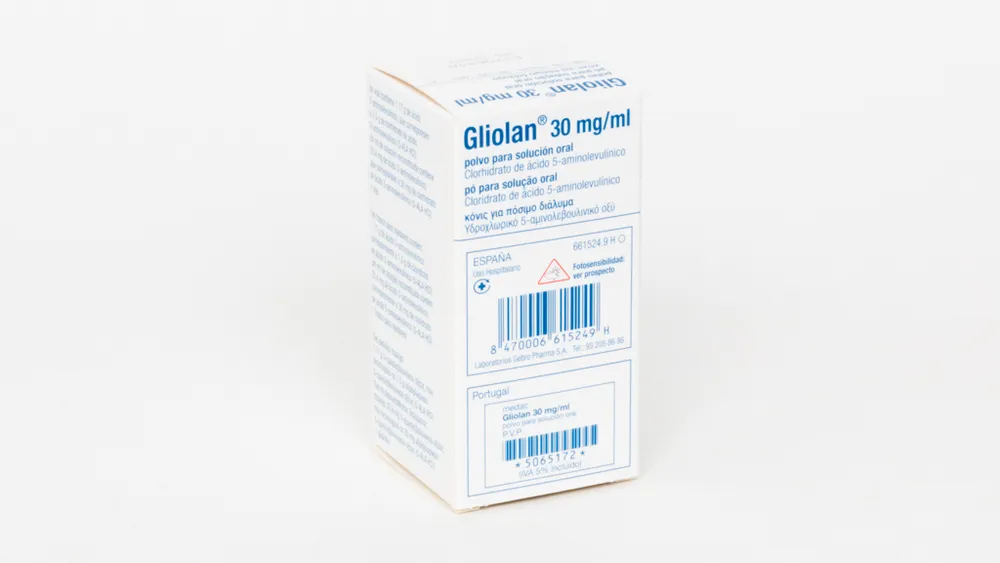
Table of Contents
Package leaflet: Information for the user
Introduction
Package leaflet: information for the user
Gliolan 30 mg/ml powder for oral solution
5-aminolevulinic acid hydrochloride
Read the entire leaflet carefully before starting to take this medicine, because it contains important information for you.
- Keep this leaflet, as you may need to read it again.
- If you have any questions, consult your doctor or pharmacist.
- If you experience any adverse reactions, consult your doctor or pharmacist, even if they are not listed in this leaflet. See section 4.
Leaflet contents
- What Gliolan is and what it is used for
- What you need to know before taking Gliolan
- How to take Gliolan
- Possible side effects
- How to store Gliolan
- Contents of the pack and other information
1. What Gliolan is and what it is used for
Gliolan is used to visualize certain brain tumours (called malignant gliomas) during tumour surgery.
Gliolan contains a substance called aminolevulinic acid (5-ALA). 5-ALA is taken up more strongly by tumour cells, which then convert it into another, similar substance. When the tumour is subsequently exposed to blue light, this new substance emits a red-violet fluorescence, helping to better distinguish between normal and tumour tissue. This assists the surgeon in removing the tumour while preserving healthy tissue.
2. What you need to know before taking Gliolan
Do not take Gliolan
- if you are allergic to 5-ALA or to porphyrins;
- if you have acute or chronic porphyria, suspected or confirmed (hereditary or acquired disorders of certain enzymes in the pathway of synthesis of the red blood pigment);
- if you are pregnant, suspected or confirmed.
Warnings and precautions
Consult your doctor or pharmacist before starting to take Gliolan.
- For 24 hours after administration of this medicine, protect your eyes and skin from intense light (e.g., surgical lighting, direct sunlight, or bright concentrated indoor light).
- If you suffer or have previously suffered from heart disease, you must inform your doctor. In such cases, this medicine should be used with caution, as it may cause a drop in blood pressure.
Renal or hepatic impairment
Clinical studies have not been conducted in patients with hepatic or renal impairment. Therefore, this medicine should be used with caution in such patients.
Elderly patients
There are no special instructions for the use of this medicine in elderly patients with normal organ function.
Children and adolescents (<18 years)
There is no experience with Gliolan in children and adolescents. Therefore, this medicine is not recommended for use in this age group.
Other medicines and Gliolan
Inform your doctor or pharmacist if you are taking, have recently taken, or might need to take any other medicines, especially those that may cause skin problems when the skin is exposed to intense light (e.g., certain types of medicines called antibiotics), as well as over-the-counter products (e.g., hypericin extracts or St. John's wort, Hypericum perforatum).
One case of severe sunburn lasting 5 days has been reported in a patient after using this medicine together with a hypericin extract. You must not take any such products during the 2 weeks following Gliolan administration.
During the 24 hours following Gliolan intake, avoid using any other medicine that may cause liver damage.
Taking Gliolan with food and drink
This medicine is generally used only once, specifically 2–4 hours before anesthesia for surgery of certain brain tumors called gliomas. You must not eat or drink for at least 6 hours before the start of anesthesia.
Pregnancy and breastfeeding
Pregnancy
It is unknown whether Gliolan may cause harm to the embryo or fetus. Do not use this medicine if you are pregnant.
Breastfeeding
It is unknown whether this medicine passes into breast milk. Mothers who are breastfeeding should not do so during the 24 hours following treatment with this medicine.
Driving and using machines
The influence of this medicine alone on the ability to drive and use machines is negligible.
3. How to take Gliolan
This medicine is a powder which must first be mixed with drinking water before use. This procedure will always be carried out by a pharmacist or a nursing professional and never by you. The usual dose is 20 mg of 5-ALA HCl per kilogram of body weight. The pharmacist or nursing professional will calculate the exact dose you require and the amount of solution (in ml) that you need to drink. You will have to drink the prepared solution 2 to 4 hours before anaesthesia.
If surgery is postponed for more than 12 hours, it should be rescheduled for the following day or later. Another dose of this medicine may be taken 2 to 4 hours before anaesthesia.
If you take more Gliolan than you should
If you have taken more Gliolan than you should have, your doctor will decide what measures are necessary to prevent any problems, including adequate protection from intense light (e.g. direct sunlight).
If you forget to take Gliolan
This medicine is administered only once, on the day of surgery, 2 to 4 hours before the start of anaesthesia. If you have forgotten to take this medicine within this time period, it is not advisable to take it immediately before the start of anaesthesia. In this case, both anaesthesia and surgery should be postponed for at least 2 hours, if possible.
If you have any further questions about the use of this medicine, ask your doctor or pharmacist.
4. Possible adverse effects
Like all medicines, this medicine can cause adverse effects, although not everyone experiences them.
The most serious adverse effects include mild disturbances in blood cell counts (red and white blood cells, platelets), disorders affecting the nervous system (neurological disorders) such as partial paralysis affecting one side of the body (hemiparesis), and blood clots that may block blood vessels (thromboembolism). The more frequently observed adverse effects are feeling unwell (vomiting), the urge to vomit (nausea), and a slight increase in certain enzymes (transaminases, γ-GT, amylase) or bilirubin (a bile pigment produced in the liver from the breakdown of red blood pigment) in the blood.
Inform your doctor immediately if you experience any discomfort.
Adverse effects are divided into the following two categories:
- Adverse effects occurring immediately after taking Gliolan and before the start of anaesthesia
- Adverse effects resulting from a combination of Gliolan, anaesthesia, and tumour resection
After administration of Gliolan and before the start of anaesthesia, the following adverse effects may occur:
Uncommon adverse effects (may affect up to 1 in 100 people): Feeling unwell (nausea), decreased blood pressure (hypotension), skin reactions (e.g., rash, sunburn-like appearance).
In combination with anaesthesia and tumour resection, the following additional adverse effects may occur:
Very common adverse effects (may affect more than 1 in 10 people): Mild disturbances in blood cell counts (red and white blood cells, platelets) and slight increase in certain enzymes (transaminases, γ-GT, amylase) or bilirubin (a bile pigment produced in the liver as a result of the breakdown of red blood pigment) in the blood. These findings reach their peak levels 7–14 days after surgery. The changes will resolve completely within a few weeks. Usually, you will not experience any symptoms when these changes occur.
Common adverse effects (may affect up to 1 in 10 people):
Feeling unwell (nausea), discomfort (vomiting), disorders affecting the nervous system (neurological disorders), such as partial paralysis on one side of the body (hemiparesis), total or partial loss of the ability to use or understand language (aphasia), epileptic seizures (convulsions), blindness in half of the visual field in one or both eyes (hemianopsia), and blood clots that may block blood vessels (thromboembolism).
Uncommon adverse effects (may affect up to 1 in 100 people):
Decreased blood pressure (hypotension), swelling of the brain (cerebral oedema).
Very rare adverse effects (may affect up to 1 in 10,000 people) or frequency not known (cannot be estimated from available data):
Reduced sense of touch (hypoesthesia), and loose or watery stools (diarrhoea).
Reporting of adverse effects
If you experience any type of adverse effect, consult your doctor or pharmacist, even if they are possible adverse effects not listed in this leaflet. You may also report them directly through the national reporting system included in Appendix V. By reporting adverse effects, you can help provide more information on the safety of this medicine.
5. Storage of Gliolan
Keep this medicine out of the sight and reach of children.
Do not use this medicine after the expiry date stated on the carton after EXP. The expiry date is the last day of the month indicated.
Store the vial in the outer packaging to protect it from light.
The reconstituted solution is physically and chemically stable for 24 hours at 25°C.
Medicines should not be disposed of via wastewater or household waste. Ask your pharmacist how to dispose of any unused medicines and their containers. This will help protect the environment.
6. Contents of the pack and other information
Composition of Gliolan
The active substance is 5-aminolevulinic acid hydrochloride (5-ALA HCl). One vial contains 1.17 g of 5-aminolevulinic acid (5-ALA), equivalent to 1.5 g of 5-ALA HCl.
One ml of reconstituted solution contains 23.4 mg of 5-ALA, equivalent to 30 mg of 5-ALA HCl.
Appearance of the medicinal product and contents of the pack
This medicine is a powder for oral solution. The powder is a compact mass of white to off-white colour. The reconstituted solution is a clear liquid, colourless to slightly yellowish in appearance.
Gliolan is supplied in glass vials and is available in pack sizes of 1, 2 and 10 vials. Only certain pack sizes may be marketed.
Marketing Authorization Holder
photonamic GmbH & Co. KG
Eggerstedter Weg 12
25421 Pinneberg
Germany
Manufacturer
photonamic GmbH & Co. KG
Eggerstedter Weg 12
25421 Pinneberg
Germany
Lyocontract GmbH
Pulverwiese 1
38871 Ilsenburg
Germany
For further information about this medicinal product, please contact the local representative of the Marketing Authorization Holder:
Belgium/Belgium/Belgium, Netherlands Pharmanovia Benelux B.V. Burgemeester Guljélaan 2 NL-4837 CZ Breda Netherlands/Netherlands/Netherlands Tel/Tel: + 31 (0)76 5600030 | Italy medac pharma s.r.l. a socio unico Via Viggiano 90 I-00178 Rome Tel: + 39 06 51 59 121 [email protected] |
| Norway medac Gesellschaft für klinische Spezialpräparate GmbH, Germany, branch Postboks 84 N-1312 Slependen Tlf: +47 90 63 81 04 |
Poland medac GmbH Sp. z o.o. Branch in Poland ul Postepu 21 B PL-02-676 Warsaw Tel.: + 48 22 430 00 30 | |
Czech Republic medac GmbH organisational unit Želetavská 1525/1 CZ 140 00 Prague 4 Tel: +420 774 486 166 | Portugal medac GmbH branch in Portugal Alameda António Sérgio nº22 6ºC P-1495-132 Algés Tel: + 351 21 410 75 83/4 |
Denmark medac Gesellschaft für klinische Spezialpräparate GmbH, Germany, branch Bagerstræde 28, 1. DK-4640 Faxe Tlf.: +46 (0)44 7850 666 | Slovak Republic medac GmbH organizational unit Slovakia Staromestská 3 SK-811 03 Bratislava Tel: +420 774 486 166 |
Spain Laboratorios Gebro Pharma, S.A. Tel: + 34 93 205 86 86 | Finland medac Gesellschaft für klinische Spezialpräparate GmbH, Germany, branch Spektri Business Park Metsänneidonkuja 4 FIN-02130 Espoo Puh/Tel: + 358 (0)10 420 4000 |
France medac SAS 1 rue Croix Barret F-69007 Lyon Tél: + 33 (0)4 37 66 14 70 | Sweden medac Gesellschaft für klinische Spezialpräparate GmbH, Germany, branch Hyllie Boulevard 34 S-215 32 Malmö Tel: +46 (0)44 7850 666 |
Ireland Fannin Ltd Fannin House South County Business Park Leopardstown IRL - Dublin 18 Tel: + 353 (0)1 290 7000 |
Date of the most recent review of this leaflet:
Detailed information on this medicine is available on the website of the European Medicines Agency: http://www.ema.europa.eu.
This leaflet is available on the website of the European Medicines Agency in all languages of the European Union/European Economic Area.