Glatiramer ViatriS 20 mg/ml solution for injection in pre-filled syringe
Spain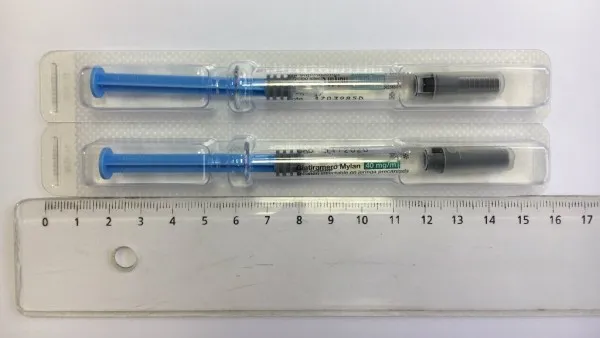
Table of Contents
- Package leaflet: Information for the user
- Introduction
- 1. What Glatiramero Viatris is and what it is used for
- 2. What you need to know before using Glatiramero Viatris
- 3. How to use Glatiramero Viatris
- 4. Possible adverse effects
- 5. Storage of Glatiramero Viatris
- 6. Contents of the pack and other information
Package leaflet: Information for the user
Introduction
Package leaflet: Information for the user
Glatiramero Viatris 20mg/ml solution for injection in pre-filled syringe
glatiramer acetate
Read all of this leaflet carefully before you start using this medicine because it contains important information for you.
- Keep this leaflet as you may need to read it again.
- If you have any questions, ask your doctor or pharmacist.
- This medicine has been prescribed for you only, and you should not give it to other people, even if they have the same symptoms as you, because it may harm them.
- If you experience any adverse reactions, consult your doctor or pharmacist, even if they are adverse reactions not listed in this leaflet. See section 4.
Contents of the leaflet
- What Glatiramero Viatris is and what it is used for
- What you need to know before using Glatiramero Viatris
- How to use Glatiramero Viatris
- Possible side effects
- How to store Glatiramero Viatris
- Contents of the pack and other information
1. What Glatiramero Viatris is and what it is used for
Glatiramero Viatris is a medicine used to treat relapsing forms of multiple sclerosis (MS). It modifies the way your body's immune system functions and is classified as an immunomodulating agent. It is believed that MS symptoms arise due to a defect in the body's immune system, which causes areas of inflammation in the brain and spinal cord.
Glatiramero is used to reduce the number of times you experience MS attacks (relapses). It has not been shown to be beneficial in patients with forms of MS that do not involve relapses or involve very few relapses. Glatiramero Viatris may have no effect on the duration of an MS attack or on the severity of symptoms during an attack.
It is used to treat patients who are able to walk without assistance.
Glatiramero may also be used in patients who have experienced symptoms for the first time that indicate a high risk of developing MS. Your doctor will rule out any other possible causes of these symptoms before treating you.
2. What you need to know before using Glatiramero Viatris
Do not use Glatiramero Viatris
- If you are allergic to glatiramer acetate or to any of the other ingredients of this medicine (listed in section 6).
Warnings and precautions
Consult your doctor or pharmacist before starting to use Glatiramero Viatris:
- If you have any kidney or heart problems, as you may require periodic tests or examinations.
- If you have or have had any problems with libido (including those related to alcohol consumption).
Glatiramero Viatris may cause severe allergic reactions, some of which may be potentially life-threatening.
These reactions may occur shortly after administration, even months or years after starting treatment, and even if no allergic reactions occurred following previous administrations.
The signs and symptoms of allergic reactions may overlap with injection-related reactions. Your doctor will inform you about the signs of an allergic reaction.
Children
Glatiramero must not be used in children under 12 years of age.
Elderly patients
The pharmacokinetics of glatiramer have not been specifically studied in elderly individuals. Please consult your doctor about this.
Other medicines and Glatiramero Viatris
Tell your doctor or pharmacist if you are taking, have recently taken, or might need to take any other medicines.
Pregnancy and breastfeeding
If you are pregnant, think you might be pregnant, or are planning to become pregnant, consult your doctor for advice regarding glatiramer treatment during pregnancy.
Glatiramero may be used during pregnancy following your doctor's recommendations.
Limited human data have not shown negative effects of glatiramer acetate on newborns/infants. Glatiramero may be used during breastfeeding.
Driving and using machines
Glatiramero does not affect the ability to drive or operate machinery.
3. How to use Glatiramero Viatris
Follow exactly the administration instructions provided by your doctor for this medicine. If in doubt, consult your doctor or pharmacist again.
The recommended daily dose in adults and adolescents aged 12 years and older is one pre-filled syringe (20 mg of glatiramer acetate), administered under the skin (subcutaneously).
It is very important that the Glatiramero Viatris injection is performed correctly:
- Only into the tissue beneath the skin (subcutaneous tissue) (see “Instructions for use” below).
- At the dose prescribed by your doctor. Administer only the dose prescribed by your doctor.
- Never use the same syringe more than once. Any unused or leftover product must be discarded.
- Do not mix or co-administer the contents of pre-filled glatiramer syringes with any other product.
- Do not use if the solution contains particles. Use a new syringe.
The first time you use glatiramer, you will be given complete instructions and supervised by a doctor or nurse. They will stay with you during the injection and for the following half hour, just to make sure you do not experience any problems.
Instructions for use
Read these instructions carefully before using glatiramer.
Before the injection, ensure you have everything you need:
- A blister containing the pre-filled syringe of glatiramer.
- A container for the disposal of used needles and syringes.
- For each injection, remove only one blister with a pre-filled syringe from the carton. Keep the remaining syringes in the box.
- If your syringe has been stored in the refrigerator, remove the blister containing the syringe at least 20 minutes before injecting the medicine, so it can warm to room temperature.
Wash your hands thoroughly with soap and water.
If you wish to use an injection device for self-injection, you may use the injection device designed for pre-filled syringes of glatiramer. The injection device for pre-filled syringes is approved only for use with Glatiramero Viatris and has not been tested with other products. Refer to the instructions for use provided with the injection device.
Choose an injection site within the areas shown in the diagrams.
There are seven possible injection sites on your body:
Area 1: abdominal area around the navel. Avoid the 5 cm zone around the navel.
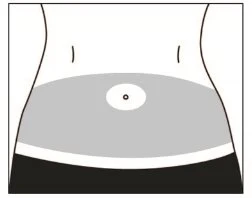
Areas 2 and 3: Thighs (above the knees)

Areas 4, 5, 6 and 7: Back of the upper arms, lower part of the upper hips (below the waist).

Within each injection area, there are several possible injection sites. Choose a different site each day. This will reduce the likelihood of irritation or pain at the injection site. Rotate injection sites within each area. Do not use the same injection site repeatedly.
Warning: Do not inject into any area that is painful, discolored, or where you feel lumps or firm nodules. It is recommended to keep a schedule of planned injection sites and record them in a diary. Some areas of your body (such as the back of your arm) may be difficult for self-injection. If you wish to use these areas, you may need assistance.
How to inject:
- Remove the syringe from the protective blister by peeling back the foil backing of the blister.
- Remove the needle cap; do not use your mouth or teeth to do this.
- Gently pinch the skin to form a skin fold between your thumb and index finger (Figure 1).
- Insert the needle into the skin as shown in Figure 2.
- Inject the medicine by firmly pushing the plunger down completely until the syringe is empty.
- Remove the syringe and needle.
- Dispose of the syringe in a secure container for sharps. Do not throw used syringes into the household trash; carefully place them in a puncture-resistant container as recommended by your doctor or nurse.

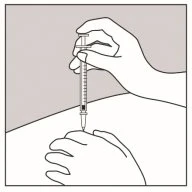
Figure 1 Figure 2
If you feel that the effect of glatiramer is too strong or too weak, inform your doctor.
If you use more Glatiramero Viatris than you should
In case of overdose or accidental ingestion, contact your doctor, pharmacist, or the Toxicology Information Service immediately at telephone: 91 562 04 20, indicating the medicine and the amount ingested.
If you forget to use Glatiramero Viatris
Take it as soon as you remember, but do not take a double dose to make up for missed doses. Take the next dose 24 hours after the previous one.
If you stop using Glatiramero Viatris
Do not stop using glatiramer without consulting your doctor.
If you have any further questions about the use of this medicine, ask your doctor or pharmacist.
4. Possible adverse effects
Like all medicines, this medicine can cause adverse effects, although not everyone will experience them.
Allergic reactions (hypersensitivity, anaphylactic reaction)
You may develop a severe allergic reaction to this medicine shortly after administration. This is an uncommon adverse effect. These reactions may occur months or years after starting treatment with Glatiramero Viatris, even if no allergic reactions occurred after previous administrations.
If you notice any of the following adverse effects, stop using glatiramer and contact your doctor immediately or go to the nearest hospital emergency department:
- widespread rash (red spots or hives),
- swelling of the eyelids, face or lips, mouth, throat or tongue,
- sudden difficulty breathing, shortness of breath, trouble breathing, or wheezing (whistling sounds when breathing),
- seizures (fits),
- difficulty swallowing or speaking,
- fainting (syncope), dizziness or feeling faint,
- collapse.
Other injection-related reactions (reactions occurring immediately after injection)
Although uncommon, some people may experience one or more of the following symptoms within minutes after a glatiramer injection. These symptoms usually do not cause problems and resolve within 30 minutes.
However, if any of the following symptoms last longer than 30 minutes, contact your doctor immediately or go to the nearest hospital emergency department:
- flushing (redness) of the chest or face (vasodilation),
- difficulty breathing (dyspnea),
- chest pain,
- rapid or strong heartbeat (palpitations, tachycardia).
Liver problems
Liver problems or worsening of pre-existing liver conditions, including liver failure (in some cases leading to liver transplantation), may occur rarely with glatiramer.
Contact your doctor immediately if you experience symptoms such as:
- nausea,
- loss of appetite,
- dark-colored urine and pale stools,
- yellowing of the skin or whites of the eyes (jaundice),
- unusual or easy bleeding.
The following adverse effects have been reported with glatiramer:
Very common (may affect more than 1 in 10 people)
- infections, flu
- anxiety, depression
- headache
- nausea
- skin rash
- joint or back pain
- feeling of weakness, skin reactions at the injection site including redness, pain, blistering, itching, tissue swelling, inflammation, and hypersensitivity (these injection site reactions are not unusual and usually improve over time), non-specific pain.
Common (may affect up to 1 in 10 people)
- respiratory tract inflammation, stomach flu, feverishness, ear inflammation, runny nose, dental abscesses, vaginal candidiasis
- non-malignant skin growths (benign skin neoplasms), tissue growth (neoplasia)
- swollen lymph nodes
- allergic reactions
- loss of appetite, weight gain
- nervousness
- altered sense of taste, increased muscle tone, migraine, speech problems, fainting, tremor
- double vision, eye problems
- ear problems
- cough, hay fever
- anal or rectal problems, constipation, tooth decay, indigestion, difficulty swallowing, intestinal incontinence, vomiting
- abnormal liver function test results
- bruising, excessive sweating, itching, skin disorders, urticaria
- neck pain
- urgent need to empty the bladder, frequent urination, inability to adequately empty the bladder
- cold, facial swelling, loss of subcutaneous tissue at injection site, local reaction, peripheral swelling due to fluid accumulation, fever.
Uncommon (may affect up to 1 in 100 people)
- abscesses, skin and underlying soft tissue inflammation, boils, herpes, kidney inflammation
- skin cancer
- increased white blood cell count, decreased white blood cell count, enlarged spleen
- decreased platelet count, changes in white blood cell shape
- enlarged thyroid or hyperactive thyroid
- low alcohol tolerance, gout, increased blood fat levels, increased blood sodium, decreased blood ferritin
- strange dreams, confusion, euphoric mood, seeing, hearing, smelling, touching or feeling things that are not there (hallucinations), aggression, abnormally happy mood, personality disorders, suicide attempt
- numbness and pain in the hands (carpal tunnel syndrome), mental disorders, seizures, difficulty writing and reading, muscular disorders, movement problems, muscle spasms, nerve inflammation, abnormal nerve-muscle connection causing abnormal muscle function, rapid involuntary eye movements, paralysis, foot drop (peroneal nerve paralysis), unconsciousness (stupor), blind spots in vision
- cataracts, corneal eye lesions, dry eyes, eye bleeding, drooping upper eyelid, pupil dilation, optic nerve damage causing vision problems
- fast heartbeat, slow heartbeat, episodes of rapid heartbeat
- varicose veins
- periodic breathing pauses, nosebleeds, abnormally fast or deep breathing (hyperventilation), sensation of throat tightness, lung problems, inability to breathe due to throat narrowing (suffocation sensation)
- inflammation of the small intestine, colon polyps, intestinal inflammation, belching, esophageal ulcer, gum inflammation, rectal bleeding, enlarged salivary glands
- gallstones, enlarged liver
- swelling of skin and soft tissues, contact skin rash, painful red lumps under the skin, skin nodules
- joint swelling, inflammation and pain (arthritis or osteoarthritis), inflammation and pain in fluid-filled sacs covering joints (bursitis, occurring in some joints), side pain, decreased muscle mass
- blood in urine, kidney stones, urinary system problems, abnormal urine findings
- breast swelling, erectile dysfunction, pelvic organ prolapse, prolonged erection, prostate disorders, abnormal Pap test results (abnormal cervical smear), testicular disorders, vaginal bleeding, vaginal disorder
- cyst, hangover, abnormally low body temperature (hypothermia), non-specific inflammation, tissue damage at injection site, mucous membrane problems
- adverse events following vaccination
Reporting of adverse effects
If you experience any type of adverse effect, talk to your doctor or pharmacist, even if it is not listed in this leaflet. You may also report them directly via the Spanish Pharmacovigilance System for Human Medicines: https://www.notificaram.es.
By reporting adverse effects, you can help provide more information on the safety of this medicine.
5. Storage of Glatiramero Viatris
Keep this medicine out of the sight and reach of children.
Store in a refrigerator (between 2°C and 8°C).
The pre-filled syringes of Glatiramero Viatris may be stored for up to one month outside the refrigerator, at temperatures between 15°C and 25°C. This may only be done once. If after one month the pre-filled syringes of Glatiramero Viatris have not been used and are still in their original packaging, they must be returned to refrigerated storage.
Do not freeze.
Keep the pre-filled syringes in the outer packaging to protect them from light.
Do not use this medicine after the expiry date which is stated on the label and on the carton after CAD or EXP. The first two digits indicate the month and the last four digits indicate the year. The expiry date refers to the last day of the stated month.
Discard any syringe containing particles.
Medicines must not be disposed of via wastewater or household waste. Ask your pharmacist how to properly dispose of medicines and packaging you no longer need. This will help protect the environment.
6. Contents of the pack and other information
Composition of Glatiramer Viatris
- The active substance is glatiramero acetate. 1 ml of the injection solution (the content of 1 pre-filled syringe) contains 20 mg of glatiramero acetate.
- The other components are mannitol (E 421) and water for injections.
Appearance of the medicine and contents of the pack
Glatiramer Viatris is a sterile, clear, colourless or slightly yellowish/brownish solution.
If the solution contains particles, discard it and start again. Use a new syringe.
7 pre-filled syringes
28 pre-filled syringes
30 pre-filled syringes
90 (3x30) pre-filled syringes
Only some pack sizes may be marketed.
Marketing Authorisation Holder
Viatris Limited
Damastown Industrial Park
Mulhuddart, Dublin 15
Dublin
Ireland
Manufacturer
Synthon Hispania S.L.
Castelló 1
Polígono Les Salines
08830 Sant Boi de Llobregat (Barcelona)
Spain
Or
Synthon BV
Microweg 22
6545 CM Nijmegen
The Netherlands
For further information about this medicine, please contact the local representative of the Marketing Authorisation Holder:
Viatris Pharmaceuticals, S.L.U.
C/ General Aranaz, 86
28027 - Madrid
Spain
This medicine is authorised in the European Economic Area member states under the following names:
Germany: CLIFT 20 mg/ml Injektionslösung in einer Fertigspritze
Belgium: Glatiramyl 20 mg/ml, oplossing voor injectie in een voorgevulde spuit
Spain: Glatiramero Viatris 20 mg/ml solución inyectable en jeringa precargada
France: GLATIRAMER MYLAN 20 mg/ml, solution injectable en seringue préremplie
Italy: COPEMYL
Netherlands: Glatirameeracetaat Mylan 20 mg/ml, oplossing voor injectie in voorgevulde spuit
Portugal: Acetato de glatirâmero Mylan
The reusable auto-injector is authorised in the European Economic Area member states and in the United Kingdom (Northern Ireland) under the following name:
MyJect
Date of the latest revision of this leaflet: November 2024.
Detailed information about this medicine is available on the website of the Spanish Agency of Medicines and Health Products (AEMPS) http://www.aemps.gob.es/