Gelidina 0.25 mg/g gel
Spain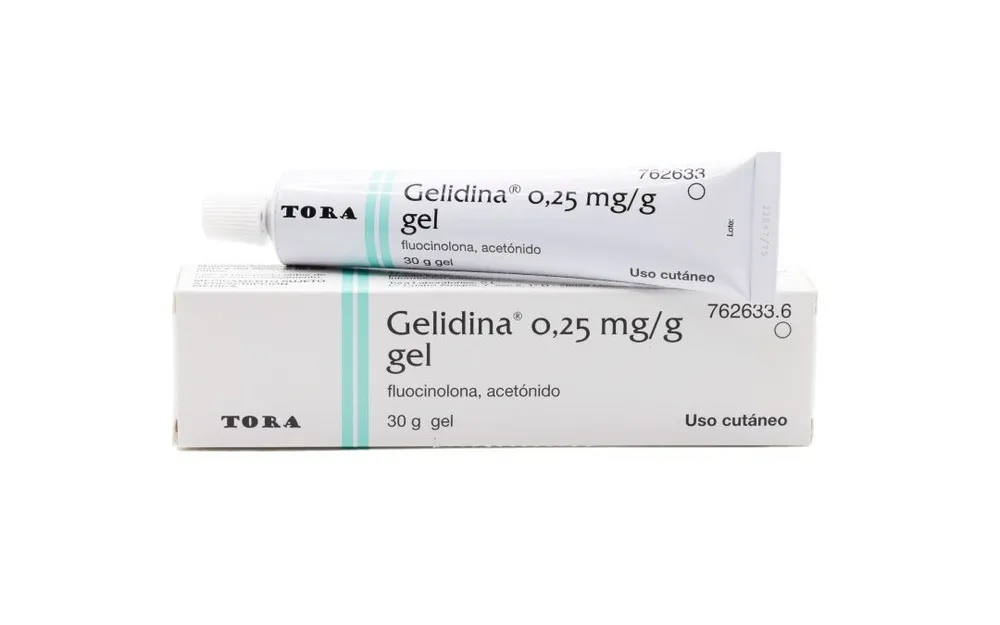
Table of Contents
Package leaflet: Information for the user
Introduction
Package leaflet: information for the user
Gelidina 0.25 mg/g gel
Fluocinolone acetonide
Read all of this leaflet carefully before you start using this medicine because it contains important information for you.
- Keep this leaflet as you may need to read it again.
- If you have any questions, ask your doctor or pharmacist.
- This medicine has been prescribed for you only; do not give it to others, even if they have the same symptoms as you, as it may harm them.
- If you experience any adverse effects, consult your doctor or pharmacist, even if they are effects not listed in this leaflet. See section 4.
Leaflet contents:
- What Gelidina is and what it is used for
- What you need to know before using Gelidina
- How to use Gelidina
- Possible adverse effects
- How to store Gelidina
- Contents of the pack and other information
1. What Gelidina is and what it is used for
The active substance of Gelidina is fluocinolone acetonide. This medicine belongs to a group of drugs known as topical corticosteroids (for external use) that work by reducing inflammation, itching, and cellular proliferation.
Gelidina is used in adults and children over 1 year of age to treat a wide variety of inflammatory, pruritic, and allergic skin lesions, such as: eczema, dermatitis, psoriasis, lichen planus, and discoid lupus erythematosus.
This gel is especially intended for use on hairy areas (difficult to access) and lesions on visible areas.
2. What you need to know before starting to use Gelidina
Do not use Gelidina
- if you are allergic to the active substance or to any of the other ingredients of this medicine (listed in section 6).
- in primary skin infections and in tuberculosis, syphilis, or viral infections (e.g., herpes or chickenpox).
- if you have lesions infected by bacteria, viruses, or fungi, do not apply this gel to infected lesions.
- on areas of skin affected by facial redness/rosacea, ulcers or wounds, inflammation of sebaceous glands (acne), or skin diseases associated with skin thinning (atrophy).
- in skin inflammation occurring around the mouth (perioral dermatitis).
- on areas of skin showing a vaccine reaction, i.e., redness or inflammation following vaccine administration.
Warnings and precautions
Consult your doctor or pharmacist before starting to use Gelidina.
- If a skin infection develops, your doctor will prescribe appropriate treatment for that fungal or bacterial infection. If the infection does not respond to treatment, your doctor may discontinue the treatment until the infection is under control.
- This gel should be used at the lowest possible dose, especially in children, and only for the minimum time necessary to relieve the skin condition.
- Prolonged use of topical corticosteroids, particularly in skin folds (such as the groin or armpits), and application under occlusive dressings (bandages that do not allow air circulation, or, for example, under a diaper), may cause atrophy of the skin, mucous membranes, and subcutaneous tissue.
- Prolonged use, excessive amounts of medication, or application over large skin areas may lead to systemic effects (those occurring when the medication is absorbed into the bloodstream), especially in children.
- If the medication causes irritation, you should stop using it and consult your doctor.
- Avoid contact of the gel with the eyes or around the eyes, on open wounds, or with mucous membranes (such as the mouth or genital area).
- If you are being treated for psoriasis, your doctor should monitor your condition frequently to detect any possible worsening.
- Inform your doctor if you experience blurred vision or other visual disturbances.
Paediatric population
Chronic administration in children may interfere with growth and development; therefore, treatment should be limited to short periods and to the minimum effective amount of the medication.
Use in athletes
Athletes are advised that this medicine contains a component, fluocinolone, which may result in a positive doping test.
Other medicines and Gelidina
Inform your doctor or pharmacist if you are using, have recently used, or might need to use any other medicines.
Do not apply other topical preparations to the treated area while using this gel.
Pregnancy, breastfeeding and fertility
If you are pregnant or breastfeeding, think you may be pregnant, or are planning to become pregnant, consult your doctor or pharmacist before using this medicine.
As a general rule, this gel should not be used during the first trimester of pregnancy.
Do not use this medicine for prolonged periods, over large areas, or with occlusive dressings if you are pregnant. Its use should be reserved for cases where the therapeutic benefit outweighs the potential risk.
Similarly, caution is advised if this medicine needs to be used during breastfeeding. Do not apply the gel to the breasts and avoid contact between the treated areas and the infant.
Driving and use of machines
This medicine does not affect the ability to drive or operate machinery.
Gelidina contains methyl parahydroxybenzoate (E-218), propyl parahydroxybenzoate (E-216), ethanol (alcohol), and propylene glycol (E-1520).
This medicine may cause allergic reactions (possibly delayed) because it contains methyl parahydroxybenzoate (E-218) and propyl parahydroxybenzoate (E-216).
This medicine contains 150 mg of alcohol (ethanol) in each gram of gel, equivalent to 0.176 ml of ethanol. Due to its ethanol content, it may cause a burning sensation on damaged skin.
This medicine contains 150 mg of propylene glycol (E-1520) in each gram of gel. Propylene glycol may cause skin irritation.
Do not use this medicine in infants under 4 weeks of age with open wounds or large areas of damaged skin (such as burns) without first consulting your doctor or pharmacist.
3. How to use Gelidina
Follow exactly the administration instructions for this medicine as indicated by your doctor or pharmacist. If in doubt, consult your doctor or pharmacist again.
The use of gel is best suited for the scalp, other hairy areas of the body, and lesions in visible areas.
Adults and children aged 1 year and older:
It may be applied in open treatment, as a thin layer on the affected area of skin, two to three times daily, gently rubbing until completely absorbed.
It may also be applied in occlusive treatment, as a thin layer on the affected area of skin, once daily, covering it with a non-porous plastic dressing.
Your doctor will determine the duration of your treatment; usually one week.
Depending on the severity of the condition, treatment may be extended from 1 to 4 weeks. If there is no improvement within this time, your doctor should re-evaluate the treatment.
Treatment should not exceed 2 months.
Use in children
Use is not recommended in children under 1 year of age.
Occlusive dressings (such as those used in the diaper area) are not recommended.
In children, treatment should be limited to short periods, and the smallest effective amount of the medicine should be used. If applied to the face, treatment should not exceed 5 days, and generally one week at most in other body areas.
If you use more Gelidina than you should
Excessive use of the gel may cause adrenal suppression (resulting in disruption of normal hormone production). In such cases, treatment should be discontinued and your doctor should monitor your hypothalamic-pituitary-adrenal axis function.
Accidental ingestion may cause episodes of tachycardia (accelerated heart rate) and occasional increases in blood pressure, which resolve without requiring medical treatment.
If you have used more of this medicine than you should, consult your doctor, pharmacist, or call the Toxicology Information Service immediately at 91-562 04 20, indicating the medicine and the amount used.
If you forget to use Gelidina
Do not apply a double dose to make up for missed doses.
If you forget to apply the gel at the scheduled time, do so as soon as you remember, then continue as before.
If you have any further questions about the use of this medicine, ask your doctor or pharmacist.
4. Possible adverse effects
Like all medicines, this medicine can cause adverse effects, although not everyone will experience them.
Rare adverse effects (may affect up to 1 in 1,000 people):
- Cutaneous atrophy with thinning of the epidermis (often irreversible)
- Telangiectasia (dilation of small blood vessels on the skin surface)
- Purpura (appearance of red patches and spots on the skin)
- Skin striae (stretch marks)
- Acneiform eruptions (acne-like rashes)
- Perioral dermatitis (small red papules around the mouth)
- Skin depigmentation (loss of skin pigmentation)
- Dermatitis and eczema, including contact dermatitis
- Burning sensation
- Rebound effect
Very rare adverse effects (may affect up to 1 in 10,000 people):
- Adrenal suppression, leading to disruption of normal hormone production
Frequency not known (cannot be estimated from available data):
- Hypersensitivity (allergic reactions)
- Pruritus (itching)
- Dry skin
- Miliaria (a condition caused by blockage of sweat ducts, resulting in the appearance of white or red bumps in various parts of the body) or rash
- Skin maceration
- Hypertrichosis (excessive hair growth)
- Folliculitis (inflammation of one or more hair follicles)
- Secondary infection
Reporting of adverse effects
If you experience any type of adverse effect, consult your doctor, pharmacist, or nurse, even if it is a possible adverse effect not listed in this leaflet. You may also report them directly via the Spanish Pharmacovigilance System for Human Medicinal Products: www.notificaRAM.es. By reporting adverse effects, you can help provide more information on the safety of this medicine.
5. Storage of Gelidina
Store below 25°C.
Keep this medicine out of the sight and reach of children.
Do not use this medicine after the expiry date stated on the packaging after EXP. The expiry date refers to the last day of the month indicated.
Medicines must not be disposed of via wastewater or household waste. Dispose of unused medicines and their containers at the SIGRE Point at your pharmacy. If you are unsure, ask your pharmacist how to dispose of medicines and containers you no longer need. This way, you will help protect the environment.
6. Contents of the container and additional information
Composition of Gelidina
- The active substance is fluocinolone acetonide. Each gram of gel contains 0.25 mg of fluocinolone acetonide.
- The other components are: anhydrous citric acid E330, carbomer 940, propylene glycol E1520, ethanol 17.6% v/v (alcohol), this small amount corresponds to 150 mg, methyl 4-hydroxybenzoate E218, propyl 4-hydroxybenzoate E216, sodium edetate, triethanolamine, purified water.
Appearance of Gelidina and contents of the container
Homogeneous, colourless, transparent gel packed in aluminium tubes with polyethylene screw caps (HDPE).
Available in tubes containing 30 and 60 grams of gel.
Only certain package sizes may be marketed.
Marketing Authorization Holder
Laboratorios ERN, S.A.
C/Perú, 228
08020 Barcelona, Spain
Manufacturer
Temmler Italia S.R.L.
Via delle Industrie, 2 - 280061 Carugate – Milan - Italy
Date of the most recent revision of this leaflet: October 2020
Detailed and up-to-date information on this medicinal product is available on the website of the Spanish Agency of Medicines and Health Products (AEMPS) http://www.aemps.gob.es/