Gastrografin 370 mg iodine/ml oral and rectal solution
Spain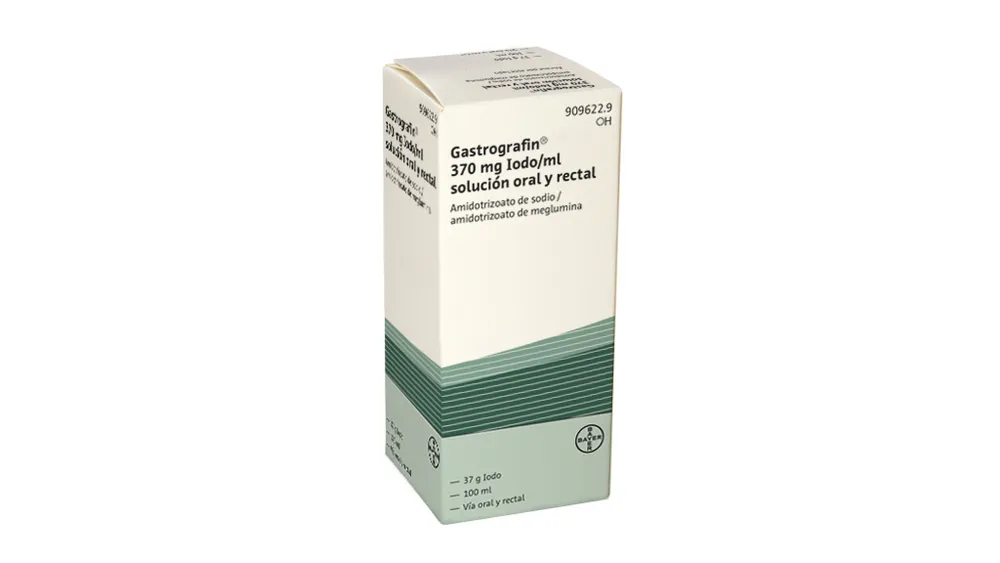
Table of Contents
- Patient Information Leaflet
- Introduction
- 1. What Gastrografin is and what it is used for
- 2. What you need to know before using Gastrografin
- **Pregnancy, breastfeeding, and fertility**
- 3. How to use Gastrografin
- 4. Possible adverse effects
- 5. Storage of Gastrografin
- 6. Contents of the pack and other information
- **Oral administration**
- **Rectal administration**
- Treatment of uncomplicated meconium ileus
Patient Information Leaflet
Introduction
Patient Information Leaflet
Gastrografin 370 mg Iodine/ml oral and rectal solution
Sodium amidotrizoate and meglumine amidotrizoate (INN)
Read the entire leaflet carefully before you start using this medicine, because it contains important information for you.
|
Package leaflet:
- What Gastrografin is and what it is used for.
- What you need to know before using Gastrografin.
- How to use Gastrografin.
- Possible side effects.
- Storage of Gastrografin.
- Contents of the pack and other information.
1. What Gastrografin is and what it is used for
This medicine is for diagnostic and therapeutic use.
Diagnostic use
-
Gastrografin is a contrast medium used for X-ray examination of the gastrointestinal tract. It can only be administered orally and rectally (enema), and is primarily indicated when the use of barium sulfate is unsatisfactory, undesirable or contraindicated. Indications include:
-
Early diagnosis of perforation (opening of a viscus or organ) or anastomotic defect (defective surgical connection), radiologically undetectable, in the esophagus and/or gastrointestinal tract, as well as acute perforations (peptic ulcer, diverticulum – pouch-like herniation of the digestive tract), following total or partial removal of the stomach or intestine (risk of perforation or leakage).
-
Suspected partial or complete stenosis (narrowing), small bowel obstruction, colonic obstruction, and acute hemorrhage (acute bleeding).
-
Megacolon (marked and pathological dilation of the colon).
-
Visualization of a foreign body or tumor prior to endoscopy.
-
Visualization of gastrointestinal fistula (abnormal tract connecting two different regions of the digestive tract).
-
Gastrografin is used with barium sulfate to accelerate gastrointestinal transit. In addition to the indications listed above, Gastrografin may be used for the same indications as barium sulfate, except for the visualization of mucosal abnormalities.
-
Gastrografin is used in computed tomography (CT, imaging of cross-sectional slices of a specific body region) to provide opacification of the entire upper (esophagus, stomach, or small intestine) and lower gastrointestinal tract (colon and rectum) as an aid in diagnosing pathologies affecting these organs.
Therapeutic use
- Treatment of uncomplicated meconium ileus (intestinal obstruction occurring in newborns).
2. What you need to know before using Gastrografin
Do not use Gastrografin
-
If you are allergic to the active substances or to any of the other ingredients of this medicine (listed in section 6).
-
If you have a known allergy to iodinated contrast media.
-
In patients at risk of aspiration or with bronchoesophageal fistula.
-
If you have clinical hyperthyroidism (overactive thyroid gland).
Do not use undiluted Gastrografin
- If you have lost a significant amount of body fluids or water (e.g., severe diarrhea, vomiting).
- In children under 10 years of age.
- If there is a possibility that Gastrografin could inadvertently enter your respiratory system.
Warnings and precautions
Consult your doctor or pharmacist before using Gastrografin.
-
If you have disturbances in hydration or electrolyte balance.
-
If you suffer from states of excitement, anxiety, or severe pain.
-
If you have had or currently have allergic reactions (e.g., seafood allergy, hay fever/acute seasonal allergic rhinitis, hives).
-
If you have a history of bronchial asthma.
-
If you have or are suspected of having hyperthyroidism (overactive thyroid) or goiter (enlarged thyroid gland), as iodinated contrast media may interfere with thyroid function, worsen or induce hyperthyroidism, or trigger a thyrotoxic crisis (a serious complication of an overactive thyroid).
-
If you have severe cardiovascular disease, as this increases the risk of experiencing a severe hypersensitivity (allergic) reaction.
-
If you are in a significantly deteriorated state of health.
-
If you are also to receive barium sulfate, you must pay attention to the relevant contraindications, precautions, and possible side effects associated with that preparation.
-
In cases of prolonged retention of Gastrografin in the gastrointestinal tract (e.g., due to obstruction or stasis), tissue damage, bleeding, necrosis, and intestinal perforation may occur.
-
Interference with diagnostic tests: If you are scheduled for any diagnostic tests related to thyroid disease, inform your doctor, as results may be altered. A minimum of 16 days should be waited after Gastrografin administration before performing such tests.
Before receiving Gastrografin, inform your doctor if any of the above conditions apply to you. Your doctor will decide whether the planned diagnostic procedure is feasible. Your thyroid function may be evaluated before administration of Gastrografin, and you may be given a thionamide drug (a medication to reduce thyroid gland activity).
The doctor should evaluate thyroid function in newborns who have been exposed to Gastrografin, either during pregnancy or after birth, because excess iodine may cause hypothyroidism (underactive thyroid gland), which may require treatment.
Use of Gastrografin with other medicines
Inform your doctor or pharmacist if you are taking, have recently taken, or might need to take any other medicines.
It is especially important to inform your doctor if you are taking any of the following medicines:
-
Beta-blockers (such as propranolol or atenolol): allergic reactions due to contrast media may be exacerbated, especially in the presence of bronchial asthma. Additionally, if you are being treated with beta-blockers, you may not respond to standard treatment of allergic reactions with beta-agonists (which promote bronchodilation).
-
Interleukin-2: If you are using this medicine (for the immune system), you should know that it increases the incidence of delayed reactions to contrast media (e.g., fever, rash, flu-like symptoms, joint pain, and itching).
-
Diuretics: If you are taking diuretics, you should know that saline rehydration is necessary to minimize the risk of acute renal failure.
-
Radiopharmaceuticals: If you are using these medicines, you should know that the uptake capacity of radiopharmaceuticals—used in the diagnosis and treatment of thyroid disorders—may be reduced for several weeks following administration of iodinated contrast media.
Pregnancy, breastfeeding, and fertility
If you are pregnant or breastfeeding, think you may be pregnant, or are planning to become pregnant, consult your doctor or pharmacist before using this medicine.
It has not been established that contrast media are safe for use in pregnant patients. Since exposure to radiation should be avoided during pregnancy whenever possible, the benefits of any radiological examination, with or without contrast medium, must be carefully weighed against the potential risks.
It is unknown whether Gastrografin is excreted in human breast milk. Some data suggest that the risk to the breastfed infant is low following maternal administration of Gastrografin. Breastfeeding is likely safe, particularly due to the low gastrointestinal absorption of Gastrografin.
Driving and use of machinery
No known effects on the ability to drive or operate machinery have been observed after administration of Gastrografin.
Gastrografin contains sodium
This medicine contains 3.76 mg of sodium (the main component of table/cooking salt) per ml. This corresponds to 0.19% of the maximum daily recommended sodium intake for an adult.
3. How to use Gastrografin
Follow exactly the administration instructions for this medicine as indicated by your doctor. If in doubt, consult your doctor or pharmacist again.
Gastrografin is a contrast medium used for a diagnostic test, which must be performed in the presence of qualified personnel, preferably under the supervision of a physician, who will provide you with specific instructions throughout the procedure.
Gastrografin is supplied as a gastrointestinal solution, which can be administered orally or rectally.
Gastrografin must not be used intravascularly (injected directly into a vein or artery).
Prior to using Gastrografin, bowel cleansing is recommended, as it facilitates the performance and validity of the diagnostic test.
The recommended dose may vary depending on the type of examination, patient's age, suspected or known pathology, route of administration, and the region being studied.
X-ray examination
Depending on the area of the gastrointestinal tract to be studied, either the oral or rectal route is used.
Target Organ |
Route of Administration |
Dose / Preparation / Dilution |
Concentration |
Age |
Esophagus |
Oral |
15–30 ml diluted with 3 times its volume of water |
25% solution |
Neonates and infants |
15–30 ml diluted with 2 times its volume of water |
33% solution |
Children up to 10 years |
||
60 ml Undiluted |
Undiluted |
Adults and children from 10 years |
||
Stomach |
Oral |
15–30 ml diluted with 3 times its volume of water |
25% solution |
Neonates and infants |
15–30 ml diluted with 2 times its volume of water |
33% solution |
Children up to 10 years |
||
60 ml Undiluted |
Undiluted |
Adults and children from 10 years |
||
Dynamic examination of gastrointestinal tract |
Oral |
15–30 ml diluted with 3 times its volume of water |
25% solution |
Neonates and infants |
15–30 ml diluted with 2 times its volume of water |
33% solution |
Children up to 10 years |
||
Maximum 100 ml of Gastrografin |
Undiluted |
Adults and children from 10 years |
||
Large intestine |
Rectal |
Up to 500 ml of dilution Diluted 5 times its volume of water |
16.7% solution |
Children under 5 years |
Up to 500 ml of dilution Diluted with 4–5 times its volume of water |
16.7% to 20% solution |
Children 5 to 18 years |
||
Up to 500 ml of dilution Diluted with 3–4 times its volume of water |
20% to 25% solution |
Adults |
Computed tomography (CT):
Depending on the area of the gastrointestinal tract to be examined, oral or rectal administration is used.
The examination can be performed after administering 0.5–1.5 liters of a 3% concentration solution of Gastrografin (30 ml of Gastrografin in 1 liter of water).
Target organ | Route and technique of administration | Preparation / Dilution | Concentration | Dosage |
Esophagus | Oral | 9 to 15 ml of Gastrografin diluted with 0.3 to 0.5 liters of water | 3% solution | Patients should drink 300 to 500 ml of this solution |
Stomach | Oral | 9 to 15 ml of Gastrografin diluted with 0.3 to 0.5 liters of water | 3% solution | Patients should drink 300 to 500 ml of this solution |
Small intestine | Oral | 9 to 15 ml of Gastrografin diluted with 0.3 to 0.5 liters of water | 3% solution | Patients should drink 300 to 500 ml of this solution |
Distal GI tract / Complete intestine | Oral* | 30 ml of Gastrografin diluted with 1 liter of water, or 45 ml of Gastrografin in 1.5 liters of water | 3% solution | Up to 1500 ml of prepared solution may be administered |
Large intestine / Rectum | Rectal | 15 ml of Gastrografin in 0.5 liters of water | 3% solution | Up to 500 ml may be administered |
*oral/rectal administration can be combined
In pediatric cases, volumes should be adjusted. The table below specifies the maximum volumes to be administered of the Gastrografin dilution with water.
Oral | Enema/rectal | |||
Age | Gastrografin | Water | Gastrografin | Water |
6 months | 3 ml | 100 ml | 1 ml | 50 ml |
2 years | 6 ml | 200 ml | 2 ml | 100 ml |
5 years | 9 ml | 300 ml | 3 ml | 150 ml |
10 years | 15 ml | 500 ml | 4 ml | 200 ml |
> 10 years | 15 – 30 ml | 500 – 1000 ml | 500 ml | 1500-2000 ml |
Treatment of uncomplicated meconium ileus
Dosage for rectal use
Gastrografin can be administered to newborns as an enema for the non-surgical treatment of uncomplicated meconium ileus. The high osmotic pressure of the contrast medium is utilized: adjacent tissue is forced to release a considerable amount of fluid, which then flows into the intestines and dissolves the thick meconium.
Gastrografin must be diluted to 3-4 times its volume in water.
A dose of 2 to 5 ml of the diluted solution is normally required, although in some cases a larger volume may be needed. The solution should be administered under fluoroscopic control.
Gastrografin associated with barium sulfate
Gastrografin combined with barium sulfate | ||
Age | Gastrografin | Barium sulfate |
From 0 to 5 years | 2–5 ml | 100 ml |
From 5 to 10 years | 10 ml | 100 ml |
From 11 to 18 years | 30 ml | Usual dose according to organ being studied |
Adults | 30 ml | Usual dose according to organ being studied |
If necessary, the proportion of Gastrografin in the suspension may be further increased in cases of pyloric spasm or pyloric stenosis (abnormalities of the pylorus, which is the final part of the stomach).
Your doctor will inform you about all characteristics related to the administration of Gastrografin. Additional information regarding the administration and handling of Gastrografin is provided at the end of the package leaflet.
If you use more Gastrografin than you should
Disturbances in fluid and electrolyte balance (the body's internal equilibrium) due to excessive administration of Gastrografin must be corrected by parenteral (any route other than the digestive tract) administration.
In case of overdose or accidental ingestion, contact the Toxicology Information Service; Telephone 91 562 04 20, indicating the medication and the amount taken.
4. Possible adverse effects
Like all medicines, this medicine may produce adverse effects, although not everyone will experience them.
Frequent adverse effects (affect between 1 and 10 out of every 100 patients):
- Vomiting, nausea, diarrhea.
Rare adverse effects (affect between 1 and 10 out of every 10,000 patients):
- Anaphylactoid shock, anaphylactoid or hypersensitivity reactions (allergic reactions that may become very serious).
- Thyroid crisis in patients with hyperthyroidism (excessive production by the thyroid gland).
- Hydroelectrolytic imbalance.
- Disorders of consciousness, headache, dizziness.
- Cardiac arrest, tachycardia (increased heart rate).
- Shock (generalized disturbance of the organism), hypotension (low blood pressure).
- Bronchospasm (narrowing or obstruction of bronchial muscles), dyspnea (difficulty breathing), aspiration of the medicine, pulmonary edema after aspiration, aspiration pneumonia.
- Intestinal perforation, abdominal pain, blister formation on the oral mucosa.
- Toxic epidermal necrolysis, urticaria, exanthema, irritation, skin rash, facial swelling (skin reactions of varying severity).
- Fever, sweating.
Adverse effects with unknown frequency (cannot be estimated from available data):
- Underactivity of the thyroid gland (hypothyroidism).
As with all contrast media, allergic reactions may occur, including severe reactions (shock) that may require immediate medical intervention. Moderate swelling of the face, lips, tongue, or throat, cough, pruritus (itching), nasal discharge, sneezing, and urticaria (rash similar to that caused by nettles) may be early signs of a serious reaction.
Delayed reactions may occur hours or days after administration of Gastrografin. Inform a healthcare professional immediately if you experience any of these symptoms or have difficulty breathing.
Gastrografin may cause diarrhea, but this stops once the intestine is emptied. Pre-existing enteritis (inflammation of the intestine) or colitis (inflammation of the colon) may temporarily worsen. In case of obstruction, prolonged contact with the intestinal mucosa may lead to erosions, bleeding, and intestinal necrosis (death of intestinal cells).
Reporting of adverse effects
If you experience any type of adverse effect, consult your doctor, even if these effects are not listed in this leaflet. You may also report them directly via the Spanish Pharmacovigilance System for Human Medicines: https://www.notificaram.es. By reporting adverse effects, you can help provide more information on the safety of this medicine.
5. Storage of Gastrografin
Keep out of the sight and reach of children.
This medicine does not require special storage temperature conditions.
Store in the original packaging to protect from light and ionizing radiation (X-rays).
Do not use this medicine after the expiry date stated on the container after EXP. The expiry date refers to the last day of the month indicated.
Medicines should not be disposed of via wastewater or household waste. Ask your pharmacist how to dispose of medicines and containers you no longer need. This will help protect the environment.
6. Contents of the pack and other information
Composition of Gastrografin
- The active substances are sodium amidotrizoate and meglumine amidotrizoate.
1 vial containing 100 ml contains 10 g of sodium amidotrizoate and 66 g of meglumine amidotrizoate (sodium diatrizoate and meglumine diatrizoate) in aqueous solution.
- The other components are sodium saccharin hydrate, calcium edetate hydrate, and water for injection.
Appearance of the product and contents of the pack
Gastrografin is a nearly colourless to yellowish solution.
Pack contents: 1 vial of 100 ml.
Marketing Authorisation Holder and Manufacturer:
Marketing Authorisation Holder
Bayer Hispania, S.L.
Av. Baix Llobregat, 3-5
08970 Sant Joan Despí (Barcelona)
Spain
Manufacturer
Berlimed S.A.
C/ Francisco Alonso, 7
Polígono industrial Santa Rosa
28806 Alcalá de Henares (Madrid)
Date of the most recent review of this leaflet: April 2024
Detailed information on this medicinal product is available on the website of the Spanish Agency of Medicines and Medical Devices (AEMPS) http://www.aemps.gob.es/.
This information is intended for healthcare professionals only
Dosage and method of administration
Oral administration
For the early diagnosis of a perforation or anastomosis in the esophagus and/or gastrointestinal tract, the patient should ingest up to 100 ml of Gastrografin. If the suspected lesion cannot be clearly identified by X-ray, the following test may be used as an aid in diagnosis. After 30–60 minutes (later if a lesion in the distal intestine is suspected), a urine sample should be taken, mixing 5 ml with 5 drops of concentrated hydrochloric acid. The contrast medium that has undergone renal excretion will appear within the following 2 hours as a typical crystal formation in the precipitate.
Rectal administration
Treatment of uncomplicated meconium ileus
For administration as an enema, a syringe and a soft rubber catheter are recommended. Backflow of the contrast medium is prevented by using adhesive tape to hold the buttocks together. A Foley catheter must not be used. The contrast medium should be introduced slowly and under continuous radiological monitoring.
The procedure is considered complete as soon as Gastrografin passes into the small intestine. To compensate for potential excessive fluid loss, an intravenous plasma infusion should be prepared prior to beginning administration.
If, one hour after removal of the catheter, the contrast medium has not yet been evacuated, radiological confirmation must be obtained to ensure that the intestine has not become excessively distended. This method must not be used in cases where immediate surgery is indicated, such as intestinal volvulus, gangrene, perforation, peritonitis, or atresia.
Optimal timing for radiographic imaging:
Gastric exposures are performed in the usual manner, whether Gastrografin is used alone or in combination with barium sulfate.
The gastric emptying time is the same as with barium sulfate, while the time required for intestinal filling is shorter. When Gastrografin is used alone, the contrast medium usually reaches the rectum within 2 hours, whereas the combination of Gastrografin and barium sulfate may take up to 3 hours, and in isolated cases even longer.
The most favorable moment for radiographic imaging of the colon is indicated by the patient's sensation of needing to defecate.
Special Precautions
- Hydration and fluid-electrolyte balance
Adequate patient hydration must be ensured before and after administration of the contrast medium. This is particularly important in patients with multiple myeloma, diabetes mellitus with renal insufficiency, polyuria, oliguria, hyperuricemia, as well as in newborns, infants, young children, and elderly patients. Fluid and electrolyte imbalances should be corrected prior to the procedure.
To compensate for potentially clinically relevant electrolyte losses during rectal administration, lactated Ringer's solution should be prepared and readily available for intravenous infusion if needed.
- Anxiety
States of excitement, anxiety, and severe pain may increase the risk of adverse reactions or intensify contrast medium-related reactions. Sedatives may be administered to such patients.
- Hypersensitivity reactions
A risk-benefit assessment is necessary, especially in patients with known hypersensitivity to Gastrografin or any of its components, due to an increased risk of hypersensitivity or anaphylactic reactions.
Premedication with antihistamines and/or glucocorticoids may be considered.
If hypersensitivity reactions occur, administration of the contrast medium must be stopped immediately, and specific intravenous treatment initiated if necessary. To ensure immediate response in emergencies, appropriate medications, an endotracheal tube, and an artificial respirator must be readily available.
- Thyroid dysfunction
A risk-benefit assessment is required in patients with suspected clinical hyperthyroidism, subclinical hyperthyroidism, or known or suspected goiter, since, like any iodinated contrast medium, Gastrografin may interfere with thyroid function, exacerbate or induce hyperthyroidism, or trigger thyrotoxic crisis.
In newborns, especially premature infants, who have been exposed to Gastrografin either via the mother during pregnancy or in the neonatal period, thyroid function should be monitored, as excess iodine exposure may cause hypothyroidism and possibly require treatment.
- Severe cardiovascular disease
In patients with cardiovascular impairment, hypersensitivity reactions may be refractory to treatment with beta-agonists if the patient is taking beta-blockers.
- Poor general health condition
The necessity of the procedure should be carefully evaluated.
- Combined use with barium sulfate
Attention must be paid to the contraindications, precautions, and potential adverse effects associated with barium sulfate.
- Gastrointestinal risks
Tissue damage, bleeding, necrosis, and intestinal perforation may occur.
- Interference with diagnostic tests
Iodinated contrast media may interfere with thyroid function tests, as the thyroid's ability to bind iodine may be reduced for several weeks. PBI (protein-bound iodine) results and radioactive iodine uptake studies, which depend on iodine measurement, may not accurately reflect thyroid function for up to 16 days following administration of iodinated contrast media.
Warnings about excipients
Gastrografin contains sodium
This medicinal product contains 3.76 mg of sodium per ml, equivalent to 0.19% of the maximum daily intake of 2 g of sodium recommended by the WHO for an adult.
Instructions for use/handling
If crystallization of the contrast medium occurs due to storage in refrigerated conditions, it may be redissolved by gentle agitation and warming to body temperature. This change does not impair the efficacy or stability of the preparation.
This medicinal product must be visually inspected prior to administration for the presence of particles. It should only be used if the solution is clear and free of particles.
Any contrast medium not used within 24 hours after opening the container must be discarded.
Disposal of unused medication and all materials that have come into contact with it must be carried out in accordance with local regulations.