Galdar 2.5 mg film-coated tablets EFG
Spain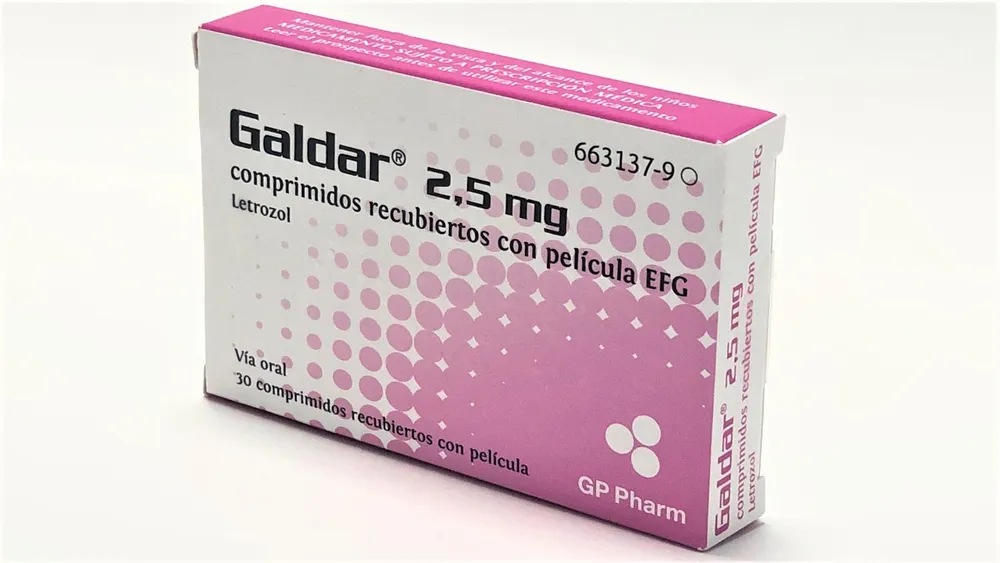
Table of Contents
Package Leaflet: Information for the User
Introduction
Package Leaflet: Information for the Patient
GALDAR 2.5 mg Film-Coated Tablets EFG
Letrozole
Read the entire leaflet carefully before you start taking this medicine, as it contains important information for you.
- Keep this leaflet, as you may need to read it again.
- If you have any questions, ask your doctor, pharmacist, or nurse.
- This medicine has been prescribed for you only, and you should not give it to others, even if they have the same symptoms as you, because it may harm them.
- If you experience any adverse effects, consult your doctor or pharmacist, even if they are effects not listed in this leaflet. See section 4.
Leaflet Contents
- What Galdar is and what it is used for.
- What you need to know before taking Galdar.
- How to take Galdar.
- Possible side effects.
- How to store Galdar.
Pack contents and other information.
1. What Galdar is and what it is used for
What Galdar is and how it works
Galdar contains an active substance called letrozole. It belongs to a group of medicines known as aromatase inhibitors. It is a hormonal (or "endocrine") treatment for breast cancer. The growth of breast cancer is usually stimulated by estrogens, which are female sex hormones. Galdar reduces the amount of estrogen by blocking an enzyme ("aromatase") involved in estrogen production, and therefore can inhibit the growth of breast cancers that require estrogen to grow. As a result, tumor cells grow more slowly or stop growing and/or spreading to other parts of the body.
What Galdar is used for
Galdar is used to treat breast cancer in women who have gone through menopause, that is, the time when menstrual periods have stopped.
It is used to help prevent breast cancer from returning. It may be used as initial treatment before breast cancer surgery, when immediate surgery is not appropriate, or as initial treatment after breast cancer surgery, or after five years of treatment with tamoxifen. Galdar is also used to prevent breast tumors from spreading to other parts of the body in patients with advanced breast cancer.
If you have any questions about how Galdar works or why this medicine has been prescribed for you, please consult your doctor.
2. What you need to know before starting to take Galdar
Carefully follow all instructions from your doctor. They may differ from the general information contained in this leaflet.
Do not take Galdar
- if you are allergic to letrozole or any of the other ingredients of this medicine (listed in section 6),
- if you still have menstrual cycles, i.e. you have not reached menopause,
- if you are pregnant,
- if you are breastfeeding.
If any of these cases apply to you, do not take this medicine and inform your doctor.
Warnings and precautions
Talk to your doctor or pharmacist before starting to take Galdar
- if you have severe kidney disease,
- if you have severe liver disease,
- if you have a history of osteoporosis or bone fractures (see also “Monitoring of Galdar treatment” in section 3).
If any of these cases apply to you, inform your doctor. Your doctor will take this into account during your treatment with Galdar.
Letrozole may cause tendon inflammation or tendon injuries (see section 4). If you experience any signs of tendon pain or inflammation, rest the affected area and contact your doctor.
Children and adolescents (under 18 years of age)
Children and adolescents must not use this medicine.
Elderly patients (65 years of age and older)
Patients aged 65 years and older may use this medicine at the same dose as adults.
Other medicines and Galdar
Inform your doctor or pharmacist if you are taking, have recently taken, or might need to take any other medicines.
Pregnancy, breastfeeding, and fertility
If you are pregnant or breastfeeding, think you may be pregnant, or are planning to become pregnant, consult your doctor or pharmacist before using this medicine.
- You should only take Galdar if you have passed the menopausal stage. However, your doctor should discuss with you the use of effective contraception, as you could still become pregnant during treatment with Galdar.
- You must not take Galdar if you are pregnant or breastfeeding, as it may harm your baby.
Driving and use of machines
If you feel dizzy, tired, drowsy, or unwell, do not drive or operate tools or machinery until you feel well again.
This medicine contains lactose. If your doctor has diagnosed you with an intolerance to certain sugars, consult with him before taking this medicine.
This medicine contains sodium.
This medicine contains less than 23 mg of sodium (1 mmol) per tablet; hence, it is essentially “sodium-free”.
Use in athletes
This medicine contains letrozole, which may lead to a positive result in doping control tests.
3. How to take Galdar
Follow exactly the instructions for use of this medicine provided by your doctor or pharmacist. If in doubt, consult your doctor or pharmacist again.
The recommended dose is one Galdar tablet once daily. Taking Galdar at the same time each day will help you remember when to take the tablet.
The tablet can be taken with or without food and should be swallowed whole with a glass of water or other liquid.
How long to take Galdar
Continue taking Galdar every day for as long as your doctor has instructed. You may need to take it for months or even years. If you have any doubts about how long you should take Galdar, consult your doctor.
Monitoring of treatment with Galdar
This medicine should only be taken under strict medical supervision. Your doctor will periodically monitor your condition to ensure the treatment is having the desired effect.
Galdar may cause a decrease in bone thickness or bone loss (osteoporosis) due to reduced estrogen levels in the body. Your doctor may decide to perform bone density measurements (a way of monitoring osteoporosis) before, during, and after treatment.
If you take more Galdar than you should
If you have taken too many Galdar tablets, or if someone else has accidentally taken them, contact your doctor or go to the hospital immediately. Show them the tablet packaging. You may require medical treatment. You may also call the Toxicology Information Service at Tel: 915620420, stating the name of the medicine and the amount taken.
If you forget to take Galdar
- If it is almost time for your next dose (e.g., within 2 or 3 hours), do not take the missed dose and take the next dose at your usual time.
- Otherwise, take the missed dose as soon as you remember, and then take the following dose at your usual time.
- Do not take a double dose to make up for a missed dose.
If you stop taking Galdar
Do not stop taking Galdar unless your doctor tells you to. See also the section “How long to take Galdar”.
If you have any further questions about the use of this medicine, ask your doctor or pharmacist.
4. Possible adverse effects
Like all medicines, this medicine can cause adverse effects, although not everyone will experience them.
Most of these adverse effects are mild to moderate and usually disappear after a few days or weeks of treatment.
Some of these adverse effects, such as hot flushes, hair loss, or vaginal bleeding, may be due to a lack of oestrogens.
Do not be alarmed by this list of possible adverse effects. You may not experience any of them.
Some adverse effects may be serious:
Uncommon (may affect up to 1 in 100 patients):
- Weakness, paralysis, or loss of sensation in any part of the body (particularly arm or leg), loss of coordination, nausea, or difficulty speaking or breathing (signs of a brain disorder, e.g. stroke).
- Sudden, pressing chest pain (signs of a heart disorder).
- Swelling and redness along a vein that is extremely tender and possibly painful to touch.
- Severe fever, chills, or mouth ulcers due to infections (lack of white blood cells).
- Persistent, severe blurred vision.
- Tendinitis or inflammation of a tendon (connective tissue that connects muscles to bones).
Rare (may affect up to 1 in 1000 patients):
- Difficulty breathing, chest pain, fainting, rapid heartbeat, bluish skin colour, or sudden pain in the arm, leg, or foot (signs of a blood clot).
- Rupture of a tendon (connective tissue that connects muscles to bones).
If you experience any of the above, inform your doctor immediately.
You should also inform your doctor immediately if you develop any of the following symptoms during treatment with Galdar:
- Swelling, mainly in the face and throat (signs of an allergic reaction).
- Yellowing of the skin and eyes, nausea, loss of appetite, darkening of urine (signs of hepatitis).
- Rash, redness of the skin, blisters on the lips, eyes or mouth, skin peeling, fever (signs of skin disorder).
Some adverse effects are very common (may affect more than 1 in 10 patients):
- Hot flushes.
- Elevated cholesterol levels (hypercholesterolaemia).
- Fatigue.
- Increased sweating.
- Bone and joint pain (arthralgia).
If any of these affect you severely, consult your doctor.
Some adverse effects are common (may affect up to 1 in 10 patients):
- Palpitations, rapid heartbeat.
- Joint stiffness (arthritis).
- Chest pain.
- Skin rash.
- Headache.
- Dizziness.
- General malaise.
- Gastrointestinal disorders such as nausea, vomiting, indigestion, constipation, diarrhoea.
- Increased or decreased appetite.
- Muscle pain.
- Thinning or loss of bone (osteoporosis), which may lead to bone fractures in some cases (see also section “Monitoring of Galdar treatment” in section 3**”)**.
- Swelling of arms, hands, feet, ankles (oedema).
- Depression.
- Weight gain.
- Hair loss.
- Increased blood pressure (hypertension).
- Abdominal pain.
- Dry skin.
- Vaginal bleeding.
If any of these affect you severely, inform your doctor.
Some adverse effects are uncommon (may affect up to 1 in 100 patients):
- Nervous system disorders such as anxiety, nervousness, irritability, numbness, memory problems, drowsiness, insomnia.
- Pain or burning sensation in the hands or wrists (carpal tunnel syndrome).
- Sensory disturbances, especially to touch.
- Eye disorders such as blurred vision, eye irritation.
- Skin disorders such as itching (urticaria).
- Vaginal dryness or discharge.
- Breast pain.
- Fever.
- Thirst, taste disturbances, dry mouth.
- Dryness of mucous membranes.
- Weight loss.
- Urinary tract infection, increased frequency of urination.
- Cough.
- Increased levels of liver enzymes.
- Yellowish skin and eye colouring.
- Increased blood levels of bilirubin (a product of red blood cell breakdown).
Adverse effects with unknown frequency (cannot be estimated from available data):
Trigger finger, a condition in which your finger or thumb becomes locked in a bent position.
If any of these affect you severely, inform your doctor.
Reporting of adverse effects
If you experience any adverse effect, talk to your doctor or pharmacist, even if it is a possible adverse effect not listed in this leaflet. You can also report them directly via the Spanish Pharmacovigilance System for Human Medicines: www.notificaram.es.
By reporting adverse effects, you can help provide more information on the safety of this medicine.
5. Storage of Galdar
- Keep this medicine out of the sight and reach of children.
- Do not use this medicine after the expiry date stated on the packaging after EXP. The expiry date refers to the last day of the month indicated.
- No special storage conditions are required.
- Do not use this medicine if you notice that the packaging is damaged or shows signs of tampering.
Medicines must not be disposed of via wastewater or household waste. Dispose of unused medicines and their containers at the SIGRE Point at your pharmacy. If you are in doubt, ask your pharmacist how to properly dispose of unused medicines and their packaging. This will help protect the environment.
6. Contents of the pack and other information
Composition of Galdar
- The active substance is letrozole. Each film-coated tablet contains 2.5 mg of letrozole.
- The other components (excipients) are lactose monohydrate (lactose), microcrystalline cellulose, maize starch, anhydrous colloidal silica, sodium carboxymethyl potato starch (potato starch), magnesium stearate. The coating consists of polyvinyl alcohol, talc, titanium dioxide (E 171), macrogol/PEG 3350, quinoline yellow aluminium lake, iron oxide red (E 172), iron oxide black (E 172).
Appearance of the product and contents of the pack
- Galdar is presented as film-coated tablets. The tablets are dark yellow in colour with a white core and are round.
- Each blister pack contains 30 tablets. Not all pack sizes may be available.
Marketing Authorization Holder
GP-Pharm, S.A.
Polígono Industrial Els Vinyets-Els Fogars, sector 2
Carretera Comarcal C-244, km 22
08777 Sant Quintí de Mediona (Barcelona)
Spain
Manufacturer
Tecnimede – Sociedade Técnico Medicinal, S.A.
Quinta da Cerca, Caixaria, 2565-187 Torres Vedras
Portugal
Date of the most recent revision of this leaflet: June 2021
Detailed and up-to-date information on this medicinal product is available on the website of the Spanish Agency of Medicines and Medical Devices (AEMPS) http://www.aemps.gob.es/