Gabitril 10 mg film-coated tablets
Spain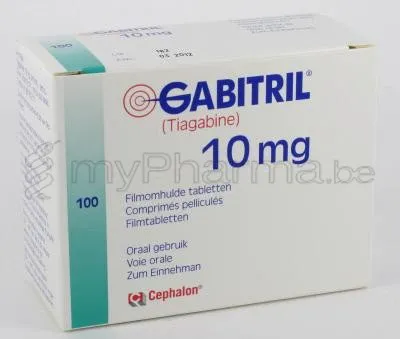
Table of Contents
Package leaflet: Information for the user
Introduction
Package leaflet: information for the user
Gabitril 10 mg film-coated tablets
Tiagabine (as monohydrochloride monohydrate)
Read all of this leaflet carefully before you start taking this medicine, because it contains important information for you.
- Keep this leaflet, as you may need to read it again.
- If you have any questions, ask your doctor or pharmacist.
- This medicine has been prescribed for you only and should not be given to other people, even if they have the same symptoms, as it may harm them.
- If you experience any adverse effects, consult your doctor or pharmacist, even if they are adverse effects not listed in this leaflet. See section 4.
Contents of the leaflet:
- What Gabitril is and what it is used for
- What you need to know before taking Gabitril
- How to take Gabitril
- Possible adverse effects
- How to store Gabitril
- Contents of the pack and other information
1. What Gabitril is and what it is used for
Gabitril is an antiepileptic medicine. Tiagabine, the active substance in Gabitril, increases brain levels of gamma-aminobutyric acid (GABA), thereby preventing or reducing the number of seizures (epileptic episodes).
Gabitril is used to help control epilepsy in adults and adolescents over 12 years of age who have partial seizures.
It is given in combination with other medicines when these are not sufficiently effective on their own.
2. Before taking Gabitril
Do not take Gabitril:
- If you are allergic (hypersensitive) to tiagabine or to any of the other ingredients of this medicine listed in section 6.
- If you have severe liver disease.
- In combination with herbal preparations containing St. John's Wort (Hypericum perforatum). See "Use of other medicines".
Take special care with Gabitril:
- If you are under 12 years of age.
- If you have generalized epilepsy, as you may experience worsening of absence seizures (short periods of impaired consciousness).
- If you stop treatment with Gabitril, as this may cause seizures to return. Do not stop taking Gabitril without consulting your doctor.
- If you have anxiety or depression, or have had them in the past, these symptoms may worsen or reappear during treatment with Gabitril. You should inform your doctor if you feel absent-minded, anxious, or depressed.
- A small number of people treated with antiepileptic medicines such as tiagabine have had thoughts of harming themselves or of suicide. If you experience such thoughts at any time, contact your doctor immediately.
- If you notice an increase in the number of seizures or new types of seizures, you must inform your doctor. Your doctor will decide whether your treatment needs to be changed.
- If you develop a skin rash, including fluid-filled blisters or spots, or if you notice unexplained bruising or darkening of the skin, contact your doctor immediately.
- If you notice any kind of vision problems, you should contact your doctor, as Gabitril may occasionally cause visual field defects.
- If your doctor has told you that you have an intolerance to certain sugars, you should not take Gabitril, as it contains lactose.
- If you have mild or moderate liver problems, your doctor will need to adjust the prescribed dose of Gabitril.
If you experience (or have experienced) any of these symptoms, please inform your doctor.
Use of other medicines:
If you are taking, have recently taken, or might need to take any of the following medicines, please consult your doctor or pharmacist before starting Gabitril:
- Other antiepileptic medicines such as phenytoin, carbamazepine, phenobarbital, and primidone, as they may reduce and shorten the effects of Gabitril.
- Rifampicin (a medicine used to treat tuberculosis), as it may reduce and shorten the effects of Gabitril.
- Herbal preparations containing St. John's Wort (Hypericum perforatum), as they must not be taken together with Gabitril (see "Do not take Gabitril").
If you need to take one or more of these medicines in combination with Gabitril, your doctor may need to adjust the dose of Gabitril.
Taking Gabitril with food and drink:
You should take Gabitril tablets with meals or a snack.
Pregnancy and breast-feeding:
As a precautionary measure, it is preferable not to take Gabitril during pregnancy or breast-feeding.
Inform your doctor if you become pregnant or plan to have a baby.
If you are pregnant or breast-feeding, think you may be pregnant, or are planning to become pregnant, consult your doctor or pharmacist before using this medicine.
Driving and using machines:
This medicine may cause symptoms such as drowsiness, dizziness, or vision disturbances, and may reduce your reaction time. These effects, as well as the underlying condition itself, may impair your ability to drive or operate machinery. Therefore, do not drive, operate machinery, or perform other activities requiring special attention until your doctor has assessed your response to this medicine.
Important information about some of the ingredients of Gabitril:
This medicine contains lactose. If your doctor has informed you that you have an intolerance to certain sugars, consult with him before taking this medicine.
3. How to take Gabitril
Follow exactly the instructions for use of this medicine given by your doctor. If in doubt, consult your doctor or pharmacist again.
Gabitril tablets must always be taken with water, during a meal or snack.
When you start taking Gabitril, your doctor will work with you to determine the appropriate dose to control your epilepsy. You will begin taking Gabitril tablets once or twice daily. Afterwards, the dose will be gradually increased until the dose sufficient to control your epilepsy is reached.
Once the dose has been established, you may need to take Gabitril tablets two or three times a day.
The initial dose of Gabitril is 5 to 10 mg daily, increasing weekly by 5 to 10 mg daily.
Depending on other medications you are taking, the average maintenance dose of Gabitril may range between 15 and 50 mg daily, although higher doses may sometimes be prescribed.
If you have mild or moderate liver problems, your doctor will need to adjust your Gabitril dose.
Gabitril tablets can be used with caution for treatment in elderly patients. Your doctor will decide which treatment is most suitable for you.
If you take more Gabitril than you should
In cases of overdose or accidental ingestion, contact your doctor or nurse immediately, or call the Toxicology Information Service at telephone number 91 562 04 20, indicating the medicine and the amount ingested.
The most common symptoms of Gabitril overdose are seizures, mutism (silence) and withdrawal, loss of consciousness, memory loss, coma, difficulty in coordination of movements, somnolence, abnormal involuntary movements (dyskinesia), dizziness, confusion, speech disturbances, agitation, tremors, involuntary muscle contractions, vomiting, and hostility.
If you forget to take Gabitril
If you miss your daily dose, take the next dose as usual. Do not take a double dose to make up for the missed dose.
If you stop taking Gabitril
You should continue taking Gabitril for as long as your doctor considers appropriate.
Do not stop treatment with Gabitril without first informing your doctor, as there is a risk of seizures recurring. Your doctor will explain how to gradually reduce the dose (over 2–3 weeks).
If you have any further questions about the use of this medicine, ask your doctor or pharmacist.
4. Possible adverse effects
Like all medicines, Gabitril may cause adverse effects, although not everyone experiences them.
Side effects are usually mild to moderate. Most occur during the first months of treatment and are often brief. These may include:
Very common adverse effects (may affect more than 1 in 10 people):
- Dizziness
- Tremors
- Somnolence
- Depression
- Nervousness
- Difficulty concentrating
- Fatigue
- Nausea
Common adverse effects (may affect between 1 and 10 in 100 people):
- Diarrhea
- Appearance of bruises (skin discoloration). If you notice the appearance of bruises, contact your doctor immediately.
Uncommon adverse effects (affect fewer than 1 in 100 people but more than 1 in 1,000):
Rare adverse effects (may affect between 1 and 10 in 10,000 people):
- Epileptic state without seizures, with decreased brain activity as determined by electroencephalogram, due either to rapid dose adjustment or to an increase in the dose of the medicine.
- Visual disturbances
- Confusion
- Hallucinations
- Agitation
- False beliefs
Frequency not known (cannot be estimated from available data):
- Encephalopathy (lethargy, confusion, with or without seizures)
- Severe blistering rash. If you notice skin changes, contact your doctor immediately.
- Severe rash, including fluid-filled blisters or a severe rash with redness and skin peeling.
- Vomiting, abdominal pain
- Difficulty controlling movements; walking, stopping or running abnormally, difficulty speaking
- Muscle twitches
- Blurred vision
- Temporary memory loss
Reporting of adverse effects:
If you experience any type of adverse effect, consult your doctor or pharmacist, even if it is a possible adverse effect not listed in this leaflet. You may also report them directly through the Spanish Pharmacovigilance System for Human Medicines: https://www.notificaram.es. By reporting adverse effects, you can help provide more information on the safety of this medicine.
5. Storage of Gabitril
Keep out of the sight and reach of children.
Do not use this medicine after the expiry date stated on the packaging and bottle after EXP. The expiry date refers to the last day of the month indicated.
Do not store above 25°C. Keep in the original packaging.
Do not remove the tablets from their container until it is time to take the medicine.
Do not use Gabitril if you notice any changes in the appearance of the tablets (e.g. if you observe a change in colour: they are normally white).
Medicines must not be disposed of via wastewater or household waste. Dispose of containers and unused medicines at the SIGRE collection point at your pharmacy. If you have any doubts, ask your pharmacist how to properly dispose of unused containers and medicines. This will help protect the environment.
6. Additional Information
Composition of Gabitril
-
The active substance is tiagabine, present in the medicine as monohydrate hydrochloride.
-
Each film-coated Gabitril 5 mg tablet contains 5 mg of Tiagabine.
-
The other components are:
Tablet core:
Microcrystalline cellulose (E 460)
Ascorbic acid (E300)
Lactose
Starch, pregelatinized (corn)
Crospovidone
Silica, colloidal anhydrous (E 551)
Hydrogenated vegetable oil (Type 1)
Stearic acid
Magnesium stearate
Coating:
Hypromellose
Hydroxypropylcellulose (E 463)
Titanium dioxide (E 171)
Appearance of the product and contents of the pack:
Gabitril are white, film-coated tablets.
Gabitril 5 mg tablets are round and marked with "251".
Gabitril tablets are supplied in a plastic bottle with a screw cap and an integrated desiccant.
Gabitril tablets are available in bottles containing 20, 30, 50, 100, and 200 tablets.
Only certain pack sizes may be commercially available.
Marketing Authorization Holder:
Teva B.V.
Swensweg 5, 2031 GA Haarlem
The Netherlands
Manufacturer:
Balkanpharma – Dupnitsa AD
3 Samokovsko Shosse Str.
Dupnitsa, 2600
Bulgaria
Local representative:
Teva Pharma, S.L.U.
C/ Anabel Segura, 11 Edificio Albatros B, 1ª planta
28108 Alcobendas (Madrid), Spain
This patient information leaflet was approved in August 2016
Detailed and up-to-date information on this medicine is available on the website of the Spanish Agency for Medicines and Health Products (AEMPS) http://www.aemps.gob.es/