Fusicutanbeta 20 mg/g + 1 mg/g cream
Spain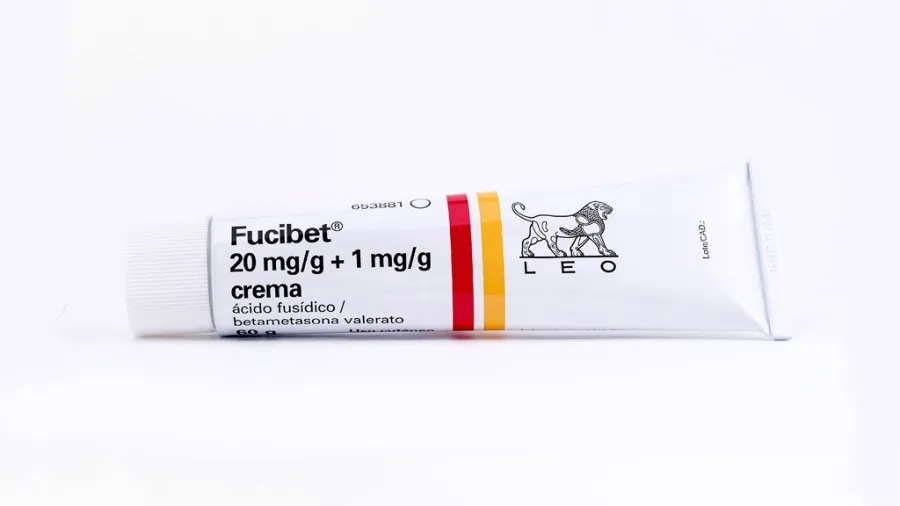
Instructions for Use
Package leaflet: Information for the user
Introduction
Package leaflet: information for the user
Fusicutanbeta 20 mg/g + 1 mg/g cream
Active substances: fusidic acid and betamethasone
Read all of this leaflet carefully before you start using this medicine, because it contains important information for you.
- Keep this leaflet, as you may need to read it again.
- If you have any questions, ask your doctor or pharmacist.
- This medicine has been prescribed for you only, and you should not give it to other people, even if they have the same symptoms as you, because it may harm them.
- If you experience any adverse effects, consult your doctor or pharmacist, even if they are effects not listed in this leaflet. See section 4.
Contents of the leaflet
- What Fusicutanbeta is and what it is used for
- What you need to know before using Fusicutanbeta
- How to use Fusicutanbeta
- Possible side effects
- How to store Fusicutanbeta
- Contents of the pack and other information
1. What Fusicutanbeta is and what it is used for
This medicine is a combination of an antibiotic and a corticosteroid.
Antibiotics are used to treat bacterial infections and are not effective against viral infections. It is important to follow your doctor's instructions regarding dosage, dosing interval, and duration of treatment. Do not store or reuse this medication. If you have leftover antibiotics after completing the treatment, return them to the pharmacy for proper disposal. Do not dispose of medications by flushing them down the drain or throwing them in the trash. |
It is used for initial treatment of infected eczema or skin inflammation caused by bacteria sensitive to fusidic acid.
2. What you need to know before using Fusicutanbeta
Do not use Fusicutanbeta
- if you are allergic to fusidic acid, betamethasone valerate, or any of the other ingredients of this medicine (listed in section 6).
- to treat fungal infections in internal organs
- to treat primary skin infections caused by fungi, viruses (e.g., Herpes or chickenpox) or bacteria, whether untreated or not controlled with appropriate treatment
- to treat specific skin symptoms associated with tuberculosis (which may appear as small purple nodules) or syphilis (which may appear as a non-pruritic skin rash or small warts), whether untreated or not controlled with appropriate treatment
- to treat skin reactions following preventive vaccination
- to treat inflammation of the skin around the mouth (perioral dermatitis)
- to treat rosacea (a facial skin condition resembling acne with redness)
- to treat acne
- in children under 2 years of age
Warnings and precautions
Talk to your doctor or pharmacist before using this medicine.
Anti-inflammatory medicines (corticosteroids) such as the active substance betamethasone in this medicine have strong effects on the body. This medicine is not recommended for use over large areas of the body or for prolonged periods, as this will significantly increase the risk of adverse effects.
Take special care if you are using this medicine near the eyes. If the cream gets into the eye, it may cause glaucoma.
Contact your doctor if you experience blurred vision or other visual disturbances.
If you feel that the infection is not improving, is getting worse, or new infections have developed after using this medicine for several days, consult your doctor or pharmacist. Your doctor may switch you to a different treatment.
Unless otherwise directed by your doctor, this medicine should not be applied to large areas of the body or the face, or in skin folds. Contact with open wounds and mucous membranes should be avoided.
Prolonged use
If you use the cream for a long time or in large amounts, the likelihood of experiencing any adverse effects increases.
Avoid prolonged use and continuous treatment with Fusicutanbeta because:
- it may cause a condition known as reversible suppression of the hypothalamic-pituitary-adrenal (HPA) axis (a complex hormonal regulatory system). This means the HPA axis may stop functioning properly while you are using the cream and may only recover after treatment has ended.
- your skin may become thinner in the area where the cream is applied.
- the bacteria being treated may become insensitive (i.e., no longer respond) to the active ingredient in the cream.
- the cream may mask symptoms of infection caused by non-sensitive bacteria, so the infection may worsen during treatment.
During treatment of the genital or anal area, the excipients used (liquid paraffin, soft white paraffin) may reduce the tensile strength of latex condoms, if used simultaneously, thereby affecting their reliability.
Children and adolescents
This medicine should be used with caution in children, as absorption of the corticosteroid may be greater through a child's skin. Use only the smallest amount necessary for as long as absolutely required. This medicine must not be used under occlusive dressings, including bandages, non-breathable dressings, clothing, or diapers.
Other medicines and Fusicutanbeta
Tell your doctor or pharmacist if you are taking, have recently taken, or might need to take any other medicines.
Pregnancy and breastfeeding
If you are pregnant or breastfeeding, think you may be pregnant, or are planning to become pregnant, consult your doctor or pharmacist before using this medicine.
Pregnancy
To avoid any risk to your baby, you should not use this medicine during pregnancy unless your doctor specifically instructs you to do so. If this medicine has been prescribed for you, use the smallest amount possible and only for as long as absolutely necessary.
Breastfeeding
If your doctor recommends using this medicine during breastfeeding, do not apply the cream to the breasts. Do not allow your baby to come into contact with treated areas.
Driving and using machines
The influence of this medicine on the ability to drive and use machines is none or negligible.
Fusicutanbeta contains methyl parahydroxybenzoate and propyl parahydroxybenzoate (E218 and E216), cetostearyl alcohol and potassium sorbate (E202).
Methyl parahydroxybenzoate and propyl parahydroxybenzoate may cause allergic reactions (possibly delayed). Cetostearyl alcohol and potassium sorbate may cause local skin reactions (e.g., contact dermatitis).
3. How to use Fusicutanbeta
Follow exactly the instructions for using this medicine as given by your doctor. If in doubt, consult your doctor or pharmacist again.
The recommended dose is:
Apply a thin layer of this medicine 2 to 3 times a day.
This medicine should be applied in a thin layer to the affected areas of skin and gently rubbed in, if possible, to promote absorption.
If there is no noticeable response to treatment within 4 days, treatment should be discontinued. The treatment should not be continued for more than 10 days.
Use in children and adolescents
This medicine should be used with caution in children. Avoid using large amounts and prolonged treatments.
Do not apply this medicine under dressings or bandages, or under diapers, especially in children.
This medicine must not be used in children under 2 years of age.
Consult your doctor if you feel that the effects of this medicine are too strong or too weak.
If you have any further questions about the use of this medicine, ask your doctor or pharmacist.
If you use more Fusicutanbeta than you should
Continue treatment with the prescribed amount of cream.
In case of overdose or accidental ingestion, contact your doctor or pharmacist immediately or call the Toxicology Information Service at telephone number 91 562 04 20, indicating the medicine and the amount ingested.
If you forget to use Fusicutanbeta
Do not use a double amount of cream to make up for a missed dose; continue treatment with the prescribed amount.
4. Possible adverse effects
Like all medicines, this medicine can cause adverse effects, although not everyone experiences them.
The most frequently reported adverse effect during treatment is itching.
Adverse effects observed during the use of Fusicutanbeta
Uncommon (may affect up to 1 in 100 people)
- Hypersensitivity reactions
- Skin inflammation (contact dermatitis), worsening of eczema, burning sensation, itching, dry skin
- Pain and/or irritation at the application site
Rare (may affect up to 1 in 1,000 people)
- Redness, hives, rash (including generalized red rash)
- Swelling and blistering at the application site
Frequency not known (cannot be estimated from available data)
- Blurred vision
Other possible adverse effects observed during the use of corticosteroids:
- Suppression of adrenal gland function (adrenal suppression)
- Increased pressure inside the eye and glaucoma (an eye condition that may affect vision) after application near the eyes
- Thinning of the skin
- Skin inflammation (including contact dermatitis and acneiform dermatitis)
- Inflammation of the skin around the mouth (perioral dermatitis)
- Stretch marks on the skin (striae)
- Dilation of small blood vessels (telangiectasia)
- Acne-like rash on the face with redness (rosacea)
- Redness of the skin
- Increased body hair growth (hypertrichosis)
- Increased sweating
- Local loss of skin pigmentation (skin lightening)
- After prolonged use, small red spots of blood under the skin
The same adverse effects may occur in children and adolescents as in adults.
Reporting of adverse effects
If you experience any type of adverse effect, consult your doctor or pharmacist, even if it is a possible adverse effect not listed in this leaflet.
You can also report them directly through the Spanish Pharmacovigilance System for Human Medicines: www.notificaRAM.es. By reporting adverse effects, you can help provide more information on the safety of this medicine.
5. Storage of Fusicutanbeta
Keep this medicine out of the sight and reach of children.
Do not use this medicine after the expiry date stated on the tube and the carton after EXP. The expiry date refers to the last day of the month indicated.
Period of validity after first opening
This medicine is valid for 6 months after the tube is first opened.
Do not store above 30 °C.
Medicines should not be disposed of via wastewater or household waste. Dispose of empty containers and unused medicines at the Punto Sigre collection point in your pharmacy. If you have any doubts, ask your pharmacist how to dispose of containers and medicines you no longer need. This will help protect the environment.
6. Contents of the pack and other information
Composition of Fusicutanbeta
The active substances are:
Fusidic acid and betamethasone
1 g of cream contains 20.4 mg of fusidic acid 0.5 H₂O (equivalent to 20 mg of fusidic acid) and 1.214 mg of betamethasone valerate (equivalent to 1 mg of betamethasone).
The other components are:
Macrogol-21-stearyl ether; cetostearyl alcohol; liquid paraffin; white soft paraffin; all-rac-α-tocopherol; hypromellose; citric acid monohydrate; methyl 4-hydroxybenzoate (E 218); propyl 4-hydroxybenzoate (E 216); potassium sorbate (E 202); purified water.
Presentation of the medicinal product and contents of the pack
This medicine is a white cream and is available in aluminum tubes of 5 g, 15 g, 30 g, and 60 g.
Only some pack sizes may be marketed.
Marketing Authorization Holder
Mibe Pharma España S.L.U.
C/Amaltea 9, 4th floor, letter B,
28045, Madrid
Spain
Manufacturer
Mibe GmbH Arzneimittel
Münchener Strasse 15
06796 Brehna
Germany
This medicinal product is authorized in the European Economic Area (EEA) member states under the following names:
Austria: Fusidinsäure plus Betamethason Dermapharm 20 mg/g + 1 mg/g Creme
Germany: Fusidinsäure/Betamethason acis 20 mg/g + 1 mg/g Creme
Belgium: fusidinezuur/betamethasone, acide fucidique/betamethasone, Fusidinsäure/Betamethason Dermapharm 20 mg/g + 1 mg/g Crème/Creme
Spain: Fusicutanbeta 20 mg/g + 1 mg/g cream
Italy: Fusicutanbeta 20 mg/g + 1 mg/g cream
Date of the most recent review of this summary: March 2021
Detailed and up-to-date information on this medicinal product is available on the website of the Spanish Agency of Medicines and Medical Devices (AEMPS) http://www.aemps.gob.es
Similar Medications
-
Celestoderm 1 mg/g + 1 mg/g cream
Form: cream
Active substance Dosage GENTAMICIN 1 mg BETAMETHASONE 17-VALERATE 1,22 mg Manufacturer: Organon Salud S.L.
-
Diprogenta 0.5 mg/g + 1 mg/g cream
Form: cream
Active substance Dosage GENTAMICIN 1,00 mg BETAMETHASONE DIPROPIONATE 0,64 mg Manufacturer: Organon Salud S.L.
-
Fucibet 20 mg/g + 1 mg/g cream
Form: cream
Active substance Dosage FUSIDIC ACID 2 g BETAMETHASONE 17-VALERATE 0,1 g Manufacturer: Laboratorios Leo Pharma S.A.
-
Fucibet Lipid 20 mg/g + 1 mg/g cream
Form: cream
Active substance Dosage FUSIDIC ACID 20 mg/g BETAMETHASONE 17-VALERATE 1,214 mg/g Manufacturer: Leo Pharma A/S
-
Mibetin 0.5 mg/g + 1 mg/g cream
Form: cream
Active substance Dosage GENTAMICIN SULFATE 1,67 mg/g BETAMETHASONE DIPROPIONATE 0,64 mg/g Manufacturer: Mibe Pharma Espana S.L.U.
This page has been machine-translated and may contain inaccuracies. The original data is available in the manufacturing country's language.
Last data check: May 18, 2026 · Data source: CIMA — AEMPS