Fruzaqla 1 mg hard capsules
Spain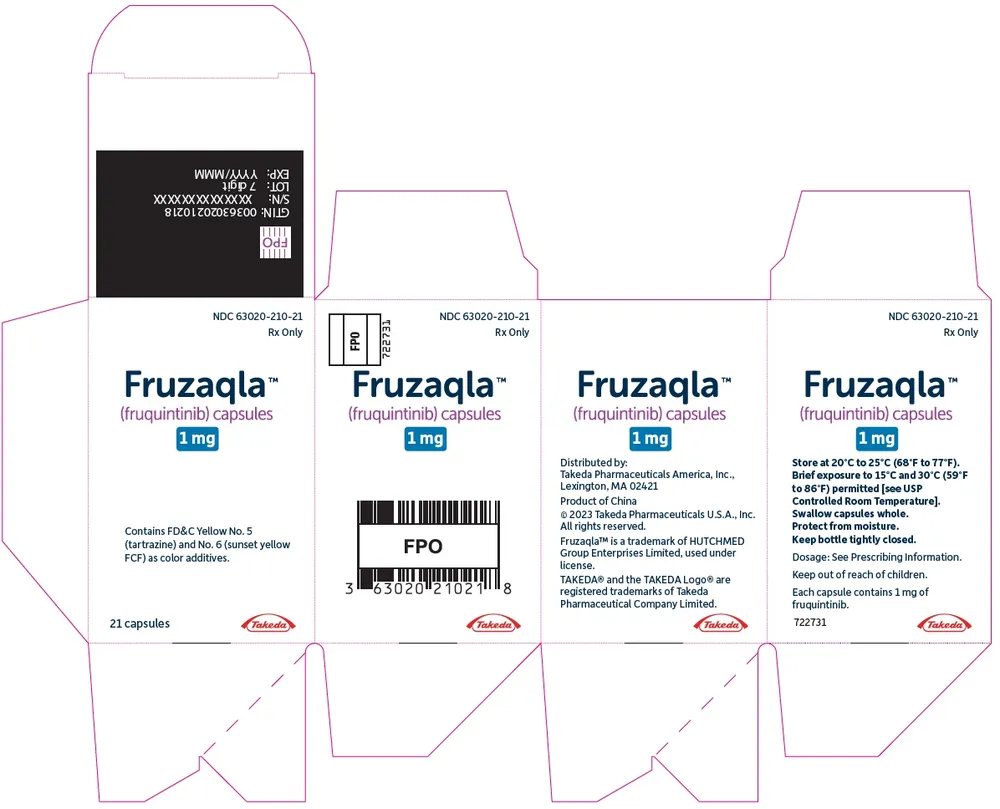
Table of Contents
Package Leaflet: Information for the User
Introduction
Package leaflet: information for the patient
FRUZAQLA 1mg hard capsules
FRUZAQLA 5mg hard capsules
fruquintinib
This medicinal product is subject to additional monitoring, which will allow quicker identification of new safety information. You can help by reporting any side effects you may experience. Information on how to report side effects is provided at the end of section 4.
Read the entire leaflet carefully before you start taking this medicine, as it contains important information for you.
- Keep this leaflet, as you may need to read it again.
- If you have any questions, ask your doctor, pharmacist, or nurse.
- This medicine has been prescribed for you only; do not pass it on to others, even if they have the same symptoms as you, as it may harm them.
- If you experience any side effects, talk to your doctor, pharmacist, or nurse, even if the side effects are not listed in this leaflet. See section 4.
Leaflet Contents
- What FRUZAQLA is and what it is used for
- What you need to know before taking FRUZAQLA
- How to take FRUZAQLA
- Possible side effects
- How to store FRUZAQLA
- Contents of the pack and other information
1. What FRUZAQLA is and what it is used for
FRUZAQLA contains the active substance fruquintinib, a cancer medicine called a kinase inhibitor.
FRUZAQLA is used to treat adult patients with colon or rectal cancer (colorectal cancer) that has spread to other parts of the body (metastatic). It is used when other treatments have not worked or are not suitable for a person.
How FRUZAQLA works
Cancer cells need new blood vessels to grow. FRUZAQLA prevents tumours from developing new blood vessels, thereby slowing down the growth and spread of cancer.
If you have any questions about how this medicine works or why it has been prescribed for you, consult your doctor, pharmacist, or nurse.
2. What you need to know before starting to take FRUZAQLA
Do not take FRUZAQLA
- if you are allergic to fruquintinib or to any of the other ingredients of this medicine (listed in section 6).
Warnings and precautions
Consult your doctor, pharmacist, or nurse before starting to take FRUZAQLA, or at any time during treatment, if you have any of the conditions listed below:
- High blood pressure. Your doctor will ensure that your blood pressure is controlled before you start taking this medicine and during treatment.
- Any bleeding problems. Inform your doctor if you have or have ever had bleeding problems, or if you are taking warfarin, acenocoumarol, or other medicines that thin the blood to prevent blood clots.
- Severe stomach and intestinal problems caused by a hole in the intestinal wall (known as gastrointestinal perforation). If you develop severe stomach or intestinal problems, consult your doctor immediately.
- Kidney problems (indicated by the presence of protein in the urine).
- Any skin problems, including redness, pain, swelling, or blisters on the palms of the hands or soles of the feet.
- Severe and persistent headache, visual disturbances, seizures, or altered mental status (such as confusion, memory loss, or disorientation). If you or people close to you notice any of these symptoms, consult your doctor immediately.
- Unhealed wound, or if you have recently undergone, are about to undergo, or plan to undergo surgery, as FRUZAQLA may affect wound healing.
- Recent blood clotting problems in veins and arteries (types of blood vessels), including stroke, heart attack, embolism, or thrombosis.
Your doctor may provide you with additional medicines to prevent more serious complications and reduce your symptoms. Your doctor may delay your next dose of FRUZAQLA or discontinue treatment with FRUZAQLA.
Children and adolescents
FRUZAQLA should not be given to children and adolescents for the treatment of colon or rectal cancer that has spread to other parts of the body, as it is not appropriate.
Other medicines and FRUZAQLA
Inform your doctor or pharmacist if you are taking, have recently taken, or might need to take any other medicines. In particular, inform your doctor or pharmacist if you are taking medicines used to treat tuberculosis or other infections, such as rifampicin.
Pregnancy
FRUZAQLA has not been studied in pregnant women. Based on its mechanism of action, FRUZAQLA should not be used during pregnancy unless clearly necessary, as it may cause harm to the fetus. If you are pregnant, think you may be pregnant, or plan to become pregnant, consult your doctor or pharmacist before using this medicine. Your doctor will discuss with you the risks associated with taking this medicine during pregnancy.
Contraception in women
Women who are able to become pregnant must use highly effective methods of contraception during treatment with FRUZAQLA and for at least 2 weeks after the last dose of the medicine. Discuss with your doctor which contraceptive methods are most suitable for you.
Breastfeeding
Inform your doctor if you are breastfeeding or plan to breastfeed. It is unknown whether FRUZAQLA passes into breast milk, and the risk to newborns/infants cannot be excluded. You must not breastfeed during treatment with this medicine or for at least 2 weeks after the last dose of FRUZAQLA. Consult your doctor about the best way to feed your baby during this period.
Driving and using machines
FRUZAQLA has a minimal effect on your ability to drive and use machines. You may feel tired after taking FRUZAQLA. Do not drive or operate tools or machinery if you experience symptoms that affect your ability to concentrate or react.
FRUZAQLA contains
Tartrazine (E102) and orange yellow S (E110) only in the 1 mg capsules. These are dyes that may cause allergic reactions.
Allura red AC (E129) only in the 5 mg capsules. This is a dye that may cause allergic reactions.
3. How to take FRUZAQLA
Follow exactly the instructions for using this medicine as given by your doctor. If you are unsure, consult your doctor or pharmacist again.
Recommended dose
The recommended dose is 5 milligrams (mg) taken once daily at approximately the same time each day for 21 days, followed by a 7-day rest period (without taking the medicine). This is considered one treatment cycle.
Depending on your response to treatment and possible adverse effects, your doctor may ask you to switch to a lower dose or to temporarily or permanently stop treatment.
How to take FRUZAQLA
- Take FRUZAQLA with or without food.
- Swallow the capsule whole with water or another drink.
- Do not chew, dissolve, or open the capsules, as the potential effects of not taking the capsule whole are unknown.
- Consult your doctor before starting treatment if you have difficulty or think you may have difficulty swallowing the capsules whole.
How long to take FRUZAQLA
Your doctor will regularly monitor your condition. You will continue taking FRUZAQLA as long as it remains effective and adverse effects are manageable.
If you take more FRUZAQLA than you should
Inform your doctor immediately if you take a higher dose than prescribed. You may require medical attention, and your doctor may instruct you to stop taking FRUZAQLA.
If you forget to take FRUZAQLA
If less than 12 hours remain until your next dose, skip the missed dose and take the next dose as scheduled.
If more than 12 hours remain until your next dose, take the missed dose and then take the next dose as scheduled.
If you vomit after taking FRUZAQLA, do not take another capsule as a replacement. Take the next dose at the usual time.
Before stopping treatment with FRUZAQLA
Do not stop taking the medicine unless instructed by your doctor. If you have any other questions about the use of this medicine, ask your doctor, pharmacist, or nurse.
4. Possible adverse effects
Like all medicines, this medicine can cause adverse effects, although not everyone experiences them. The following adverse effects may occur with this medicine.
Serious adverse effects
Tell your doctor immediately if you notice any of the following serious adverse effects.
High blood pressure
Tell your doctor if you experience any of the following symptoms:
- Severe headache.
- Dizziness or lightheadedness.
- Confusion.
- Severe chest pain.
Bleeding
FRUZAQLA may cause serious bleeding in the digestive system, such as in the stomach, throat, rectum, or intestine. Seek immediate medical attention if you experience any of the following symptoms:
- Blood in your stools or black stools.
- Blood in your urine.
- Stomach pain.
- Coughing or vomiting blood.
Serious stomach and intestinal problems due to gastrointestinal perforation
Treatment with FRUZAQLA may cause gastrointestinal perforation.
Seek immediate medical attention if you experience any of the following symptoms:
- Coughing or vomiting blood.
- Severe or persistent abdominal (stomach) pain.
- Red or black stools.
Reversible inflammation of the brain (posterior reversible encephalopathy syndrome)
Seek urgent medical attention immediately and call your doctor if you experience any of the following symptoms:
- Headache.
- Confusion.
- Seizures.
- Changes in vision.
Other adverse effects
Tell your doctor, pharmacist, or nurse if you notice any of the following adverse effects:
Very common (may affect more than 1 in 10 people):
- Decrease in platelet count (cells that help blood to clot), seen in blood tests (thrombocytopenia), which may result in bruising and bleeding more easily.
- Reduced activity of the thyroid gland (hypothyroidism), which may cause tiredness, weight gain, and changes in skin and hair color.
- Weight loss and decreased appetite (anorexia).
- High blood pressure (hypertension).
- Voice changes or hoarseness (dysphonia).
- Frequent or loose bowel movements (diarrhea).
- Dry mouth or pain, sores, or ulcers in the mouth (stomatitis).
- Increased levels of liver enzymes in blood tests, such as aspartate aminotransferase and alanine aminotransferase.
- Increased levels of bilirubin in the blood (abnormal liver function tests).
- Redness, pain, blisters, and swelling on the palms of the hands or soles of the feet (palmar-plantar erythrodysesthesia syndrome).
- Pain in the bones, muscles, chest, or neck (musculoskeletal discomfort).
- Joint pain (arthralgia).
- Protein in the urine (proteinuria).
- Weakness, lack of strength and energy, excessive tiredness (asthenia/fatigue).
Common (may affect up to 1 in 10 people):
- Lung infection (pneumonia).
- Throat and nose infection (upper respiratory tract infection).
- Bacterial infection.
- Decrease in white blood cell count in blood tests (leucopenia), which may increase the risk of infection.
- Decrease in neutrophil count (a type of white blood cell) in blood tests (neutropenia), which may increase the risk of infection.
- Low potassium levels as seen in blood tests (hypokalemia).
- Nosebleeds (epistaxis).
- Sore throat.
- Bleeding in the digestive system, such as in the stomach, rectum, or intestine (gastrointestinal hemorrhage).
- Formation of a hole in the stomach (gastrointestinal perforation).
- Increased levels of pancreatic enzymes in blood tests (which may be a sign of pancreatic problems).
- Pain in the teeth, gums, or lips (oral pain).
- Skin rash.
- Mouth sores (mucosal inflammation).
Uncommon (may affect up to 1 in 100 people):
- Reversible inflammation of the brain (posterior reversible encephalopathy syndrome).
- Pain in the stomach area, nausea, vomiting, and fever, which may be symptoms of inflammation of the pancreas (pancreatitis).
- Severe pain in the upper right or central abdomen, nausea, and vomiting, which may be symptoms of inflammation of the gallbladder (cholecystitis).
- Delayed wound healing.
Frequency not known (cannot be estimated from available data):
- Sudden, severe pain in the abdomen, chest, or back, which may be a symptom of a tear in the wall of the aorta (aortic dissection).
Reporting of adverse effects
If you experience any adverse effect, talk to your doctor or pharmacist, even if it is a possible adverse effect not listed in this leaflet. You can also report them directly through the national reporting system detailed in Appendix V. By reporting adverse effects, you can help provide more information on the safety of this medicine.
5. Storage of FRUZAQLA
Keep this medicine out of the sight and reach of children.
Do not use this medicine after the expiry date stated on the carton and on the label of the bottle after EXP. The expiry date refers to the last day of the month indicated.
This medicine does not require any special storage temperature.
Store in the original packaging to protect it from moisture.
Keep the bottle tightly closed.
Medicines must not be disposed of via wastewater or household waste. Ask your pharmacist how to dispose of any containers and medicines you no longer need. Doing so helps protect the environment.
6. Contents of the pack and other information
Composition of FRUZAQLA
FRUZAQLA 1mg hard capsules
-
The active substance is fruquintinib. Each hard capsule contains 1 mg of fruquintinib.
-
The other components are:
-
Capsule filling: maize starch, microcrystalline cellulose (E460), talc (E553b).
-
Capsule shell: gelatin, titanium dioxide (E171), tartrazine (E102), orange yellow colour (E110).
-
Printing ink: shellac (E904), propylene glycol (E1520), potassium dioxide, black iron oxide (E172).
FRUZAQLA 5mg hard capsules
-
The active substance is fruquintinib. Each hard capsule contains 5 mg of fruquintinib.
-
The other components are:
-
Capsule filling: maize starch, microcrystalline cellulose (E460), talc (E553b).
-
Capsule shell: gelatin, titanium dioxide (E171), allura red AC (E129), brilliant blue colour (E133).
-
Printing ink: shellac (E904), propylene glycol (E1520), potassium dioxide, black iron oxide (E172).
Appearance of the product and contents of the pack
FRUZAQLA 1 mg hard capsules (approximately 16 mm in length) are white capsules with a yellow shell printed with «HM013» over «1mg».
FRUZAQLA 5 mg hard capsules (approximately 19 mm in length) are white capsules with a red shell printed with «HM013» over «5mg».
Each bottle contains 21 hard capsules and a desiccant. The desiccant is a moisture-absorbing material contained within a small sachet. Its purpose is to protect the capsules from moisture.
Keep the desiccant inside the bottle. Do not ingest the desiccant.
Marketing Authorisation Holder
Takeda Pharmaceuticals International AG Ireland Branch
Block 2 Miesian Plaza
50‑58 Baggot Street Lower
Dublin 2
D02 HW68
Ireland
Manufacturer
Takeda Ireland Limited
Bray Business Park
Kilruddery
Co. Wicklow
A98 CD36
Ireland
For further information about this medicinal product, please contact the local representative of the Marketing Authorisation Holder:
Belgium/Belgium/Belgium Takeda Belgium NV Tel/Tel: +32 2 464 06 11 | Lithuania Takeda, UAB Tel: +370 521 09 070 |
Bulgaria Takeda Bulgaria EOOD Tel: +359 2 958 27 36 | Luxembourg/Luxembourg Takeda Belgium NV Tel/Tel: +32 2 464 06 11 |
Czech Republic Takeda Pharmaceuticals Czech Republic s.r.o. Tel: +420 234 722 722 | Hungary Takeda Pharma Kft. Tel.: +36 1 270 7030 |
Denmark Takeda Pharma A/S Tlf.: +45 46 77 10 10 | Malta Drugsales Ltd Tel: +356 21419070 |
Germany Takeda GmbH Tel: +49 (0)800 825 3325 | Netherlands Takeda Nederland B.V. Tel: +31 20 203 5492 |
Estonia Takeda Pharma OÜ Tel: +372 6177 669 | Norway Takeda AS Tlf: +47 800 800 30 |
Greece Takeda HELLAS S.A. Tel: +30 210 6387800 | Austria Takeda Pharma Ges.m.b.H. Tel: +43 (0) 800-20 80 50 |
Spain Takeda Farmacéutica España, S.A. Tel: +34 917 90 42 22 | Poland Takeda Pharma Sp. z o.o. Tel.: +48223062447 |
France Takeda France SAS Tél: +33 1 40 67 33 00 | Portugal Takeda Farmacêuticos Portugal, Lda. Tel: +351 21 120 1457 |
Croatia Takeda Pharmaceuticals Croatia d.o.o. Tel: +385 1 377 88 96 | Romania Takeda Pharmaceuticals SRL Tel: +40 21 335 03 91 |
Ireland Takeda Products Ireland Ltd Tel: 1800 937 970 | Slovenia Takeda Pharmaceuticals farmacevtska družba d.o.o. Tel: +386 (0) 59 082 480 |
Iceland Vistor hf. Sími: +354 535 7000 | Slovakia Takeda Pharmaceuticals Slovakia s.r.o. Tel: +421 (2) 20 602 600 |
Italy Takeda Italia S.p.A. Tel: +39 06 502601 | Finland Takeda Oy Puh/Tel: 0800 774 051 |
Cyprus A.POTAMITIS MEDICARE LTD Tel: +357 22583333 | Sweden Takeda Pharma AB Tel: 020 795 079 |
Latvia Takeda Latvia SIA Tel: +371 67840082 | United Kingdom (Northern Ireland) Takeda UK Ltd Tel: +44 (0) 3333 000 181 |
Date of the most recent review of this summary:
Other sources of information
Detailed information on this medicine is available on the website of the European Medicines Agency: http://www.ema.europa.eu.