Fridex 1 mg/ml eye drops in single-dose container
Spain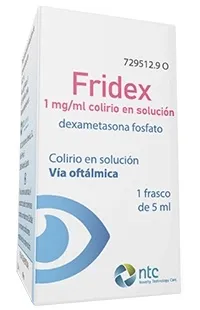
Table of Contents
Patient Information Leaflet
Introduction
Patient Information Leaflet
Fridex 1 mg/ml eye drops solution in single-dose container
Dexamethasone phosphate
Read all of this leaflet carefully before you start using this medicine, as it contains important information for you.
- Keep this leaflet, as you may need to read it again.
- If you have any questions, ask your doctor or pharmacist.
- This medicine has been prescribed for you only. Do not pass it on to others, even if they have the same symptoms as you, because it may harm them.
- If you experience any side effects, talk to your doctor or pharmacist, even if they are side effects not listed in this leaflet. See section 4.
Leaflet contents
- What Fridex is and what it is used for
- What you need to know before using Fridex
- How to use Fridex
- Possible side effects
- How to store Fridex
- Contents of the pack and other information
1. What Fridex is and what it is used for
This medicine contains the active substance dexamethasone, which is a corticosteroid intended to suppress inflammatory symptoms (pain, heat, swelling, and redness).
This medicine is indicated for the treatment of inflammation of your eyes.
If you have an eye infection (red eye, tearing and mucus), you will be given another medicine to take at the same time as Fridex (see Section 2).
2. What you need to know before using Fridex
Do not use Fridex
- if you are allergic to sodium dexamethasone phosphate or any of the other ingredients of this medicine (listed in section 6);
- if you have an eye infection that may be caused by bacteria (acute purulent infection), fungi or viruses (herpes virus, vaccinia virus, varicella virus) or caused by amoebae (a parasite);
- if you have damage to the surface of the eye (small holes, ulcers or lesions that have not healed properly);
- if you have high eye pressure known to be caused by glucocorticoids (a family of corticosteroid medicines).
Warnings and precautions
Talk to your doctor or pharmacist before using this medicine.
Do not inject, do not ingest.
Avoid contact between the tip of the dispenser container and the eye or eyelids.
Strict eye monitoring is required during use of Fridex, and particularly:
- for children and elderly patients. More frequent monitoring is recommended.
- if you have an eye infection. Use this medicine only if you are also being treated with an anti-infective medicine.
- if you have corneal ulcer (an open sore on the eye surface with sometimes severe pain, tearing, eyelid spasms, and vision loss). Do not use this medicine unless inflammation is the main reason for delayed healing.
- if you suffer from high eye pressure. If you have previously had high eye pressure after using an ocular steroid medicine, you are at risk of developing it again when using this medicine.
- if you have glaucoma, a condition that can damage the optic nerve and may lead to vision loss.
- children: do not use for long-term continuous treatment.
- if you have severe allergic conjunctivitis (redness, swelling, itching, and tearing of the eyes) not controlled by other medicines. Use this medicine only for a short period.
- if you have diabetes. Inform your ophthalmologist or optometrist about your condition before using this medicine.
- if you have a red eye that has not been diagnosed. Do not use this medicine before speaking with your doctor.
- diabetic patients: if you are diabetic, inform your ophthalmologist or optometrist.
- if you have a red eye that has not been diagnosed, do not use this medicine.
- for children and elderly patients. More frequent monitoring is recommended.
Avoid wearing contact lenses during use of this medicine.
Contact your doctor if you notice swelling and weight gain around the trunk and face, as these are usually the first signs of a condition called Cushing's syndrome. Reduced adrenal gland function may develop after stopping long-term or intensive treatment with this medicine. Consult your doctor before stopping treatment on your own. These risks are particularly important in children and patients taking a medicine called ritonavir or cobicistat.
Contact your doctor if you experience blurred vision or other visual disturbances.
Children
Do not use this medicine in children for long-term continuous treatment.
Using Fridex with other medicines
Tell your doctor or pharmacist if you are taking, have recently taken, or might need to take any other medicines.
If you are using other eye drops, wait 15 minutes before instilling the other medicine.
The combined use of eye drops containing steroids and eye drops containing beta-blockers (used to treat high eye pressure) may cause calcium phosphate precipitation on the eye surface.
Inform your doctor if you are taking ritonavir or cobicistat, as these medicines may increase the amount of dexamethasone in the blood.
Pregnancy and breastfeeding
If you are pregnant or breastfeeding, think you may be pregnant, or are planning to become pregnant, consult your doctor or pharmacist before using this medicine.
There is insufficient information on the use of this medicine during pregnancy to assess possible adverse effects. For this reason, the use of this medicine during pregnancy is not recommended.
It is not known whether this medicine passes into breast milk. However, the dose of this medicine is low; therefore, this medicine may be used during breastfeeding.
Driving and use of machines
You may experience blurred vision for a short time after using this eye drop. Wait until your vision is normal before driving or operating machinery.
Fridex contains phosphate
This medicine contains 0.4461 mg of phosphates in 0.3 ml, equivalent to 1.487 mg/ml.
If you have severe damage to the transparent layer at the front of the eye (the cornea), phosphates may very rarely cause cloudy patches in the cornea due to calcium accumulation during treatment.
3. How to use Fridex
Follow exactly the instructions for administering this medicine as given by your doctor or pharmacist. If in doubt, consult your doctor or pharmacist again.
Dosage
The usual recommended dose is 1 drop, 4 to 6 times daily in the affected eye.
If your condition is more severe, you may be instructed to start with 1 drop every hour, then switch to 1 drop every 4 hours once the medicine has started to work. It is important to reduce the dose gradually to avoid the condition worsening again.
Use in elderly patients
No dose adjustment of the medicine is required.
Use in children
Do not use this medicine in children for long-term treatment without breaks.
Method of administration
This medicine must be instilled into the eye. Do not inject or swallow the medicine.
|
- Open the aluminum pouch containing 5 single-dose containers.
- Wash your hands thoroughly before using these drops.
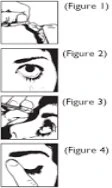
- Separate one single-dose container from the strip and open the top of the single-dose container (Figure 1).
- Tilt your head backward and gently pull down the lower eyelid with your finger (Figure 2). Apply one drop into the eye to be treated. Avoid contact between the tip of the container and the eye or eyelids (Figure 3).
- Immediately after instilling the drop, gently press with your finger on the inner corner of the eye closest to the nose for a few minutes (Figure 4). This helps prevent the eye drops from spreading to the rest of your body.
- Discard the single-dose container after use. Do not save it for later use.
Duration of treatment
You will usually need to use your drops for several days. Do not use this medicine for more than 14 days.
If you use more Fridex than you should
If too much medicine has been instilled into the eye and it causes pain, rinse the eye with sterile water. Immediately inform your doctor or pharmacist.
In case of overdose or accidental ingestion, consult your doctor or pharmacist immediately or call the Toxicology Information Service at: 91 562 04 20, indicating the medicine and the amount ingested.
If you forget to use Fridex
Do not use a double dose to make up for missed doses.
If you stop using Fridex
Do not stop using this medicine abruptly. Inform your doctor if you are considering discontinuing the treatment.
If you have any further questions about the use of this medicine, ask your doctor or pharmacist.
4. Possible adverse effects
Like all medicines, this medicine can cause adverse effects, although not everyone will experience them.
Very common (may affect more than 1 in 10 people)
- increased eye pressure after 2 weeks of using the drops.
Common (may affect up to 1 in 10 people)
- discomfort, irritation, stinging, burning, itching, and blurred vision after use. These are usually mild and do not last long.
Uncommon (may affect up to 1 in 100 people)
- signs of an allergic reaction
- delayed healing
- cloudy lens (cataract)
- eye infections
- increased eye pressure (glaucoma)
- if used frequently, the kidneys may fail to produce enough hormones (adrenal cortical suppression). This could present as low blood sugar levels, dehydration, weight loss, and confusion about where you are.
Very rare (may affect up to 1 in 10,000 people)
- inflamed surface of the eye causing red eyes, tearing, and irritation (conjunctivitis)
- dilated pupil (mydriasis)
- swelling of the face (facial edema)
- drooping eyelids (ptosis)
- eye inflammation causing pain and redness (uveitis)
- calcium deposits on the eye surface (corneal calcification)
- inflamed eye surface causing blurred vision, dry eyes, light sensitivity, burning, tearing, and a gritty sensation in the eye (crystalline keratopathy)
- changes in the thickness of the eye surface
- swelling of the eye surface (corneal edema)
- ulcer on the eye surface causing pain, tearing, squinting, and vision loss
- small holes in the eye surface (corneal perforation)
Reporting of adverse effects
If you experience any adverse effects, talk to your doctor or pharmacist, even if they are possible side effects not listed in this leaflet. You can also report them directly via the Spanish Pharmacovigilance System for Human Medicinal Products: www.notificaRAM.es. By reporting adverse effects, you can help provide more information on the safety of this medicine.
5. Fridex Storage
Keep this medicine out of the sight and reach of children.
Do not use this medicine after the expiry date stated on the packaging. The expiry date refers to the last day of the month indicated.
After opening the single-dose container: discard any residual solution remaining in the single-dose container after instillation.
Keep the single-dose containers inside the pouch to protect them from light and use within 60 days.
Store the single-dose container in the outer packaging to protect it from light.
Store below 25°C.
Medicines must not be disposed of via wastewater or household waste. Return unused containers and medicines to the SIGRE collection point at your pharmacy, or any other medicine waste collection system. If in doubt, ask your pharmacist how to dispose of containers and medicines you no longer need. This will help protect the environment.
6. Contents of the pack and other information
Composition of Fridex
-
The active substance is dexamethasone sodium phosphate. Each ml of solution contains 1 mg of dexamethasone phosphate (as dexamethasone sodium phosphate), equivalent to 40 micrograms of dexamethasone phosphate (with a theoretical drop volume of approximately 40 microliters).
-
The other components are: disodium edetate, dibasic sodium phosphate dodecahydrate, sodium chloride, hydrochloric acid (for pH adjustment), sodium hydroxide (for pH adjustment), and water for injections.
Nature of the product and contents of the container
Fridex is a clear, colourless solution supplied in single-dose containers.
Each single-dose container holds 0.3 ml of solution.
A box contains 20 or 30 single-dose containers packed in pouches.
Marketing Authorization Holder and Manufacturer
Marketing Authorization Holder
NTC S.r.l.
Via Luigi Razza, 3
20124 Milan (Italy)
Manufacturer
Farmigea SpA
Via Giovan Battista Oliva, 6/8
56121 Pisa (PI)
Italy
For further information about this medicinal product, please contact the local representative of the Marketing Authorization Holder:
NTC Ophthalmics Iberica S.L.
Calle Pinar, 5,
28006 Madrid, Spain
This medicinal product is authorized in the European Economic Area member states under the following names:
Portugal: Dexametasona NTC
United Kingdom: Dexamethasone phosphate 1 mg/mL (as sodium phosphate) Eye drops, Solution in a single-dose container
Spain: Fridex 1 mg/ml eye drops solution in single-dose container
Date of the most recent review of this leaflet: July 2019
Detailed and up-to-date information on this medicinal product is available on the website of the Spanish Agency for Medicines and Health Products (AEMPS) http://www.aemps.gob.es/