Freeflex Glucosalina solution for infusion
Spain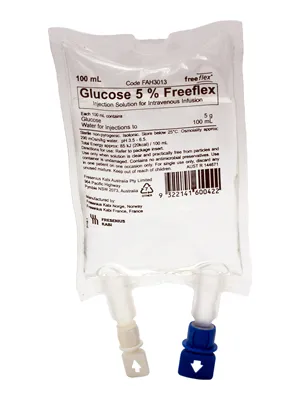
Table of Contents
Patient Information Leaflet
Introduction
PACKAGE LEAFLET: INFORMATION FOR THE USER
Freeflex Glucosalina solution for infusion
Glucose and Sodium chloride
Read the entire leaflet carefully before you start using the medicine:
the same symptoms as you, because it could harm them.
effects not listed in this leaflet, inform your doctor or pharmacist. |
Package leaflet:
- What Freeflex Glucosalina is and what it is used for
- Before you use Freeflex Glucosalina
- How to use Freeflex Glucosalina
- Possible side effects
- How to store Freeflex Glucosalina
- Further information
1. What Freeflex Glucosalina is and what it is used for
Freeflex Glucosalina is an intravenous infusion solution supplied in 250 ml, 500 ml, and 1000 ml bags.
This medicine belongs to the group of intravenous solutions that affect electrolyte balance with carbohydrates.
Freeflex Glucosalina is indicated for:
- States of dehydration with moderate electrolyte losses.
- Disorders of carbohydrate metabolism.
- As a vehicle for the administration of drugs and electrolytes.
2. BEFORE USING FREEFLEX GLUCOSALINA
Do not use Freeflex Glucosalina
- If you are allergic (hypersensitive) to the active substance or to any of the other components of Freeflex Glucosalina.
- In states of hyperhydration (fluid overload).
- In conditions of generalized edema (accumulation of fluid in body tissues) or ascitic cirrhosis (progressive chronic liver disease with fluid accumulation).
- In states of hyperglycemia (elevated blood glucose levels).
- In states of hypernatremia (elevated sodium levels in blood).
- In states of hyperchloremia (elevated chloride levels in blood).
- In states of hyperosmolar coma (loss of consciousness due to increased concentration of salts in blood).
- In states of hyperlactacidemia (elevated lactic acid in blood).
- In severe cases of cardiac, hepatic, or renal failure.
- During the first 24 hours after head trauma.
Take special care with Freeflex Glucosalina
- Regular blood tests to monitor glucose, electrolytes, fluid balance, and acid-base equilibrium are recommended, as frequent and massive administration of glucosaline solutions may cause fluid overload (hyperhydration), disturbances in acid-base balance, and significant ionic depletions. In such cases, electrolyte supplementation may be necessary.
- This medicine will be administered with caution if you suffer from any of the following conditions: hypertension, cardiac failure, peripheral or pulmonary edema, renal dysfunction, preeclampsia (symptoms preceding seizures and drop in blood pressure in pregnant women), or cardiac, hepatic, and/or renal disorders, or if you are an elderly patient.
- Freeflex Glucosalina will be administered with caution in premature infants and full-term neonates.
- Your blood glucose levels will be carefully monitored if you have intracranial hypertension.
- If you have suffered an acute ischemic stroke (sudden onset of impaired blood supply), this medicine must not be administered.
- If this medicine is administered over a prolonged period, it is recommended to add potassium to the solution as a safety measure.
- Administration of solutions containing glucose may cause vitamin B1 (thiamine) deficiency, particularly in cases of malnutrition.
- If you have diabetes mellitus, glucose-containing solutions may be used provided that appropriate treatment (insulin) has been initiated. These solutions should also be used with caution if you have Addison's disease or carbohydrate intolerance.
- Repeated administration at the same injection site should be avoided due to the risk of thrombophlebitis.
Use of other medicines
Inform your doctor or pharmacist if you are taking, have recently taken, or might take any other medicines, including those obtained without a prescription, as it may be necessary to interrupt treatment or adjust the dose of one or more of them.
Certain medicines may interact with Freeflex Glucosalina. In such cases, it may be necessary to change the dose or discontinue treatment with one of the medicines.
It is important that you inform your doctor if you are taking any of the following medicines:
- Insulin or oral antidiabetics (biguanides, sulfonylureas), as these medicines reduce the effect of glucose.
- Corticosteroids, due to the risk of increased blood glucose levels or because these medicines may cause sodium and water retention.
- Digitalis glycosides (digoxin), as digitalis activity may increase, increasing the risk of toxicity.
- Lithium carbonate, as administration of sodium chloride accelerates renal excretion of lithium, leading to reduced therapeutic effect of the latter.
Pregnancy and breastfeeding
Consult your doctor or pharmacist before using any medicine.
During pregnancy, your doctor will decide whether glucosaline solution is appropriate, as it should be used with caution in this case.
Excessive administration of glucose-containing solutions during pregnancy may cause maternal hyperglycemia, fetal hyperinsulinemia, and fetal acidosis, which may be harmful to the newborn.
There is no evidence suggesting that Freeflex Glucosalina may cause adverse effects in the neonate during breastfeeding. Nevertheless, it is recommended to use it with caution during this period.
Driving and using machines
There is no indication that Freeflex Glucosalina may affect the ability to drive or operate machinery.
3. HOW TO USE FREEFLEX GLUCOSALINE
Follow exactly the administration instructions for Freeflex Glucosaline provided by your doctor. Consult your doctor or pharmacist if you have any doubts.
Your fluid balance and plasma levels of glucose and electrolytes (especially sodium) will be monitored during administration.
Your doctor will determine the dose and frequency at which the solution will be administered, based on your age, body weight, clinical condition (particularly hydration status), and the nature of any medication that may have been added to the solution.
The recommended dosage is:
For adults, elderly, and adolescents: 500 ml to 3000 ml every 24 hours.
For infants and children:
- From 0 to 10 kg body weight: 100 ml/kg/24 h
- From 10 to 20 kg body weight: 1000 ml + 50 ml/kg/24 h for weight above 10 kg
-
20 kg body weight: 1500 ml + 20 ml/kg/24 h for weight above 20 kg
If you use more Freeflex Glucosaline than you should
If the glucosaline solution is not administered correctly and under proper control, one or more of the following signs of overdose may occur: fluid overload, electrolyte disturbances, and acid-base imbalance.
If these requirements are not met and symptoms of intoxication occur, administration must be discontinued and symptomatic treatment initiated.
In case of overdose or accidental ingestion, contact the Toxicology Information Service.
Telephone: 91 562 04 20.
4. Possible adverse effects
Like all medicines, Freeflex Glucosalina may produce adverse effects, although not everyone will experience them.
Adverse reactions related to the administration technique may occur, including fever, infection at the injection site, local reaction or pain, venous irritation, venous thrombosis or phlebitis extending from the injection site, extravasation, and hypervolemia.
Adverse reactions may also be associated with medications added to the solution; the nature of the added medications will determine the possibility of any additional undesirable effects.
If adverse reactions occur, the infusion should be discontinued.
If you consider any of the adverse effects you experience to be severe, or if you notice any adverse effect not listed in this leaflet, inform your doctor or pharmacist.
5. Storage of FREEFLEX GLUCOSALINE
Store below 25°C.
Keep out of the reach and sight of children.
Do not use Freeflex Glucosaline after the expiry date stated on the container.
Do not use Freeflex Glucosaline if the solution is not clear or contains precipitates.
Medicines must not be disposed of via wastewater or household waste. Ask your pharmacist how to
dispose of medicines and packaging that you no longer need. This will help protect the
environment.
6. ADDITIONAL INFORMATION
Composition of Freeflex Glucosalina
The active substances are glucose and sodium chloride. Each 100 ml of solution contains 3.5 g of anhydrous glucose (as monohydrate) and 0.35 g of sodium chloride.
The other components are: water for injections
Osmolality (theoretical): 313 mOsm/L
pH: 3.2 – 6.5
Cl- (theoretical): 60 mmol/L
Na+ (theoretical): 60 mmol/L
Calories (theoretical): 140 kcal/L
Appearance of the product and contents of the container
Freeflex Glucosalina is a clear, transparent, and colorless solution. It is supplied in bags of 250 ml, 500 ml, and 1000 ml.
Marketing Authorization Holder and Manufacturer
Marketing Authorization Holder
Fresenius Kabi España S.A.U
Torre Mapfre-Vila Olímpica
C/ Marina 16-18
08005-Barcelona (Spain)
Manufacturer
Fresenius Kabi España, S.A.U
Dr. Ferran, 4
Vilassar de Dalt (Barcelona)
08339, Spain
Fresenius Kabi Deutschland GmbH
Freseniusstraße, 1
61169 Friedberg
Germany
This leaflet was last reviewed in
December 2008
<-------------------------------------------------------------------------------------------------------------------->
This information is intended only for doctors or healthcare professionals:
Freeflex Glucosalina is provided as a solution for intravenous administration and will be used in a hospital setting by appropriate healthcare personnel.
Freeflex Glucosalina is administered by infusion.
The contents of each Freeflex Glucosalina container are intended for single use only.
Once the container has been opened, the solution should be administered immediately. Any unused portion must be discarded.
The solution should be clear and free from precipitates. Do not administer if otherwise.
Rate of administration:
The infusion rate is normally 40 ml/kg/24 h in adults, elderly patients, and adolescents.
In pediatric patients, the infusion rate is on average 5 ml/kg/h, but this value varies with age: 6–8 ml/kg/h for children under 12 months, 4–6 ml/kg/h for children aged 12–23 months, and 2–4 ml/kg/h for school-aged children (2–11 years).
The infusion rate should not exceed the patient's glucose oxidation capacity in order to avoid hyperglycemia. Therefore, the maximum dose ranges from 5 mg/kg/min in adults to 10–18 mg/kg/min in infants and children, depending on age and total body mass.
To administer the solution, and especially when adding medications, maximum aseptic technique must be maintained.
When adding medications to the solution or administering concomitantly with other drugs, compatibility must be verified.
It has been reported that glucosaline solution containing 3.5% glucose and 0.35% sodium chloride is incompatible with mitomycin due to the low pH of this solution.
In addition, incompatibility has been observed with various isotonic glucosaline solutions when mixed with: sodium amoxicillin, sodium heparin, sodium imipenem-cilastatin, and meropenem. However, these medications may be compatible with this type of solution depending on various factors such as drug concentration (sodium heparin) or the time interval between reconstitution and administration (sodium amoxicillin, sodium imipenem-cilastatin, and meropenem).
Furthermore, incompatibility has been reported when certain medications are diluted in glucose-containing solutions, including: sodium ampicillin, amrinone lactate, sodium amoxicillin/clavulanic acid, interferon alfa-2b, and procainamide hydrochloride. However, amrinone lactate or sodium amoxicillin/clavulanic acid may be injected directly into the injection site while these infusion solutions are being administered.
Incompatibility has also been reported when certain medications are diluted in chloride-containing solutions, including amsacrine and trimetrexate glucuronate.