Fosfosoda 24.4 g / 10.8 g oral solution
Spain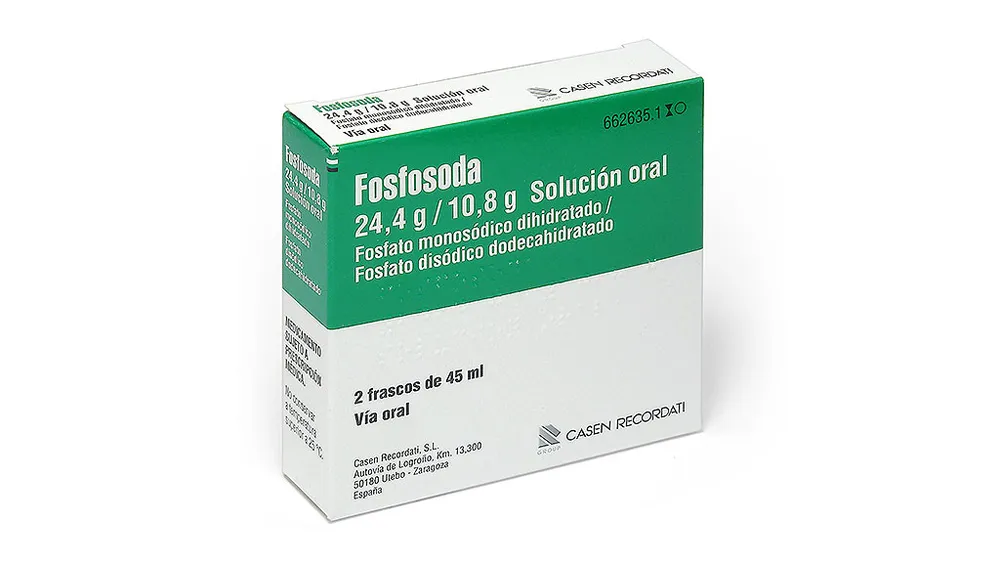
Table of Contents
- Package leaflet: Information for the user
- Introduction
- 1. What Fosfosoda is and what it is used for
- 2. What you need to know before taking Fosfosoda
- **Pregnancy, breastfeeding and fertility**
- 3. How to take Fosfosoda
- Follow exactly the administration instructions for this medication as indicated by your doctor or pharmacist. If in doubt, consult your doctor or pharmacist again.
- ? Before you start taking Fosfosoda and until after your examination, it is important that you drink only "CLEAR LIQUID." Do not consume any solid food. "CLEAR LIQUID" includes water; clear broth or strained broth to remove any solids; fruit juices without pulp (but not red or purple-colored ones); black tea or coffee without milk, and carbonated or non-carbonated soft drinks, such as lemonade.
- **APPOINTMENT DAY**
- *Immediately take your second dose (see description above)*.**
- You may continue drinking "CLEAR LIQUID" until 8:00 a.m. when you are thirsty. If you drink "CLEAR LIQUID" after 8:00 a.m., you may need to go to the bathroom several times, which could make it difficult for you to attend your hospital appointment.
- 4. Possible adverse effects
- 5. Storage of Fosfosoda
- 6. Package contents and other information
Package leaflet: Information for the user
Introduction
PACKAGE LEAFLET: INFORMATION FOR THE USER
Fosfosoda 24.4 g/10.8 g oral solution
Monosodium phosphate dihydrate, Disodium phosphate dodecahydrate
Read the entire leaflet carefully before you start taking this medicine, because it contains important information for you.
- Keep this leaflet, as you may need to read it again.
- If you have any questions, ask your doctor, pharmacist or nurse.
- This medicine has been prescribed for you only, and you should not give it to others, even if they have the same symptoms as you, because it could harm them.
- If you experience any adverse effects, consult your doctor, pharmacist or nurse, even if these are effects not listed in this leaflet. See section 4.
Leaflet contents:
- What Fosfosoda is and what it is used for
- What you need to know before taking Fosfosoda
- How to take Fosfosoda
- Possible side effects
- How to store Fosfosoda
Pack contents and other information
1. What Fosfosoda is and what it is used for
Fosfosoda is an intestinal evacuant that works by increasing the water content of your stools. It is a solution that you drink and comes in packages containing two 45 ml bottles. Each bottle contains one dose which must be diluted in water before use (see section 3).
You need to take Fosfosoda to clean your large intestine or colon before an endoscopy, intestinal surgery, or radiological examination. It is important that your intestine is completely clean so that your doctor can see it clearly.
Fosfosoda is not a treatment for constipation.
Fosfosoda is indicated in adults.
2. What you need to know before taking Fosfosoda
Do not take Fosfosoda if
- You are allergic to disodium phosphate dodecahydrate, sodium dihydrogen phosphate dihydrate, or to any of the other ingredients of this medicine (listed in section 6).
- You are under 18 years of age.
- You feel unwell, are vomiting, or have abdominal pain.
- You have kidney disease.
- You have symptomatic heart failure.
- You have an abnormal accumulation of fluid between the abdomen and abdominal organs (ascites).
- You know or suspect you have intestinal obstruction, perforation, or intestinal paralysis.
- You have an enlarged colon (megacolon), either hereditary or acquired.
- You have active inflammatory bowel disease.
- You have overactive parathyroid glands (hyperparathyroidism).
Do not take Fosfosoda in combination with other laxative products containing sodium phosphate.
Consult your doctor if you think any of the above conditions apply to you.
Your doctor will then decide whether Fosfosoda is suitable for you.
Warnings and precautions
Talk to your doctor, pharmacist, or nurse before starting to take Fosfosoda.
Take special care with Fosfosoda
- If you are weak or elderly (65 years of age or older).
- If you have heart or kidney disease.
- If you have disturbances in your body's salt levels (electrolyte imbalances) or are at risk of such disturbances, for example if you are dehydrated.
- If you have low blood pressure or reduced intestinal motility in part or all of your intestine.
- If you have had a colostomy or ileostomy (a surgical procedure in which a portion of the colon or ileum is brought through an opening in the abdominal wall).
- If you have undergone any other type of stomach or intestinal surgery.
- If you are on a low-salt diet (see also “Important information about some of the ingredients of Fosfosoda” at the end of section 2)
Talk to your doctor, even if any of the above conditions are currently present or have occurred in the past. Fosfosoda may slightly alter your heart rhythm due to imbalances in salts (electrolytes), so you may require direct medical supervision during treatment.
Keep in mind that after taking Fosfosoda you will experience frequent liquid bowel movements. You must drink as much "CLEAR LIQUID" (see section 3) as possible to avoid dehydration.
This product usually takes effect within 30 minutes to 6 hours. If you have not had a bowel movement within 6 hours after the first or second dose, stop taking the product and contact a doctor immediately, as you may become dehydrated.
Other medicines and Fosfosoda
Tell your doctor or pharmacist if you are taking, have recently taken, or might need to take any other medicines, especially if you are taking medications for:
- High blood pressure (hypertension) or angina (e.g. calcium channel blockers, angiotensin-converting enzyme inhibitors (ACE inhibitors), and angiotensin receptor antagonists (ARBs)),
- Medicines that increase urine excretion (diuretics),
- Non-steroidal anti-inflammatory drugs (NSAIDs), such as aspirin,
- Certain medicines for mental disorders (those containing lithium),
- Other drugs that may dehydrate you or alter your body's salt levels (potassium, sodium, phosphate, or water) (electrolyte balance),
- Medicines that affect heart rhythm,
- Medicines containing parathyroid hormone,
- Medicines usually taken orally: for example, oral contraceptives, antiepileptics, antidiabetics, or antibiotics, because Fosfosoda may reduce or even nullify the body's absorption of these medicines, reducing or eliminating their effect.
Consult your doctor or pharmacist if you have any doubts.
Taking Fosfosoda with food and drink
See section 3 of this leaflet.
Pregnancy, breastfeeding and fertility
If you are pregnant or breastfeeding, think you may be pregnant, or are planning to become pregnant, consult your doctor or pharmacist before using this medicine. You should not take this medicine during pregnancy unless your doctor considers it necessary. If you are breastfeeding, it is recommended to express and discard breast milk from the time of taking the first dose until 24 hours after taking the second dose of the bowel evacuant solution. You must not breastfeed your child during the 24 hours following the administration of the second dose of Fosfosoda.
Weakened patients and elderly (65 years and older)
Please pay special attention to the instructions in the sections “Take special care with Fosfosoda” and “If you are taking other medicines,” as well as the instructions on how to take this medicine in section 3 (below). You may require special medical supervision.
Driving and use of machines
Do not drive, operate machinery or tools if you feel tired or dizzy, or think you may be dehydrated after taking Fosfosoda. You should remain close to a toilet after taking this medicine.
Fosfosoda contains sodium
This medicine contains 5000 mg of sodium (the main component of table/cooking salt) in each 45 ml dose. This corresponds to 250% of the maximum recommended daily sodium intake for an adult. Patients on low-sodium (low-salt) diets should take into account the potential harm this may cause.
Fosfosoda contains ethanol
This medicine contains 29 mg of alcohol (ethanol) in each 45 ml dose. The amount in 45 ml of this medicine is equivalent to less than 0.73 ml of beer or 0.29 ml of wine. The small amount of alcohol contained in this medicine does not produce any noticeable effect.
Fosfosoda contains sodium benzoate
This medicine contains 15 mg of sodium benzoate (E 211) in each 45 ml dose.
3. How to take Fosfosoda
Follow exactly the administration instructions for this medication as indicated by your doctor or pharmacist. If in doubt, consult your doctor or pharmacist again.
? Before you start taking Fosfosoda and until after your examination, it is important that you drink only "CLEAR LIQUID." Do not consume any solid food. "CLEAR LIQUID" includes water; clear broth or strained broth to remove any solids; fruit juices without pulp (but not red or purple-colored ones); black tea or coffee without milk, and carbonated or non-carbonated soft drinks, such as lemonade.
- To help prevent nausea while taking this medication, you should drink as much "CLEAR LIQUID" as possible.
- Fosfosoda causes several diarrhea-like bowel movements. It usually starts working within 30 minutes, and its effect may last up to 6 hours. Please stay close to a toilet until bowel movements stop.
- If you have not had a bowel movement within 6 hours after taking either the first or second dose, consult a doctor immediately, as you may become dehydrated.
You must begin taking Fosfosoda THE DAY BEFORE your hospital appointment.
How to take your first or second dose
Dilute the contents of one bottle (45 ml) of Fosfosoda in half a glass of cold water (120 ml). Drink this mixture, then follow it immediately with at least one full glass (240 ml) of cold water. Continue drinking as much "CLEAR LIQUID" as possible to replace fluids lost during bowel movements.
When to take your first or second dose
Please read the instructions below based on the time of your hospital appointment.
If you do not follow these instructions completely, your examination or surgery may not be possible.
MORNING APPOINTMENT: 8:00 – 12:00 HOURS
DAY BEFORE THE APPOINTMENT
At 7:00 a.m., drink at least one full glass (240 ml) of a "CLEAR LIQUID" for breakfast. You may drink more if desired.
Immediately after, take yourfirst dose (see instructions above).
At 1:00 p.m., drink at least three full glasses (720 ml) more of "CLEAR LIQUID" for lunch. During the afternoon, you may continue drinking "CLEAR LIQUID" as needed when thirsty.
At 7:00 p.m., drink at least one full glass (240 ml) of "CLEAR LIQUID." You may drink more if desired.
Immediately after, take yoursecond dose (see instructions above).
You may continue drinking "CLEAR LIQUID" until midnight when thirsty. Drinking "CLEAR LIQUID" after midnight may cause you to use the bathroom several times, which could interfere with sleep.
AFTERNOON APPOINTMENTS: 12:00 – 5:00 P.M.
DAY BEFORE THE APPOINTMENT
At 1:00 p.m., have a light meal, for example, broth and a sandwich. Do not eat any more solid food until after your hospital appointment. During the afternoon, you may drink "CLEAR LIQUID" if thirsty.
At 7:00 p.m., drink at least one full glass (240 ml) of "CLEAR LIQUID" for dinner. You may drink more if desired.
Immediately after, take yourfirst dose (see instructions above).
During the evening, you must drink at least three additional full glasses (720 ml) of water or "CLEAR LIQUID" before going to bed.
APPOINTMENT DAY
At 7 a.m., drink at least one full glass of a "CLEAR LIQUID" for breakfast. You may drink more if desired.
Immediately take your second dose (see description above).**
You may continue drinking "CLEAR LIQUID" until 8:00 a.m. when you are thirsty. If you drink "CLEAR LIQUID" after 8:00 a.m., you may need to go to the bathroom several times, which could make it difficult for you to attend your hospital appointment.
After your hospital visit, make sure you drink plenty of fluids to replace those you lost while taking Fosfosoda.
If you take more Fosfosoda than you should
In case of overdose or accidental ingestion, contact your doctor or pharmacist immediately or call the Toxicology Information Service at telephone number 91 562 04 20, indicating the medication and the amount ingested.
You may become dehydrated, experience heart and circulation problems, have difficulty breathing, feel anxious, or suffer from colicky-type pains.
If you forget to take Fosfosoda
Please consult your doctor. Do not take a double dose to make up for forgotten doses.
4. Possible adverse effects
Like all medicines, this medicine can cause adverse effects, although not everyone experiences them.
Very rarely, Fosfosoda may cause serious allergic reactions with or without rash. Inform your doctor immediately or contact the emergency service at your nearest hospital if your hands, face, lips, throat or tongue begin to swell, or if you have difficulty breathing or swallowing.
Other possible adverse effects of Fosfosoda:
Very common (may affect more than 1 in 10 people)
Nausea, abdominal pain, bloating and diarrhoea, chills, weakness and dizziness.
Common (may affect up to 1 in 10 people)
Vomiting, chest pain and headache.
Uncommon (may affect up to 1 in 100 people)
Dehydration.
Rare (may affect up to 1 in 1,000 people)
Increased calcium levels in the kidneys.
Very rare (may affect up to 1 in 10,000 people)
Heart attack, palpitations, low blood pressure, disturbances in blood electrolyte levels (which may cause muscle twitching and spasms), cramps, tingling, loss of consciousness and kidney failure.
Not known (frequency cannot be estimated from available data)
Hyponatremia (low sodium concentration in the blood which may cause neurological disorders such as confusion, coma or seizures).
If you consider any of the adverse effects you experience to be severe, or if you notice any adverse effects not listed in this leaflet, inform your doctor or pharmacist.
Reporting of adverse effects
If you experience any type of adverse effect, consult your doctor, pharmacist or nurse, even if it is a possible adverse effect not listed in this leaflet. You can also report them directly via the Spanish Pharmacovigilance System for Human Medicinal Products (www.notificaRAM.es). By reporting adverse effects, you can help provide more information on the safety of this medicine.
5. Storage of Fosfosoda
Keep this medicine out of the sight and reach of children.
Do not use this medicine after the expiry date stated on the packaging after Exp. The expiry date is the last day of the month indicated.
Do not store above 25 °C.
Once the container is opened, use immediately. Discard any unused solution.
Medicines must not be disposed of via wastewater or household waste. Dispose of empty containers and unused medicines at the SIGRE collection point at your pharmacy. Ask your pharmacist how to dispose of containers and medicines you no longer need. This way, you will help protect the environment.
6. Package contents and other information
Composition of Fosfosoda
- The active substances are monosodium phosphate dihydrate 24.4 g and disodium phosphate dodecahydrate 10.8 g per 45 ml dose.
- The other components are: Sodium benzoate (E211); sodium saccharin; glycerol; purified water; ginger and lemon flavour composed of ginger oleoresin; alcohol; lemon essence; partially deterpinated lemon essence; citric acid and purified water.
Appearance of the product and contents of the container
Fosfosoda is a clear, colourless oral solution with a ginger and lemon odour, supplied in containers containing either two or one hundred 45 ml bottles sealed with screw caps. Each bottle contains one dose. Only certain pack sizes may be marketed.
Marketing Authorization Holder and Manufacturer
Casen Recordati, S.L., Autovía de Logroño, km 13.300, 50180 Utebo, Zaragoza, Spain
This medicinal product is authorised in the Member States of the European Economic Area and in the United Kingdom (Northern Ireland) under the following names:
Denmark: Phosphoral oral opløsning
Finland: Phosphoral oraaliliuos
France: Recholan, solution buvable
Germany: Phospho-soda Lösung zum Einnehmen
Greece: Phospho-soda
Ireland: Phospho-soda oral solution
Netherlands: Phosphoral, drank
Portugal: Phospho-Soda Solução oral
Spain: Fosfosoda solución oral
Sweden: Phosphoral oral lösning
United Kingdom (Northern Ireland): Phospho-soda oral solution
Date of the most recent revision of this leaflet: March 2022
Other sources of information
Detailed information on this medicinal product is available on the website of the Spanish Agency for Medicines and Health Products (AEMPS) http://www.aemps.gob.es/