Forxiga 10 mg film-coated tablets
Spain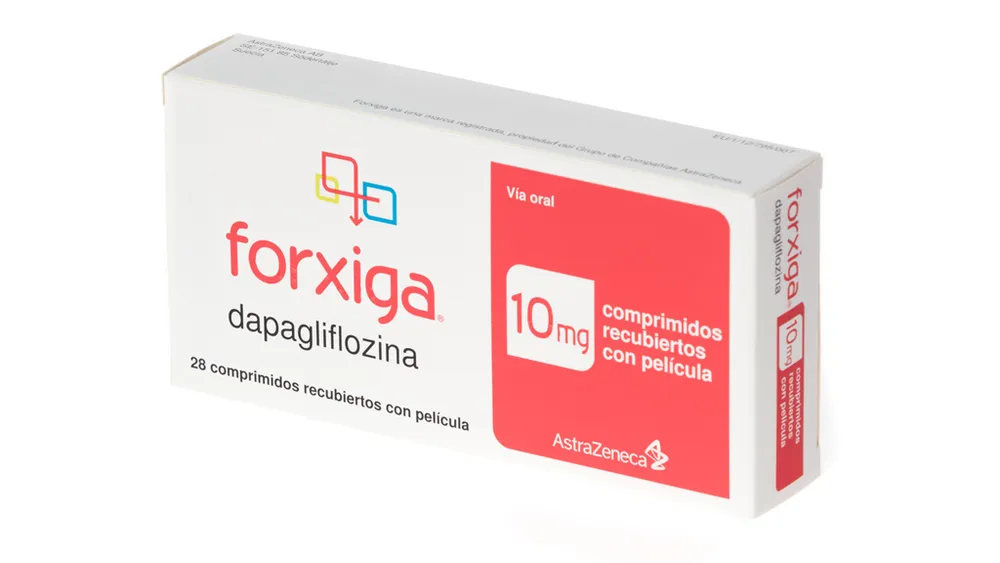
Table of Contents
Package leaflet: Information for the user
Introduction
Package leaflet: information for the patient
Forxiga 5 mg film-coated tablets
Forxiga 10 mg film-coated tablets
dapagliflozin
Read the entire leaflet carefully before you start taking this medicine, because it contains important information for you.
- Keep this leaflet; you may need to read it again.
- If you have any questions, ask your doctor, pharmacist, or nurse.
- This medicine has been prescribed for you only, and you should not give it to other people, even if they have the same symptoms as you, because it may harm them.
- If you experience any adverse effects, consult your doctor or pharmacist, even if they are adverse effects not listed in this leaflet. See section 4.
Contents of the leaflet
- What Forxiga is and what it is used for
- Before you take Forxiga
- How to take Forxiga
- Possible side effects
- How to store Forxiga
- Further information
1. What Forxiga is and what it is used for
What Forxiga is
Forxiga contains the active substance dapagliflozin. It belongs to a group of medicines called "sodium-glucose cotransporter 2 (SGLT2) inhibitors". These work by blocking the SGLT2 protein in the kidney. By blocking this protein, blood sugar (glucose), salt (sodium), and water are removed from the body through the urine.
What Forxiga is used for
Forxiga is used to treat:
-
Type 2 diabetes
-
in adults and children 10 years of age and older.
-
if your type 2 diabetes cannot be controlled by diet and exercise alone.
-
Forxiga can be used alone or together with other medicines for diabetes.
-
it is important that you continue to follow the dietary and exercise advice given to you by your doctor, pharmacist, or nurse.
-
Heart failure
-
in adults (18 years of age and older) when the heart does not pump blood as well as it should.
-
Chronic kidney disease
-
in adults with reduced kidney function.
What is type 2 diabetes and how does Forxiga help?
- In type 2 diabetes, your body either does not produce enough insulin or is unable to use the insulin it produces effectively. This leads to high blood sugar levels. This can cause serious problems such as heart or kidney disease, blindness, and poor circulation in the arms and legs.
- Forxiga works by removing excess sugar from your body. It may also help prevent heart disease.
What is heart failure and how does Forxiga help?
-
This type of heart failure occurs when the heart does not pump blood to the lungs and the rest of the body as effectively as it should. This can lead to serious medical problems and the need for hospitalization.
-
The most common symptoms of heart failure are shortness of breath, constant tiredness, and swelling of the ankles.
-
Forxiga helps protect the heart from worsening and improves your symptoms. It may reduce the need for hospitalization and may help some patients live longer.
What is chronic kidney disease and how does Forxiga help?
- When you have chronic kidney disease, your kidneys may gradually lose their function. This means they are no longer able to clean and filter your blood as they should. Loss of kidney function can lead to serious medical problems and the need for hospitalization.
- Forxiga helps protect your kidneys from further loss of function. This may help some patients live longer.
2. What you need to know before taking Forxiga
Do not take Forxiga
- if you are allergic to dapagliflozin or to any of the other ingredients of this medicine (listed in section 6).
Warnings and precautions
Contact a doctor or the nearest hospital immediately
Diabetic ketoacidosis:
- If you have diabetes and experience nausea or vomiting, stomach pain, excessive thirst, rapid and deep breathing, confusion, drowsiness or unusual tiredness, sweet-smelling breath, a sweet or metallic taste in your mouth, or a different smell in your urine or sweat, or rapid weight loss.
- The above symptoms may be signs of “diabetic ketoacidosis” – a rare but serious condition, sometimes potentially life-threatening, which occurs in diabetes due to an increase in “ketone bodies” in your blood or urine, detectable through laboratory tests.
- The risk of developing diabetic ketoacidosis may be increased by prolonged fasting, excessive alcohol consumption, dehydration, sudden reductions in insulin dose, or increased insulin requirements due to major surgery or serious illness.
- Diabetic ketoacidosis may occur while being treated with Forxiga even when your blood glucose levels are normal.
If you suspect you have diabetic ketoacidosis, contact a doctor or the nearest hospital immediately and do not take this medicine.
Fournier’s gangrene (necrotizing fasciitis of the perineum):
- Contact your doctor immediately if you develop a combination of symptoms such as pain, tenderness, redness or swelling of the genitals or the area between the genitals and the anus, accompanied by fever or general malaise. These symptoms could indicate a rare but serious, even potentially life-threatening infection called necrotizing fasciitis of the perineum or Fournier’s gangrene, which destroys tissue under the skin. Fournier’s gangrene requires immediate treatment.
Contact a doctor, pharmacist, or nurse before starting Forxiga
- if you have “type 1 diabetes” – the type that usually appears at a young age and in which your body produces no insulin. Forxiga should not be used to treat this condition.
- if you have diabetes and have kidney problems – your doctor may prescribe an additional or different medicine to control your blood sugar.
- if you have liver problems – your doctor may start you on a lower dose.
- if you are taking medicines to lower your blood pressure (antihypertensives) or have a history of low blood pressure (hypotension). More information is provided later under "Taking Forxiga with other medicines."
- if you have very high blood sugar levels that could lead to dehydration (loss of too much fluid from your body). Possible signs of dehydration are listed in section 4. Inform your doctor before starting Forxiga if you have any of these signs.
- if you have or develop nausea, vomiting, fever, or are unable to eat or drink. These conditions may cause dehydration. Your doctor may advise you to stop taking Forxiga until you recover to prevent dehydration.
- if you frequently get urinary tract infections.
If any of the above situations apply to you (or if you are unsure), speak with your doctor, pharmacist, or nurse before taking Forxiga.
Diabetes and foot care
If you have diabetes, it is important to regularly check your feet and follow any foot care advice given by your healthcare professional.
Glucose in urine
Because of how Forxiga works, your urine will test positive for glucose while you are taking this medicine.
Children and adolescents
Forxiga can be used in children aged 10 years and older for the treatment of type 2 diabetes. There are no data available in children under 10 years of age.
Forxiga is not recommended in children and adolescents under 18 years of age for the treatment of heart failure or chronic kidney disease, as it has not been studied in these patients.
Taking Forxiga with other medicines
Tell your doctor, pharmacist, or nurse if you are taking, have recently taken, or might need to take any other medicines.
In particular, inform your doctor:
- if you are taking a medicine used to remove fluid from the body (a diuretic).
- if you are taking other medicines that lower blood sugar levels, such as insulin or a “sulfonylurea” medicine. Your doctor may decide to reduce the dose of these medicines to prevent low blood sugar levels (hypoglycaemia).
- if you are taking lithium, as Forxiga may reduce the amount of lithium in your blood.
Pregnancy and breastfeeding
If you are pregnant or breastfeeding, think you may be pregnant, or are planning to become pregnant, consult your doctor or pharmacist before taking this medicine. You must stop taking this medicine if you become pregnant, as it is not recommended during the second and third trimesters of pregnancy. Talk to your doctor about the best way to control blood glucose during pregnancy.
Consult your doctor if you are breastfeeding or planning to breastfeed before taking this medicine. Do not use Forxiga while breastfeeding. It is unknown whether this medicine passes into human breast milk.
Driving and using machines
Forxiga has no or negligible influence on the ability to drive or use machines.
Taking this medicine together with other medicines called sulfonylureas or with insulin may cause very low blood sugar levels (hypoglycaemia), which can lead to symptoms such as trembling, sweating, and vision disturbances that may affect your ability to drive or use machines.
Do not drive or operate tools or machinery if you feel dizzy while taking Forxiga.
Forxiga contains lactose
Forxiga contains lactose. If your doctor has informed you of an intolerance to certain sugars, consult with them before taking this medicine.
3. How to take Forxiga
Follow exactly the instructions given by your doctor for taking this medicine. If in doubt, consult your doctor, pharmacist, or nurse again.
What dose to take
- The recommended dose is one 10 mg tablet daily.
- Your doctor may start you on a 5 mg dose if you have a liver problem.
- Your doctor will prescribe the appropriate dose for you.
How to take this medicine
- Swallow the tablet whole with half a glass of water.
- You may take the tablet with or without food.
- You may take the tablet at any time of day. However, try to take it at the same time each day. This will help you remember to take it.
Your doctor may prescribe Forxiga together with another medicine(s). Remember to take these other medicines according to your doctor's instructions. This will help achieve the best results for your health.
Diet and exercise may help your body use blood sugar more effectively. If you have diabetes, it is important to follow any diet and exercise plan recommended by your doctor while taking Forxiga.
If you take more Forxiga than you should
If you take more Forxiga tablets than you should, contact your doctor or go to a hospital immediately. Take the medicine pack with you.
If you forget to take Forxiga
What you should do if you forget to take a tablet depends on how long it is until your next dose.
- If there are 12 hours or more until your next dose, take a dose of Forxiga as soon as you remember. Then take your next dose at the usual time.
- If there are less than 12 hours until your next dose, skip the missed dose. Take your next dose at the usual time.
- Do not take a double dose of Forxiga to make up for a missed dose.
If you stop taking Forxiga
Do not stop taking Forxiga without first consulting your doctor. If you have diabetes, your blood sugar may rise without this medicine.
If you have any further questions about the use of this product, ask your doctor, pharmacist, or nurse.
4. Possible adverse effects
Like all medicines, Forxiga may cause adverse effects, although not everybody gets them.
Contact a doctor or the nearest hospital immediately if you experience any of the following adverse effects:
- Angioedema, very rare (may affect up to 1 in 10,000 people).
These are the signs of angioedema:
-
swelling of the face, tongue, or throat
-
difficulty swallowing
-
hives and breathing difficulties
-
Diabetic ketoacidosis, rare in patients with type 2 diabetes (may affect up to 1 in 1,000 people).
These are the signs of diabetic ketoacidosis (see also section 2, Warnings and precautions):
- increased levels of “ketone bodies” in your urine or blood
- nausea or vomiting
- stomach pain
- excessive thirst
- rapid and deep breathing
- confusion
- unusual drowsiness and tiredness
- sweet smell on your breath, a sweet or metallic taste in your mouth, or a different odor in your urine or sweat
- rapid weight loss
This may occur regardless of blood sugar levels. Your doctor must decide whether to temporarily or permanently discontinue your treatment with Forxiga.
- Necrotizing fasciitis of the perineum or Fournier’s gangrene, a serious infection of the soft tissues of the genitals or the area between the genitals and the anus, very rare.
Stop taking Forxiga and consult a doctor immediately if you notice any of these serious adverse effects:
- Urinary tract infection, common (may affect up to 1 in 10 people).
These are the signs of a serious urinary tract infection:
- fever and/or chills
- burning sensation when urinating (urinating)
- back or side pain
Although not common, if you notice blood in your urine, inform your doctor immediately.
Contact your doctor as soon as possible if you experience any of the following adverse effects:
- Reduction in blood sugar levels (hypoglycaemia), very common (may affect more than 1 in 10 people) in patients with diabetes who take this medicine together with a sulfonylurea or insulin.
The signs of low blood sugar are:
- chills, sweating, feeling very anxious, rapid heartbeat
- feeling of hunger, headache, vision disturbances
- change in mood or feeling confused.
Your doctor will explain how to treat low blood sugar levels and what to do if you experience any of the above signs.
Other adverse effects of Forxiga treatment:
Common
- genital infections (candidiasis) of the penis or vagina (signs may include irritation, itching, and abnormal discharge or odor)
- back pain
- increased urine volume or need to urinate more frequently
- changes in blood cholesterol or lipid levels (observed in blood tests)
- increases in red blood cell count (observed in blood tests)
- decreases in creatinine renal clearance (observed in blood tests) at the beginning of treatment
- dizziness
- rash
Uncommon (may affect up to 1 in 100 people)
- excessive loss of body fluids (dehydration; signs may include very dry or sticky mouth, little or no urination, or rapid heartbeat)
- thirst
- constipation
- waking up at night due to need to urinate
- dry mouth
- weight loss
- increase in creatinine (observed in blood tests) at the beginning of treatment
- increase in urea (observed in blood tests)
Very rare
- inflammation of the kidneys (tubulointerstitial nephritis)
Reporting of adverse effects
If you experience any type of adverse effect, talk to your doctor, pharmacist, or nurse, even if it is a possible adverse effect not listed in this leaflet. You can also report them directly through the national reporting system included in Appendix V. By reporting adverse effects, you can help provide more information on the safety of this medicine.
5. Storage of Forxiga
Keep this medicine out of the sight and reach of children.
Do not use this medicine after the expiry date stated on the blister or packaging following EXP/EXP. The expiry date refers to the last day of the month indicated.
No special storage conditions are required.
Medicines should not be disposed of via wastewater or household waste. Ask your pharmacist how to dispose of any unused medicines and their packaging. This will help protect the environment.
6. Contents of the pack and other information
Composition of Forxiga
- The active substance is dapagliflozin.
Each film-coated tablet (tablet) of Forxiga 5 mg contains dapagliflozin propanediol monohydrate equivalent to 5 mg of dapagliflozin.
Each film-coated tablet (tablet) of Forxiga 10 mg contains dapagliflozin propanediol monohydrate equivalent to 10 mg of dapagliflozin.
-
The other components are:
-
tablet core: microcrystalline cellulose (E460i), lactose (see section 2 “Forxiga contains lactose”), crospovidone (E1202), silicon dioxide (E551), magnesium stearate (E470b).
-
coating: polyvinyl alcohol (E1203), titanium dioxide (E171), macrogol 3350 (E1521), talc (E553b), yellow iron oxide (E172).
Appearance of the product and contents of the pack
The film-coated tablets of Forxiga 5 mg are yellow, round, with a diameter of 0.7 cm. They are marked with “5” on one side and “1427” on the other.
The film-coated tablets of Forxiga 10 mg are yellow, diamond-shaped, approximately 1.1 x 0.8 cm diagonally. They are marked with “10” on one side and “1428” on the other.
Forxiga 5 mg tablets are available in aluminum blisters in pack sizes of 14, 28 or 98 film-coated tablets in non-perforated calendar blisters, and in packs of 30x1 or 90x1 film-coated tablets in pre-perforated unit-dose blisters.
Forxiga 10 mg tablets are available in aluminum blisters in pack sizes of 14, 28 or 98 film-coated tablets in non-perforated calendar blisters, and in packs of 10x1, 30x1 or 90x1 film-coated tablets in pre-perforated unit-dose blisters.
Only certain pack sizes may be marketed in your country.
Marketing Authorization Holder
AstraZeneca AB
SE-151 85 Södertälje
Sweden
Manufacturer
AstraZeneca AB
Gärtunavägen
SE-152 57 Södertälje
Sweden
AstraZeneca UK Limited
Silk Road Business Park
Macclesfield
SK10 2NA
United Kingdom
For further information about this medicinal product, please contact the local representative of the Marketing Authorization Holder:
Belgium/Belgium/Belgium AstraZeneca S.A./N.V. Tel: +32 2 370 48 11 | Lithuania UAB AstraZeneca Lietuva Tel: +370 5 2660550 |
| Luxembourg/Luxembourg AstraZeneca S.A./N.V. Tél/Tel: +32 2 370 48 11 |
Czech Republic AstraZeneca Czech Republic s.r.o. Tel: +420 222 807 111 | Hungary AstraZeneca Kft. Tel.: +36 1 883 6500 |
Denmark AstraZeneca A/S Tlf: +45 43 66 64 62 | Malta Associated Drug Co. Ltd Tel: +356 2277 8000 |
Germany AstraZeneca GmbH Tel: +49 40 809034100 | Netherlands AstraZeneca BV Tel: +31 85 808 9900 |
Estonia AstraZeneca Tel: +372 6549 600 | Norway AstraZeneca AS Tlf: +47 21 00 64 00 |
Greece AstraZeneca A.E. Tel: +30 2 106871500 | Austria AstraZeneca Österreich GmbH Tel: +43 1 711 31 0 |
Spain AstraZeneca Farmacéutica Spain, S.A. Tel: +34 91 301 91 00 | Poland AstraZeneca Pharma Poland Sp. z o.o. Tel.: +48 22 245 73 00 |
France AstraZeneca Tél: +33 1 41 29 40 00 | Portugal AstraZeneca Produtos Farmacêuticos, Lda. Tel: +351 21 434 61 00 |
Croatia AstraZeneca d.o.o. Tel: +385 1 4628 000 | Romania AstraZeneca Pharma SRL Tel: +40 21 317 60 41 |
Ireland AstraZeneca Pharmaceuticals (Ireland) DAC Tel: +353 1609 7100 | Slovenia AstraZeneca UK Limited Tel: +386 1 51 35 600 |
Iceland Vistor Sími: +354 535 7000 | Slovakia AstraZeneca AB, o.z. Tel: +421 2 5737 7777 |
Italy AstraZeneca S.p.A. Tel: +39 02 00704500 | Finland AstraZeneca Oy Puh/Tel: +358 10 23 010 |
Cyprus Aléktōr Pharmakeutikē Ltd Tel: +357 22490305 | Sweden AstraZeneca AB Tel: +46 8 553 26 000 |
Latvia SIA AstraZeneca Latvija Tel: +371 67377100 |
Date of the most recent review of this leaflet:
Other sources of information
Detailed information on this medicinal product is available on the European Medicines Agency website: https://www.ema.europa.eu.