Foliferron 100 mg / 0.150 mg film-coated tablets
Spain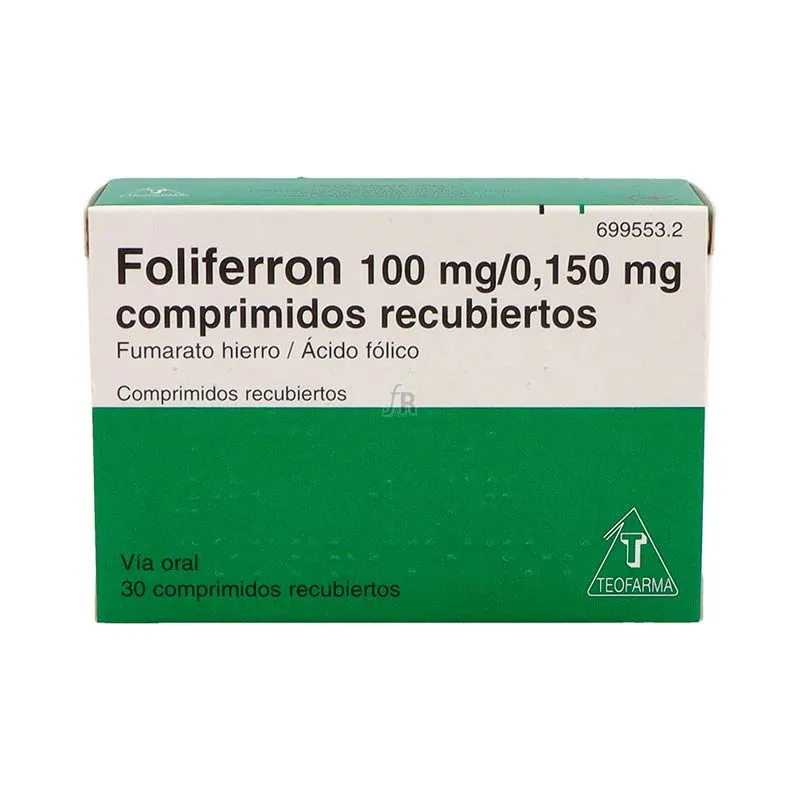
Table of Contents
Package leaflet: Information for the user
Introduction
PACKAGE LEAFLET: INFORMATION FOR THE USER
FOLIFERRON 100 mg / 0.150 mg film-coated tablets
Ferrous fumarate / Folic acid
Read the entire leaflet carefully before starting to take this medicine, because it contains important information for you.
Follow exactly the instructions for administration of the medicine contained in this leaflet or those indicated by your doctor.
- Keep this leaflet, as you may need to read it again.
- If you need advice or more information, consult your pharmacist.
- If you experience any adverse reactions, consult your doctor or pharmacist, even if they are adverse reactions not listed in this leaflet. See section 4.
- You should consult your doctor if you worsen or do not improve.
Leaflet contents
- What Foliferron is and what it is used for.
- What you need to know before taking Foliferron.
- How to take Foliferron.
- Possible adverse effects.
- How to store Foliferron.
- Contents of the pack and other information
1. What Foliferron is and what it is used for
Foliferron tablets provide additional iron and folic acid (a vitamin), and are used to prevent iron and folic acid deficiencies in pregnant women, as well as to prevent certain fetal abnormalities.
2. What you need to know before taking Foliferron
Do not take Foliferron
- If you are allergic to iron, folic acid, or any of the other ingredients of this medicine (listed in section 6).
- If you have excess iron in your body (e.g. haemochromatosis, hemosiderosis).
- If you have vitamin B12 deficiency (megaloblastic anaemia).
- If you have undergone repeated blood transfusions.
- If you are receiving concomitant intravenous iron therapy.
Warnings and precautions
- Although rare, you may develop a hypersensitivity reaction to folic acid.
- If you have an acute gastrointestinal disorder (such as gastroduodenal ulcer or colitis).
- You should not use this medicine in certain types of anaemia, such as megaloblastic anaemia or pernicious anaemia.
- When taking Foliferron, your stools may become dark green or black. This effect is harmless.
Use of Foliferron with other medicines
Inform your doctor or pharmacist if you are taking or have recently taken any other medicines, including those obtained without a prescription.
Please note that these instructions may also apply to medicines that have been used previously or may be used in the future.
Inform your doctor if:
- you are taking barbiturates, as concomitant administration may reduce folic acid levels and the efficacy of the barbiturate.
- you are taking medicines containing cholestyramine or colestipol (medicines used to lower blood cholesterol levels), as they may decrease folic acid absorption.
- you are taking medicines containing sulfasalazine (used to treat inflammatory bowel diseases such as ulcerative colitis), as the requirement for folic acid may be increased in these patients.
- you have epilepsy and are being treated with anticonvulsants such as phenytoin and primidone, as Foliferron may increase the frequency of seizures.
- you are taking medicines containing pyrimethamine (used to treat malaria), as concomitant administration with folic acid may reduce the efficacy of pyrimethamine.
- you are taking medicines containing ascorbic acid (vitamin C), as iron absorption may be altered.
- you are being treated with proton pump inhibitors such as pantoprazole, esomeprazole, omeprazole, or lansoprazole, as they may reduce the effect of iron salts.
- you are being treated with medicines containing acetohydroxamic acid (used to treat infection-related kidney stones), as concomitant use with iron supplements reduces the absorption of these medicines.
- you are receiving treatment with dimercaprol (a medicine used as an antidote to treat poisoning by certain substances), as concomitant administration with iron produces a toxic complex; therefore, iron treatment should be postponed until at least 24 hours after discontinuation of dimercaprol.
- you are taking certain antibiotics such as tetracyclines or quinolones; you should take Foliferron at least two to three hours before or after the antibiotic.
- you are taking medicines containing thyroxine (for thyroid disorders) or penicillamine (an antirheumatic), as Foliferron may reduce the effect of these medicines; therefore, you should avoid taking Foliferron within two hours before or after administration of these medicines.
- you are taking antacids, calcium supplements, or medicines containing bicarbonate, carbonate, oxalates, or phosphates, as these compounds may reduce the absorption of Foliferron. You should take these medicines at least 2 hours after taking Foliferron.
- you are taking medicines containing chloramphenicol (an antibiotic), as they may reduce folic acid absorption and diminish the effect of iron.
- you are taking medicines containing methyldopa, as Foliferron may reduce its hypotensive effect.
- you are being treated with non-steroidal anti-inflammatory drugs such as salicylates or methylbutazone, as concomitant oral administration with Foliferron may result in mutual potentiation of gastrointestinal mucosal irritation effects.
- you are undergoing treatment with oral bisphosphonates, used for the treatment and prevention of osteoporosis; administration of Foliferron should be avoided within 2 hours before or after taking these medicines.
Use of Foliferron with food and drinks
Certain foods such as tea, coffee, milk, cereals, may reduce iron absorption.
Pregnancy, breastfeeding, and fertility
Consult your doctor or pharmacist before taking any medicine.
The use of Foliferron during pregnancy is safe, as pregnancy may lead to iron and folic acid deficiency, and therefore supplementation is recommended as prevention.
The use of iron and folic acid—the two active ingredients in Foliferron—during breastfeeding is safe, although folic acid is excreted in breast milk. This is a physiological situation in which deficiency in both nutrients may occur, and therefore supplementation is recommended as prevention.
Driving and using machines
The influence of Foliferron on the ability to drive and use machines is none or negligible.
Foliferron contains sucrose
If your doctor has diagnosed you with an intolerance to certain sugars, consult with him before taking this medicine.
3. How to take Foliferron
Follow exactly the administration instructions for Foliferron tablets provided by your doctor. Consult your doctor or pharmacist if you have any doubts.
The recommended dose is 1 tablet three times a day. Take the tablet whole, with a little water or fruit juice (avoid milk), preferably after meals.
If you take more Foliferron than you should
Overdose with Foliferron is rare in adults, but may occur in children. Toxicity due to excessive intake is related to iron overdose. If you have taken a large amount of Foliferron at once, you may experience stomach discomfort or other symptoms requiring urgent medical attention and treatment.
In case of overdose or accidental ingestion, consult your doctor or pharmacist or call the Toxicology Information Service at telephone number 915 620 420, indicating the medication and the amount used.
If you forget to take Foliferron
Remember to take your medication. If you forget to take a dose, take it as soon as possible, unless it is almost time for your next dose. Do not take a double dose to make up for missed doses.
If you have any further questions about the use of this product, ask your doctor or pharmacist.
4. Possible adverse effects
Like all medicines, Foliferron tablets can cause adverse effects, although not everyone will experience them.
The most frequent adverse effects (may affect up to 1 in 100 patients) are especially abdominal pain, acid reflux, nausea, vomiting, constipation, or diarrhea. Passing dark green or black stools is common due to iron excretion. This effect is harmless.
Rare adverse effects (may affect up to 1 in 1,000 patients): on rare occasions, a severe allergic reaction may occur. Consult your doctor immediately if you experience any of the following symptoms: flushing, itching/swelling (especially of the face, tongue, or throat), dizziness, and/or difficulty breathing.
Reporting of adverse effects
If you experience any type of adverse effect, consult your doctor, pharmacist, or nurse, even if it is a possible adverse effect not listed in this leaflet. You may also report them directly through the Spanish Pharmacovigilance System for Human Medicines: https://www.notificaram.es. By reporting adverse effects, you can help provide more information on the safety of this medicine.
5. Storage of Foliferron
Keep out of sight and reach of children.
Store at room temperature.
Do not use Foliferron after the expiry date which is stated on the packaging, after EXP. The expiry date refers to the last day of the month indicated.
Medicines should not be disposed of via wastewater drains or in household waste. Dispose of unused containers and medicines at the SIGRE collection point at your pharmacy. If in doubt, ask your pharmacist how to properly dispose of unused containers and medicines. This will help protect the environment.
6. Package contents and additional information
Composition of Foliferron tablets
- The active substances are: Iron (as ferrous fumarate) and folic acid. Each tablet contains 100 mg of ferrous fumarate (equivalent to 32.8 mg of iron) and 0.150 mg of folic acid.
- Other components: sucrose, corn starch, sodium carmellose, magnesium stearate, microcrystalline cellulose, povidone K90, cetyl alcohol, ethanol, colloidal silica, polyethylene glycol 3350, arabic gum, polyethylene glycol 6000, tricalcium basic phosphate, gelatin, polyvinyl acetate, Eudragit E; talc, red-brown iron oxide, yellow iron oxide (E-172), wax, and water.
Appearance of the medicinal product and contents of the pack
Foliferron are brown coated tablets in packs of 30 tablets.
Marketing Authorization Holder and Manufacturer
Teofarma S.R.L.
Via F.lli Cervi 8
27010 VALLE SALIMBENE (Pavia)
ITALY
Date of the most recent revision of this leaflet: January 2018
Detailed and up-to-date information on this medicinal product is available on the website of the Spanish Agency of Medicines and Medical Devices (AEMPS) http://www.aemps.gob.es