FML 1 mg/ml eye drops in suspension
Spain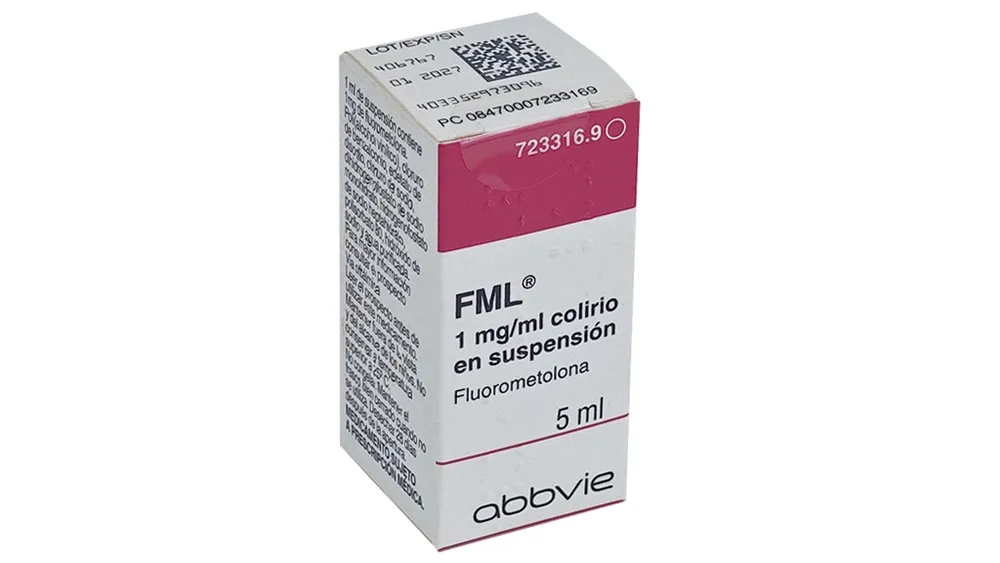
Table of Contents
Package leaflet: Information for the user
Introduction
Package leaflet: information for the user
FML 1 mg/ml eye drops, suspension
fluorometholone
Read the entire leaflet carefully before you start using this medicine, because it contains important information for you.
- Keep this leaflet, as you may need to read it again.
- If you have any questions, ask your doctor or pharmacist.
- This medicine has been prescribed for you only, and you should not give it to other people, even if they have the same symptoms as you, because it could harm them.
- If you experience any adverse effects, consult your doctor or pharmacist, even if these effects are not listed in this leaflet. See section 4.
Leaflet contents
- What FML is and what it is used for
- What you need to know before using FML
- How to use FML
- Possible side effects
- How to store FML
- Contents of the pack and other information
1. What FML is and what it is used for
It is an ophthalmic solution (eye drops) containing fluorometholone as the active substance, a corticosteroid used in the treatment of certain inflammatory ocular disorders.
FML eye drops are indicated for the treatment of non-infectious inflammatory conditions of the palpebral and bulbar conjunctivas (the transparent membranes covering the eye), the transparent convex membrane at the front part of the eye (cornea), and the anterior segment of the eye, which are responsive to corticosteroids.
2. What you need to know before using FML
Do not use FML:
- If you are allergic to fluorometholone or to any of the other ingredients of this medicine (listed in section 6).
- If you have or think you may have an eye infection caused by bacteria, viruses, or fungi; corneal inflammation (keratitis) caused by herpes simplex; or tuberculosis affecting the eye(s).
Warnings and precautions
Consult your doctor, pharmacist, or nurse before starting to use FML.
- Use this medicine only in your eye(s).
- You should not use FML for more than 10 days unless advised by your doctor or ophthalmologist.
- Use with caution if you have glaucoma or are taking medication to treat elevated intraocular pressure. Prolonged use of this medicine may lead to elevated ocular pressure and/or glaucoma (with optic nerve damage and reduced visual acuity). Eye pressure should be monitored regularly during treatment. Cataracts may also develop. Patients who are predisposed (e.g., those with diabetes or myopia) have a higher risk of developing ocular hypertension and cataracts. Consult your doctor if in doubt.
- If your symptoms worsen, contact your doctor. You may become more susceptible to eye infections while using this medicine. Corticosteroids may also mask signs of infection or worsen it, especially with prolonged use in purulent eye infections. If you already have a bacterial eye infection, consult your doctor regarding its treatment.
- Prolonged use of ophthalmic corticosteroids may lead to fungal infections of the cornea, in which case treatment must be discontinued. In addition, excessive doses may delay healing of eye injuries.
It is also known that ophthalmic NSAIDs (Non-Steroidal Anti-Inflammatory Drugs) may slow or delay healing (see section "Other medicines and FML").
- If you have any condition or are undergoing treatment that causes thinning of the cornea or the white part of the eye (sclera), use of this medicine may lead to corneal perforation.
- Contact your doctor if you experience blurred vision or other visual disturbances.
Children
The efficacy and safety of this medicine have not been established in children under 3 years of age.
The potential increase in intraocular pressure caused by prolonged use of this medicine is of particular concern in children; the risk of ocular hypertension may be higher in children and may occur earlier than in adults. In addition, topical corticosteroids may cause systemic effects in children.
Other medicines and FML
Inform your doctor or pharmacist if you are taking, have recently taken, or might need to take any other medicines.
Inform your doctor if you are using ophthalmic NSAIDs (Non-Steroidal Anti-Inflammatory Drugs). The combined use of steroids and ophthalmic NSAIDs may increase problems with corneal healing.
Some medicines may increase the effects of FML, so your doctor will closely monitor you if you are taking these medicines (including some used for HIV: ritonavir, cobicistat).
Pregnancy, breastfeeding, and fertility
If you are pregnant or breastfeeding, think you may be pregnant, or are planning to become pregnant, consult your doctor or pharmacist before using this medicine. The use of FML is not recommended during pregnancy and should not be used during breastfeeding.
Driving and using machines
You may notice blurred vision for a short time after applying the eye drops.
Do not drive or operate machinery until your vision is clear.
FML contains benzalkonium chloride and phosphates
This medicine contains 0.046 mg of benzalkonium chloride per ml.
Benzalkonium chloride may be absorbed by soft contact lenses, altering their color. Remove contact lenses before using this medicine and wait 15 minutes before reinserting them.
Benzalkonium chloride may cause eye irritation, especially if you have dry eye or other corneal conditions (the transparent layer at the front of the eye). Consult your doctor if you experience a foreign body sensation, stinging, or eye pain after using this medicine.
This medicine contains 4.86 mg of phosphates per ml.
If you have severe corneal damage (the transparent layer at the front of the eye), treatment with phosphates may, in very rare cases, cause blurred vision due to calcium accumulation.
3. How to use FML
Follow exactly the administration instructions for this medicine given by your doctor. If in doubt, consult your doctor or pharmacist again.
Ophthalmic route (in the eye[s]).
Recommended dose:
Adults and children over 3 years of age:
1 drop in the affected eye(s) 2 to 4 times a day. During the first 24 to 48 hours of treatment, if necessary, your doctor may recommend applying 1 drop every 4 hours.
If you have glaucoma, treatment should not exceed 2 weeks unless your doctor has given you different instructions (see section 2).
Prolonged treatment should be avoided.
If continued treatment is required, it should be discontinued gradually by reducing the frequency of administration.
If symptoms do not improve within two days, you should consult your doctor again.
Use in children
If this medicine is used in children over 3 years of age, it is recommended to use the lowest dose and reduce both the frequency of administration and the duration of treatment.
Usage recommendations
Do not use the product if the safety seal on the neck of the container is broken before first use.
Use the eye drops as follows:

- Wash your hands and shake the container before use. Tilt your head backward and look upward.
- Gently pull down the lower eyelid to form a small pouch.
- Invert the bottle and gently squeeze until one drop falls into the eye. Do not touch the eye, eyelid, surrounding areas, or any other surface with the tip of the container. The drops could become contaminated.
- Release the lower eyelid and close the eye for 30 seconds. After using this eye drop, gently press with your finger on the inner corner of the eye, near the nose. This helps prevent the medicine from passing into the rest of the body.
- Repeat steps 2 to 4 in the other eye, if treatment is also needed.
If a drop does not fall into the eye, try again.
Replace the cap and close the bottle tightly immediately after use. Wipe off excess liquid from your cheek with a clean tissue.
In continued treatment, the medicine should be withdrawn gradually by reducing the frequency of applications.
If you are using another eye drop, wait at least 5 minutes before using FML.
If you are using other ophthalmic medicines, wait at least 5 minutes between administering this eye drop and other ophthalmic medicines. Ophthalmic ointments should be administered last.
If you use more FML than you should
If you use more FML drops than you should, it is unlikely to cause harm. If you have administered more drops than intended, rinse the eye with plenty of lukewarm water. Do not apply further drops until the next scheduled dose at the usual time.
In case of overdose or accidental ingestion, contact your doctor or pharmacist immediately or call the Toxicology Information Service at telephone: 91 562 04 20, indicating the medicine and the amount used.
If someone accidentally ingests FML, it is unlikely to cause any harm. The affected person should drink fluids to dilute it.
If you forget to use FML
Do not use a double dose to make up for missed doses.
If you forget a dose, use FML as soon as possible, unless it is almost time for the next dose. In that case, take the next dose at the usual time.
If you stop using FML
FML should be used according to your doctor's instructions. Do not stop treatment until your doctor tells you to.
If you have any further questions about the use of this medicine, ask your doctor or pharmacist.
4. Possible adverse effects
Like all medicines, this medicine may cause adverse effects, although not everyone experiences them.
The following adverse effects have been observed with this medicine. Frequency cannot be estimated from the available data:
Effects on the eyes
Frequency not known:
Increased pressure inside the eye and/or glaucoma
Cataracts (loss of lens transparency in the eye leading to vision loss)
Eye irritation
Eye redness (ocular hyperemia)
Eye pain
Blurred vision
Itchy eyes
Sensation of a foreign body in the eye
Swelling of the eyelid or eye
Eye discharge
Excessive tearing
General effects
Frequency not known:
Bad taste, skin rash, allergic reaction (hypersensitivity).
During treatment with corticosteroids in the eyes, the following may also occur:
Effects on the eyes
Eyelid redness (palpebral erythema)
Inflammation in the eye
Excessive dilation of the pupil (mydriasis)
Ulcers on the surface of the eye (in the cornea)
Eye infection (including bacterial, fungal, or viral infections)
Visual field defects
Inflammation of the cornea (keratitis)
Inflammation of the middle layer of the eye (acute anterior uveitis)
Paralysis of the eye's ciliary muscle (cycloplegia)
Drooping eyelid
Thinning of the sclera (white of the eye) or cornea.
Other effects
Rare cases of Cushing's syndrome (swelling and weight gain in body and face).
Reporting of adverse effects
If you experience any type of adverse effect, consult your doctor or pharmacist, even if it is a possible adverse effect not listed in this leaflet. You can also report them directly via the Spanish Pharmacovigilance System for Human Medicines: https://www.notificaram.es. By reporting adverse effects, you can help provide more information on the safety of this medicine.
5. Storage of FML
Keep this medicine out of the sight and reach of children.
Do not store above 25°C. Do not freeze.
Discard the container 28 days after opening, even if there is product remaining.
Keep the container tightly closed to avoid contamination and store in an upright position.
Do not use this medicine after the expiry date stated on the packaging after CAD/EXP. The expiry date refers to the last day of the month indicated.
Medicines should not be disposed of via wastewater or household waste. Return unused medicines and empty containers to the Punto Sigre collection point at your pharmacy. If you are unsure, ask your pharmacist how to dispose of unused medicines and their containers. This will help protect the environment.
6. Contents of the pack and other information
Composition of FML
- The active substance is fluorometholone. One ml of suspension contains 1 mg of fluorometholone (0.1%).
- The other components (excipients) are: poly(vinyl alcohol), benzalkonium chloride, disodium edetate, sodium chloride, sodium dihydrogen phosphate monohydrate, sodium hydrogen phosphate heptahydrate, polysorbate 80, sodium hydroxide (to adjust pH) and purified water.
Appearance of the product and contents of the container
FML is a sterile, white suspension eye drop.
It is presented in a plastic dropper container.
Each container holds 5 ml of eye drop suspension.
Marketing Authorization Holder and Manufacturer
Marketing Authorization Holder
AbbVie Spain, S.L.U.
Avenida de Burgos 91,
28050 Madrid
Spain
Manufacturer
Allergan Pharmaceuticals Ireland
Castlebar Road, Co. Mayo
Westport
Ireland
Date of the most recent review of this leaflet: May 2025.
Detailed information on this medicine is available on the website of the Spanish Agency of Medicines and Medical Devices (AEMPS): http://www.aemps.gob.es/