Fluorescein oculos 10% solution for injection
Spain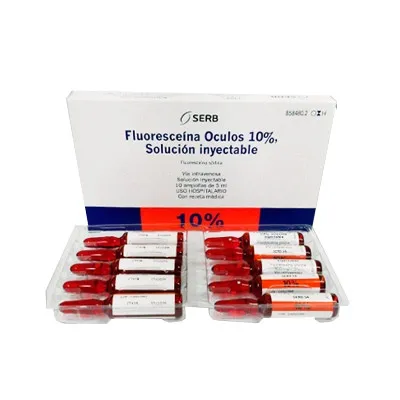
Table of Contents
Package leaflet: Information for the user
Introduction
Package leaflet: information for the user
Fluorescein Oculos 100 mg/ml solution for injection
Sodium fluorescein
Read the entire leaflet carefully before you start using this medicine, because it contains important information for you.
- Keep this leaflet as you may need to read it again.
- If you have any questions, ask your doctor or nurse.
- This medicine has been prescribed for you only, and you should not give it to other people even if they have the same symptoms as you, because it could harm them.
- If you experience any adverse effects, consult your doctor, even if they are adverse effects not listed in this leaflet. See section 4.
Contents of the leaflet
- What Fluorescein Oculos is and what it is used for
- What you need to know before using Fluorescein Oculos
- How to use Fluorescein Oculos
- Possible adverse effects
- How to store Fluorescein Oculos
- Contents of the pack and other information
1. What Fluorescein Oculos is and what it is used for
This medicine is for diagnostic use only.
Fluorescein Oculos belongs to a group of medicines called "Diagnostic agents: dyes".
Fluorescein Oculos is an injectable solution administered only into a vein (intravenous route).
Fluorescein Oculos is a dye used in adults (18 years of age and older) as a contrast medium to visualize the blood vessels of the retina and iris by a technique called fluorescein angiography.
2. What you need to know before using Fluoresceína Oculos
Before you are given Fluoresceína Oculos, your doctor may collect your complete medical history, including information about any medicines you are taking.
If you have ever been given fluorescein or another medicine used for diagnostic tests and experienced a serious hypersensitivity reaction, your doctor will decide whether you can be given fluorescein again.
Do not use Fluoresceína Oculos
- If you are allergic (hypersensitive) to fluorescein or to any of the other ingredients of this medicine (listed in section 6).
- This medicine must not be injected into the arteries (arterial route) or into the spinal cord (intrathecal route).
Warnings and precautions
Your doctor or another healthcare professional will administer this medicine through an injection into one of your veins. Fluoresceína Oculos is for intravenous injection only and MUST NOT be injected into the arteries (arterial route) or into the spinal cord (intrathecal route).
Reactions to this injection may occur during treatment with Fluoresceína Oculos. Before the injection, you may be given medicines that help reduce the likelihood of infusion-related reactions (see “Medicines administered during treatment with Fluoresceína Oculos” in section 3).
Immediately inform your doctor or nurse if you experience any signs of an infusion-related reaction. These signs are listed at the beginning of section 4.
Talk to your doctor before using Fluoresceína Oculos
- if you have a history of cardiovascular disease, diabetes, or lung disease.
- if you currently have or have previously had a condition called bronchial asthma (a disease affecting the lungs) or any type of allergy, you must inform your doctor, as Fluoresceína Oculos may cause serious reactions in these cases.
- if you have previously undergone angiography (a medical test to visualize blood vessels) and experienced a serious reaction as a result, or if you have previously had severe allergic reactions, you must inform your doctor. In such cases, your doctor will assess the importance of performing this test versus the risk of a severe allergic reaction.
- if you are taking medicines called beta-blockers, including beta-blocker eye drops, serious (although rare) life-threatening allergic reactions (anaphylactic reactions) may occur when used with Fluoresceína Oculos.
If any of the above apply to you, inform your doctor before starting Fluoresceína Oculos.
Other medicines and Fluoresceína Oculos
Inform your doctor or pharmacist if you are currently using, have recently used, or might need to use any other medicines.
If you are being treated with medicines called beta-blockers, including beta-blocker eye drops, inform your doctor, as serious (although rare) life-threatening allergic reactions (anaphylactic reactions) may occur when used in combination with Fluoresceína Oculos.
Avoid simultaneous intravenous administration of sodium fluorescein with other solutions or mixing it with other solutions or agents, as interactions cannot be ruled out.
Interference with diagnostic tests
If you are scheduled for any diagnostic tests (blood or urine analyses), inform your doctor that you are being treated with Fluoresceína Oculos, as this medicine has the property of producing fluorescence (a fluorescent green color) and may interfere with test results for 3 to 4 days after administration.
Children and adolescents
Specific studies have not been conducted in children. Therefore, this medicine should not be used in children and adolescents under 18 years of age.
Elderly population
Fluoresceína Oculos may be used in patients aged 65 years or older.
Pregnancy and breastfeeding
If you are pregnant or breastfeeding, think you may be pregnant, or are planning to become pregnant, consult your doctor before using this medicine.
Pregnancy
There are no or limited data on the use of sodium fluorescein in pregnant women. The use of Fluoresceína Oculos during pregnancy should be avoided unless absolutely necessary.
Breastfeeding
If you are breastfeeding, consult your doctor before taking this medicine.
Fluorescein is excreted in breast milk. After taking this medicine, you must not breastfeed for 7 days. During this period, you should express and discard your breast milk.
Driving and use of machines
Fluoresceína Oculos is not known to affect the ability to drive or operate machinery. However, for the diagnostic test for which Fluoresceína Oculos is used, medicines that cause pupil dilation (enlargement) are often required, which may result in temporary visual disturbances that could impair your ability to drive or operate machinery.
Fluoresceína Oculos contains sodium
This medicine contains 65.5 mg of sodium (the main component of table salt) per ampoule. This corresponds to 3.3% of the maximum daily recommended intake of sodium in an adult's diet.
3. How to use Fluorescein Oculos
Adults
One single 5 ml vial is administered intravenously (into a vein), preferably into the antecubital vein in the arm, taking precautions to avoid leakage of Fluorescein Oculos outside the vein into surrounding tissues (extravasation).
Fluorescein Oculos is a medicine used to perform a diagnostic test, which must be carried out in the presence of qualified personnel, preferably under the supervision of a physician, who will provide you with specific instructions throughout the procedure.
This medicine must not be administered intrathecally (injected into the lower back) or intra-arterially (injected directly into an artery).
Children and adolescents
This medicine must not be used in children and adolescents under 18 years of age, as safety and efficacy have not been established in this age group. See section 2.
Elderly patients (65 years and older)
No dosage adjustment is required for patients in this age group.
Medications administered during treatment with Fluorescein Oculos
Prior to injection, your doctor or nurse may administer medications to help reduce the risk of infusion-related reactions. These include antihistamines and corticosteroids (a medicine that suppresses inflammation).
If you use more Fluorescein Oculos than you should
In case of overdose or accidental ingestion, consult your doctor or nurse immediately or call the Toxicology Information Service at telephone number 91 562 04 20, indicating the medicine and the amount ingested.
If you have any further questions about the use of this medicine, ask your doctor or nurse.
4. Possible adverse effects
Like all medicines, Fluorescein Oculos may cause adverse effects, although not everyone experiences them.
Some side effects may be serious and may require immediate medical attention.
- Severe allergic reactions, including anaphylactic (uncommon, may affect up to 1 in 100 people) or anaphylactoid (rare, may affect up to 1 in 1,000 people) shock, have been reported in patients receiving Fluorescein Oculos. These reactions can be life-threatening and require urgent medical treatment. Immediately inform your doctor or nurse if you experience any of the following symptoms after administration of Fluorescein Oculos: chest pain (rare, may affect up to 1 in 1,000 people) or sensation of chest tightness (frequency not known, cannot be estimated from available data), wheezing (rare, may affect up to 1 in 1,000 people), difficulty breathing (rare, may affect up to 1 in 1,000 people), skin rash and urticaria (rare, may affect up to 1 in 1,000 people), swelling of the face, lips or tongue, fainting (rare, may affect up to 1 in 1,000 people).
- Reactions at the injection site, such as venous inflammation: symptoms may include thrombosis at the infusion site (frequency not known, cannot be estimated from available data), swelling (rare, may affect up to 1 in 1,000 people), pain (frequency not known, cannot be estimated from available data), redness at the injection site which may cause tissue damage. If the product leaks into the surrounding tissue at the injection site (extravasation) (uncommon, may affect up to 1 in 100 people), a painful inflammatory reaction may occur, which could even lead to tissue necrosis. Inform your doctor immediately if you experience any of the above symptoms.
If necessary, the patient may be required to remain under medical supervision for at least 30 minutes after the procedure.
Other adverse effects:
Uncommon: may affect up to 1 in 100 people
Allergic reactions, loss of consciousness, low blood pressure, vomiting, nausea, skin rash, skin redness, skin rash (urticaria), itching, malaise.
Rare: may affect up to 1 in 1,000 people
Coma, seizures, headache, dizziness, tingling, changes in taste sensation, tremors in part of the body, cardiac arrest, heart attack, cardiovascular collapse, decreased heart rate, increased heart rate, shock, pallor, hot flushes, laryngeal edema, asthma, dyspnea, cough, throat irritation, sneezing, difficulty breathing including airway constriction, abdominal pain, dermatitis, excessive sweating, skin discoloration (yellowish coloration), discoloration (yellowish coloration) of urine, edema, asthenia, sensation of heat, chills.
Very rare: may affect up to 1 in 10,000 people
Low platelet count, partial or complete loss of sensation in part of the body, respiratory arrest, pulmonary edema, hypersalivation, cold sweat.
Not known: cannot be estimated from available data
Stroke, aphasia, venous thrombosis, arterial hypertension, respiratory disorder, throat tightness, retching.
If any of the above symptoms worsen, inform your doctor or nurse immediately.
Reporting of adverse effects
If you experience any type of adverse effect, consult your doctor or nurse, even if it is a possible adverse effect not listed in this leaflet. You may also report them directly via the Spanish Pharmacovigilance System for Human Medicines: www.notificaRAM.es. By reporting adverse effects, you can help provide more information on the safety of this medicine.
5. Storage of Fluorescein Oculos
Keep this medicine out of the sight and reach of children.
Do not use this medicine after the expiry date stated on the packaging after “Expiry”. The expiry date is the last day of the month indicated.
Do not store above 25 °C.
Keep the ampoules in the outer packaging.
Medicines should not be disposed of via wastewater or household waste. Doing so helps protect the environment.
6. Pack contents and other information
Composition of Fluorescein Oculos
- The active substance is sodium fluorescein. Each vial (5 ml) contains 500 mg of sodium fluorescein.
- The other components are sodium hydroxide and water for injections.
Appearance of the product and pack contents
Fluorescein Oculos is available as an injectable solution in colorless glass vials of 5 ml. Each package contains 1 or 10 vials.
Only certain pack sizes may be commercially available.
Marketing Authorization Holder
SERB SA
Avenue Louise, 480
1050 Brussels
Belgium
Manufacturer
SERB
32 rue de Monceau
75008 Paris
France
Local representative
LABORATORIOS RUBIO, S.A.
Industria 29 - Pol. Ind. Comte de Sert
08755 Castellbisbal (Barcelona)
Spain
Date of the most recent review of this leaflet: November 2023
Detailed and up-to-date information on this medicinal product is available on the website of the Spanish Agency of Medicines and Health Products (AEMPS) http://www.aemps.gob.es/.
INFORMATION FOR HEALTHCARE PROFESSIONALS
This information is intended exclusively for physicians or healthcare professionals:
This medicine must not be administered by intrathecal or intra-arterial routes. Fluorescein Oculos should be administered into the antecubital vein, taking precautions to avoid extravasation.
Before administration, carefully inspect the contents of the vial to ensure there is no discoloration of the product or precipitation of particles in the solution.
After opening a vial, use it immediately.
Do not mix or dilute in the syringe with other drugs or solutions. To avoid physical incompatibilities, Fluorescein Oculos must not be administered simultaneously with injectable drug solutions of acidic pH (particularly antihistamines such as promethazine) or with citric acid through the same intravenous line, as they may cause precipitation of fluorescein. In addition, intravenous cannulas should be flushed before and after injection of the drugs.
Prior to initiating fluorescein injection, precautions should be taken to avoid extravasation and to ensure that the needle is properly inserted into the vein (preferably the antecubital vein). The high pH of the fluorescein solution may cause severe local tissue damage. Complications due to extravasation may result in severe pain, thrombophlebitis, and inflammatory tissue reaction that could lead to tissue necrosis.
In the event of extravasation, the injection must be stopped immediately, and appropriate measures should be taken to relieve pain and treat the damaged tissue.
An emergency cart equipped with appropriate resuscitation equipment, including medications used to treat hypersensitivity reactions such as epinephrine, intravenous fluids for volume replacement, and corticosteroids, must always be available during administration.
In patients identified as being at risk of hypersensitivity reactions, but in whom fluorescein angiography is essential, the procedure should be performed in the presence of a specialist in resuscitation.
The patient should remain under close observation for at least 30 minutes after fluorescein angiography.
Fluorescein Oculos contains 65.5 mg of sodium (the main component of table salt) per vial. This corresponds to 3.3% of the maximum daily recommended dietary intake for an adult.
Dispose of any unused portion.
Refer to section 3 of this Patient Information Leaflet and the Summary of Product Characteristics before administering Fluorescein Oculos to a patient.