Flunutrak 0.5 mg/g cream
Spain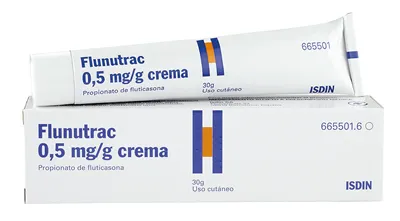
Table of Contents
Package leaflet: Information for the user
Introduction
Package leaflet: information for the patient
Flunutrac 0,5 mg/g cream
Fluticasone propionate
Read all of this leaflet carefully before you start using this medicine, because it contains important information for you.
- Keep this leaflet, as you may need to read it again. If you have any questions, ask your pharmacist.
- This medicine has been prescribed for you only, and you should not give it to other people, even if they have the same symptoms as you, since it may harm them.
- If you experience any adverse effects, consult your doctor or pharmacist, even if they are adverse effects not listed in this leaflet. See section 4.
Contents of this leaflet
- What Flunutrac is and what it is used for
- What you need to know before using Flunutrac
- How to use Flunutrac
- Possible side effects
- How to store Flunutrac
- Contents of the pack and other information
1. What Flunutrac is and what it is used for
Flunutrac 0.5 mg/g cream belongs to a group of medicines known as corticosteroids, which have an anti-inflammatory effect when used topically.
Fluticasone is a potent corticosteroid that, when applied to the skin, treats a wide variety of inflammatory skin conditions. It is used to relieve inflamed skin, redness, and itching in numerous skin problems not caused by microorganisms and that respond to corticosteroids.
2. What you need to know before using Flunutrac
Do not use Flunutrac
-
if you are allergic to fluticasone or to any of the other components of Flunutrac (listed in section 6)
-
if you have rosacea (redness and inflammation of the facial skin), acne vulgaris, or perioral dermatitis (inflammatory rash around the mouth).
-
if you have viral skin infections such as herpes simplex or varicella (chickenpox)
-
if you have perianal or genital pruritus (itching around the anal or genital area).
-
if you have skin ulcers, atrophy (thinning of the skin), or cutaneous vascular fragility.
-
if you have ichthyosis (a skin disease characterized by dryness and scaling).
-
if you have juvenile dermatosis (any inflammatory skin disease) or dermatoses in children under 1 year of age, including dermatitis (skin inflammation) and diaper rash.
-
if you have ulcerated skin wounds.
-
if you have infected skin lesions caused by bacterial or fungal infections.
Warnings and precautions
Consult your doctor or pharmacist before using Flunutrac
-
if you are pregnant or think you may be pregnant, or if you are breastfeeding (see section “Pregnancy and Lactation”).
-
if you use this medicine over large areas of the body for prolonged periods, especially when treating children, as this may increase the absorption of the product and the risk of toxicity.
-
if you use it on the face, as it may cause atrophic changes such as thinning of the skin. It is important not to allow the cream to come into contact with the eyes.
-
if you use it on covered areas of the body. Do not use this product under occlusive dressings; the affected area must be exposed to air and not covered by dressings, tight clothing, or similar materials. In infants, diapers may act as an occlusive dressing. Clean the skin before changing the dressing.
-
if your doctor has prescribed the cream for psoriasis. You should visit your doctor regularly at periodic intervals to monitor your progress.
-
if you are using other products (including cosmetics) on the affected areas of skin, as they may negatively affect the product's efficacy. Consult your doctor if you have any doubts.
Contact your doctor if you experience blurred vision or other visual disturbances.
Children
Do not use this medicine in children under 1 year of age.
Inform your doctor if symptoms do not improve within one or two weeks of starting treatment. Once the skin condition has improved (usually between the first and second week), apply the cream less frequently. Daily use of the cream for longer than 4 weeks is not recommended.
Flunutrac should only be used in children to relieve inflamed, red, and itchy skin caused by atopic dermatitis, and only under the supervision of a specialist doctor. Consult a dermatologist before using Flunutrac for any other type of dermatosis in children.
Other medicines and Flunutrac
Inform your doctor or pharmacist if you are taking, have recently taken, or might need to take any other medicines, including those obtained without a prescription.
Pregnancy, lactation, and fertility
If you are pregnant or breastfeeding, think you may be pregnant, or plan to become pregnant, consult your doctor or pharmacist before using this medicine.
Pregnancy
Flunutrac should only be used during pregnancy if the benefit of treatment to the mother outweighs any potential risk to the fetus.
Lactation
It is unknown whether fluticasone propionate is excreted in breast milk. Flunutrac should only be used during breastfeeding if the benefit of treatment to the mother outweighs any potential risk to the infant.
Driving and use of machines
It is unknown whether fluticasone negatively affects the ability to drive or operate machinery.
Flunutrac contains cetostearyl alcohol, imidurea, and propylene glycol.
This medicine may cause local skin reactions (such as contact dermatitis) because it contains cetostearyl alcohol.
This medicine contains imidurea, which may release traces of formaldehyde. Formaldehyde may cause local skin reactions (such as contact dermatitis).
This medicine contains 100 mg of propylene glycol in 1 gram of cream.
3. How to use Flunutrac
Your doctor will prescribe the appropriate dose for you.
Follow exactly the administration instructions for Flunutrac given by your doctor. Consult your doctor or pharmacist if you have any doubts.
For adults and children from 1 year of age, apply a thin layer of Flunutrac to the affected area of skin once or twice daily, unless your doctor instructs otherwise. Ask your doctor about the duration of treatment.
In certain conditions (psoriasis, atopic dermatitis, etc.), it is not advisable to stop treatment abruptly; the number of applications should be gradually reduced. Follow your doctor's instructions exactly.
If symptoms reappear after recovery, your doctor will indicate the appropriate dose for you. The usual dose is one application per day, two days per week.
It is not advisable to interrupt treatment abruptly in certain skin conditions such as psoriasis or atopic dermatitis. You should consult your doctor about the most appropriate way to discontinue treatment.
Instructions for use:
- Wash your hands
- Apply a thin layer of cream and carefully spread it until completely absorbed
- Wash your hands, unless the cream is being used to treat the hands
If your skin condition does not improve during the first or second week of treatment, inform your doctor.
If you use more Flunutrac than you should
If you use more Flunutrac than you should, especially in children, carefully wash the affected skin areas to remove all the cream and consult your doctor or pharmacist.
In case of overdose or accidental ingestion, contact your doctor or pharmacist immediately or call the Toxicology Information Service at telephone number 91.562.04.20, indicating the medication and the amount administered.
If you forget to use Flunutrac
Do not use a double dose to make up for missed doses.
If you forget to apply the cream, apply it at the correct dose as soon as you remember, or wait until the next scheduled application if it is almost time.
If you stop treatment with Flunutrac
Do not stop using the medicine even if you feel well, unless your doctor tells you to.
If you have any further questions about the use of this medicine, ask your doctor or pharmacist.
4. Possible adverse effects
Like all medicines, this medicine can cause adverse effects, although not everyone experiences them.
Frequent adverse effects (affects more than 1 in 100 patients but less than 1 in 10 patients):
- Itching (pruritus)
Uncommon adverse effects (affects more than 1 in 1,000 patients but less than 1 in 100 patients):
- Local burning sensation
Very rare adverse effects (affects less than 1 in 10,000 patients):
- Secondary infections (infections occurring during or after treatment of an existing infection), especially when occlusive dressings are used or skin folds are involved.
- Hypersensitivity. Use of Flunutrac should be discontinued if signs of hypersensitivity occur.
- Hypercortisolism (increased levels of corticosteroids) due to prolonged use of large amounts of corticosteroids, or treatment of extensive skin areas.
Adverse reactions are more likely to occur in infants and children, and when occlusive dressings are used.
- Dilation of superficial blood vessels due to prolonged and intensive treatment with potent corticosteroid preparations.
- Allergic contact dermatitis (allergic skin reactions).
- Worsening of signs and symptoms of dermatoses (skin reaction manifested by inflammation).
- Pustular psoriasis caused either by the treatment itself or by its discontinuation.
- Local skin atrophic changes such as thinning, striae, hypertrichosis (excessive hair growth in a specific area), and hypopigmentation (skin discoloration) caused by prolonged and intensive treatment with potent corticosteroid preparations.
Not known (frequency cannot be estimated from available data):
- Vascular purpura (a group of skin disorders characterized by purplish or reddish-brown discoloration).
- Skin fragility.
- Perioral dermatitis (inflammation of the skin around the mouth).
- Rosacea (redness and inflammation of the facial skin).
- Crusting.
- Leg ulcers.
- Acne.
- Impaired wound healing.
- Blurred vision.
Reporting of adverse effects
If you experience any type of adverse effect, consult your doctor or pharmacist, even if it is a possible adverse effect not listed in this leaflet. You may also report them directly via the Spanish Pharmacovigilance System for Human Medicines: http://www.notificaRAM.es.
By reporting adverse effects, you can help provide more information on the safety of this medicine.
5. Storage of Flunutrac
Keep out of the sight and reach of children.
Do not use this medicine after the expiry date stated on the container. The expiry date refers to the last day of the month indicated.
Do not store above 30°C.
Validity period after first opening: 6 months
Medicines must not be disposed of via wastewater or household waste. Dispose of empty containers and unused medicines at the SIGRE collection point at your pharmacy. If in doubt, ask your pharmacist how to dispose of containers and unused medicines. This will help protect the environment.
Do not use this medicine if you notice any visible signs of deterioration.
6. Contents of the pack and other information
Composition of Flunutrac
The active substance is fluticasone propionate. Each 100 g of cream contains 0.05 g of fluticasone propionate.
The other components are macrogol, cetostearyl ether, cetyl alcohol, isopropyl myristate, liquid paraffin, purified water, propylene glycol (E-1520), citric acid monohydrate, anhydrous disodium phosphate, imidazolinyl urea.
Appearance of the product and contents of the pack
Flunutrac is a white, viscous cream contained in a 30 g aluminum tube with a screw cap.
Marketing Authorization Holder
ISDIN SA
Provençals 33
08019 Barcelona
Spain
Manufacturer
Laboratorios Salvat, S.A.
C/ Gall, 30-36 - 08950
Esplugues de Llobregat
Barcelona - Spain
This medicinal product is authorized in the Member States of the European Economic Area under the following names:
Spain Flunutrac 0.5 mg/g cream
Netherlands Cortifil 0.5 mg/g crème
Italy Flunutrac 0.05% cream
Portugal Flunutra 0.5 mg/g creme
United Kingdom Fluticasone propionate 0.05% cream
Date of the most recent review of this leaflet: July 2020
Detailed and up-to-date information on this medicinal product is available on the website of the Spanish Agency of Medicines and Health Products (AEMPS) http://www.aemps.es/