Finomel peri emulsion for infusion
SpainTable of Contents
Package leaflet: Information for the user
Introduction
Package leaflet: Information for the user
Finomel Peri emulsion for infusion
Read the entire leaflet carefully before you start using this medicine, because it contains important information for you.
-
Keep this leaflet, as you may need to read it again.
-
If you have any questions, consult your doctor or nurse.
-
This medicine has been prescribed for you only, and you should not give it to other people, even if they have the same symptoms as you, because it may harm them.
- If you experience any adverse effects, consult your doctor or nurse, even if they are adverse effects not listed in this leaflet. See section 4.
Contents of the leaflet
- What Finomel Peri is and what it is used for
- What you need to know before you start using Finomel Peri
- How to use Finomel Peri
- Possible side effects
- How to store Finomel Peri
- Contents of the pack and other information
1. What Finomel Peri is and what it is used for
Finomel Peri contains amino acids (components used to build proteins), glucose (carbohydrates), lipids (fats), and salts (electrolytes).
Finomel Peri is used to feed adults when normal oral feeding is insufficient or not possible.
2. What you need to know before starting to use Finomel Peri
Do not use Finomel Peri:
- If you are allergic to fish, egg, soy, peanut, or corn/corn products (see also the section “Warnings and precautions” below), or to any of the ingredients of this medicine (see the list in section 6).
- If you have high levels of fats in the blood.
- If you have serious liver problems.
- If you have blood coagulation disorders.
- If you have a disorder that prevents your body from processing amino acids.
- If you have serious kidney problems.
- If you have too much sugar in your blood.
- If you have abnormally high levels of any of the electrolytes (sodium, potassium, magnesium, calcium and/or phosphorus) in the blood.
- If you have problems receiving large volumes of intravenous fluids, such as acute pulmonary edema, hyperhydration, or decompensated heart conditions.
- If you have any acute and serious health condition, such as severe post-traumatic conditions, uncontrolled diabetes mellitus, acute myocardial infarction, stroke, embolism, metabolic acidosis, severe sepsis (bacteria in the blood), hypotonic dehydration, or hyperosmolar coma.
In all cases, your doctor will decide whether you should be given this medicine based on factors such as your age, weight, and clinical condition, along with the results of all tests performed.
Warnings and precautions
Talk to your doctor or nurse before starting to use Finomel Peri if you have:
- any serious kidney problems. You should also inform your doctor if you are undergoing dialysis (artificial kidney) or any other blood-cleaning treatment.
- any serious liver problems
- any blood coagulation disorders
- abnormal functioning of the adrenal glands (adrenal insufficiency). The adrenal glands are triangular-shaped glands located on top of the kidneys.
- heart failure
- lung disease
- fluid accumulation in the body (hyperhydration)
- insufficient body water (dehydration)
- excess sugar in the blood (diabetes mellitus) without treatment
- heart attack or shock due to sudden heart failure
- severe metabolic acidosis (excessively acidic blood)
- systemic infection (septicemia)
Infusion must be stopped immediately if any abnormal signs or symptoms of an allergic reaction develop, such as fever, chills, skin rash, or difficulty breathing. This medicine contains fish oil, soybean oil, egg phospholipids, and glucose derived from corn, which may cause hypersensitivity reactions. Cross-allergic reactions between soybean and peanut seed proteins have been observed.
Difficulty in breathing could also indicate the formation of small particles in the lungs that block blood vessels (pulmonary vascular precipitates). If you experience any breathing difficulty, inform your doctor or nurse. They will decide on the appropriate action.
During infusion, if you notice pain, burning, stiffness, swelling, or skin discoloration at the infusion site, or any leakage during infusion, inform your doctor or nurse immediately. Administration will be stopped immediately and restarted in another vein.
There is a risk of infection or sepsis (presence of bacteria or their toxins in the blood), especially when a tube (intravenous catheter) is placed into the vein. Your doctor will closely monitor you for signs of infection. The use of "aseptic techniques" (germ-free) when placing and maintaining the catheter and when preparing the nutritional formula can reduce the risk of infection.
Cases of fat overload syndrome have been reported with similar products. A reduced or limited capacity of the body to eliminate the fats contained in Finomel Peri may lead to fat overload syndrome (see section 4: Possible side effects).
If you are severely malnourished and require intravenous feeding, parenteral nutrition should be initiated carefully and slowly.
Additional laboratory tests
Before starting the infusion, metabolic disorders and your body's water and electrolyte balance should be corrected. To monitor the effectiveness and safety of treatment, your doctor may perform laboratory and clinical tests while you are receiving this medicine. Your doctor will monitor your condition and may adjust the dose or add other medications.
Children and adolescents
There is no experience with the use of Finomel Peri in children and adolescents.
Other medicines and Finomel Peri
Tell your doctor or nurse if you are taking, have recently taken, or might need to take any other medicines.
Finomel Peri contains calcium. It must not be administered simultaneously or through the same route as the antibiotic ceftriaxone, as particles may form. If the same device is used to administer these medicines consecutively, it must be thoroughly flushed.
The olive and soybean oils present in Finomel Peri contain vitamin K. This usually does not affect blood-thinning medicines (anticoagulants) such as coumarin. However, if you are taking anticoagulants, you must inform your doctor.
The lipids in this emulsion may interfere with the results of certain laboratory tests if the blood sample is taken before the lipids have been cleared from your bloodstream (they are generally cleared within 5 to 6 hours after stopping lipid infusion).
Pregnancy and breastfeeding
If you are pregnant or breastfeeding, think you may be pregnant, or plan to become pregnant, consult your doctor before taking this medicine. There are no data on the use of Finomel Peri in pregnant or breastfeeding women. Use of this medicine during pregnancy and breastfeeding may be considered if your doctor determines it is necessary.
Driving and using machines
Not applicable, as the medicine is administered in a hospital setting.
3. How to use Finomel Peri
Follow exactly the instructions for administering this medicine as given by your doctor. If in doubt, consult your doctor again.
This medicine is administered by intravenous infusion (drip) through a small tube directly into a vein.
Your doctor will decide the dose to be administered individually, depending on your body weight and functional status. A healthcare professional will administer Finomel Peri to you.
Use in children
The safety and efficacy in children and adolescents under 18 years of age have not been established.
If you use more Finomel Peri than you should
It is unlikely that you will receive too much medicine, as Finomel Peri will be administered by a healthcare professional.
4. Possible adverse effects
Like all medicines, this medicine can cause adverse effects, although not everyone experiences them. The following adverse effects have been reported with unknown frequency:
- hypersensitivity reactions (which may cause symptoms such as swelling, fever, drop in blood pressure, skin rashes, hives (red raised spots), flushing, headache);
- refeeding syndrome (a condition that develops when nutrition is reintroduced after long periods of fasting);
- high blood sugar levels (hyperglycemia);
- dizziness;
- headache;
- inflammation of the vein (thrombophlebitis);
- pulmonary embolism;
- breathing difficulties;
- nausea;
- vomiting;
- slight increase in body temperature;
- high blood (plasma) concentrations of liver compounds;
- fat overload syndrome;
- loss of perfusion in surrounding tissue (extravasation).
Reporting of adverse effects
If you experience any type of adverse effect, consult your doctor or nurse, even if it is a possible adverse effect not listed in this leaflet. You can also report them directly via the Spanish Pharmacovigilance System for Human Medicines: https://www.notificaram.es. By reporting adverse effects, you can help provide more information on the safety of this medicine.
5. Storage of Finomel Peri
Keep this medicine out of the sight and reach of children.
Store in the overpouch. Do not freeze.
Do not use this medicine after the expiry date stated on the bag and outer packaging following EXP. The expiry date is the last day of the month indicated.
Do not use this medicine if you see visible particles in the solution or if the bag is damaged.
Medicines must not be disposed of via wastewater or household waste. Ask your pharmacist how to dispose of medicines and packaging that you no longer need. This will help protect the environment.
6. Contents of the container and other information
Composition of Finomel Peri
- The active substances are
g per 1000 ml | |
Alanine | 6.52 |
Arginine | 3.62 |
Glycine | 3.24 |
Histidine | 1.51 |
Isoleucine | 1.89 |
Leucine | 2.30 |
Lysine (as hydrochloride equivalent) | 2.28 |
Methionine | 1.26 |
Phenylalanine | 1.76 |
Proline | 2.14 |
Serine | 1.58 |
Threonine | 1.32 |
Tryptophan | 0.57 |
Tyrosine | 0.13 |
Valine | 1.83 |
Sodium acetate trihydrate | 1.77 |
Potassium chloride | 1.41 |
Calcium chloride dihydrate | 0.23 |
Magnesium sulfate heptahydrate | 0.78 |
Sodium glycerophosphate hydrate | 1.87 |
Zinc sulfate heptahydrate | 0.007 |
Glucose (as monohydrate equivalent) | 77.8 |
Refined soybean oil | 8.46 |
Refined olive oil | 7.05 |
Medium-chain triglycerides | 7.05 |
Omega-3 fatty acid-rich fish oil | 5.64 |
- The other components are: glacial acetic acid, hydrochloric acid, egg phospholipids, glycerol, sodium oleate, all-rac-α-tocopherol, sodium hydroxide, water for injections.
Appearance of Finomel Peri and contents of the container
Amino acid and glucose solutions are clear, colourless or slightly yellowish, and free from particles. The lipid emulsion is homogeneous and white in colour.
After mixing the three compartments, the product appears as a white emulsion.
Container sizes
4 bags of 1085 ml
4 bags of 1450 ml
4 bags of 2020 ml
Marketing Authorization Holder and Manufacturer
Marketing Authorization Holder:
Baxter SL
Pouet de Camilo, 2.
46394 Ribarroja del Turia (Valencia)
Spain
Manufacturer:
Baxter SA
Boulevard René Branquart 80
7860 Lessines
Belgium
This medicinal product is authorized in the Member States of the European Economic Area under the following names:
Austria, Czech Republic, Germany, Greece, Ireland, Spain, United Kingdom: Finomel Peri
Poland: Finomel Peri
Belgium, Luxembourg, Netherlands: Periomegomel
Denmark, Finland, Iceland, Norway, Sweden: Finomel Perifer
France: Fosomelperi
Italy: Finomel
Date of the most recent revision of this leaflet: December 2023
Detailed and up-to-date information on this medicinal product is available on the website of the Spanish Agency of Medicines and Health Products (AEMPS) http://www.aemps.gob.es/
<------------------------------------------------------------------------------------------------------------------------>
This information is intended for healthcare professionals only
A. QUALITATIVE AND QUANTITATIVE COMPOSITION
Finomel Peri is supplied in a plastic bag with three compartments. Each bag contains a sterile, non-pyrogenic combination of 13% glucose solution, 10% amino acid solution with electrolytes, and 20% lipid emulsion.
After mixing the contents of the three compartments, the composition of the reconstituted emulsion is shown in the following table:
Active substance | 1085 ml | 1450 ml | 2020 ml |
Fish oil rich in omega-3 fatty acids | 6.12 g | 8.16 g | 11.40 g |
Refined olive oil | 7.65 g | 10.20 g | 14.25 g |
Refined soybean oil | 9.18 g | 12.24 g | 17.10 g |
Medium-chain triglycerides | 7.65 g | 10.20 g | 14.25 g |
Alanine | 7.08 g | 9.46 g | 13.17 g |
Arginine | 3.93 g | 5.26 g | 7.31 g |
Glycine | 3.52 g | 4.71 g | 6.55 g |
Histidine | 1.64 g | 2.19 g | 3.05 g |
Isoleucine | 2.05 g | 2.74 g | 3.82 g |
Leucine | 2.50 g | 3.34 g | 4.64 g |
Lysine(equivalent to lysine hydrochloride) | 1.98 g(2.48 g) | 2.65 g(3.31 g) | 3.69 g(4.61 g) |
Methionine | 1.37 g | 1.83 g | 2.54 g |
Phenylalanine | 1.92 g | 2.56 g | 3.56 g |
Proline | 2.33 g | 3.11 g | 4.32 g |
Serine | 1.71 g | 2.29 g | 3.18 g |
Threonine | 1.44 g | 1.92 g | 2.67 g |
Tryptophan | 0.62 g | 0.82 g | 1.14 g |
Tyrosine | 0.14 g | 0.18 g | 0.25 g |
Valine | 1.98 g | 2.65 g | 3.69 g |
Sodium acetate trihydrate | 1.92 g | 2.57 g | 3.57 g |
Potassium chloride | 1.53 g | 2.05 g | 2.85 g |
Calcium chloride dihydrate | 0.25 g | 0.34 g | 0.47 g |
Magnesium sulfate heptahydrate | 0.84 g | 1.13 g | 1.57 g |
Sodium glycerophosphate hydrate | 2.03 g | 2.71 g | 3.77 g |
Zinc sulfate heptahydrate | 0.008 g | 0.011 g | 0.015 g |
Glucose(equivalent to glucose monohydrate) | 76.7 g(84.4 g) | 102.6 g(112.8 g) | 142.9 g(157.2 g) |
- DOSAGE AND ADMINISTRATION
Dosage
The dose should be individualized according to the patient's energy expenditure, clinical condition, body weight, and ability to metabolize the components of Finomel Peri, as well as the additional energy or protein administered orally or enterally. Therefore, the appropriate bag size should be selected.
Average daily requirements in adults are:
- In patients with normal nutritional status or mild catabolic stress: 0.6 to 0.9 g of amino acids/kg body weight/day (0.10 to 0.15 g of nitrogen/kg body weight/day).
- In patients with moderate to high metabolic stress, with or without malnutrition: 0.9 to 1.6 g of amino acids/kg body weight/day (0.15 to 0.25 g of nitrogen/kg body weight/day).
- In patients with special conditions (e.g., burns or marked anabolism), nitrogen requirements may be even higher.
The maximum daily dose varies depending on the patient's clinical condition and may change from day to day.
The infusion rate should be gradually increased during the first hour.
The infusion rate should be adjusted according to the administered dose, daily volume intake, and duration of infusion.
The recommended infusion time is 14 to 24 hours.
The regimen of 20 ml to 40 ml/kg body weight/day corresponds to 0.6–1.3 g of amino acids/kg body weight/day (equivalent to 0.10–0.21 g of nitrogen/kg body weight/day) and to 14–27 kcal/kg body weight/day of total energy (11–22 kcal/kg body weight/day of non-protein energy).
The maximum infusion rate for glucose is 0.25 g/kg body weight/h, for amino acids 0.1 g/kg body weight/h, and for lipids 0.15 g/kg body weight/h.
The infusion rate must not exceed 3.0 ml/kg body weight/h (corresponding to 0.09 g of amino acids, 0.21 g of glucose, and 0.09 g of lipids/kg body weight/h).
The recommended maximum daily dose is 40 ml/kg body weight/day, which will provide 1.3 g of amino acids/kg body weight/day (equivalent to 0.21 g of nitrogen/kg body weight/day), 2.8 g of glucose/kg body weight/day, 1.2 g of lipids/kg body weight/day, and a total energy of 27 kcal/kg body weight/day (equivalent to 22 kcal/kg body weight/day of non-protein energy).
Paediatric population
No studies have been conducted with Finomel Peri in the paediatric population.
Patients with renal/hepatic impairment
Use with caution in patients with hepatic insufficiency, including cholestasis and/or elevated liver enzymes. Liver function parameters should be closely monitored.
Method of administration
For intravenous use, infusion into a peripheral or central vein.
For instructions on reconstitution of the medicinal product prior to administration, see section E Special precautions for disposal and other handling.
If peripheral veins are used for infusions, the osmolarity of the solutions should be taken into account, as thrombophlebitis may occur. The catheter insertion site should be evaluated daily for signs of local thrombophlebitis.
For information on mixing with other infusions or blood before or during administration, see section C Incompatibilities.
- INCOMPATIBILITIES
This medicinal product must not be mixed with other medicinal products unless compatibility has been documented.
Ceftriaxone must not be mixed or administered with intravenous solutions containing calcium, including Finomel Peri.
Finomel Peri must not be administered simultaneously with blood through the same infusion line.
- OVERDOSAGE
In case of overdose, nausea, vomiting, chills, hyperglycaemia, electrolyte disturbances, and signs of hypervolaemia or acidosis may occur. In such cases, the infusion must be stopped immediately.
If hyperglycaemia occurs, it should be treated according to the clinical situation with appropriate insulin administration and/or adjustment of the infusion rate. In addition, an overdose could cause fluid overload, electrolyte imbalances, and hyperosmolarity.
If symptoms persist after stopping the infusion, haemodialysis, haemofiltration, or haemodiafiltration may be considered.
- SPECIAL PRECAUTIONS FOR DISPOSAL AND OTHER HANDLING
To open:
- Remove the protective overpouch.
- Discard the sachet containing the oxygen absorber.
- Use only if the bag is undamaged, the non-permanent seals are intact (i.e., the contents of the three compartments have not mixed), the amino acid solution and glucose solution in their respective chambers are clear, colourless or slightly yellowish, and free from visible particles, and the lipid emulsion is a homogeneous milky-appearing liquid.
To mix the chambers:
- Ensure the product is at room temperature when breaking the non-permanent seals.
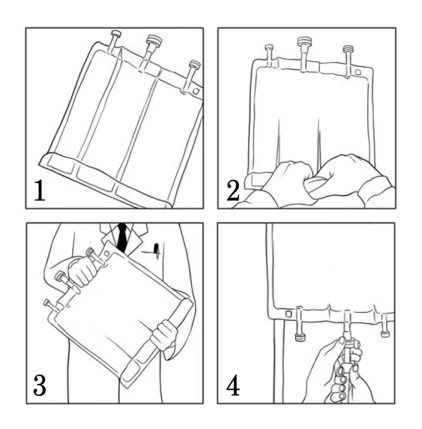
- Roll the bag manually upon itself, starting from the top of the bag (hanger end). (Illustration 1) The non-permanent seals will disappear from the side near the inlets. Continue rolling until the seals open approximately halfway along their length. (Illustration 2)
- Mix the bag by inverting it at least three times. (Illustration 3)
- The appearance after reconstitution is a homogeneous milky emulsion.
After removing the protective cap from the medication port, compatible additives may be added through the medication port (see subsection “Additions”).
Remove the protective cap from the infusion port and connect the infusion set. Hang the bag on an infusion stand and carry out the infusion using standard technique. (Illustration 4)
After opening the bag, the contents should be used immediately. An opened bag must never be stored for subsequent infusion.
Do not reconnect a partially used bag. Do not connect bags in series to avoid the risk of gas embolism.
Additions
Additions must not be made to the bag without first checking compatibility, as precipitation or destabilization of the lipid emulsion could lead to vascular occlusion.
Additions must be performed under aseptic conditions.
Finomel Peri may be mixed with the following additives:
- multivitamin preparations
- multiple trace elements preparations
- selenium
- zinc
- sodium salt
- potassium salt
- magnesium salt
- calcium salt
- phosphate salt
The following indicative compatibility table shows possible additions of multiple trace elements products such as Nutryelt, multivitamin products such as Cernevit, as well as generic electrolytes and trace elements in defined amounts. The addition of clinically necessary electrolytes and trace elements should take into account the amounts already included in the initial formulation of the bag.
Additive | Total content after addition for all Finomel Peri bag sizes |
Nutryelt (composition per vial: zinc 153 µmol; copper 4.7 µmol; manganese 1.0 µmol; fluoride 50 µmol; iodine 1.0 µmol; selenium 0.9 µmol; molybdenum 0.21 µmol; chromium 0.19 µmol; iron 18 µmol) | 2 vialsa/bag |
Cernevit (composition per vial: vit. A (as retinol palmitate) 3500 IU, vit. D3 (cholecalciferol) 220 IU, vit. E (alpha-tocopherol) 11.2 IU, vit. C (ascorbic acid) 125 mg, vit. B1 (thiamine) 3.51 mg, vit. B2 (riboflavin) 4.14 mg, vit. B6 (pyridoxine) 4.53 mg, vit. B12 (cyanocobalamin) 6 µg, vit. B9 (folic acid) 414 µg, vit. B5 (pantothenic acid) 17.25 mg, vit. B8 (biotin) 69 µg, vit. PP (nicotinamide) 46 mg) | 2 vialsb/bag |
Sodium | 138 mmol/l |
Potassium | 138 mmol/l |
Magnesium | 5 mmol/l |
Calcium | 4.6 mmol/l |
Phosphate (organic, as sodium glycerophosphate) or Phosphate (inorganic, as potassium phosphate) | 18.5 mmol/l 9.2 mmol/l |
Selenium | 7.6 µmol/l |
Zinc | 0.31 mmol/l |
|
Compatibility may vary between products from different sources, and healthcare professionals are advised to carry out appropriate checks when mixing Finomel Peri with other parenteral solutions.
Mix the contents of the bag thoroughly and inspect the mixture visually. There should be no signs of phase separation of the emulsion. The mixture is a homogeneous emulsion of milky white color.
When additions are made, the final osmolarity of the mixture must be measured before administration through a peripheral vein.