Fesoterodine CINFA 8 mg prolonged-release tablets EFG
Spain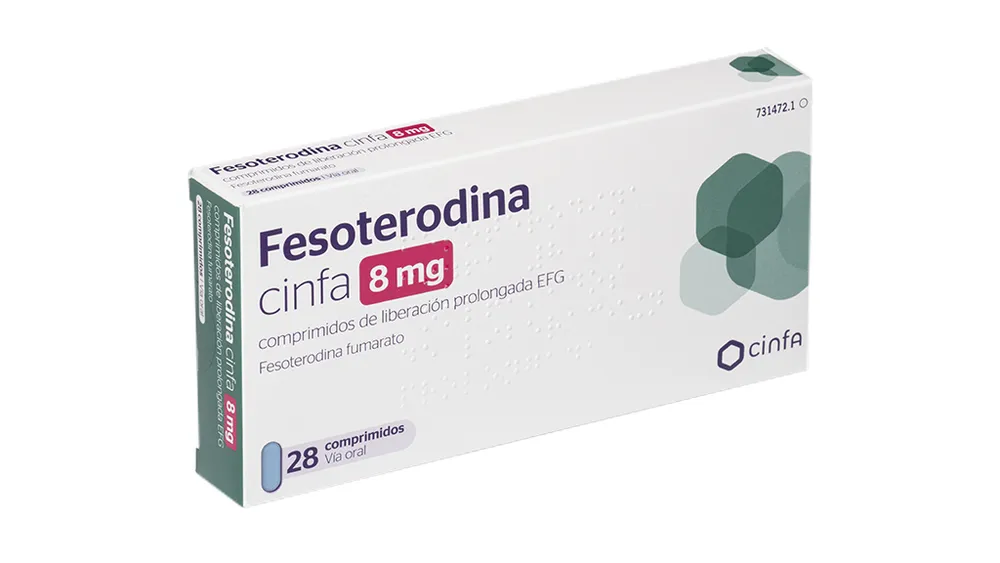
Table of Contents
- Package leaflet: Information for the user
- Introduction
- 1. What Fesoterodina cinfa is and what it is used for
- 2. What you need to know before taking Fesoterodina cinfa
- 3. How to take Fesoterodine cinfa
- 4. Possible adverse effects
- 5. Storage of Fesoterodine cinfa
- 6. Contents of the pack and other information
Package leaflet: Information for the user
Introduction
Package leaflet: information for the user
Fesoterodina cinfa 8 mg prolonged-release tablets EFG
fesoterodine fumarate
Read the entire leaflet carefully before you start taking this medicine, because it contains important information for you.
- Keep this leaflet, as you may need to read it again.
- If you have any questions, ask your doctor or pharmacist.
- This medicine has been prescribed for you only, and you should not give it to other people, even if they have the same symptoms as you, because it could harm them.
- If you experience any adverse reactions, consult your doctor or pharmacist, even if they are adverse reactions not listed in this leaflet. See section 4.
Leaflet contents
- What Fesoterodina cinfa is and what it is used for
- What you need to know before taking Fesoterodina cinfa
- How to take Fesoterodina cinfa
- Possible side effects
- How to store Fesoterodina cinfa
- Contents of the pack and other information
1. What Fesoterodina cinfa is and what it is used for
Fesoterodina cinfa contains an active substance called fesoterodine fumarate and is a type of treatment known as an antimuscarinic, which reduces the activity of the overactive bladder. It is used in adults to treat symptoms.
Fesoterodina cinfa treats the symptoms of overactive bladder, such as:
- inability to control when to urinate (urgency incontinence)
- sudden need to urinate (urgency)
- needing to urinate more frequently than usual (increased urinary frequency).
2. What you need to know before taking Fesoterodina cinfa
Do not take Fesoterodina cinfa:
- If you are allergic to fesoterodine or to any of the other ingredients of this medicine (listed in section 6) (see section 2, “Fesoterodina cinfa contains lactose and sodium”).
- If you are unable to empty your bladder completely (urinary retention).
- If your stomach empties slowly (gastric retention).
- If you have a type of eye disease called narrow-angle glaucoma (increased eye pressure) that is not controlled (adequately treated).
- If you have a condition causing excessive muscle weakness (myasthenia gravis).
- If you have severe ulceration and inflammation of the colon (severe ulcerative colitis).
- If you have an abnormally long or dilated colon (toxic megacolon).
- If you have severe liver problems.
- If you have kidney problems or moderate to severe liver problems and are taking medicines containing any of the following active substances: itraconazole or ketoconazole (used to treat fungal infections), ritonavir, atazanavir, indinavir, saquinavir, or nelfinavir (antiviral medicines used to treat HIV infection), clarithromycin or telithromycin (used to treat bacterial infections), or nefazodone (used to treat depression).
Warnings and precautions
Talk to your doctor or pharmacist before taking fesoterodine.
Fesoterodine may not always be suitable for you. Inform your doctor before taking fesoterodine if any of the following apply:
- if you have difficulty emptying your bladder completely (e.g., due to an enlarged prostate);
- if you have ever experienced reduced intestinal motility or suffer from severe constipation;
- if you are being treated for a type of eye disease called narrow-angle glaucoma;
- if you have severe kidney or liver problems, as your doctor may need to adjust your dose;
- if you have a condition called autonomic neuropathy causing symptoms such as changes in blood pressure or disturbances in the intestine or sexual function;
- if you have a gastrointestinal disorder affecting the passage and/or digestion of food;
- if you suffer from heartburn or burping;
- if you have a urinary tract infection, your doctor may need to prescribe antibiotics.
Heart problems: Inform your doctor if you have any of the following conditions:
- you have an abnormality on your ECG (electrocardiogram, a recording of heart activity) known as QT interval prolongation, or if you are taking any medicines known to cause this effect;
- your heart rate is slow (bradycardia);
- you have a heart condition such as myocardial ischemia (reduced blood flow to the heart), irregular heartbeats, or heart failure;
- you have hypokalemia, a condition characterized by abnormally low levels of potassium in the blood.
Children and adolescents
Do not give this medicine to children or adolescents under 18 years of age, as it has not yet been established whether it is effective or safe for them.
Other medicines and Fesoterodina cinfa
Tell your doctor or pharmacist if you are taking, have recently taken, or might need to take any other medicines. Your doctor will advise you whether you can use fesoterodine together with other medicines.
Please inform your doctor if you are taking any of the following medicines. Taking these medicines together with fesoterodine may cause adverse effects such as dry mouth, constipation, difficulty emptying the bladder completely, or more severe or frequent drowsiness than usual.
- Medicines containing the active substance amantadine (used to treat Parkinson's disease).
- Certain medicines used to increase gastrointestinal motility or to relieve stomach cramps or spasms, and medicines used to prevent travel sickness, such as those containing metoclopramide.
- Certain medicines used to treat psychiatric disorders, such as antidepressants and neuroleptics.
Also inform your doctor if you are taking any of the following medicines:
- medicines containing any of the following active substances that may increase the metabolism of fesoterodine and thus reduce its effect: St. John's wort (Hypericum perforatum, a herbal medicine), rifampicin (used to treat bacterial infections), carbamazepine, phenytoin, or phenobarbital (used, among others, to treat epilepsy);
- medicines containing any of the following active substances that may increase fesoterodine levels in the blood: itraconazole or ketoconazole (used to treat fungal infections), ritonavir, atazanavir, indinavir, saquinavir, or nelfinavir (antiviral medicines used to treat HIV infection), clarithromycin or telithromycin (used to treat bacterial infections), nefazodone (used to treat depression), fluoxetine or paroxetine (used to treat depression or anxiety), bupropion (used to quit smoking or treat depression), quinidine (used to treat arrhythmias), or cinacalcet (used to treat hyperparathyroidism);
- medicines containing the active substance methadone (used to treat severe pain and drug dependence).
Pregnancy and breastfeeding
If you are pregnant or breastfeeding, think you may be pregnant, or plan to become pregnant, consult your doctor or pharmacist before using this medicine.
You must not take fesoterodine if you are pregnant, as the effects of fesoterodine during pregnancy and on the newborn are unknown.
It is unknown whether fesoterodine is excreted in human breast milk; therefore, do not breastfeed during treatment with fesoterodine.
Driving and using machines
Fesoterodine may cause blurred vision, dizziness, and drowsiness. If you experience any of these effects, do not drive or operate tools or machinery.
Fesoterodina cinfa contains lactose
If your doctor has diagnosed you with an intolerance to certain sugars, consult him before taking this medicine.
Fesoterodina cinfa contains sodium
This medicine contains less than 1 mmol of sodium (23 mg) per tablet; hence, it is essentially “sodium-free”.
3. How to take Fesoterodine cinfa
Follow exactly the instructions given by your doctor or pharmacist for taking this medicine. If you are unsure, consult your doctor or pharmacist again.
The recommended starting dose of fesoterodine is one 4 mg tablet per day. Depending on your response to the medication, your doctor may prescribe a higher dose: one 8 mg tablet per day.
You should swallow the tablet whole with a glass of water. Do not chew the tablet. Fesoterodine can be taken with or without food.
To help you remember to take your medicine, it may be easier to take it at the same time every day.
If you take more Fesoterodine cinfa than you should
If you have taken more tablets than prescribed, or if someone else accidentally takes your tablets, contact your doctor or hospital immediately. Show them the medicine packaging.
In case of overdose or accidental ingestion, contact your doctor or pharmacist immediately, or call the Toxicology Information Service at 91 562 04 20, indicating the medicine and the amount ingested.
If you forget to take Fesoterodine cinfa
If you forget to take a tablet, take it as soon as you remember, but do not take more than one tablet per day. Do not take a double dose to make up for a missed dose.
If you stop taking Fesoterodine cinfa
Do not stop treatment with fesoterodine without first talking to your doctor, as symptoms of overactive bladder may return or worsen when you discontinue treatment with fesoterodine.
If you have any further questions about the use of this medicine, ask your doctor or pharmacist.
4. Possible adverse effects
Like all medicines, this medicine may cause adverse effects, although not everyone will experience them.
Some adverse effects may be serious
Rarely, severe allergic reactions including angioedema may occur. You must stop taking fesoterodine and contact your doctor immediately if you develop swelling of the face, mouth or throat.
Other adverse effects
Very common (may affect more than 1 in 10 people):
You may experience dry mouth. This effect is usually mild or moderate. This may increase the risk of dental caries. Therefore, you should brush your teeth regularly twice a day and visit a dentist if in doubt.
Common (may affect up to 1 in 10 people):
- dry eyes
- constipation
- digestive disorders (dyspepsia)
- pain or discomfort when urinating (dysuria)
- dizziness
- headache
- stomach pain
- diarrhoea
- malaise (nausea)
- difficulty sleeping (insomnia)
- dry throat
Uncommon (may affect up to 1 in 100 people):
- urinary tract infection
- somnolence
- difficulty tasting (dysgeusia)
- vertigo
- skin rash
- dry skin
- itching
- stomach discomfort
- gas (flatulence)
- difficulty completely emptying the urinary bladder (urinary retention)
- delayed urination (difficulty initiating micturition)
- severe tiredness (fatigue)
- increased heart rate (tachycardia)
- palpitations
- liver problems
- cough
- dry nose
- sore throat
- acid reflux from the stomach
- blurred vision
Rare (may affect up to 1 in 1,000 people):
- urticaria
- confusion
Reporting of adverse effects
If you experience any type of adverse effect, consult your doctor or pharmacist, even if they are possible adverse effects not listed in this leaflet. You may also report them directly via the Spanish Pharmacovigilance System for Human Medicines: https://www.notificaram.es. By reporting adverse effects, you can help provide more information on the safety of this medicine.
5. Storage of Fesoterodine cinfa
Keep this medicine out of the sight and reach of children.
Do not use this medicine after the expiry date stated on the packaging and on the blister, after EXP. The expiry date refers to the last day of the month indicated.
This medicine does not require any special storage temperature.
Store in the original packaging to protect it from moisture.
Medicines must not be disposed of via wastewater or household waste. Dispose of empty containers and unused medicines at the SIGRE Point in your pharmacy. If you have any doubts, ask your pharmacist how to properly dispose of containers and unused medicines. This will help protect the environment.
6. Contents of the pack and other information
Composition of Fesoterodina cinfa
- The active substance is fesoterodine fumarate. Each prolonged-release tablet contains 8 mg of fesoterodine fumarate, equivalent to 6.2 mg of fesoterodine.
- The other components are:
Tablet core: glyceryl dibehenate, monohydrate lactose (see section 2 “Fesoterodina cinfa contains lactose and sodium”), microcrystalline cellulose, hypromellose, and talc.
Coating: polyvinyl alcohol, talc, titanium dioxide (E-171), glycerol monocaprylocaprate (Type I), sodium lauryl sulfate, indigo carmine aluminum lake (E-132), and red iron oxide.
Appearance of the product and contents of the pack
Blue, oval, biconvex, film-coated prolonged-release tablets, marked with the number “8” on one side.
Fesoterodina cinfa is available in OPA/Alu/PVC-Alu blisters in packages containing 10, 14, 20, 28, 30, 40, 42, 50, 56, 60, 70, 80, 84, 90, 98 and 100 prolonged-release tablets.
Only certain pack sizes may be marketed.
Marketing Authorization Holder and Manufacturer
Marketing Authorization Holder
Laboratorios Cinfa, S.A.
Carretera Olaz-Chipi, 10. Polígono Industrial Areta
31620 Huarte (Navarra) – Spain
Manufacturer
Rontis Hellas Medical and Pharmaceutical Products S.A.
Larissa Industrial Area, P.O. Box 3012,
Larissa, 41 500, Greece
or
Laboratorios Cinfa, S.A.
Carretera Olaz-Chipi, 10. Polígono Industrial Areta
31620 Huarte (Navarra) – Spain
Date of the most recent revision of this leaflet: 04/2021
Detailed information on this medicinal product is available on the website of the Spanish Agency of Medicines and Health Products (AEMPS) http://www.aemps.gob.es/
You can access detailed and up-to-date information about this medicine by scanning with your mobile phone (smartphone) the QR code included in the package leaflet and carton. You can also access this information at the following internet address: https://cima.aemps.es/cima/dochtml/p/86137/P_86137.html
QR code link: https://cima.aemps.es/cima/dochtml/p/86137/P_86137.html