Ferriprox 500 mg film-coated tablets
Spain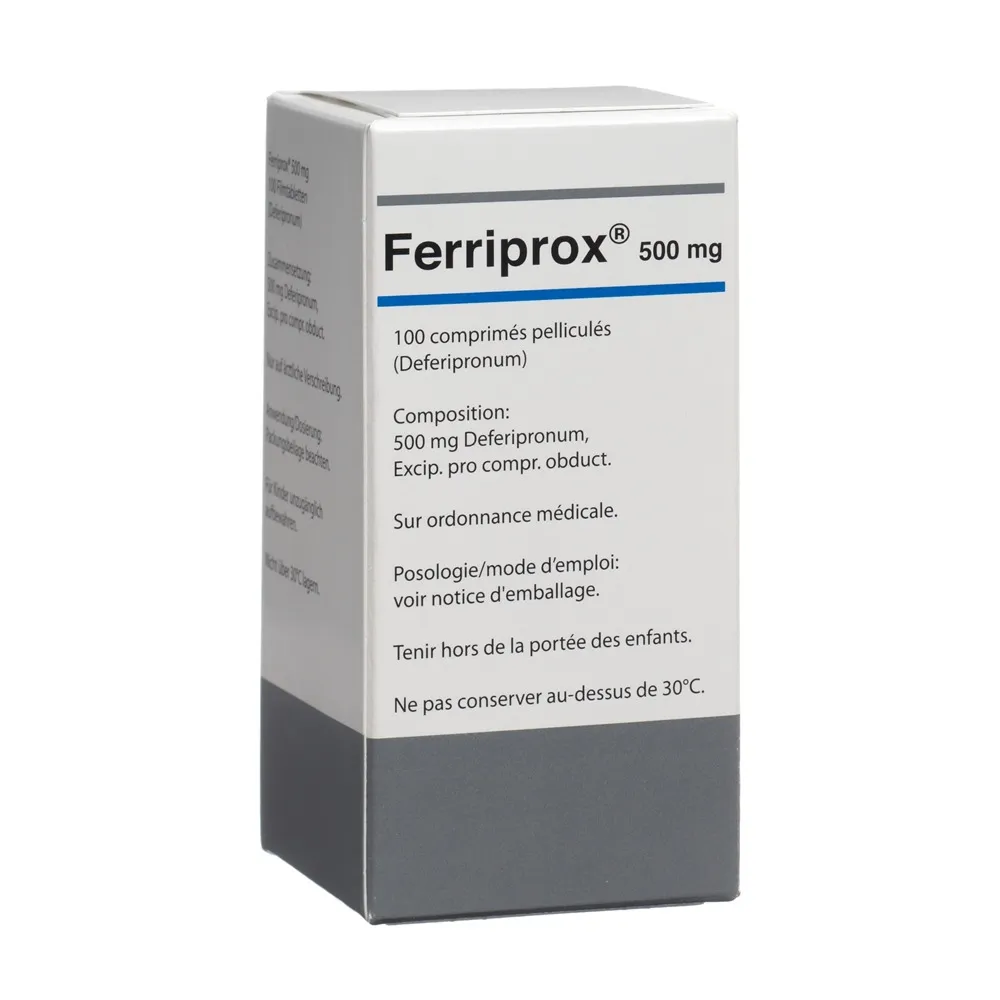
Table of Contents
Package leaflet: Information for the user
Introduction
Package leaflet: information for the user
Ferriprox 500 mg, film-coated tablets
deferiprone
Read the entire leaflet carefully before you start taking this medicine, because it contains important information for you.
-
Keep this leaflet, as you may need to read it again.
-
If you have any questions, ask your doctor or pharmacist.
-
This medicine has been prescribed for you only, and you should not give it to other people, even if they have the same symptoms as you, because it may harm them.
-
If you experience any adverse effects, consult your doctor or pharmacist, even if they are effects not listed in this leaflet. See section 4.
-
A patient card is attached inside the carton. You must detach, complete, and carefully read this patient card and carry it with you. Hand in this patient card to your doctor if you develop symptoms of infection such as fever, sore throat, or flu-like symptoms.
Contents of the leaflet
-
What Ferriprox is and what it is used for
-
What you need to know before taking Ferriprox
-
How to take Ferriprox
-
Possible adverse effects
-
How to store Ferriprox
-
Contents of the pack and other information
1. What Ferriprox is and what it is used for
Ferriprox contains the active substance deferiprone. Ferriprox is an iron chelator, a type of medicine that removes excess iron from the body.
Ferriprox is used to treat iron overload caused by frequent blood transfusions in patients with beta-thalassaemia major when current chelation therapy is contraindicated or inadequate.
2. What you need to know before starting to take Ferriprox
Do not take Ferriprox
-
if you are allergic to deferiprone or to any of the other ingredients of this medicine (listed in section 6).
-
if you have a history of repeated episodes of neutropenia (low white blood cell (neutrophil) count).
-
if you have a history of agranulocytosis (very low white blood cell (neutrophil) count).
-
if you are currently taking medicines known to cause neutropenia or agranulocytosis (see section “Other medicines and Ferriprox”).
-
if you are pregnant or during the breastfeeding period.
Warnings and precautions
-
The most serious adverse effect that may occur while taking Ferriprox is a very low count of white blood cells (neutrophils). This condition, known as agranulocytosis or severe neutropenia, has occurred in 1 to 2 out of every 100 people who took Ferriprox in clinical studies. Since white blood cells help fight infections, a low neutrophil count may put you at risk of developing a potentially life-threatening infection. To monitor for neutropenia, your doctor will ask you to have a blood test (to check your white blood cell count) regularly on a weekly basis while you are receiving Ferriprox treatment. It is very important that you attend all these appointments. See the patient card included in the package. If you experience any symptoms of infection such as fever, sore throat, or flu-like symptoms, seek medical attention immediately. Your white blood cell count must be checked within 24 hours to rule out possible agranulocytosis.
-
If you have tested positive for human immunodeficiency virus (HIV) or if you have severely impaired liver or kidney function, your doctor may recommend additional tests.
In addition, your doctor will require you to undergo tests to monitor your body iron levels. Your doctor may also ask you to undergo liver biopsies.
Other medicines and Ferriprox
Do not take medicines known to cause neutropenia or agranulocytosis (see section “Do not take Ferriprox”). Inform your doctor or pharmacist if you are taking, have recently taken, or might need to take any other medicines, including those obtained without a prescription.
Do not take aluminium-based antacids at the same time as Ferriprox.
Consult your doctor or pharmacist before taking vitamin C with Ferriprox.
Pregnancy and breastfeeding
Ferriprox may cause harm to the fetus when used in pregnant women. Ferriprox must not be used during pregnancy unless clearly necessary. If you are pregnant or become pregnant during treatment with Ferriprox, contact your doctor immediately.
Both female and male patients are advised to take special precautions regarding sexual activity if there is any possibility of pregnancy: Women of childbearing potential are advised to use effective contraception during treatment with Ferriprox and for 6 months after the last dose. Men are advised to use effective contraception during treatment and for 3 months after the last dose. You should discuss this with your doctor.
Do not take Ferriprox if you are breastfeeding. See the patient card included in the package.
Driving and use of machines
Not applicable.
3. How to take Ferriprox
Follow exactly the instructions for using this medicine as given by your doctor. If in doubt, consult your doctor or pharmacist again. The amount of Ferriprox you take will depend on your body weight. The usual dose is 25 mg/kg, taken 3 times a day, resulting in a total daily dose of 75 mg/kg. The total daily dose should not exceed 100 mg/kg. Take the first dose in the morning, the second at midday, and the third in the evening. Ferriprox may be taken with or without food; however, it may be easier to remember to take Ferriprox if you take it with meals.
If you take more Ferriprox than you should
There are no reports of acute overdose with Ferriprox. If you have accidentally taken more than the prescribed dose, you should contact your doctor.
If you forget to take Ferriprox
Ferriprox will be most effective if you do not miss any doses. If you miss a dose, take it as soon as you remember, and then take the next dose at the usual time. If you miss more than one dose, do not take a double dose to make up for the missed doses. Continue with the next dose at the usual time. Do not change your daily dose without first talking to your doctor.
4. Possible side effects
Like all medicines, this medicine can cause side effects, although not everybody gets them.
The most serious adverse effect of Ferriprox is a very low white blood cell count (neutrophils). This disorder, known as agranulocytosis or severe neutropenia, has occurred in 1 to 2 out of every 100 people who took Ferriprox during clinical trials. A low white blood cell count may lead to a serious and potentially fatal infection. Inform your doctor immediately if you experience any signs of infection such as: fever, sore throat, or flu-like symptoms.
Very common side effects (may affect more than 1 in 10 people):
- abdominal pain;
- nausea;
- vomiting;
- red/brown discoloration of urine.
If you experience nausea or vomiting, taking Ferriprox with a small amount of food may help. Discoloration of the urine is a very common effect and is not harmful.
Common side effects (may affect up to 1 in 10 people):
- low white blood cell count (agranulocytosis and neutropenia);
- headache;
- diarrhoea;
- increased liver enzymes;
- fatigue;
- increased appetite.
Frequency not known (cannot be estimated from available data):
- allergic reactions, such as rash or hives.
Episodes of joint pain and swelling ranged from mild pain in one or more joints to severe disability. In most cases, the pain disappeared while patients continued taking Ferriprox.
Neurological disorders (such as tremors, difficulty walking, double vision, involuntary muscle contractions, motor coordination problems) have been observed in children who were voluntarily prescribed more than double the recommended dose of 100 mg/kg/day for several years. Such disorders have also been observed in children receiving standard doses of deferiprone. Children stopped experiencing these symptoms after discontinuation of Ferriprox.
Reporting of side effects
If you experience any side effect, talk to your doctor or pharmacist, even if it is a possible side effect not listed in this leaflet. You can also report them directly through the Spanish Pharmacovigilance System for Human Medicinal Products: https://www.notificaram.es. By reporting side effects, you can help provide more information on the safety of this medicine.
5. Storage of Ferriprox
Keep this medicine out of the sight and reach of children.
Do not use this medicine after the expiry date stated on the packaging after EXP. The expiry date is the last day of the month indicated.
Do not store above 30 °C.
Medicines should not be disposed of via wastewater or household waste. Ask your pharmacist how to dispose of medicines and packaging you no longer need. This will help protect the environment.
6. Contents of the pack and other information
Composition of Ferriprox
The active substance is deferiprone. Each 500 mg tablet contains 500 mg of deferiprone.
The other components are:
core: microcrystalline cellulose, magnesium stearate, colloidal anhydrous silica.
coating: hypromellose, macrogol, titanium dioxide.
Appearance of the product and contents of the pack
Film-coated tablet, white or almost white, capsule-shaped, with “APO” and “500” printed on one side and smooth on the other. The tablet measures 7.1 mm x 17.5 mm x 6.8 mm and is scored. The tablet can be divided into equal doses.
Ferriprox is packed in bottles of 100 tablets.
Marketing Authorization Holder:
Chiesi Farmaceutici S.p.A.
Via Palermo 26/A
43122 Parma
Italy
Manufacturer responsible:
Eurofins PROXY Laboratories B.V.
Archimedesweg 25
2333 CM Leiden
The Netherlands
Further information on this medicinal product is available upon request by contacting the local representative of the Marketing Authorization Holder:
Spain Chiesi España, S.A.U. Tel: + 34 934948000 |
Date of the most recent review of this leaflet: September 2022
Other sources of information
Detailed information on this medicinal product is available on the website of the European Medicines Agency http://www.ema.europa.eu.