Ferinject 50 mg/ml injection and infusion dispersion
Spain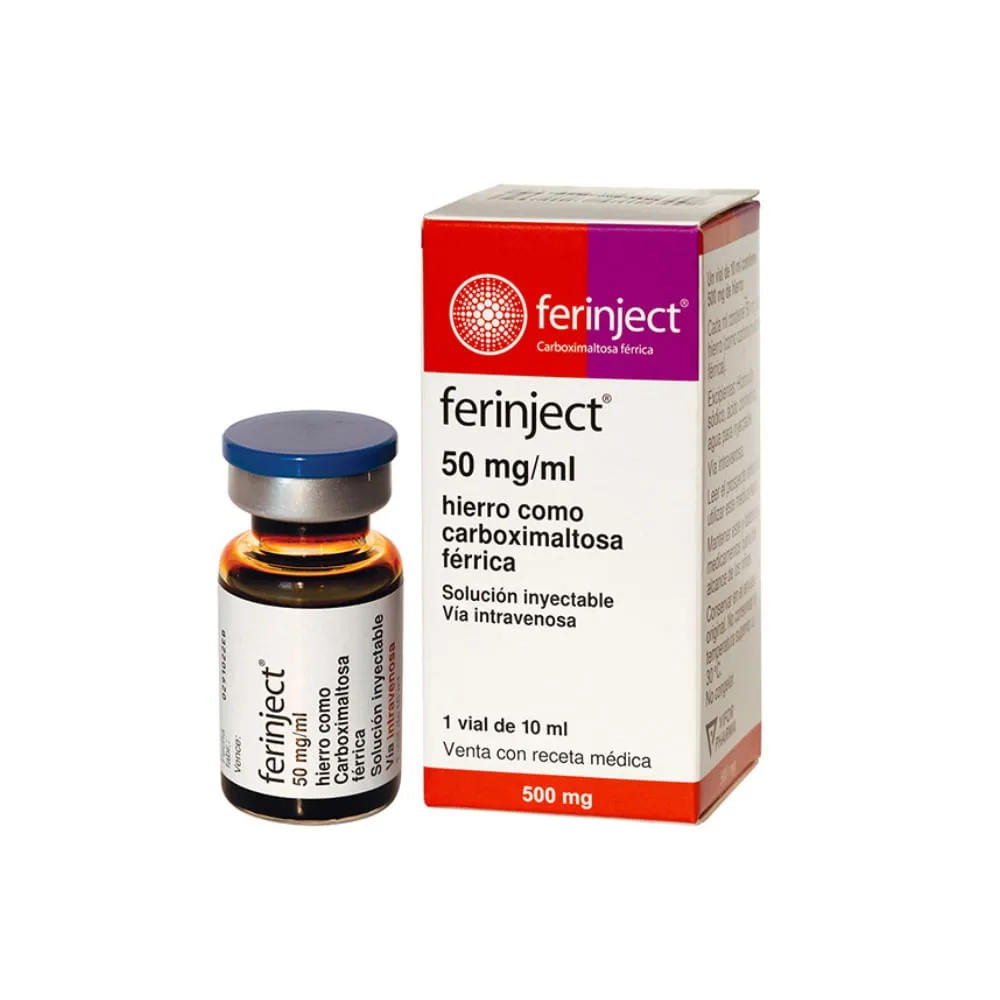
Table of Contents
Package leaflet: Information for the user
Introduction
Package leaflet: information for the user
Ferinject 50 mg/ml solution for infusion
Ferric carboxymaltose
Read the entire leaflet carefully before you start using this medicine, because it contains important information for you.
- Keep this leaflet, as you may need to read it again.
- If you have any questions, ask your doctor or pharmacist.
- If you experience any adverse reactions, talk to your doctor, even if they are not listed in this leaflet. See section 4.
Leaflet contents
- What Ferinject is and what it is used for
- What you need to know before using Ferinject
- How Ferinject is administered
- Possible side effects
- How to store Ferinject
- Contents of the pack and other information
1. What Ferinject is and what it is used for
Ferinject is a medicine containing iron.
Medicines containing iron are used when there is insufficient iron in the body. This condition is known as iron deficiency.
Ferinject is used to treat iron deficiency when:
- Oral iron is not sufficiently effective or you cannot tolerate oral iron.
- Your doctor decides that you need iron very quickly to replenish your iron stores.
Your doctor will determine whether you have iron deficiency by performing a blood test.
2. What you need to know before using Ferinject
Do not use Ferinject
- If you are allergic (hypersensitive) to ferric carboxymaltose or to any of the other ingredients of this medicine (listed in section 6).
- If you have experienced severe allergic reactions (hypersensitivity) to other injectable iron preparations.
- If you have anemia not caused by iron deficiency.
- If you have iron overload (excess iron in the body) or disorders in iron utilization.
Warnings and precautions
Talk to your doctor or nurse before starting treatment with Ferinject:
- If you have a history of drug allergies.
- If you have systemic lupus erythematosus.
- If you have rheumatoid arthritis.
- If you have severe asthma, eczema, or other allergies.
- If you have any infection.
- If you have any liver disorder.
- If you have or have had low blood phosphate levels.
Ferinject must not be administered to children under 1 year of age.
Incorrect administration of Ferinject may result in leakage of the product at the administration site, which can cause skin irritation and brown discoloration at the site that may last for a long time. If this occurs, administration must be stopped immediately.
Use of Ferinject with other medicines
Inform your doctor if you are taking, have recently taken, or might need to take any other medicines, including those obtained without a prescription. If Ferinject is administered together with oral iron preparations, the oral preparations may be less effective.
Pregnancy
There is limited data on the use of Ferinject in pregnant women. If you are pregnant or breastfeeding, think you may be pregnant, or are planning to become pregnant, consult your doctor before using this medicine.
If you become pregnant during treatment, you should seek medical advice so that your doctor can decide whether or not the medicine should be continued.
Breastfeeding
If you are breastfeeding, consult your doctor before receiving Ferinject. It is unlikely that Ferinject poses a risk to breastfed infants.
Driving and using machines
Ferinject is unlikely to affect your ability to drive or operate machinery.
Ferinject contains sodium
This medicine contains up to 5.5 mg of sodium (main component of table/cooking salt) per milliliter of undiluted dispersion.
Each 2 ml vial contains less than 1 mmol of sodium (23 mg); this is essentially "sodium-free".
Each 10 ml vial contains up to 55 mg of sodium (main component of table/cooking salt). This corresponds to 2.8% of the maximum daily sodium intake recommended for an adult.
Each 20 ml vial contains up to 110 mg of sodium (main component of table/cooking salt). This corresponds to 5.5% of the maximum daily sodium intake recommended for an adult.
3. How Ferinject is administered
Your doctor will decide how much Ferinject you should receive, how often you need it, and for how long. Your doctor will perform a blood test to determine the dose you require.
Adults and adolescents aged 14 years or older
Your doctor or nurse will administer Ferinject undiluted by injection, diluted by intravenous infusion, or during dialysis:
- By injection, you may be given up to 20 ml of Ferinject, corresponding to 1,000 mg of iron, once weekly, administered directly into a vein.
- By intravenous infusion, you may be given up to 20 ml of Ferinject, corresponding to 1,000 mg of iron, once weekly, administered directly into a vein. Since Ferinject is diluted with sodium chloride solution for intravenous infusion, the volume of the solution may be up to 250 ml and will appear brown.
- If you are undergoing dialysis, you may receive Ferinject during a hemodialysis session through the dialyzer.
Children and adolescents aged 1 to 13 years
- Your doctor or nurse will administer Ferinject either undiluted by injection or diluted by intravenous infusion: Your child will receive Ferinject directly into the vein. It will appear brown.
- If your child is undergoing dialysis, Ferinject must not be administered.
Ferinject will be administered in a facility where immunological or allergic reactions can be appropriately and rapidly treated. After each administration, you will remain under observation for at least 30 minutes under the supervision of a doctor or nurse.
If you receive more Ferinject than you should
Since this medicine will be administered by trained medical personnel, it is unlikely that you will receive too high a dose.
Overdose may lead to iron accumulation in the body. Your doctor will monitor your iron parameters to prevent iron accumulation.
4. Possible adverse effects
Like all medicines, this medicine can cause adverse effects, although not everyone experiences them.
Serious adverse effects:
Contact your doctor immediately if you experience any of the following signs and symptoms that may indicate a severe allergic reaction: skin rash (e.g., hives), itching, difficulty breathing, wheezing, and/or swelling of the lips, tongue, throat, or body, and chest pain, which may be a sign of a potentially serious allergic reaction called Kounis syndrome.
In some patients, these allergic reactions (affecting fewer than 1 in 1,000 people) can be serious or potentially life-threatening (known as anaphylactic reactions) and may be associated with heart or circulatory problems and loss of consciousness.
You should consult a doctor if you develop worsening fatigue, or muscle or bone pain (pain in arms or legs, joints, or back). This could be a sign of low blood phosphorus levels, which could cause softening of your bones (osteomalacia). This condition may sometimes lead to bone fractures. Your doctor may also monitor your blood phosphate levels, especially if you require multiple iron treatments over time.
Your doctor is aware of these possible adverse effects and will monitor you during and after the administration of Ferinject.
Other adverse effects you should report to your doctor if they become severe:
Frequent (may affect up to 1 in 10 people): headache, dizziness, sensation of warmth (hot flushes), hypertension, nausea, and injection/perfusion site reactions (see also section 2).
Uncommon (may affect up to 1 in 100 people): numbness, tingling or prickling sensation on the skin, altered taste sensation, increased heart rate, low blood pressure, difficulty breathing, vomiting, indigestion, stomach pain, constipation, diarrhea, itching, hives, skin redness, skin rash, muscle pain, joint and/or back pain, pain in arms or legs, muscle spasms, fever, fatigue, chest pain, swelling of the hands and/or feet, chills, and general malaise.
Rare (may affect up to 1 in 1,000 people): inflammation of a vein, anxiety, fainting, feeling of weakness, wheezing, excessive flatulence, sudden swelling of the face, mouth, tongue, or throat that may make breathing difficult, pallor, and skin color changes in areas of the body other than the administration site.
Unknown frequency (frequency cannot be estimated from available data): loss of consciousness and facial swelling.
Pseudo-flu illness (may affect up to 1 in 1,000 people) may occur several hours or several days after injection and is usually characterized by symptoms such as elevated temperature and muscle and joint pain.
Some blood parameters may be temporarily altered, which may be detected in laboratory tests.
The following change in blood parameters is frequent: decreased blood phosphorus levels.
The following changes in blood parameters are uncommon: increased levels of certain liver enzymes known as alanine aminotransferase, aspartate aminotransferase, gamma-glutamyl transferase, and alkaline phosphatase, and increased levels of an enzyme called lactate dehydrogenase.
Ask your doctor for more information.
Reporting of adverse effects
If you experience any adverse effect, consult your doctor or nurse, even if it is a possible adverse effect not listed in this leaflet. You may also report them directly via the Spanish Pharmacovigilance System for Human Medicines: www.notificaRAM.es.
By reporting adverse effects, you can help provide more information on the safety of this medicine.
5. Storage of Ferinject
Keep Ferinject out of the sight and reach of children.
Do not use Ferinject after the expiry date stated on the packaging after EXP. The expiry date refers to the last day of the month indicated.
Do not store above 30 °C. Do not freeze.
For information on storage conditions after dilution or after first opening of the medicinal product, see section "This information is intended for healthcare professionals only".
Ferinject is normally stored by the physician or hospital.
6. Contents of the container and other information
Composition of Ferinject
The active substance is ferric carboxymaltose, an iron carbohydrate complex. The concentration of iron in the product is 50 mg per milliliter. Each 2 ml vial contains ferric carboxymaltose equivalent to 100 mg of iron. Each 10 ml vial contains ferric carboxymaltose equivalent to 500 mg of iron. Each 20 ml vial contains ferric carboxymaltose equivalent to 1,000 mg of iron. The other components (excipients) are sodium hydroxide (for pH adjustment), hydrochloric acid (for pH adjustment), and water for injections.
Appearance of the product and contents of the pack
Ferinject is a dark brown, opaque injectable and infusion dispersion.
Ferinject is supplied in glass vials containing:
- 2 ml of dispersion. Pack sizes: 1, 2 or 5 vials.
- 10 ml of dispersion. Pack sizes: 1, 2 or 5 vials.
- 20 ml of dispersion. Pack sizes: 1 vial of 20 ml.
Only certain pack sizes may be marketed.
Marketing Authorization Holder and Manufacturer
Vifor France
100-101 Terrasse Boieldieu
Tour Franklin La Défense 8
92042 Paris La Défense Cedex
France
Tel. +33 (0)1 41 06 58 90
Fax +33 (0)1 41 06 58 99
e-mail: [email protected]
This medicinal product is authorized in the European Economic Area (EEA) Member States and in the United Kingdom (Northern Ireland) under the following names:
Germany, Austria, Bulgaria, Cyprus, Croatia, Denmark, Slovakia, Spain, Estonia, Finland, France, Greece, Hungary, Ireland, Iceland, Italy, Latvia, Norway, Netherlands, Poland, Portugal, United Kingdom (Northern Ireland), Czech Republic, Romania, Sweden: Ferinject®. Belgium, Luxembourg: Injectafer®. Slovenia: Iroprem®.
Date of the most recent review of this leaflet: May 2025.
Further information on this medicinal product is available upon request by contacting the local representative of the Marketing Authorization Holder.
Local Representative:
Vifor Pharma España S.L.
Av. Diagonal 611, 10th Floor
08028 Barcelona
Spain
Telephone: 902 12 11 11
Fax: 932 202 340
E-mail: [email protected]
Detailed and up-to-date information on this medicinal product is available on the website of the Spanish Agency of Medicines and Health Products (AEMPS) http://www.aemps.gob.es /
This information is intended for healthcare professionals only:
Closely monitor patients for signs and symptoms of hypersensitivity reactions during and after each administration of Ferinject.
Ferinject must only be administered when trained personnel and appropriate medical resources are immediately available to recognize and manage anaphylactic reactions, in a setting where full resuscitation equipment is accessible. Patients should be observed for at least 30 minutes after each administration of Ferinject for the occurrence of adverse reactions.
Step 1: Determination of iron required
Individual iron requirements for replacement with Ferinject are determined based on body weight and hemoglobin (Hb) level of the patient. Refer to Table 1 for the calculation of total iron required. Two doses may be necessary to replace the total required iron; see Step 2 for maximum individual doses.
Table 1: Determination of total iron required
Hb | Patient body weight | |||
g/dl | mmol/l | Less than 35 kg | 35 kg to < 70 kg | 70 kg or more |
<10 | <6.2 | 30 mg/kg body weight | 1,500 mg | 2,000 mg |
10 to <14 | 6.2 to <8.7 | 15 mg/kg body weight | 1,000 mg | 1,500 mg |
≥14 | ≥8.7 | 15 mg/kg body weight | 500 mg | 500 mg |
Step 2: Calculation and administration of the maximum individual dose(s) of iron
Depending on the total iron requirement determined, the appropriate dose of Ferinject must be administered, taking into account the following:
Adults and adolescents aged 14 years or older
A single administration of Ferinject must not exceed:
- 15 mg of iron/kg body weight (for administration by intravenous injection) or 20 mg of iron/kg body weight (for administration by intravenous infusion)
- 1,000 mg of iron (20 mL of Ferinject)
The recommended maximum weekly cumulative dose of Ferinject is 1,000 mg of iron (20 mL of Ferinject). If the total iron required is higher, administration of an additional dose should occur no sooner than 7 days after the first dose.
Children and adolescents aged 1 to 13 years
A single administration of Ferinject must not exceed:
- 15 mg of iron/kg body weight
- 750 mg of iron (15 mL of Ferinject)
The recommended maximum weekly cumulative dose of Ferinject is 750 mg of iron (15 mL of Ferinject). If the total iron required is higher, administration of an additional dose should occur no sooner than 7 days after the first dose.
Children under 1 year of age
The use of Ferinject is not recommended in children under 1 year of age.
Patients with chronic kidney disease dependent on hemodialysis
In adults and adolescents aged 14 years or older, a maximum single daily dose of 200 mg of iron must not be exceeded in patients with chronic kidney disease dependent on hemodialysis.
The use of Ferinject is not recommended in children aged 1 to 13 years with chronic kidney disease requiring hemodialysis.
Method of administration
Ferinject must only be administered intravenously: by injection, by infusion, or during a hemodialysis session, undiluted, directly into the venous limb of the dialyzer. Ferinject must not be administered subcutaneously or intramuscularly.
Care must be taken to avoid paravenous leakage when administering Ferinject. Paravenous leakage of Ferinject at the administration site may cause skin irritation and possible long-lasting brown discoloration. In the event of paravenous leakage, administration of Ferinject must be immediately discontinued.
Intravenous injection
Ferinject may be administered as an undiluted intravenous injection. In adults and adolescents aged 14 years or older, the maximum single dose is 15 mg of iron/kg body weight, but must not exceed 1,000 mg of iron. In children aged 1 to 13 years, the maximum individual dose is 15 mg of iron/kg body weight, but must not exceed 750 mg of iron. Administration regimens are shown in Table 2:
Table 2: Administration regimen for intravenous injection of Ferinject
Ferinject volume required | Equivalent iron dose | Administration regimen/Minimum administration time | ||||
2 | a | 4 ml | 100 | a | 200 mg | No prescribed minimum time |
> 4 | a | 10 ml | > 200 | a | 500 mg | 100 mg of iron/min |
> 10 | a | 20 ml | > 500 | a | 1,000 mg | 15 minutes |
Intravenous infusion
Ferinject may be administered by intravenous infusion, in which case it must be diluted. In adults and adolescents aged 14 years or older, the maximum single dose is 20 mg of iron/kg body weight, but must not exceed 1,000 mg of iron. In children aged 1 to 13 years, the maximum individual dose is 15 mg of iron/kg body weight, but must not exceed 750 mg of iron.
For infusion, Ferinject may only be diluted in a sterile 0.9% m/V sodium chloride solution as shown in Table 3. Note: For stability reasons, Ferinject must not be diluted to concentrations below 2 mg of iron/ml (excluding the volume of ferric carboxymaltose dispersion).
Table 3: Dilution schedule for Ferinject for intravenous infusion
Volume of Ferinject required | Equivalent iron dose | Maximum volume of sterile 0.9% m/V sodium chloride solution | Minimum administration time | ||||
2 | to | 4 ml | 100 | to | 200 mg | 50 ml | No prescribed minimum time |
> 4 | to | 10 ml | > 200 | to | 500 mg | 100 ml | 6 minutes |
> 10 | to | 20 ml | > 500 | to | 1,000 mg | 250 ml | 15 minutes |
Monitoring measures
The physician must carry out a new assessment based on the individual clinical picture of the patient. The Hb level should be re-evaluated at least 4 weeks after the last administration of Ferinject, to allow sufficient time for erythropoiesis and iron utilization. If the patient requires further iron replenishment, iron requirements should be recalculated using Table 1 above.
Incompatibilities
Oral iron absorption is reduced when administered concomitantly with parenteral iron preparations. Therefore, if necessary, oral iron therapy should not be initiated until at least 5 days after the last administration of Ferinject.
Overdose
Administration of Ferinject in amounts exceeding the quantity required to correct iron deficiency may lead to iron accumulation in storage sites, which over time may result in hemosiderosis. Monitoring of iron parameters such as serum ferritin and transferrin saturation may help identify iron accumulation. If iron accumulation occurs, treat according to standard medical practice, i.e., consider the use of an iron chelator.
Stability during use
Shelf life after container opening:
From a microbiological standpoint, parenteral preparations should be used immediately.
If not used immediately, the storage times and conditions prior to use are the responsibility of the user.
Administration of the product must be performed under controlled and validated aseptic conditions. Chemical and physical stability during use has been demonstrated for 7 days at 30 °C.
Shelf life in polyethylene and polypropylene containers after dilution with sterile 0.9% m/V sodium chloride solution:
From a microbiological standpoint, parenteral preparations should be used immediately after dilution with sterile 0.9% m/V sodium chloride solution.
If not used immediately, the storage times and conditions prior to use are the responsibility of the user and, in general, should not exceed 24 hours between 2 °C and 8 °C.
Chemical and physical stability during use has been demonstrated for 72 hours at 30 °C at concentrations of 2 mg/ml and 5 mg/ml.
Shelf life in polypropylene syringe (undiluted):
From a microbiological standpoint, this product should be used immediately.
If not used immediately, the storage times and conditions prior to use are the responsibility of the user and, in general, should not exceed 24 hours between 2 °C and 8 °C.
Chemical and physical stability during use has been demonstrated for 72 hours at 30 °C.