Ferbisol 100 mg gastro-resistant capsules
Spain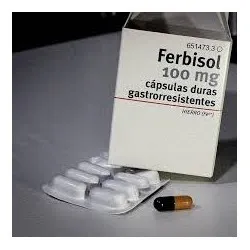
Table of Contents
- Package leaflet: Information for the user
- Introduction
- 1. What Ferbisol is and what it is used for
- 2. What you need to know before starting to take Ferbisol
- 3. How to take Ferbisol
- **Duration of treatment**
- 4. Possible adverse effects
- 5. Storage of Ferbisol
- 6. Contents of the pack and other information
Package leaflet: Information for the user
Introduction
Package leaflet: information for the patient
Ferbisol 100 mg gastro-resistant hard capsules
Iron (Fe2+)
Read the entire leaflet carefully before you start taking this medicine, because it contains important information for you.
-
Keep this leaflet, as you may need to read it again.
-
If you have any questions, ask your doctor or pharmacist.
- This medicine has been prescribed for you only, and you should not give it to other people, even if they have the same symptoms as you, because it may harm them.
-
If you experience any adverse reactions, consult your doctor or pharmacist, even if they are adverse reactions not listed in this leaflet. See section 4.
Leaflet contents
- What Ferbisol is and what it is used for
- What you need to know before taking Ferbisol
- How to take Ferbisol
- Possible side effects
- How to store Ferbisol
- Contents of the pack and other information
1. What Ferbisol is and what it is used for
Ferbisol is a form of iron that can be taken orally to treat or prevent iron deficiency. Iron is essential for oxygen transport and energy transfer in the body. The capsules are referred to as gastro-resistant because they do not release their contents in the stomach. They release iron in the intestine, where it is absorbed.
Ferbisol is used for the treatment of iron deficiency.
2. What you need to know before starting to take Ferbisol
Do not take Ferbisol
- If you are allergic to the iron complex or to any of the other components of this medicine (listed in section 6),
- If you have a narrowing in your throat (oesophagus),
- If you suffer from a disease called hereditary iron storage disorder (hemochromatosis),
- If you suffer from a condition involving iron accumulation (chronic hemolysis, thalassemia, other hemoglobinopathies),
- If you have any disorders in iron utilization (e.g., sideroblastic anemia (defective red blood cells may be produced), lead-induced anemia),
- If you receive periodic blood transfusions.
Children
- Children under 6 years of age must not take Ferbisol.
- Children aged 6 years and older whose body weight is less than 20 kg must not take Ferbisol.
Warnings and precautions
Talk to your doctor or pharmacist before starting to take Ferbisol.
Special care is needed with Ferbisol:
- If you already suffer from a gastrointestinal disorder such as chronic inflammatory bowel disease, narrowing of the oesophagus or intestine, intestinal pouches (diverticula), gastritis, gastric or intestinal ulcers.
- If you suffer from chronic kidney disease requiring erythropoietin, iron should be administered intravenously as oral iron is poorly absorbed in uremic individuals.
- If you suffer from hepatic insufficiency and/or alcoholism.
- If you are elderly and have blood or iron losses of unknown origin. In this case, the cause of the anemia/bleeding source must be carefully investigated.
- Your teeth may become discolored during treatment with Ferbisol (this discoloration may disappear when you stop taking Ferbisol. If not, it can be removed with an abrasive toothpaste or professional dental cleaning).
Children
- Exercise special caution when administering Ferbisol to children, as overdose may lead to poisoning in children.
Other medicines and Ferbisol
Tell your doctor or pharmacist if you are taking, have recently taken, or might need to take any other medicines.
Increased efficacy and possible adverse effects
- Painkillers (analgesics) and anti-rheumatic drugs (e.g., salicylates and phenylbutazone): may worsen any gastric mucosal irritation that Ferbisol may cause.
- Concomitant administration of intravenous iron together with oral iron may induce a drop in blood pressure (hypotension) or even collapse due to rapid release of iron and possible overload. This combination is not recommended.
Reduced efficacy and possible increase in adverse effects
- Certain antibiotics (tetracyclines) or medications (bis-phosphonates) used for treating weakened bones (osteoporosis): when taking Ferbisol, both iron absorption and absorption of tetracyclines or bis-phosphonates are reduced. This means the effects of all these medicines are diminished. Ask your doctor whether you need to increase the dose of these medicines.
- Medicines containing calcium, magnesium, or aluminium, e.g., antacids, calcium and magnesium salts for replacement: these medicines reduce or prevent absorption of iron from Ferbisol. You may need to increase the amount of Ferbisol you take.
- Medicines for arthritis, such as penicillamine and orally administered gold compounds, medicines for Parkinson's disease such as L-methyldopa and levodopa, and L-thyroxine used in the treatment of thyroxine deficiency: these medicines are less well absorbed when taken with iron-containing Ferbisol. Consult your doctor whether you need to increase your dose of these medicines.
- Treatments for infections (antibiotics) in the group known as fluoroquinolones, such as ciprofloxacin, levofloxacin, norfloxacin, and ofloxacin: iron greatly reduces the amount of these drugs absorbed. Consult your doctor if you are taking Ferbisol before starting treatment with these medicines.
The time interval between administration of Ferbisol and any of the above-mentioned medicines should be at least 2 hours.
The interval between administration of Ferbisol and tetracyclines and other doxycyclines (see below) should be at least 3 hours.
- Do not take doxycycline and Ferbisol together, as doxycycline may inhibit the absorption and circulation of Ferbisol.
Other possible side effects
- False positive results may frequently occur in blood trace tests of faeces.
Taking Ferbisol with food and drinks
Ferbisol must not be taken with food. Some substances contained in plant-based foods (e.g., cereals and vegetables) may form complexes with iron (e.g., phytates, oxalates, and phosphates). These complexes interfere with iron absorption. Ingredients in coffee, tea, milk, and cola drinks may also reduce iron absorption into the blood.
The interval between ingestion of these substances and Ferbisol should be at least two hours.
Pregnancy, breastfeeding, and fertility
There are no known risks when using Ferbisol during pregnancy and breastfeeding.
If you are pregnant or breastfeeding, think you might be pregnant, or plan to become pregnant, consult your doctor or pharmacist before using this medicine.
Driving and using machines
Ferbisol does not affect your ability to drive or operate machinery.
Ferbisol contains sodium lauryl sulfate
This medicine contains less than 23 mg of sodium (1 mmol) per capsule; this is essentially "sodium-free".
3. How to take Ferbisol
Follow exactly the instructions for use of this medicine as given by your doctor. If in doubt, consult your doctor or pharmacist again.
You must not take more than 5 mg of Ferbisol per kilogram of body weight. For example, if you weigh 60 kg, the maximum daily dose should be 5 x 60 = 300 mg (3 capsules).
Unless otherwise prescribed by your doctor, the usual dose is:
Children over 6 years (with a minimum body weight of 20 kg), adolescents and adults
Body weight (kg) | Capsules per dose | Dosing frequency | Total Fe2+ dose (mg) |
≥ 20 | 1 | Once daily | 100 |
Adolescents over 15 years of age (with a body weight above 50 kg) and adults.
In adolescents over 15 years of age and adults, the following doses are recommended at the beginning of treatment in cases of pronounced iron deficiency.
Body weight (kg) | Capsules per dose | Dosing frequency | Total Fe2+ dose (mg) |
50 - < 60 | 1 | 2 times daily | 200 |
≥ 60 | 1 | 2 – 3 times daily, distributed throughout the day | 200 - 300 |
Use in children and adolescents
Ferbisol must not be used in children under 6 years of age (with a body weight of less than 20 kg) (see section 2).
For children over 6 years of age (minimum body weight 20 kg) (see section 2), one capsule per day may be administered. For other doses, see table.
Method of administration
Take Ferbisol capsules with sufficient water. DO NOT chew the capsule. The capsules should be taken with a sufficiently long interval from meals (for example, on an empty stomach in the morning or between main meals), as absorption may be reduced by components of food.
Note
If you are unable to swallow the capsules or do not like them, you may empty the capsule and swallow the contents. To do this, carefully separate the two parts of the capsule over a bowl. Gently shake out the contents, collect with a teaspoon, and ingest. You should drink some water after ingesting the capsule contents.
Duration of treatment
Your doctor will decide the duration of your treatment.
Treatment should continue until normal blood iron levels are achieved, which requires between 10 and 20 weeks, or longer if the underlying condition persists.
The duration of treatment to prevent iron deficiency varies depending on the situation (pregnancy, blood donation, chronic hemodialysis, planned autologous transfusion).
If you take more Ferbisol than you should
After an intentional or accidental overdose, the symptoms described in section 4, “Possible side effects,” are the most commonly occurring and will be more severe.
If you have taken a large amount of Ferbisol, inform your doctor immediately.
Overdose may cause poisoning, especially in children.
Iron poisoning may cause symptoms such as agitation, stomach pain, nausea, vomiting, and diarrhea. Stools may appear tarry, and vomit may contain blood. Shock, metabolic changes such as increased acidity in the body, and coma may occur. Death may occur after seizures, Cheyne-Stokes respiration (an abnormal breathing pattern characterized by alternating periods of shallow and deep breathing), coma, and pulmonary edema.
In case of overdose or accidental ingestion, contact the Toxicology Information Service at telephone number 91 562 04 20.
If you forget to take Ferbisol
Do not take a double dose to make up for missed doses. If you have forgotten to take one or more doses of Ferbisol, continue taking it for a slightly longer period of time.
If you stop treatment with Ferbisol
No special precautions are required before stopping treatment with Ferbisol.
If you have any further questions about the use of this medicine, ask your doctor or pharmacist.
4. Possible adverse effects
Like all medicines, this medicine can cause adverse effects, although not everyone will experience them.
Ferbisol may in some cases (for which the frequency cannot be calculated) cause a severe allergic reaction (anaphylactic reaction). If you experience a severe rash, itching, or difficulty breathing, you should consult your doctor immediately.
Frequent adverse effects (affect between 1 and 10 patients in every 100)
- stomach or intestinal discomfort (abdominal),
- heartburn,
- vomiting,
- loose stools (diarrhea),
- nausea,
- constipation,
- dark stools (faeces).
Rare adverse effects (affect between 1 and 10 patients in every 10,000)
- dental staining (see also “Take special care with Ferbisol” in section 2),
- skin hypersensitivity (e.g. skin manifestations, exanthema, rash, urticaria).
Not known (frequency cannot be estimated from available data)
- abdominal pain and upper abdominal pain,
- gastrointestinal bleeding,
- discoloration of the tongue,
- discoloration inside the mouth.
Other effects in children
In children under 6 years of age, iron capsules may cause poisoning (see sections 2 and 3).
Reporting of adverse effects
If you experience any type of adverse effect, consult your doctor or pharmacist, even if it is a possible adverse effect not listed in this leaflet. You can also report them directly through the Spanish Pharmacovigilance System for Human Medicines: http://www.notificaram.es. By reporting adverse effects, you can help provide more information on the safety of this medicine.
5. Storage of Ferbisol
Keep this medicine out of sight and reach of children.
Do not use this medicine after the expiry date stated on the packaging and blister after EXP. The expiry date refers to the last day of the month indicated.
Do not store above 25°C.
Medicines should not be disposed of via wastewater drains or household waste. Return unused medicines and their packaging to the SIGRE collection point at your pharmacy. Ask your pharmacist how to dispose of medicines and packaging you no longer need. This will help protect the environment.
6. Contents of the pack and other information
Composition of Ferbisol
- The active substance is ferrous glycine sulfate complex (II). One capsule contains: 567.7 mg ferrous glycine sulfate complex (II) (equivalent to 100 mg of Fe²⁺).
- The other components are:
Pellets with ferrous glycine sulfate complex (II):
Ascorbic acid, microcrystalline cellulose, hypromellose, hydroxypropylcellulose, methacrylic acid-ethyl acrylate copolymer (1:1) dispersion 30% (Eudragit L30 D-55) (containing methacrylic acid-ethyl acrylate copolymer, sodium lauryl sulfate, polysorbate 80), acetyl triethyl citrate and talc.
Capsule:
Body: gelatin, titanium dioxide (E 171), red iron oxide (E 172), yellow iron oxide (E 172).
Cap: gelatin, titanium dioxide (E 171), red iron oxide (E 172), black iron oxide (E 172).
Appearance of the product and contents of the pack
Ferbisol is a gastro-resistant hard gelatin capsule of approximate size 21.7 mm x 7.5 mm, with an opaque chocolate brown cap, unprinted, and an opaque orange body, unprinted. It contains coated, enteric pellets of greyish-brown colour.
Ferbisol is available in packs containing 50 gastro-resistant capsules.
Marketing Authorization Holder and Manufacturer
Marketing Authorization Holder
Teofarma S.r.l.
Via F.lli Cervi, 8
27010 Valle Salimbene (PV) – Italy
Fax 0039.0382.525845
e-mail: [email protected]
Local Representative
Laboratorios BIAL, S.A.
C/Alcalá 265, Edificio 2, Planta 2ª
28027 Madrid
Spain
Manufacturer
Aesica Pharmaceuticals GmbH
Alfred-Nobel-Strasse 10
40789 Monheim
Germany
Date of the latest revision of this leaflet: 01/2024
Detailed information on this medicinal product is available on the website of the Spanish Agency of Medicines and Health Products (AEMPS) http://www.aemps.gob.es