Febuxostat Mabo 80 mg film-coated tablets EFG
Spain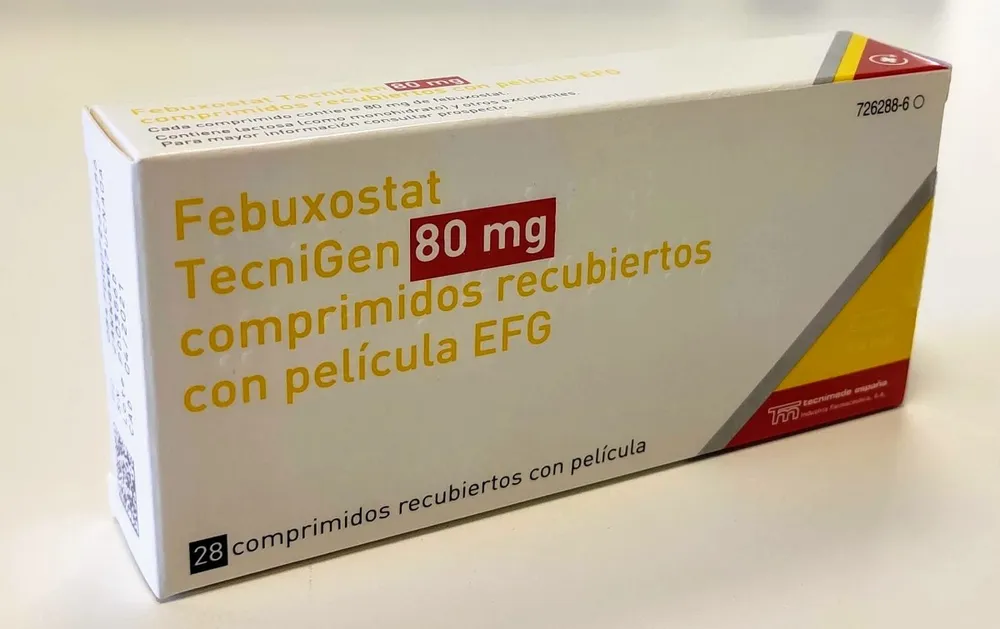
Instructions for Use
Package leaflet: Information for the user
Introduction
Package leaflet: information for the user
Febuxostat MABO 80 mg film-coated tablets EFG.
Read all of this leaflet carefully before you start taking this medicine, because it contains important information for you.
- Keep this leaflet, as you may need to read it again.
- If you have any questions, ask your doctor or pharmacist.
- This medicine has been prescribed for you only and must not be given to other people, even if they have the same symptoms as you, because it could harm them.
- If you experience any side effects, talk to your doctor or pharmacist, even if they are side effects not listed in this leaflet. See section 4.
Leaflet contents:
-
What Febuxostat MABO is and what it is used for
-
What you need to know before taking Febuxostat MABO
-
How to take Febuxostat MABO
-
Possible side effects
-
Storage of Febuxostat MABO
-
Contents of the pack and other information
1. What Febuxostat MABO is and what it is used for
Febuxostat MABO tablets contain the active substance febuxostat and are used to treat gout, which is associated with an excess in the body of a chemical compound called uric acid (urate). In some people, uric acid accumulates in the blood to the point where it can no longer dissolve. When this occurs, urate crystals form both within and around the joints and kidneys. These crystals can cause sudden and severe pain, redness, heat, and swelling in the joints (this is known as gout attacks). If left untreated, large deposits called tophi may form around and within the joints. Tophi can damage joints and bones.
Febuxostat MABO works by reducing the concentration of uric acid. Maintaining a low uric acid concentration by taking Febuxostat MABO once daily helps prevent the formation of crystals and, over time, reduces symptoms. If the uric acid concentration is kept low for a sufficient period, the size of the tophi also decreases.
2. What you need to know before taking Febuxostat MABO
Do not take Febuxostat MABO
- if you are allergic to febuxostat or to any of the other ingredients of this medicine (listed in section 6)
Warnings and precautions
Consult your doctor or pharmacist before taking Febuxostat MABO:
- if you have or have had heart failure or other heart problems
- if you have or have had kidney disease and/or severe allergic reactions to allopurinol (a medicine used to treat gout)
- if you have or have had liver disease or impaired liver function
- if you are being treated for high levels of uric acid due to Lesch-Nyhan syndrome (a rare inherited disorder in which there is too much uric acid in the blood)
- if you have thyroid problems.
If you experience allergic reactions to Febuxostat MABO, stop taking this medicine (see also section 4). Possible symptoms of allergic reactions may include:
- rash including severe forms (e.g. blisters, nodules, exfoliative rashes causing itching), itching
- swelling of the limbs or face
- difficulty breathing
- fever with swollen lymph nodes
- also severe allergic reactions which may be life-threatening, associated with circulatory arrest.
Rare cases of life-threatening skin reactions (Stevens-Johnson Syndrome) have been reported with the use of febuxostat, initially appearing on the trunk as red target-like spots or circular lesions often with a blister in the center. It may also include mouth, throat, nose, genital ulcers, and conjunctivitis (red and swollen eyes). The rash may progress to widespread blistering or skin peeling.
If you have developed Stevens-Johnson Syndrome with febuxostat, you must never restart treatment. If you develop a rash or these skin symptoms, seek immediate medical attention and inform your doctor that you are taking this medicine.
If you experience a gout flare (sudden, intense pain accompanied by tenderness, redness, warmth, and swelling in a joint), wait until the flare subsides before starting treatment with Febuxostat MABO.
Some people may experience gout flares when starting certain medicines that control uric acid levels. Not everyone experiences these flares, but they may occur even while taking Febuxostat MABO, especially during the first weeks or months of treatment. It is important to continue taking Febuxostat MABO even if you have a flare, as this medicine continues to work to reduce uric acid. If you continue taking Febuxostat MABO daily, gout flares will become less frequent and less painful over time.
If necessary, your doctor will prescribe other medicines to prevent or treat flare symptoms (such as joint pain and swelling).
In patients with very high urate levels (e.g., those undergoing chemotherapy for cancer), treatment with medicines to lower uric acid may lead to xanthine accumulation in the urinary tract, potentially causing kidney stones, although this has not been observed in patients treated with febuxostat for Tumor Lysis Syndrome.
Your doctor may perform blood tests to check that your liver is functioning normally.
Children and adolescents
Do not give this medicine to children under 18 years of age, as safety and efficacy have not been established.
Taking Febuxostat MABO with other medicines
Inform your doctor or pharmacist if you are taking, have recently taken, or might need to take any other medicines, including those obtained without a prescription.
It is especially important that you inform your doctor or pharmacist if you are taking medicines containing any of the following active substances, as they may interact with Febuxostat MABO, and your doctor may need to take special measures:
- Mercaptopurine (used to treat cancer)
- Azathioprine (used to reduce immune response)
- Theophylline (used to treat asthma)
Pregnancy and breastfeeding
It is not known whether Febuxostat MABO may harm the fetus. Febuxostat MABO must not be used during pregnancy. It is not known whether Febuxostat MABO passes into breast milk. Do not use Febuxostat MABO if you are breastfeeding or planning to breastfeed.
If you are pregnant or breastfeeding, think you may be pregnant, or plan to become pregnant, consult your doctor or pharmacist before using this medicine.
Driving and use of machines
Be aware that you may experience dizziness, somnolence, blurred vision, numbness, or tingling sensations during treatment. If this occurs, you should not drive or operate machinery.
Febuxostat MABO contains lactose
Febuxostat MABO tablets contain lactose (a type of sugar). If your doctor has informed you that you have an intolerance to certain sugars, consult with him before taking this medicine.
Febuxostat MABO contains sodium
This medicine contains less than 23 mg of sodium (1 mmol) per tablet; therefore, it is essentially “sodium-free”.
3. How to take Febuxostat MABO
Follow exactly the administration instructions for this medicine given by your doctor. If you have any doubts, consult your doctor or pharmacist again.
- The recommended dose is one tablet per day. The blister pack has the days of the week printed on the back to help you check that you take your dose every day.
- The tablets are taken orally, with or without food.
Febuxostat MABO is marketed as 80 mg tablets. Your doctor will prescribe the most appropriate dose for you.
Continue taking Febuxostat MABO every day, even if you no longer have gout attacks.
If you take more Febuxostat MABO than you should
In case of accidental overdose, consult your doctor or go to the nearest emergency department.
If you forget to take Febuxostat MABO
If you forget a dose of Febuxostat MABO, take it as soon as you remember, unless it is almost time for the next dose; in that case, skip the missed dose and take the next one at the usual time. Do not take a double dose to make up for missed doses.
If you stop taking Febuxostat MABO
Even if you feel better, do not stop taking Febuxostat MABO unless your doctor tells you to. If you stop taking Febuxostat MABO, uric acid levels may rise again, and symptoms may worsen due to the formation of new urate crystals in the joints and kidneys.
If you have any further questions about the use of this medicine, ask your doctor or pharmacist.
4. Possible side effects
Like all medicines, this medicine can cause side effects, although not everybody gets them.
Stop taking this medicine and contact your doctor immediately or go to the nearest hospital if you experience any of the following rare side effects (may affect up to 1 in 1,000 people), as you may be about to experience a serious allergic reaction:
- anaphylactic reactions, hypersensitivity to the medicine (see also section 2 “Warnings and precautions”)
- skin rashes that may be life-threatening, characterized by blistering and peeling of the skin and mucous membranes (e.g. mouth and genitals), painful sores in the mouth and/or genital areas, accompanied by fever, sore throat, and fatigue (Stevens-Johnson Syndrome/Toxic Epidermal Necrolysis), or enlarged lymph nodes, liver enlargement, hepatitis (including liver failure), increased number of white blood cells (leukocytes) in blood (Drug Reaction with Eosinophilia and Systemic Symptoms - DRESS syndrome) (see section 2)
- generalized skin rashes
Frequent side effects (may affect up to 1 in 10 people) are the following:
? abnormal results in liver function tests
? diarrhea
? headache
? rash (including various types of rash, see below under “uncommon” and “rare” sections)
? nausea
? worsening of gout symptoms
? localized swelling due to fluid retention in tissues (edema)
Other side effects not mentioned above are listed below.
Uncommon side effects (may affect up to 1 in 100 people) are the following:
- decreased appetite, change in blood sugar levels (diabetes), which may present as excessive thirst, increased blood fats, weight gain
- loss of sexual appetite
- difficulty sleeping, drowsiness
- dizziness, numbness, tingling sensation, decreased or altered sensitivity (hypoesthesia, hemiparesis or paresthesia), altered or reduced sense of taste (hypogeusia), abnormalities in ECG (electrocardiogram), irregular or rapid heartbeat, awareness of heartbeats (palpitations)
- hot flushes or flushing (redness of the face or neck), increased blood pressure, bleeding (hemorrhage, observed only in patients receiving chemotherapy for blood disorders)
- cough, breathing difficulties, discomfort or chest pain, inflammation of the nasal passages and/or throat (upper respiratory tract infection), bronchitis
- dry mouth, abdominal pain or discomfort or gas, heartburn or indigestion, constipation, more frequent bowel movements, vomiting, stomach discomfort
- itching, hives, skin inflammation or discoloration, small red or purple spots on the skin, small skin lesions, interconnected bumps on the skin, rash, skin lesions and spots, other skin disorders
- muscle cramps, muscle weakness, muscle and joint pain, bursitis or arthritis (inflammation of the joints, usually accompanied by pain, swelling or stiffness), limb pain, back pain, muscle spasms
- blood in urine, abnormally frequent urination, abnormal urine tests (increased concentration of proteins in urine), reduced kidney function
- fatigue, chest pain, chest discomfort
- gallstones or stones in the bile ducts (cholelithiasis)
- increased levels of thyroid-stimulating hormone (TSH) in blood
- changes in blood biochemistry or in the number of blood cells or platelets (abnormal blood test results)
- kidney stones
- difficulty achieving erection
Rare side effects (may affect up to 1 in 1,000 people) are the following:
- muscle damage, which in rare cases may be severe. It may cause muscle problems and particularly, if you also feel unwell or have high fever, it may be due to abnormal muscle breakdown. Contact your doctor immediately if you experience muscle pain, tenderness or weakness
- severe swelling of the deeper layers of the skin, especially around the lips, eyes, genitals, hands, feet or tongue, which may cause sudden difficulty in breathing
- high fever accompanied by measles-like rash, enlarged lymph nodes, liver enlargement (including liver failure), increased number of white blood cells in blood (leukocytosis, with or without eosinophilia)
- skin redness (erythema), different types of rashes (e.g. itchy, with white spots and blisters, with pus-filled blisters, with skin peeling, measles-like rash), generalized erythema, necrosis, blistering detachment of the skin and mucous membranes, leading to exfoliation and possible sepsis (Stevens-Johnson Syndrome/Toxic Epidermal Necrolysis)
- restlessness
- sensation of thirst
- ringing in the ears
- blurred vision, changes in vision
 hair loss
- mouth ulcers
- inflammation of the pancreas: common symptoms are abdominal pain, nausea and vomiting
- increased sweating
- weight loss, increased appetite, uncontrolled loss of appetite (anorexia)
- muscle and/or joint stiffness
- abnormal blood cell count (white blood cells, red blood cells or platelets)
- urgent need to urinate
- changes or decreased urine volume due to kidney inflammation (tubulo-interstitial nephritis)
- liver inflammation (hepatitis)
- yellowing of the skin (jaundice)
- liver damage
- increased levels of creatine phosphokinase in blood (a marker of muscle damage)
If you experience any side effect, inform your doctor or pharmacist. This includes any side effect not mentioned in this leaflet.
Reporting of side effects
If you experience any type of side effect, talk to your doctor, pharmacist or nurse, even if it is a possible side effect not listed in this leaflet. You can also report them directly through the national reporting system listed in Annex V.
By reporting side effects, you can help provide more information on the safety of this medicine.
5. Storage of Febuxostat MABO
- Keep this medicine out of the sight and reach of children.
- Do not use this medicine after the expiry date stated on the cardboard box and on the blister after CAD/EXP. The expiry date refers to the last day of the month indicated.
- This medicine does not require any special storage conditions.
Do not dispose of medicines via wastewater or household waste. Ask your pharmacist how to dispose of medicines and packaging that you no longer need. This will help protect the environment.
6. Contents of the pack and other information
Composition of Febuxostat MABO
The active substance is febuxostat.
Each tablet contains 80 mg of febuxostat, equivalent to 82.28 mg of febuxostat hemihydrate.
The other components are:
Tablet core: lactose monohydrate, microcrystalline cellulose (E460), magnesium stearate (E470b), hydroxypropylcellulose (E463), sodium croscarmellose, colloidal anhydrous silica (E551).
Tablet coating: polyvinyl alcohol (E1203), titanium dioxide (E171), macrogol 3350, talc (E553b), yellow iron oxide (E172), methacrylic acid-ethyl acrylate copolymer (1:1) (type A), sodium hydrogen carbonate (E500(ii)).
Appearance of the product and contents of the pack
Light yellow or yellow, film-coated, capsule-shaped tablets, with the number “80” engraved on one side and smooth on the other, measuring 16.5 mm x 7.0 mm ± 5%.
Febuxostat MABO 80 mg is available in Al-OPA/Alu/PVC or Al-PVC/PE/PVDC blisters.
Febuxostat MABO 80 mg is available in packs containing 14, 28, 45, 56, 84 and 98 film-coated tablets.
Only certain pack sizes may be commercially available.
Marketing Authorization Holder and Manufacturer
Marketing Authorization Holder:
MABO-FARMA S.A.
Calle Vía de los Poblados 3,
Edificio 6, 28033, Madrid,
Spain.
Manufacturer:
Rontis Hellas Medical and Pharmaceutical Products S.A
P.O. Box 3012 Larisa
41004, Greece
or
PharOS MT Ltd
HF 62X, Hal-Far Industrial Estate,
Birzebbugia BBG 3000,
Malta
This medicinal product is authorized in the Member States of the European Economic Area under the following names:
Spain: Febuxostat MABO 80mg film-coated tablets EFG
Malta: Febuxostat PharOS 80mg film-coated tablets
Date of the most recent review of this leaflet: November 2021
Similar Medications
-
Adenuric 120 mg film-coated tablets
Form: tablets, film-coated
Active substance Dosage FEBUXOSTAT 120 mg Manufacturer: Menarini International Operations Luxembourg S.A.
-
Adenuric 80 mg film-coated tablets
Form: tablets, film-coated
Active substance Dosage FEBUXOSTAT 80 mg Manufacturer: Menarini International Operations Luxembourg S.A.
-
Febuxostat Aurovitas 120 mg film-coated tablets EFG
Form: tablets, film-coated
Active substance Dosage FEBUXOSTAT 120 mg Manufacturer: Aurovitas Spain, S.A.U.
-
Febuxostat Aurovitas 80 mg film-coated tablets EFG
Form: tablets, film-coated
Active substance Dosage FEBUXOSTAT 80 mg Manufacturer: Aurovitas Spain, S.A.U.
-
Febuxostat CINFA 80 mg film-coated tablets EFG
Form: tablets, film-coated
Active substance Dosage FEBUXOSTAT 80 mg Manufacturer: Laboratorios Cinfa S.A.
-
Febuxostat Cinfa 120 mg film-coated tablets EFG
Form: tablets, film-coated
Active substance Dosage FEBUXOSTAT 120 mg Manufacturer: Laboratorios Cinfa S.A.
-
Febuxostat Cinfamed 120 mg film-coated tablets EFG
Form: tablets, film-coated
Active substance Dosage FEBUXOSTAT 120 mg Manufacturer: Laboratorios Cinfa S.A.
-
Febuxostat Cinfamed 80 mg film-coated tablets EFG
Form: tablets, film-coated
Active substance Dosage FEBUXOSTAT 80 mg Manufacturer: Laboratorios Cinfa S.A.
-
Febuxostat Normon 120 mg film-coated tablets EFG
Form: tablets, film-coated
Active substance Dosage FEBUXOSTAT 120 mg Manufacturer: Laboratorios Normon S.A.
-
Febuxostat Normon 80 mg film-coated tablets EFG
Form: tablets, film-coated
Active substance Dosage FEBUXOSTAT 80 mg Manufacturer: Laboratorios Normon S.A.
-
Febuxostat Pharma Combix 80 mg film-coated tablets EFG
Form: tablets, film-coated
Active substance Dosage FEBUXOSTAT HEMIHYDRATE 80 mg Manufacturer: Laboratorios Combix S.L.U.
-
Febuxostat STADA 120 mg film-coated tablets EFG
Form: tablets, film-coated
Active substance Dosage FEBUXOSTAT 120 mg Manufacturer: Laboratorio Stada S.L.
This page has been machine-translated and may contain inaccuracies. The original data is available in the manufacturing country's language.
Last data check: May 18, 2026 · Data source: CIMA — AEMPS