Fasturtec 1.5 mg/ml powder and solvent for concentrate for solution for infusion
Spain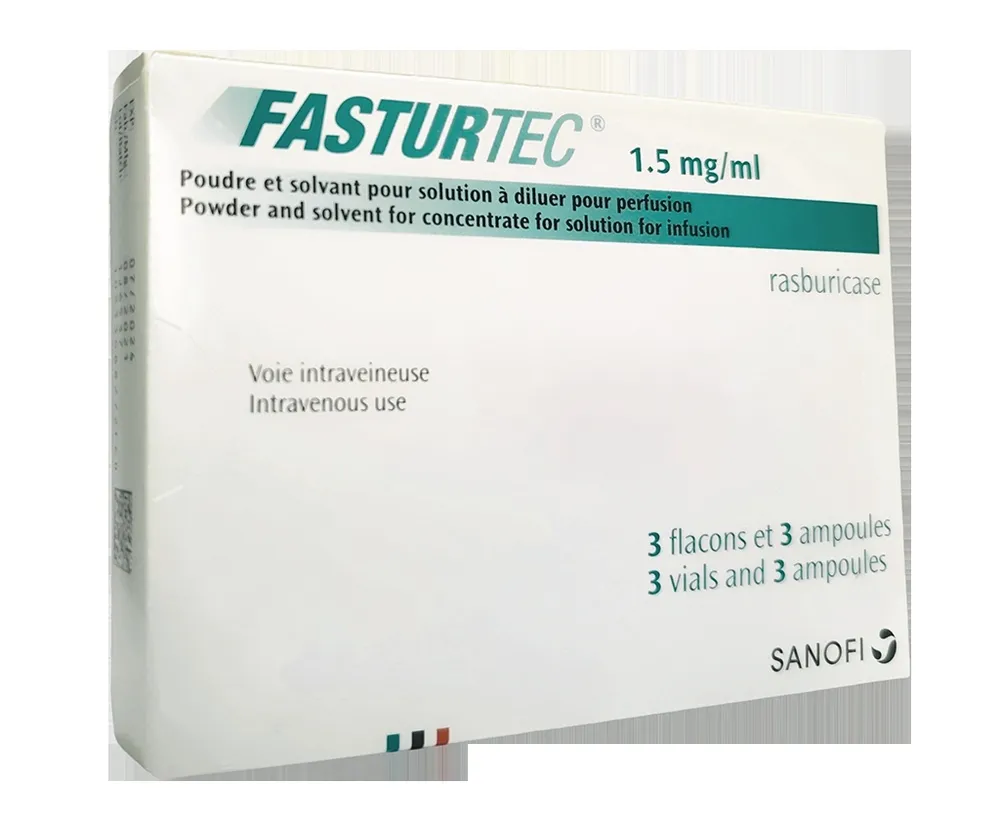
Table of Contents
Patient Information Leaflet
Introduction
Patient Information Leaflet
Fasturtec 1.5 mg/ml powder and solvent for concentrate for solution for infusion
rasburicase
Please read all of this leaflet carefully before you start using this medicine, because it contains important information for you.
- Keep this leaflet, as you may need to read it again.
- If you have any questions, consult your doctor, nurse or hospital pharmacist.
- If you experience any side effects, consult your doctor, nurse or hospital pharmacist, even if they are side effects not listed in this leaflet. See section 4.
Leaflet contents:
- What Fasturtec is and what it is used for
- What you need to know before you use Fasturtec
- How to use Fasturtec
- Possible side effects
- How to store Fasturtec
- Contents of the pack and other information
1. What Fasturtec is and what it is used for
Fasturtec contains rasburicase as its active substance.
Rasburicase is used to treat or prevent high levels of uric acid in the blood that occur in adults, children, and adolescents (aged 0 to 17 years) with blood cell disorders (hematological diseases) who are about to receive or are currently receiving chemotherapy.
When chemotherapy is administered, cancer cells are destroyed, releasing large amounts of uric acid into the bloodstream.
Fasturtec works by facilitating the elimination of uric acid from the body through the kidneys.
2. What you need to know before using Fasturtec
Do not use Fasturtec:
- if you are allergic (hypersensitive) to rasburicase, to another uricase, or to any of the other components of this medicine listed in section 6
- if you have a history of hemolytic anemia (a condition caused by abnormal destruction of red blood cells).
Warnings and precautions
Consult your doctor, nurse, or hospital pharmacist if you have a history of any type of allergy.
Inform your doctor if you have ever had an allergic reaction to any other medicines; Fasturtec may cause allergic-type reactions such as severe anaphylaxis, including potentially life-threatening anaphylactic shock or fatal allergic reactions.
Inform your doctor immediately if you notice any of the following symptoms, as treatment may need to be stopped:
- swelling of the face, lips, tongue, or throat
- cough or wheezing
- difficulty breathing or swallowing
- skin rash, itching, or hives (irritation-like rash)
These could be the first signs of a severe allergic reaction. Treatment with Fasturtec may need to be discontinued, and you may require additional treatments.
It is unknown whether the risk of developing an allergic reaction increases with repeated treatment with Fasturtec.
If blood disorders occur involving abnormal destruction of red blood cells (hemolysis) or abnormal levels of blood pigments (methemoglobinemia), your doctor will immediately and permanently discontinue treatment with Fasturtec.
Use of Fasturtec with other medicines
Inform your doctor if you are taking or have recently taken any other medicines, including those obtained without a prescription.
Pregnancy and breastfeeding
Inform your doctor if you are, or think you might be, pregnant, or if you are breastfeeding.
Driving and use of machines
There is no information available regarding the ability to drive and use machinery.
Fasturtec contains sodium
This medicine contains up to 10.5 mg of sodium (from table/cooking salt) per vial. This corresponds to 0.53% of the maximum daily recommended sodium intake for an adult.
3. How to use Fasturtec
Fasturtec will be administered before or during your chemotherapy treatment.
Fasturtec is injected slowly into a vein over approximately 30 minutes.
Your dose will be calculated according to your body weight.
The recommended dose is 0.20 mg per kg of body weight per day, in both children and adults.
It will be administered once daily, for up to 7 days.
During treatment with Fasturtec, your doctor will perform blood tests to monitor your uric acid levels and will decide how long your treatment should last.
Your doctor may also perform blood tests to ensure that you do not develop any blood disorders.
If you use more Fasturtec than you should
If this occurs, your doctor will carry out strict periodic monitoring of your red blood cells and will treat any symptoms that may arise.
If you have any further questions about the use of this medicine, ask your doctor, nurse, or hospital pharmacist.
4. Possible adverse effects
Like all medicines, Fasturtec can cause adverse effects, although not everyone will experience them.
Fasturtec will be administered at the same time as other medicines which could also cause adverse effects.
If you suddenly notice:
- swelling of the face, lips, tongue or other part of the body
- difficulty breathing, wheezing or trouble breathing
- skin rash, itching or hives
Tell your doctor, nurse or hospital pharmacist immediately, as these symptoms may be signs of a severe allergic reaction (anaphylaxis). These effects are rare (may affect up to 1 in 1,000 patients).
Very common adverse effects (may affect more than 1 in 10 people):
- diarrhoea
- vomiting
- nausea
- headache
- fever
Common adverse effects (may affect up to 1 in 10 patients):
- allergic reactions, mainly skin rashes and urticaria
Uncommon adverse effects (may affect up to 1 in 100 patients):
- severe hypersensitivity reactions, such as anaphylaxis (rare), including anaphylactic shock (frequency not known), which could be fatal
- low blood pressure (hypotension)
- wheezing or difficulty breathing (bronchospasm)
- blood disorders such as conditions in which red blood cells are abnormally destroyed (haemolysis), destruction of red blood cells (haemolytic anaemia), or abnormal levels of pigments in the blood (methaemoglobinaemia)
- seizures (convulsions)
Rare adverse effects (may affect up to 1 in 1,000 patients):
- runny nose or nasal congestion, sneezing, facial pressure or pain (rhinitis)
Frequency not known (cannot be estimated from available data):
- involuntary muscle movements (involuntary muscle contraction)
If you notice any of these adverse effects, inform your doctor, nurse or hospital pharmacist.
Reporting of adverse effects
If you experience any type of adverse effect, talk to your doctor, nurse or hospital pharmacist, even if it is a possible adverse effect not listed in this leaflet. You may also report them directly through the national reporting system included in Appendix V. By reporting adverse effects, you can help provide more information on the safety of this medicine.
5. Storage of Fasturtec
Keep this medicine out of the sight and reach of children.
Do not use this medicine after the expiry date stated on the packaging after EXP. The expiry date refers to the last day of the month indicated.
Store in a refrigerator (between 2°C and 8°C).
Do not freeze.
Keep in the original packaging to protect from light.
Do not use this medicine if you notice that the solution is not clear and/or contains particles.
6. Contents of the pack and other information
Composition of Fasturtec
- The active substance is rasburicase 1.5 mg/ml. Rasburicase is produced by genetic engineering in a microorganism called Saccharomyces cerevisiae.
- The other components of the powder are: alanine, mannitol, disodium phosphate dodecahydrate, disodium phosphate dihydrate, sodium dihydrogen phosphate dihydrate.
- The other components of the solvent are: poloxamer 188, water for injections.
Appearance of the product and contents of the container
Fasturtec is presented as a powder for concentrate for solution for infusion (sterile concentrate powder) with a solvent.
The powder is white or almost white, either agglomerated or not.
The solvent is a clear, colourless liquid.
Pack containing 3 vials of 1.5 mg rasburicase and 3 ampoules of 1 ml solvent. The powder is contained in 2 ml or 3 ml clear glass vials with a rubber stopper, and the solvent is contained in 2 ml clear glass ampoules.
Pack containing 1 vial of 7.5 mg rasburicase and 1 ampoule of 5 ml solvent. The powder is contained in a 10 ml clear glass vial with a rubber stopper, and the solvent is contained in a 5 ml clear glass ampoule.
Only some pack sizes may be marketed.
Marketing Authorisation Holder
Sanofi Winthrop Industrie
82 avenue Raspail
94250 Gentilly
France
Manufacturers
Sanofi S.r.l.
Via Valcanello, 4
03012 Anagni (FR)
Italy
Further information on this medicinal product is available upon request to the local representative of the Marketing Authorisation Holder.
Belgium/Belgium/Belgium Sanofi Belgium Tel/Tel: +32 (0)2 710 54 00 | Luxembourg/Luxembourg Sanofi Belgium Tel/Tel: +32 (0)2 710 54 00 (Belgium/Belgium) |
| Hungary sanofi-aventis zrt., Hungary Tel.: +36 1 505 0050 |
Czech Republic Sanofi s.r.o. Tel: +420 233 086 111 | Malta Sanofi S.r.l. Tel: +39 02 39394275 |
Denmark Sanofi A/S Tlf: +45 45 16 70 00 | Netherlands Sanofi B.V. Tel: +31 20 245 4000 |
Germany Sanofi-Aventis Deutschland GmbH Tel.: 0800 04 36 996 Tel. from abroad: +49 69 305 70 13 | Norway sanofi-aventis Norge AS Tlf: +47 67 10 71 00 |
Estonia Swixx Biopharma OÜ Tel: +372 640 10 30 | Austria sanofi-aventis GmbH Tel: +43 1 80 185 – 0 |
Greece sanofi-aventis AEBE Tel: +30 210 900 16 00 | Poland Sanofi sp. z o.oTel.: +48 22 280 00 00 |
Spain sanofi-aventis, S.A. Tel: +34 93 485 94 00 | Portugal Sanofi - Produtos Farmacêuticos, Lda. Tel: +351 21 35 89 400 |
France Sanofi Winthrop Industrie Tél: 0 800 222 555 Call from abroad: +33 1 57 63 23 23 Croatia Swixx Biopharma d.o.o. Tel: +385 1 2078 500 | Romania Sanofi Romania SRL Tel: +40 (0) 21 317 31 36 |
Ireland sanofi-aventis Ireland Ltd. T/A SANOFI Tel: +353 (0) 1 403 56 00 | Slovenia Swixx Biopharma d.o.o. Tel: +386 1 235 51 00 |
Iceland Vistor hf. Sími: +354 535 7000 | Slovakia Swixx Biopharma s.r.o. Tel: +421 2 208 33 600 |
Italy sanofi S.r.l. Tel 800.536389 | Finland Sanofi Oy Puh/Tel: +358 (0) 201 200 300 |
Cyprus C.A. Papaellinas Ltd. Tel: +357 22 741741 | Sweden Sanofi AB Tel: +46 (0)8 634 50 00 |
Latvia Swixx Biopharma SIA Tel: +371 6 616 47 50 | United Kingdom (Northern Ireland) sanofi-aventis Ireland Ltd. T/A SANOFI Tel: +44 (0) 800 035 2525 |
Lithuania Swixx Biopharma UAB Tel: +370 5 236 91 40 |
Date of the most recent review of this leaflet:
Other sources of information
Detailed information on this medicine is available on the European Medicines Agency website: http://www.ema.europa.eu
The following information is intended only for healthcare professionals:
See section 3 “How to use Fasturtec” and the practical information on preparation and handling described below.
Fasturtec must be reconstituted with the full volume of supplied diluent (i.e., the vial containing 1.5 mg rasburicase must be reconstituted with the ampoule containing 1 ml diluent; the vial containing 7.5 mg rasburicase must be reconstituted with the ampoule containing 5 ml diluent). After reconstitution, a solution with a concentration of 1.5 mg/ml rasburicase is obtained, which must then be diluted further with a 9 mg/ml sodium chloride (0.9%) solution.
Reconstitution of the solution:
Add the contents of one ampoule of diluent to a vial containing rasburicase and mix gently by rotating under controlled and validated aseptic conditions.
Do not shake.
Inspect visually before use. Only clear, colourless solutions free from particles should be used.
For single use only; any unused solution must be discarded.
The diluent contains no preservative. Therefore, the reconstituted solution must be diluted under controlled and validated aseptic conditions.
Dilution prior to infusion:
The required volume of reconstituted solution depends on the patient's body weight. It may be necessary to use several vials to obtain the amount of rasburicase required for one administration. The required volume of reconstituted solution, obtained from one or more vials, must then be diluted with a 9 mg/ml sodium chloride (0.9%) solution to a total volume of 50 ml. The final concentration of rasburicase in the infusion solution depends on the patient's body weight.
The reconstituted solution contains no preservative. Therefore, the diluted solution must be administered immediately.
Infusion:
The final solution must be infused over 30 minutes.
Handling of samples:
If monitoring of a patient's uric acid levels is required, a strict sample handling procedure must be followed to minimize ex vivo degradation of the analyte. Blood should be placed into pre-chilled tubes containing heparin anticoagulant. Samples should be immersed immediately in an ice/water bath. Plasma samples must be prepared immediately by centrifugation in a pre-chilled centrifuge (4°C). Finally, plasma must be kept in an ice/water bath and uric acid levels analysed within 4 hours.