Fasenra 30 mg solution for injection in pre-filled syringe
Spain
Table of Contents
Package leaflet: Information for the user
Introduction
Package leaflet: information for the patient
Fasenra 30 mg solution for injection in a pre-filled syringe
benralizumab
Read the entire leaflet carefully before you start receiving this medicine, because it contains important information for you.
- Keep this leaflet, as you may need to read it again.
- If you have any questions, consult your doctor, pharmacist, or nurse.
- This medicine has been prescribed for you only, and you should not give it to others, even if they have the same symptoms as you, because it could harm them.
- If you experience any adverse effects, consult your doctor, pharmacist, or nurse, even if they are adverse effects not listed in this leaflet. See section 4.
Leaflet contents
- What Fasenra is and what it is used for
- What you need to know before using Fasenra
- How Fasenra is administered
- Possible side effects
- How to store Fasenra
- Contents of the pack and other information
1. What Fasenra is and what it is used for
What Fasenra is
Fasenra contains the active substance benralizumab, which is a monoclonal antibody, meaning a type of protein that recognizes and binds to a specific substance in the body. The target of benralizumab is a protein called interleukin-5 receptor, which is found particularly on a type of white blood cell called an eosinophil.
What Fasenra is used for
Asthma
Fasenra is used to treat severe eosinophilic asthma in adults. Eosinophilic asthma is a type of asthma in which patients have too many eosinophils in their blood or lungs.
Fasenra is used in combination with other asthma medications (high-dose "inhaled corticosteroids" plus other anti-asthma drugs) when the disease is not well controlled by those other medications alone.
Eosinophilic granulomatosis with polyangiitis (EGPA)
Fasenra is used to treat EGPA in adults. EGPA is a disease in which people have too many eosinophils in their blood and tissues and also have some form of vasculitis. This means there is inflammation of the blood vessels. This disease most frequently affects the lungs and sinuses, but often affects other organs such as the skin, heart, and kidneys.
How Fasenra works
Eosinophils are white blood cells involved in the inflammation of asthma and EGPA. By binding to eosinophils, Fasenra helps reduce their numbers and the associated inflammation.
Benefits of using Fasenra
Asthma
Fasenra may reduce the frequency of asthma attacks you are experiencing, helping you breathe better and reducing your asthma symptoms. If you are using medications called "oral corticosteroids," taking Fasenra may also allow you to reduce your daily dose or discontinue treatment with oral corticosteroids needed to control your asthma.
EGPA
Fasenra may reduce symptoms and prevent flares of EGPA. This medicine may also allow you to reduce the daily dose of oral corticosteroids needed to control your symptoms.
2. What you need to know before using Fasenra
Do not use Fasenra:
- If you are allergic to benralizumab or to any of the other ingredients of this medicine (listed in section 6). Talk to your doctor, nurse, or pharmacist if you think this applies to you.
Warnings and precautions
Talk to your doctor, nurse, or pharmacist before using Fasenra:
- if you have a parasitic infection or live in an area where parasitic infections are common, or if you travel to such a region. This medicine may reduce your ability to fight certain types of parasitic infections.
- if you have ever had an allergic reaction to an injection or medication (see section 4 for symptoms of an allergic reaction).
Also, consult your doctor, pharmacist, or nurse if you are receiving Fasenra:
- if your asthma remains uncontrolled or worsens during treatment with this medicine.
- if you experience any symptoms of an allergic reaction (see section 4). Allergic reactions have occurred in patients receiving this medicine.
Fasenra is not a rescue medicine. Do not use it to treat a sudden asthma attack.
Be alert for signs of serious allergic reactions
Fasenra may potentially cause serious allergic reactions. You should be alert for signs of such reactions (such as hives, rash, difficulty breathing, fainting, discomfort, feeling dizzy and/or swelling of the face, tongue, or mouth) while receiving Fasenra.
It is important that you discuss with your doctor how to recognize early symptoms of serious allergic reactions and how to manage them if they occur.
To improve traceability of biological medicines, record the name and batch number shown on the outer packaging and on the label of the pre-filled syringe each time you receive a new pack of Fasenra, and provide this information when reporting any adverse event.
Other medicines for asthma or EGPA
Do not stop abruptly or change the dose of your other medications for your condition when starting Fasenra.
If your response to treatment allows, your doctor may attempt to reduce the dose of some of these medicines, especially those known as "corticosteroids." This should be done gradually and under the direct supervision of your doctor.
Tell your doctor if you are taking, have recently taken, or might need to take any other medicines before using Fasenra.
Children and adolescents
Do not administer this medicine to children under 18 years of age, as the safety and benefits of this medicine are unknown in this population.
Pregnancy and breastfeeding
If you are pregnant or breastfeeding, think you may be pregnant, or plan to become pregnant, consult your doctor before using this medicine.
Do not use Fasenra during pregnancy unless your doctor tells you otherwise. It is unknown whether Fasenra may affect the fetus.
It is not known whether components of Fasenra can pass into human breast milk. If you are breastfeeding or plan to breastfeed, talk to your doctor.
Driving and using machines
It is unlikely that Fasenra will affect your ability to drive or use machines.
Fasenra contains polysorbate 20
This medicine contains 0.06 mg of polysorbate 20 (of plant origin) in each 30 mg pre-filled syringe. Polysorbates may cause allergic reactions. Inform your doctor if you have any known allergies.
3. How to use Fasenra
Always use this medicine exactly as your doctor has told you. If you are unsure, consult your doctor, nurse, or pharmacist.
Asthma
The recommended dose is one 30 mg injection. The first 3 injections are given every 4 weeks. Afterwards, the injections are 30 mg doses every 8 weeks.
EGPA
The recommended dose is one 30 mg injection every 4 weeks.
Fasenra is administered by injection just under the skin (subcutaneously). You and your doctor or nurse should decide whether you should self-inject Fasenra. You must not self-inject Fasenra if you have not previously received Fasenra, or if you have previously had an allergic reaction to Fasenra.
You or your caregiver must receive training on the correct way to inject Fasenra. Read the ‘Instructions for Use’ for the pre-filled syringe carefully before using Fasenra.
If you forget to use Fasenra
If you forget to inject a dose of Fasenra, speak to your doctor, pharmacist, or nurse as soon as possible.
If you stop treatment with Fasenra
Do not stop treatment with Fasenra unless your doctor advises you to do so. Stopping or interrupting treatment with Fasenra may cause your symptoms to return and asthma exacerbations.
If your asthma symptoms worsen while receiving Fasenra injections, speak to your doctor.
If you have any further questions about the use of this medicine, ask your doctor, pharmacist, or nurse.
4. Possible adverse effects
Like all medicines, this medicine can cause adverse effects, although not everyone will experience them.
Severe allergic reactions
Contact your doctor immediately if you think you may be having an allergic reaction. Such reactions may occur hours or days after the injection.
Frequency not known (cannot be estimated from available data):
- anaphylaxis
Typical symptoms include:
o swelling of the face, tongue or mouth
o breathing difficulties
o fainting, dizziness, lightheadedness (due to a drop in blood pressure)
Frequent (may affect up to 1 in 10 people):
- hypersensitivity reactions (hives, skin rash)
Other adverse effects
Frequent (may affect up to 1 in 10 people):
- headache
- pharyngitis (sore throat)
- fever (high temperature)
- injection site reaction (for example, pain, redness, itching, swelling near the injection site)
Reporting of adverse effects
If you experience any adverse effect, talk to your doctor, pharmacist or nurse, even if it is a possible adverse effect not listed in this leaflet. You can also report them directly through the national reporting system included in Appendix V. By reporting adverse effects, you can help provide more information on the safety of this medicine.
5. Storage of Fasenra
Keep this medicine out of the sight and reach of children.
Fasenra is for single use only.
Do not use this medicine after the expiry date stated on the label and the carton after ‘EXP/CAD’. The expiry date refers to the last day of the month indicated.
Store in the original packaging to protect from light.
Store in a refrigerator (between 2 °C and 8 °C).
The syringe may be stored at room temperature up to 25 °C for a maximum of 14 days. After removal from the refrigerator, Fasenra must be used within 14 days or discarded, and the date of disposal should be written on the carton.
Do not shake, freeze, or expose to heat.
Medicines must not be disposed of via wastewater. Ask your pharmacist how to dispose of medicines and containers you no longer need. This will help protect the environment.
6. Contents of the pack and other information
Composition of Fasenra
The active substance is benralizumab. One pre-filled syringe of 1 ml solution contains 30 mg of benralizumab.
The other components are histidine, histidine monohydrochloride monohydrate, trehalose dihydrate, polysorbate 20 (E 432), and water for injections.
Appearance of the product and contents of the pack
Fasenra is a solution in a clear glass syringe. It ranges in colour from colourless to yellow. It may contain particles.
Fasenra is available in a pack containing 1 pre-filled syringe.
Marketing Authorisation Holder
AstraZeneca AB
SE-151 85 Södertälje
Sweden
Manufacturer
AstraZeneca AB
Gärtunavägen
SE-152 57 Södertälje
Sweden
MedImmune UK Ltd
6 Renaissance Way
Liverpool, L24 9JW
United Kingdom
AstraZeneca Nijmegen B.V., Nijmegen
Lagelandseweg 78
Nijmegen, 6545CG
The Netherlands
For more information about this medicine, you may contact the local representative of the Marketing Authorisation Holder:
Belgium/Belgium/Belgium AstraZeneca S.A./N.V. Tel: +32 2 370 48 11 | Lithuania UAB AstraZeneca Lietuva Tel: +370 5 2660550 |
| Luxembourg/Luxembourg AstraZeneca S.A./N.V. Tél/Tel: +32 2 370 48 11 |
Czech Republic AstraZeneca Czech Republic s.r.o. Tel: +420 222 807 111 | Hungary AstraZeneca Kft. Tel.: +36 1 883 6500 |
Denmark AstraZeneca A/S Tlf.: +45 43 66 64 62 | Malta Associated Drug Co. Ltd Tel: +356 2277 8000 |
Germany AstraZeneca GmbH Tel: +49 40 809034100 | Netherlands AstraZeneca BV Tel: +31 85 808 9900 |
Estonia AstraZeneca Tel: +372 6549 600 | Norway AstraZeneca AS Tlf: +47 21 00 64 00 |
Greece AstraZeneca A.E. Tel: +30 210 6871500 | Austria AstraZeneca Österreich GmbH Tel: +43 1 711 31 0 |
Spain AstraZeneca Farmacéutica Spain, S.A. Tel: +34 91 301 91 00 | Poland AstraZeneca Pharma Poland Sp. z o.o. Tel.: +48 22 245 73 00 |
France AstraZeneca Tél: +33 1 41 29 40 00 | Portugal AstraZeneca Produtos Farmacêuticos, Lda. Tel: +351 21 434 61 00 |
Croatia AstraZeneca d.o.o. Tel: +385 1 4628 000 | Romania AstraZeneca Pharma SRL Tel: +40 21 317 60 41 |
Ireland AstraZeneca Pharmaceuticals (Ireland) DAC Tel: +353 1609 7100 | Slovenia AstraZeneca UK Limited Tel: +386 1 51 35 600 |
Iceland Vistor hf. Tel: +354 535 7000 | Slovakia AstraZeneca AB, o.z. Tel: +421 2 5737 7777 |
Italy AstraZeneca S.p.A. Tel: +39 02 00704500 | Finland AstraZeneca Oy Puh/Tel: +358 10 23 010 |
Cyprus Alkemion Pharmaceutical Ltd Tel: +357 22490305 | Sweden AstraZeneca AB Tel: +46 8 553 26 000 |
Latvia SIA AstraZeneca Latvija Tel: +371 67377100 | United Kingdom (Northern Ireland) AstraZeneca UK Ltd Tel: +44 1582 836 836 |
Date of the most recent review of this leaflet:
Detailed information on this medicine is available on the European Medicines Agency website: https://www.ema.europa.eu.
<---------------------------------------------------------------------------------------------------------------->
Instructions for use
Fasenra 30 mg solution for injection in pre-filled syringe
benralizumab
For subcutaneous injection
Single-use pre-filled syringe
Before starting to use the Fasenra pre-filled syringe, a healthcare professional should train you or your caregiver on how to use it correctly.
Read these “Instructions for Use” before starting to use the Fasenra pre-filled syringe and each time you need to administer a new injection. There may be new information. This information does not replace a consultation with your healthcare professional regarding your condition or treatment.
If you or your caregiver have any questions, consult your healthcare professional.
Important information
Store Fasenra in a refrigerator between 2°C and 8°C inside its carton until ready for use. Fasenra may be kept at room temperature up to 25°C for a maximum of 14 days. After removal from the refrigerator, Fasenra must be used within 14 days or discarded.
Do not use your Fasenra pre-filled syringe if:
| Do not:
|
If any of the above occurs, discard the syringe in a puncture-resistant sharps container and use a new prefilled syringe.
Each Fasenra prefilled syringe contains 1 dose of Fasenra for single use only.
Keep Fasenra and all medicines out of the sight and reach of children.
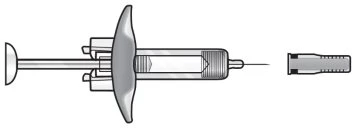
Your Fasenra prefilled syringe
Do not remove the needle cap until you have reached Step 6 and are ready to inject Fasenra.
Do not touch the needle guard activation clips to avoid prematurely activating the safety device (needle guard).
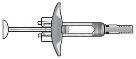
Needle shield activation clips | Syringe barrel | Expiration date label | Needle cap | |||
Plunger tip |
| |||||
Plunger | Finger flanges | View window | Needle |
Step 1 – Gather the materials
- 1 Fasenra pre-filled syringe from the refrigerator
- 1 alcohol wipe
- 1 cotton ball or gauze pad
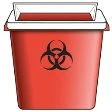
- 1 sharps container
(See step 9 – Dispose of the pre-filled syringe)
|
|
|
|
Pre-filled syringe | Alcohol wipe | Cotton ball or gauze | Sharps container |


Step 2 – Prepare to use your pre-filled syringe | |
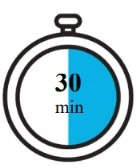
Check the expiration date (EXP). Do not use if the expiration date has passed. Before administration, allow the pre-filled syringe to reach room temperature (20°C to 25°C) by removing it from the refrigerator and leaving it unopened in its carton for approximately 30 minutes. Do not heat the pre-filled syringe by any other method. For example, do not heat it in a microwave, with hot water, or place it near sources of heat. Use Fasenra within 14 days after removing it from the refrigerator. |
|
Step 3 – Check the liquid | |
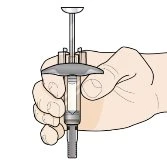
Hold the barrel of the syringe (not the plunger) to remove the syringe. Look at the liquid through the viewing window. The liquid should be clear and colorless to slightly yellowish. It may contain small white particles. Do not inject Fasenra if the liquid is cloudy, discolored, or contains large particles. You may see a small air bubble in the liquid. This is normal. You do not need to do anything about it. |
|
Step 4 – Choose the injection site | |
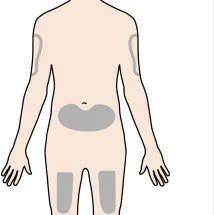
The recommended site for injection is the front part of the thigh. You may also use the lower part of the abdomen. Do not inject:
A caregiver may inject it into the upper arm, thigh, or abdomen. Do not attempt to self-inject into the upper arm. For each injection, choose a different site, at least 3 cm away from the previous injection site. |
|

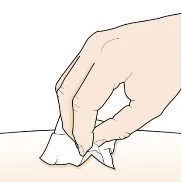
Step 5 – Clean the injection site | |
Wash your hands thoroughly with soap and water. Clean the injection site with an alcohol wipe using a circular motion. Allow it to air dry. Do not touch the cleaned area before the injection. Do not fan or blow on the cleaned area. |
|
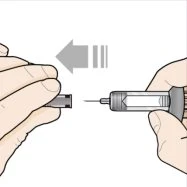
Step 6 – Remove the needle cap | |
Hold the syringe with one hand and carefully pull off the needle cap with the other hand. Do not touch the plunger or plunger head while removing the needle cap. Set the needle cap aside for proper disposal later. You may see a drop of liquid at the tip of the needle. This is normal. Do not use the syringe if it has been dropped without the needle cap in place or if the needle is damaged or dirty. Do not touch the needle or allow it to contact any surface. Proceed directly to the next steps without delay. |
|
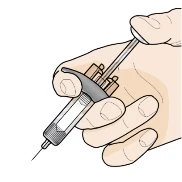
Step 7 – Inject Fasenra | |
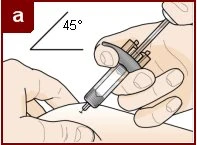
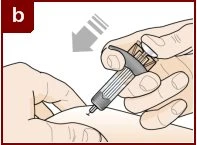
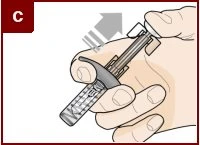
Hold the pre-filled syringe in one hand, as shown in the figure. Use your other hand to gently pinch and hold the area of skin where you want to inject. This creates a firmer surface. Do not push the plunger until the needle is fully inserted into the skin. Do not pull back on the plunger at any time. Inject Fasenra by following the steps shown in figures a, b, and c. |
|
|
|
|
Perform a quick, dart-like motion to insert the needle into the pinched skin. Insert the needle at a 45-degree angle. | Use your thumb to push the plunger head. Continue pushing the plunger all the way down to ensure that all of the medication has been injected. | Keep your thumb pressing on the plunger head while withdrawing the needle from the skin. Release pressure on the plunger slightly until the needle shield activation clips cover the needle. |
Step 8 – Check the injection site | |
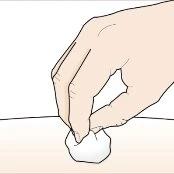
There may be a small amount of blood or fluid at the injection site. This is normal. Gently press on the skin with a cotton ball or gauze until bleeding stops. Do not rub the injection site. If necessary, cover the injection site with a small bandage. |
|
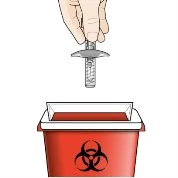
Step 9 – Dispose of the used pre-filled syringe | |
Do not throw the pre-filled syringe into your household waste. Do not recap the pre-filled syringe. Dispose of the needle cap and any other used materials in your household waste. |
|
Waste disposal guide Dispose of the container as a whole according to the instructions provided by your healthcare professional or pharmacist. Do not recycle your sharps container. |