Farmorubicina 50 mg powder for injection and for infusion
Spain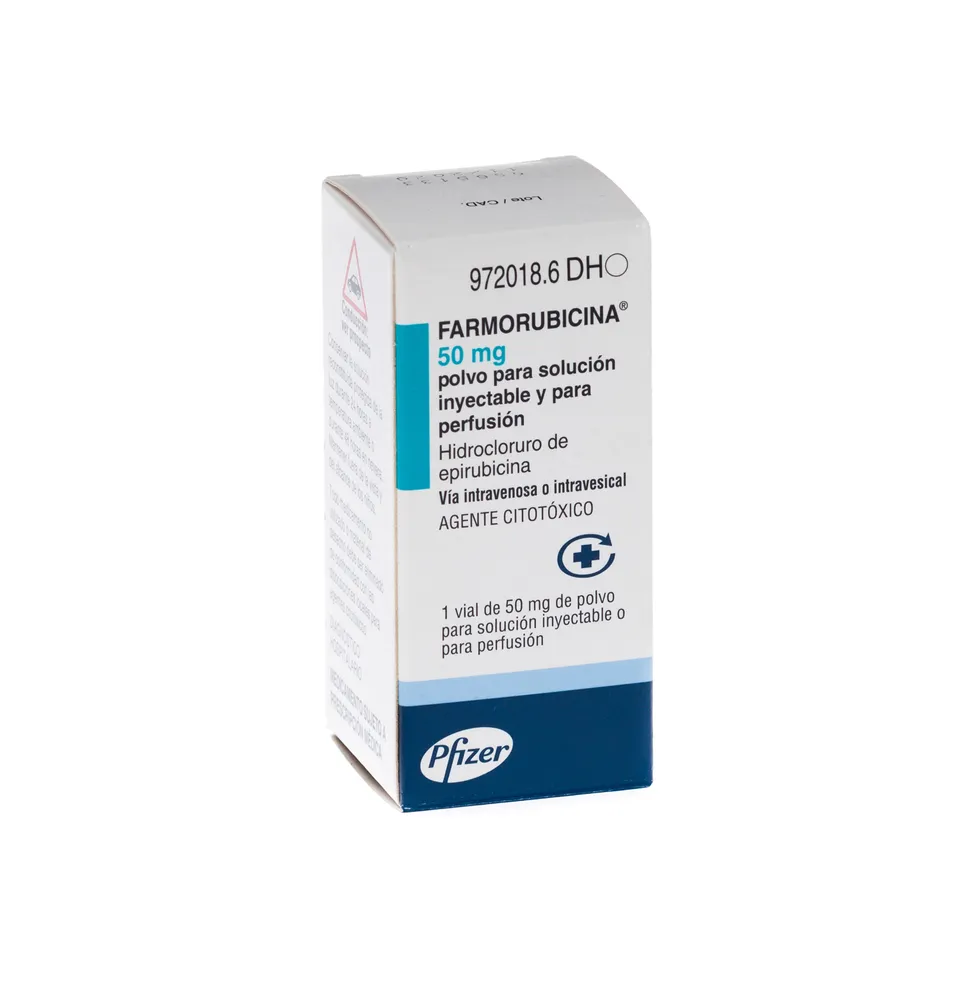
Table of Contents
- Package leaflet: Information for the user
- Introduction
- 1. What Farmorubicin 50 mg powder is and what it is used for
- 2. What you need to know before using Farmorubicina 50 mg powder
- 3. How to use Farmorubicin 50 mg powder
- 4. Possible adverse effects
- 5. Storage of Farmorubicin 50 mg powder
- 6. Contents of the container and additional information
Package leaflet: Information for the user
Introduction
Package leaflet: information for the patient
Farmorubicin 50 mg powder for injectable solution and for infusion
Epirubicin hydrochloride
Read the entire leaflet carefully before you start using this medicine, because it contains important information for you.
-
Keep this leaflet, as you may need to read it again.
-
If you have any questions, consult your doctor or pharmacist.
-
This medicine has been prescribed for you only, and you should not give it to other people, even if they have the same symptoms as you, because it may harm them.
- If you experience any adverse effects, consult your doctor or pharmacist, even if they are adverse effects not listed in this leaflet. See section 4.
Leaflet contents
-
What Farmorubicin 50 mg powder is and what it is used for
-
What you need to know before using Farmorubicin 50 mg powder
-
How to use Farmorubicin 50 mg powder
-
Possible side effects
- How to store Farmorubicin 50 mg powder
-
Contents of the pack and other information
1. What Farmorubicin 50 mg powder is and what it is used for
Farmorubicin is an anticancer antibiotic-type medicine belonging to the anthracycline group, used in the treatment of various types of cancer. It is administered intravenously (into a vein) or intravesically (by direct injection into the urinary bladder). Farmorubicin acts as a cytotoxic agent: it inhibits the cell cycle and prevents the proliferation of cancer cells.
Farmorubicin may be used alone or in combination with other medicines to treat the following types of cancer:
- Breast cancer.
- Soft tissue sarcoma: malignant tumors that may affect cartilage, muscles, fat, blood vessels, or other tissues.
- Stomach cancer.
- Small cell lung cancer (a specific type of lung cancer).
- Advanced ovarian cancer.
- Early-stage (superficial) bladder tumors and for the prevention of possible recurrences after surgery.
2. What you need to know before using Farmorubicina 50 mg powder
Do not use Farmorubicina 50 mg powder:
- If you are allergic to the active substance (epirubicin hydrochloride), to other anticancer agents of the same group (anthracyclines), or to any of the other components of this medicine (listed in section 6).
Do not use Farmorubicina if administration is intravenous:
- If you have lower than normal blood cell counts, reduced bone marrow activity, impairing your ability to fight infections or diseases.
- If you have or have had severe liver problems.
- If you have severe heart problems (severe heart failure, recent myocardial infarction, severe arrhythmias, unstable angina, or cardiomyopathy).
- If you have previously been treated with high doses of epirubicin hydrochloride or other anticancer agents of the same group (anthracyclines). These medicines have similar adverse effects.
- If you have a severe, generalized acute infection.
Do not use Farmorubicina if administration is intravesical:
- If you have urinary tract infections, bladder inflammation, or blood in the urine.
- If the tumor has penetrated the bladder wall.
- If you have problems with catheterization (tube in the bladder).
Warnings and precautions
Talk to your doctor or pharmacist before starting to use Farmorubicina 50 mg powder.
- If you have or have had heart problems, or if you are receiving, have received, or have been irradiated with radiotherapy in areas near the heart.
- If you have previously been treated with other anthracyclines.
- If you are being treated with other medicines for cancer.
- If you are being treated with other medicines capable of suppressing heart contraction.
- If your immune system is impaired, i.e., you have lost the ability to fight infections or diseases.
- If you have or have had liver problems.
- If you have or have had kidney problems.
- If you have or have had gout, as epirubicin may cause elevated uric acid levels.
- If you need to be vaccinated while undergoing treatment with this medicine, since live or attenuated virus vaccines should not be administered, and the response to inactivated or killed vaccines may be reduced.
- If you experience discomfort at or near the injection site during infusion (possible leakage of fluid into surrounding tissue).
- If you have stomatitis or mucositis (sore lips or mouth ulcers).
- If you are pregnant or think you might be pregnant (see section Pregnancy, breastfeeding, and fertility).
- If you are breastfeeding (see section Pregnancy, breastfeeding, and fertility).
- If you are male or female, you must use effective contraceptive methods during treatment with epirubicin due to the potential toxicity of the medicine (see section Pregnancy, breastfeeding, and fertility).
- If you are taking or have recently taken trastuzumab (a medicine used to treat certain types of cancer). Trastuzumab can remain in the body for up to 7 months. Since trastuzumab can affect the heart, you must not use Farmorubicina until 7 months after stopping trastuzumab. If Farmorubicina is used before this time, your heart function must be carefully monitored.
- In pregnant women, some reports have linked epirubicin to heart problems in newborns and fetuses, including fetal death.
Using Farmorubicina 50 mg powder with other medicines
Inform your doctor or pharmacist if you are using, have recently used, or might need to use any other medicines.
The adverse effects may be increased or the action of other medicines may be altered, such as those used to treat heart conditions, cancer, ulcers, or medicines that affect the immune system.
Certain types of vaccines (live and attenuated) must not be administered during treatment with epirubicin.
Pregnancy, breastfeeding, and fertility
If you are pregnant or breastfeeding, think you may be pregnant, or plan to become pregnant, consult your doctor or pharmacist before using this medicine.
You must not use Farmorubicina during pregnancy unless your doctor considers immediate treatment to be essential. Your doctor will inform you of the potential risks of receiving this medicine during pregnancy.
Both men and women should seek advice on fertility preservation before treatment. Women of childbearing age must use effective contraceptive methods during treatment with epirubicin and for at least 6.5 months after the last dose. Men must use effective contraceptive methods during treatment and for at least 3.5 months after the last dose.
Do not breastfeed while being treated with Farmorubicina or for at least 7 days after the last dose.
Farmorubicina may cause loss of menstruation and infertility during treatment.
Driving and using machines
No studies have been conducted on the effects of Farmorubicina on the ability to drive and use machines.
It is unknown whether Farmorubicina has any effect on the ability to drive vehicles or operate machinery. However, you should not drive if you experience any adverse events (such as nausea or vomiting) that could impair your ability to drive or operate machinery.
Farmorubicina 50 mg powder contains methyl parahydroxybenzoate
Farmorubicina 50 mg powder may cause allergic reactions (possibly delayed) and, exceptionally, bronchospasm (sudden sensation of breathlessness) because it contains methyl parahydroxybenzoate.
This medicine does not contain sodium. However, it may be prepared with a solution containing sodium. Inform your doctor if you are on a low-salt (sodium) diet.
3. How to use Farmorubicin 50 mg powder
Farmorubicin 50 mg powder must be administered only under the supervision of a physician experienced in using this type of treatment. Consult your doctor or pharmacist if you have any doubts.
Your doctor will determine the dose, duration of treatment, and the most appropriate route of administration for you, based on your condition and response to treatment.
Your doctor will inform you of the number of treatment cycles you require.
If you use more Farmorubicin than you should
This medicine will be administered to you in the hospital, making it unlikely that you would receive more Farmorubicin than prescribed; however, some of the known serious adverse effects of the medicine could occur.
In case of overdose or accidental ingestion, contact your doctor or pharmacist immediately or call the Toxicology Information Service at telephone number: 91 562 04 20, indicating the medicine and the amount ingested.
4. Possible adverse effects
Like all medicines, Farmorubicin may cause adverse effects, although not everyone experiences them.
If you experience any adverse effects, consult your doctor or pharmacist, even if they are adverse effects not listed in this leaflet.
Very common adverse effects (may affect more than 1 in 10 people) include:
- Infections,
- Inflammation of the eye conjunctiva (conjunctivitis),
- Decreased number of red blood cells (anaemia), which may make you feel tired or sleepy (lethargy); decreased number of different types of white blood cells (leucopenia, neutropenia, granulocytopenia); febrile neutropenia; decreased number of platelets (thrombocytopenia), which may make you bruise more easily or bleed more when injured.
- Inflammation of the cornea (keratitis),
- Hot flushes,
- Inflammation of a vein (phlebitis),
- Nausea, vomiting, inflammation of the mucosa of the mouth (stomatitis), inflammation of the mucous membranes of the gastrointestinal tract, diarrhoea,
- Hair loss (alopecia), skin toxicity near the site of drug administration,
- Absence of menstruation (amenorrhoea),
- Malaise, fever,
- Changes in liver enzyme levels (transaminases), indicating possible liver problems,
- Reddish colouration of urine for 1 or 2 days after administration of the medicine; this is normal and should not be a cause for concern,
- Cystitis after administration of the medicine directly into the bladder; in some cases, blood in the urine may occur.
Common adverse effects (may affect up to 1 in 10 people) include:
- Loss of appetite, dehydration,
- Increased heart rate (ventricular tachycardia), disturbances in the conduction of heart impulses (atrioventricular block and bilateral bundle branch block), decreased heart rate (bradycardia), cardiac disorders (congestive heart failure) which may cause difficulty breathing (dyspnoea),
- Bleeding, appearance of reddish colouration on the skin and mucous membranes (rubefaction),
- Inflammation of the oesophagus (oesophagitis), gastrointestinal pain, gastrointestinal erosion, gastrointestinal ulcer,
- Skin rash, itching, abnormal nail and skin discolouration, skin lesions,
- Need to urinate frequently (polyuria),
- Skin redness (erythema) at the site of administration, chills,
- Pain or burning at the injection site,
- Abnormalities in tests assessing heart function (reduced ejection fraction).
Uncommon adverse effects (may affect up to 1 in 100 people) include:
- Systemic infection (sepsis), pneumonia,
- Malignant tumour of blood-forming tissue (various types of leukaemia: acute myeloid leukaemia and acute lymphocytic leukaemia),
- Inflammation of a vein due to the presence of a blood clot (thrombophlebitis), obstruction of a blood vessel (embolism),
- Blockage of a pulmonary artery (pulmonary embolism),
- Gastrointestinal bleeding,
- Red, itchy skin rash (urticaria), skin redness (erythema),
- Feeling of tiredness (asthenia).
Rare adverse effects (may affect up to 1 in 1,000 people) include:
- Severe allergic reaction (anaphylactic reaction), local reactions such as a burning sensation in the bladder, and increased frequency of urination after intravesical administration,
- Increased uric acid levels in blood (hyperuricaemia),
- Cardiac toxicity that may cause abnormalities in the electrocardiogram,
- Decreased number of sperm in semen (azoospermia),
- Dizziness.
Adverse effects with unknown frequency (cannot be estimated from available data) include:
- Shock caused by systemic infection (septic shock), pain at the injection site, severe inflammation of soft tissues under the skin (cellulitis),
- Shock, hardening of the vein where the injection was given (phlebosclerosis),
- Tissue hypoxia due to decreased bone marrow function (hypoxia),
- Abdominal discomfort, appearance of pigmentation (brown spots) in the oral mucosa,
- Sensitivity to light (photosensitivity),
- Death of affected tissue (soft tissue necrosis) following accidental injection outside the vein, pain,
- Hypersensitivity of irradiated skin (radiation recall reaction).
When the medicine is administered directly into the bladder for the treatment of superficial bladder tumours, severe allergic reactions are rare, but local reactions such as a burning sensation in the bladder and increased frequency of urination may occur. Cystitis may also occur. These adverse reactions are usually reversible.
Reporting of adverse effects
If you experience any adverse effect, talk to your doctor or pharmacist, even if it is a possible adverse effect not listed in this leaflet. You can also report them directly via the Spanish Pharmacovigilance System for Human Medicinal Products: https://www.notificaram.es. By reporting adverse effects, you can help provide more information on the safety of this medicine.
5. Storage of Farmorubicin 50 mg powder
No special storage conditions are required.
Keep this medicine out of the sight and reach of children.
Do not use this medicine after the expiry date stated on the container after EXP. The expiry date refers to the last day of the month indicated.
Medicines should not be disposed of via wastewater or household waste. Ask your pharmacist how to properly dispose of unused medicines and their containers. This will help protect the environment.
6. Contents of the container and additional information
Composition of Farmorubicin 50 mg powder
- The active substance is epirubicin hydrochloride.
- The other components (excipients) are: anhydrous lactose and methyl parahydroxybenzoate (E-218).
Appearance of the product and contents of the container
Clear glass vials with rubber stoppers containing red-colored lyophilized powder.
Presented in a pack size of 1 vial.
Marketing Authorization Holder
Pfizer, S.L.
Avda. de Europa 20B
Parque Empresarial La Moraleja
28108 Alcobendas (Madrid)
Manufacturer
Latina Pharma S.p.A
Via Murillo, 7
04013 Sermoneta (LT)
Italy
Date of the most recent review of this leaflet: March 2023
Detailed and up-to-date information on this medicinal product is available on the website of the Spanish Agency of Medicines and Health Products (AEMPS) http://www.aemps.gob.es/
IMPORTANT INFORMATION FOR HEALTHCARE PROFESSIONALS
Reconstitution of the lyophilized powder prior to administration
Dissolve the powder from Farmorubicin 50 mg for injectable and perfusion solution in 25 ml of sterile saline solution or water for injections to obtain a final concentration of 2 mg/ml.
To minimize the microbiological risk, reconstitution should be performed immediately before use.
The vial contents are under negative pressure. To minimize aerosol formation during reconstitution, particular care should be taken when inserting the needle. Inhalation of any aerosol generated during reconstitution must be avoided.
After reconstitution, the resulting solution should be used immediately. Any unused portion must be discarded.
Intravenous administration
It is recommended that the medicine be administered via an intravenous infusion system (using 0.9% saline solution), after confirming that the needle is properly inserted into the vein. To minimize the risk of thrombosis or drug extravasation, typical infusion times range between 3 and 20 minutes, depending on the dose and volume of solution to be infused. Bolus injection is not recommended due to the risk of extravasation, which may occur upon needle aspiration (see section 4.4), even in the presence of adequate blood return.
Intravesical administration
For intravesical administration, the prescribed dose (as reconstituted solution) should be diluted in sterile saline solution or water for injections to a final volume of 50 ml.
The epirubicin solution should be instilled via a catheter, left in place for one hour, after which the patient should be instructed to empty the bladder. During instillation, the patient should be rotated to ensure greater contact of the solution with the pelvic bladder mucosa. To avoid unwanted dilution with urine, the patient should not ingest any fluids within 12 hours prior to instillation.
Protective measures
Due to the toxic nature of the compound, the following protective recommendations must be followed:
- Personnel must be trained in reconstitution and handling techniques.
- Pregnant individuals should avoid handling this medicine.
- Personnel handling epirubicin must wear protective clothing: protective goggles, gowns, disposable gloves, and disposable masks.
- Reconstitution must be performed in a designated area (preferably under a laminar flow system). The work surface should be protected with absorbent, laminated, disposable paper.
- All materials used for reconstitution, administration, or cleaning, including gloves, must be disposed of in high-risk waste bags for destruction by high-temperature incineration.
- Any spillage or leakage should be treated with diluted sodium hypochlorite solution (1% available chlorine), preferably by soaking, followed by rinsing with water.
- All cleaning materials must be disposed of as described above.
- In case of skin contact, wash the affected area thoroughly with water and soap or with sodium bicarbonate solution. In any case, do not scrub the skin with a brush.
- In case of eye contact, retract the eyelid(s) and rinse the affected eye(s) with copious amounts of water for at least 15 minutes. Seek medical attention thereafter.
- Always wash hands after removing gloves.
Disposal of unused medicine and of all materials that have come into contact with it must be carried out in accordance with local regulations.