Farinstop spray solution for oral spray
Spain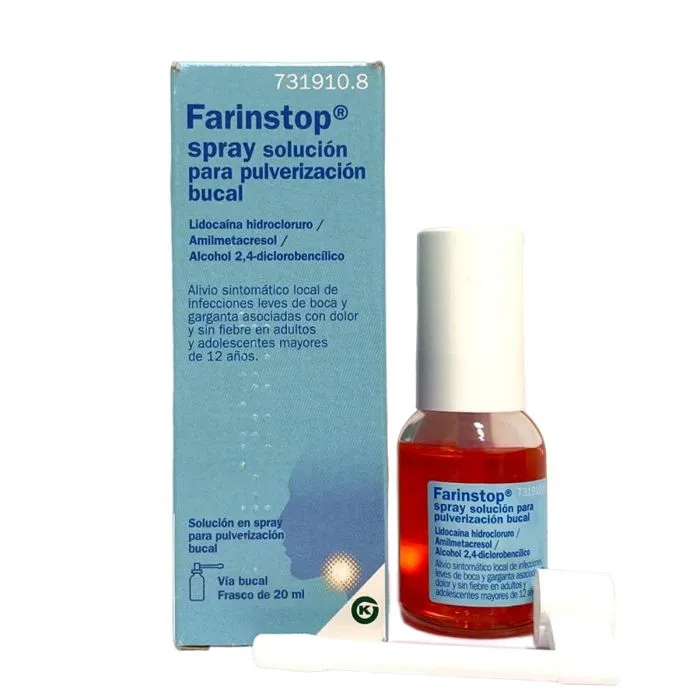
Table of Contents
- Patient Information Leaflet
- Introduction
- **Read the entire leaflet carefully before you start using this medicine, as it contains important information for you.**
- 1. What Farinstop spray is and what it is used for
- 2. What you need to know before using Farinstop spray
- **Do not use Farinstop spray**
- **Children and adolescents**
- **Use of Farinstop spray with other medicines**
- **Use of Farinstop Spray with food, drinks, and alcohol**
- **Pregnancy and lactation**
- **Driving and Use of Machines**
- 3. How to use Farinstop spray
- **Use in children and adolescents**
- **If you use more Farinstop spray than you should**
- 4. Possible adverse effects
- **Reporting of adverse reactions**
- 5. Storage of Farinstop spray
- 6. Contents of the container and additional information
- **Composition of Farinstop spray**
Patient Information Leaflet
Introduction
Patient Information Leaflet
Farinstop spray solution for oral spray
Amylmetacresol/2,4-dichlorobenzyl alcohol/Lidocaine hydrochloride monohydrate
Read the entire leaflet carefully before you start using this medicine, as it contains important information for you.
Follow exactly the instructions for taking this medicine as described in this leaflet or as advised by your doctor or pharmacist.
? Keep this leaflet, as you may need to read it again.? If you need advice or more information, consult your pharmacist.? If you experience any adverse effects, consult your doctor or pharmacist, even if they are possible side effects not listed in this leaflet—see section 4.? You should consult a doctor if you get worse or do not improve after 3 days.
Contents of the leaflet
- What Farinstop spray is and what it is used for.
- What you need to know before using Farinstop spray.
- How to use Farinstop spray.
- Possible adverse effects.
- How to store Farinstop spray.
- Contents of the pack and other information.
1. What Farinstop spray is and what it is used for
Farinstop spray contains amylmetacresol and 2,4-dichlorobenzyl alcohol, both antiseptics, and lidocaine hydrochloride monohydrate, a local anesthetic for the throat.
It is indicated for the local symptomatic relief of mild mouth and throat infections associated with pain and without fever in adults and adolescents over 12 years of age.
You should consult a doctor if symptoms worsen or do not improve after 3 days.
2. What you need to know before using Farinstop spray
Do not use Farinstop spray
- If you are allergic to lidocaine hydrochloride monohydrate or to other amide-type local anesthetic drugs, amylmetacresol, 2,4-dichlorobenzyl alcohol, or to any of the other ingredients of this medicine (see list in section 6).
Warnings and precautions
Consult your doctor or pharmacist before using Farinstop spray.
You must inform your doctor if you:
- Have asthma.
The anesthetics contained in this medicine may cause aspiration (coughing during meals or a choking sensation) while eating. Do not eat food immediately after using this medicine.
This medicine may numb your tongue and increase the risk of biting trauma. Therefore, take care when eating and drinking hot foods.
Follow the recommended dosage: if taken in large amounts or too frequently, this medicine may affect the heart or nervous system and may cause seizures.
Elderly people or those who are seriously ill or frail are more sensitive to possible adverse reactions to this medicine and should consult their doctor before using it.
Do not use this medicine in the mouth or throat if you have any extensive wounds in those areas.
Children and adolescents
This medicine is not recommended for children under 12 years of age.
Use of Farinstop spray with other medicines
Inform your doctor or pharmacist if you are taking, have recently taken, or might need to take any other medicines.
Specifically consult your doctor or pharmacist if you are taking any of the following medicines, as a dose adjustment may be necessary:
- Beta-blockers (used to treat heart failure or vascular diseases)
- Medicines containing cimetidine (used to treat stomach ulcers)
- Other local anesthetics (amides)
- Medicines used to treat heart conditions, such as mexiletine or procainamide
- Medicines such as fluvoxamine (used to treat depression)
- Antibiotics, such as erythromycin or itraconazole
Although interactions are not usually expected, do not use other oral or throat antiseptics while using Farinstop spray.
Use of Farinstop Spray with food, drinks, and alcohol
Do not take this medicine immediately before meals or before drinking.
Pregnancy and lactation
Pregnancy:
Use of this medicine is not recommended during pregnancy.
Lactation:
Use of this medicine is not recommended during breastfeeding.
Driving and Use of Machines
This medicine has no influence—or only an insignificant effect—on the ability to drive and use machines.
Farinstop spray contains sorbitol (E-420)
This medicine contains 33.80 mg of sorbitol per dose. Sorbitol is a source of fructose. If your doctor has informed you that you (or your child) have an intolerance to certain sugars, or if you have been diagnosed with hereditary fructose intolerance (HFI)—a rare condition in which a person is unable to metabolize fructose—consult your doctor before you (or your child) take or receive this medicine, as it may cause serious adverse effects.
Farinstop spray contains ethanol
This medicine contains 84.03 mg of alcohol (ethanol) per dose. The amount in each dose of this medicine is equivalent to less than 2.10 ml of beer or 0.84 ml of wine.
The small amount of alcohol contained in this medicine does not produce any perceptible effect.
Farinstop spray: contains sodium
This medicine contains less than 1 mmol of sodium (23 mg) per dose, i.e., it is essentially "sodium-free."
3. How to use Farinstop spray
Take this medicine exactly as described in this leaflet or as directed by your doctor or pharmacist. Consult your doctor or pharmacist if you have any doubts.
The recommended doses are:
-
Adults and adolescents aged 15 years and older: one dose of 2 sprays into the mouth and/or throat, 1 to 6 times daily.
-
Adolescents aged 12 to 15 years: one dose of 2 sprays into the mouth and/or throat, 1 to 4 times daily.
Use in children and adolescents
The use of this medicine is not recommended in children under 12 years of age.
For oral use only.
Do not inhale while spraying.
If symptoms do not improve within 3 days, worsen, or if you develop fever, yellow-green mucus, or discomfort when swallowing, consult your doctor or pharmacist.
Prolonged use of this medicine beyond 5 days is not recommended, as it may disrupt the natural microbial balance of the throat.
Instructions for use:
- Lift the spray pump.
- Insert the spray nozzle into your mouth and aim it toward the affected area. Press the spray head with your index finger.
Before first use of Farinstop spray, prime the spray by pressing the spray head several times away from you until a consistent spray is achieved.
Hold your breath while spraying.
If you use more Farinstop spray than you should
Events that may occur in case of incorrect use or overdose: excessive anaesthesia (loss of sensitivity) of the upper digestive and respiratory tracts, insomnia, restlessness, excitement, respiratory depression (slow breathing). Shortness of breath, headache, fatigue, exercise intolerance, dizziness, and loss of consciousness may also occur due to a disorder called methaemoglobinaemia. Seek immediate medical help or call the Toxicology Information Service at telephone number 91 562 04 20, specifying the medication and the amount ingested.
If you have any further questions about the use of this medicine, ask your doctor or pharmacist.
4. Possible adverse effects
Like all medicines, this medicine may cause adverse effects, although not everyone will experience them. The following adverse reactions have been reported during the period of use for the combination of active substances in this medicine:
Stop taking Farinstopspray and consult a doctor immediately if you experience symptoms of angioedema, such as
- swollen face, tongue, or throat
- difficulty swallowing
- hives and breathing difficulties
Rare (may affect up to 1 in 1,000 people): hypersensitivity reactions (burning, itching), symptoms of allergic shock, angioedema, throat irritation, and unpleasant taste.
Very rare (may affect up to 1 in 10,000 people): gastrointestinal discomfort.
If you experience any type of adverse effect, consult your doctor or pharmacist, even if it is a possible adverse effect not listed in this leaflet.
Reporting of adverse reactions
If you experience any type of adverse reaction, consult your doctor or pharmacist, even if it is a possible adverse reaction not listed in this leaflet.
You can also report them directly via the Spanish Pharmacovigilance System for Human Medicinal Products (www.notificaram.es). By reporting adverse reactions, you can help provide more information on the safety of this medicine.
5. Storage of Farinstop spray
Keep this medicine out of the sight and reach of children.
Do not use this medicine after the expiry date stated on the bottle and the carton following EXP. The expiry date refers to the last day of the month indicated.
Do not store above 30°C.
Keep the bottle in the outer packaging to protect it from light.
Medicines must not be disposed of via wastewater or household waste. Dispose of empty containers and unused medicines at the SIGRE collection point at your pharmacy. If you are in doubt, ask your pharmacist how to dispose of containers and medicines you no longer need. This will help protect the environment.
6. Contents of the container and additional information
Composition of Farinstop spray
The active substances are, per 100 ml:
Amilmetacresol……………………………………………………………………………0.223 g
2,4-Dichlorobenzyl alcohol………………………………………………………………0.446 g
Lidocaine hydrochloride monohydrate……………………………………0.690 g (equivalent to 0.600 g of lidocaine)
20 ml = 76 doses = 153 sprays.
The other ingredients are:
Ethanol 96%
Liquid sorbitol (non-crystallizing) (E 420)
Erythrosine (E 127): Erythrosine, moisture, sodium chloride and sodium sulfate
Sodium saccharin (E 954)
Citric acid monohydrate
Glycerol (E 422)
Levomenthol
Mint flavor: L-Menthone, isomenthone, menthyl acetate, isopulegol, propylene glycol (E 1520), Neomenthol, L-menthol, pulegone, piperitone
Anise flavor: propylene glycol (E 1520), ethanol, anethole and natural flavoring substances
Sodium hydroxide (for pH adjustment)
Purified water
Appearance of the product and contents of the container
The oral spray solution is transparent and red, with a taste and smell of anise and mint.
Farinstop spray is supplied in a high-density polyethylene (HDPE) bottle or in a type III glass bottle, equipped with a mechanical spray pump.
Each bottle contains 20 ml of solution, providing 153 sprays.
Marketing Authorization Holder and Manufacturer
Marketing Authorization Holder:
Kern Pharma, S.L.
Venus, 72 - Pol. Ind. Colón II
08228 Terrassa - Barcelona
Spain
Manufacturer:
Laboratories CHEMINEAU
93, route de la Monnaie
Vouvray 37210, France
This medicinal product is authorized in the Member States of the European Economic Area under the following names:
Germany: GEISERSPRAY Spray zur Anwendung in der Mundhöhle, Lösung
Slovakia: SERSPARY orálna roztoková aerodisperzia
Spain: Farinstop spray solución para la pulverización bucal
France: AMYLMETACRESOL/ALCOOL DICHLOROBENZYLIQUE/LIDOCAINE BIOGARAN CONSEIL 223 mg/ 446 mg/ 600 mg, solution pour pulvérisation buccale
Poland: LABIPRAY spray
Czech Republic: CRISTISOL
Date of the most recent review of this leaflet: June 2020
Detailed and up-to-date information on this medicinal product is available on the website of the Spanish Agency for Medicines and Health Products (AEMPS) http://www.aemps.es