Famvir 125 mg film-coated tablets
Spain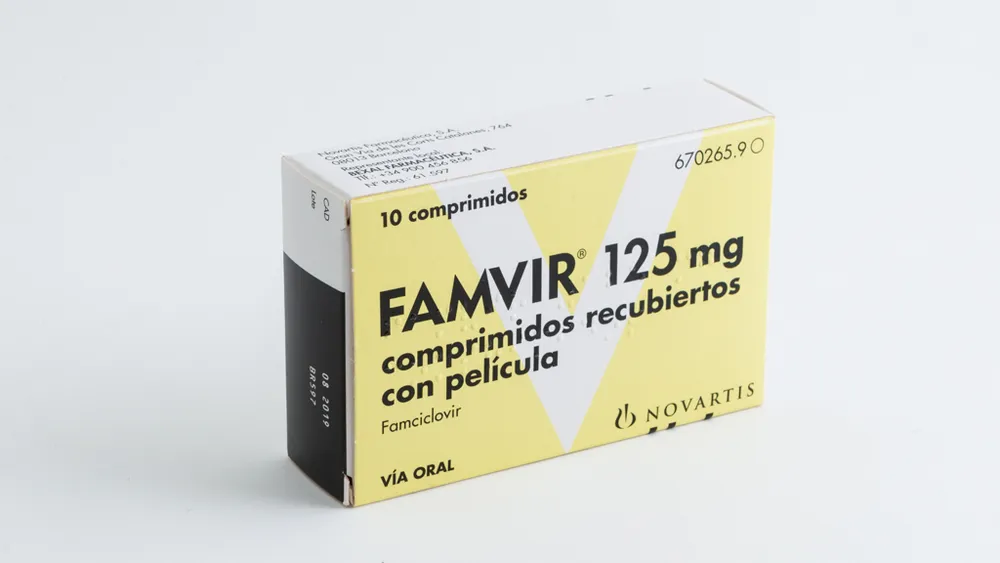
Table of Contents
Patient Information Leaflet
Introduction
Patient Information Leaflet
Famvir 125 mg film-coated tablets
Famciclovir
Read the entire leaflet carefully before you start taking this medicine, as it contains important information for you.
- Keep this leaflet, as you may need to read it again.
- If you have any questions, ask your doctor or pharmacist.
- This medicine has been prescribed for you only. Do not pass it on to other people, even if they have the same symptoms as you, because it may harm them.
- If you experience any adverse effects, consult your doctor or pharmacist, even if they are adverse effects not listed in this leaflet. See section 4.
Leaflet Contents:
- What Famvir is and what it is used for
- What you need to know before taking Famvir
- How to take Famvir
- Possible side effects
- How to store Famvir
- Contents of the pack and other information
1. What is Famvir and what is it used for
Famvir is an antiviral medicine. It stops the replication of the infecting virus. Since the virus multiplies at a very early stage of infection, you will benefit most from treatment if you start taking Famvir as soon as the first symptoms appear.
Famvir is used to treat two types of viral infections in adults:
- Herpes zoster, which is a viral infection caused by a virus called varicella zoster (the same virus that causes chickenpox). Famvir stops the spread of the virus in the body, allowing faster healing.
- Famvir is also used to treat herpes zoster affecting the area around the eye or even within the eye itself (ophthalmic zoster).
- Genital herpes. Genital herpes is a viral infection caused by herpes simplex virus type 1 or 2. It is usually transmitted through sexual contact. It causes blisters and a burning or itching sensation around the genitals, which can be painful. Famvir is used to treat episodes of genital herpes in adults. People who have frequent episodes of genital herpes may also take Famvir to help prevent recurrences.
2. What you need to know before taking Famvir
Do not take Famvir
- if you are allergic to famciclovir or to any of the other ingredients of this medicine (listed in section 6), or to penciclovir (the active metabolite of famciclovir and an ingredient in some other medicines)
If you think you may be allergic, consult your doctor.
Warnings and precautions
Talk to your doctor before taking Famvir
- If you have or have previously had any kidney disease. Your doctor may decide to prescribe you a lower dose of Famvir.
- If you have problems with your body's immune system.
- If you have liver problems.
If any of these apply to you, consult your doctor before taking Famvir.
Children and adolescents (under 18 years of age)
The use of Famvir is not recommended in children and adolescents.
Preventing transmission of genital herpes to others
If you are taking Famvir to treat or suppress genital herpes, or if you have had genital herpes in the past, you should practice safe sex by using condoms. This is important to avoid spreading the infection to others. You should not have sex if you have pain or blisters in the genital area.
Taking Famvir with other medicines
Tell your doctor or pharmacist if you are taking, have recently taken, or might need to take any other medicines.
It is especially important that you inform your doctor or pharmacist if you are taking any of the following medicines:
- Raloxifene (used to prevent and treat osteoporosis).
- Probenecid (used to treat high levels of uric acid associated with gout and to increase blood levels of penicillin-type antibiotics) or other medicines that may affect your kidneys.
Taking Famvir with food and drinks
You may take Famvir with or without food.
Pregnancy, breast-feeding, and fertility
If you are pregnant or breast-feeding, think you may be pregnant, or are planning to become pregnant, consult your doctor before using this medicine. Famvir should not be used during pregnancy unless clearly necessary. Your doctor will discuss with you the potential risks of taking Famvir during pregnancy.
Famvir should not be used during breast-feeding unless clearly necessary. Your doctor will discuss with you the potential risks of taking Famvir while breast-feeding.
Driving and using machines
Famvir may cause dizziness, drowsiness, or confusion. If you experience any of these symptoms while being treated with Famvir, do not drive or operate machinery.
Famvir 125 mg film-coated tablets contain lactose.
If your doctor has diagnosed you with an intolerance to certain sugars, consult him before taking this medicine.
3. How to take Famvir
Follow exactly the instructions for using this medicine as given by your doctor.
If you are unsure, consult your doctor or pharmacist again.
- The daily dose and duration of treatment will depend on the type of viral infection you have – see below. Your doctor will prescribe the correct dose for you.
- To achieve the best results, start taking the medicine as soon as the first signs and symptoms appear.
- Do not have sexual intercourse with anyone if you have symptoms of genital herpes – even if you have started treatment with Famvir. This is because you may transmit the herpes infection to your partner.
- If you have or have had kidney problems, your doctor may decide to give you a lower dose of Famvir.
Dose for herpes zoster
If you have a normal immune system, the recommended dose is 500 mg three times a day for seven days.
If you have a weakened immune system, the recommended dose is 500 mg three times a day for ten days.
Dose for genital herpes
The dose depends on the status of your immune system and the stage of your infection.
If you have a normal immune system, the dose is as follows:
For the first episode, the recommended dose is 250 mg three times a day for five days.
For treating new episodes, the recommended dose is 125 mg twice a day for five days.
For preventing new episodes, the recommended dose is 250 mg twice a day.
Your doctor will inform you how long you need to continue taking your tablets.
If you have a weakened immune system, the dose is as follows:
For treating the current episode, the recommended dose is 500 mg twice a day for seven days.
For preventing new episodes, the dose is 500 mg twice a day.
Your doctor will inform you how long you need to continue taking your tablets.
If you take more Famvir than you should
If you have taken more tablets than you should, or if anyone else has accidentally taken your medicine, go immediately to your doctor or hospital. Show them your tablet pack. You may also call the Toxicology Information Service at telephone number 91 562 04 20, stating the medicine and the amount taken.
Taking too much Famvir may damage your kidneys. People with kidney problems may rarely develop renal failure if their dose is not properly reduced.
If you forget to take Famvir
If you forget to take a dose of Famvir, take it as soon as you remember. Then take the next dose at the scheduled time. However, do not take two doses within less than 1 hour; in that case, skip the missed dose. Also, do not take a double dose to make up for a missed dose.
If you have any further questions about the use of this medicine, ask your doctor or pharmacist.
4. Possible adverse effects
Like all medicines, this medicine can cause adverse effects, although not everyone will experience them.
Serious adverse effects:
Many of these effects are uncommon (may affect up to 1 in 100 patients) or rare (may affect up to 1 in 1,000 patients).
- Severe blisters on the skin and/or mucous membranes of the lips, eyes, mouth, nasal passages, or genitals (these could be signs of serious allergic skin reactions).
- Unexplained bruising, redness, or purplish areas on the skin or nosebleeds (these may be signs of a decrease in the number of platelets in the blood).
- Swelling beneath the skin surface (e.g., swelling of the face, around the eyes, eyelids, and throat).
- Yellowish discoloration of the skin and/or eyes (signs of jaundice).
The frequency of the following adverse effects is unknown (cannot be estimated from available data):
- Purple spots on the skin, itching, burning (signs of inflamed blood vessels).
- Seizures or epileptic fits.
- Difficulty breathing or swallowing. Rash, itching, hives, wheezing or coughing, feeling faint, dizziness, changes in level of consciousness. Hypotension, with or without generalized itching, skin redness, facial/throat swelling, bluish discoloration of the lips, tongue, or skin (signs of a severe allergic reaction).
If you notice any of these adverse effects, contact a doctor immediately or go to the nearest emergency service.
Very common adverse effects (these effects may affect more than 1 in 10 patients)
- Headache
Common adverse effects (these effects may affect up to 1 in 10 patients)
- Nausea
- Vomiting
- Abdominal pain
- Diarrhea
- Dizziness
- Rash
- Itching
- Abnormal liver function test results
Uncommon adverse effects (these effects may affect up to 1 in 100 patients)
- Confusion
- Drowsiness (usually in elderly people)
- Itchy rash (urticaria)
Rare adverse effects (these effects may affect up to 1 in 1,000 patients)
- Hallucinations (seeing or hearing things that are not real)
- Palpitations (signs of abnormal heartbeats)
Reporting of adverse effects
If you experience any type of adverse effect, consult your doctor, even if it is a possible adverse effect not listed in this leaflet. You may also report them directly via the Spanish Pharmacovigilance System for Human Medicines (www.notificaRAM.es). By reporting adverse effects, you can help provide more information on the safety of this medicine.
5. Storage of Famvir
- Keep this medicine out of sight and reach of children.
- Do not use this medicine after the expiry date stated on the packaging after EXP. The expiry date refers to the last day of the month indicated.
- Do not store above 25°C.
- Store in the original packaging to protect from moisture.
- Do not use this medicine if you notice that the packaging is damaged or shows signs of deterioration.
- Medicines must not be disposed of via wastewater or household waste. Unused medicines and their containers should be returned to the SIGRE collection point at your pharmacy. If you are unsure, please ask your pharmacist how to dispose of unused medicines and their packaging. This will help protect the environment.
6. Contents of the pack and other information
Composition of Famvir
- The active substance is famciclovir.
- The other components are anhydrous lactose, sodium starch glycolate from potato (Type A), hydroxypropyl cellulose and magnesium stearate. The tablet coating consists of hypromellose, titanium dioxide (E 171), Macrogol 4000 and Macrogol 6000.
Appearance of the product and contents of the pack
Famvir is presented as film-coated tablets.
White, round, biconvex film-coated tablet with bevelled edges, marked with “FV” on one side and “125” on the other.
Each pack contains 10 tablets.
Marketing Authorisation Holder
Phoenix Labs
Suite 12, Bunkilla Plaza
Bracetown Business Park
Clonee, County Meath, Ireland
Local representative
EUROMED PHARMA SPAIN S.L.
C/Eduard Maristany, 430-432
08918 Badalona
Barcelona - Spain
Tel: + 34 932 684 208
Fax: + 34 933 150 469
Manufacturer responsible
LABORATORI FUNDACIÓ DAU
Pol. Ind. Consorci Zona Franca. c/ C, 12-14
08040 Barcelona
Spain
Cosmo S.p.A.
Via Cristoforo Colombo, 1
20020 Lainate (Milan)
Italy
This medicinal product is authorised in the Member States of the European Economic Area under the following names:
EU/EEA Member State | Brand Name |
Austria | Famvir Film Tablets |
Cyprus | Famvir |
Denmark | Famvir |
Finland | Famvir |
France | Oravir |
Germany | Famvir Film Tablets |
Greece | Famvir |
Hungary | Famvir® |
Iceland | Famvir |
Ireland | Famvir |
Italy | Famvir |
Malta | Famvir |
Spain | Famvir |
Sweden | Famvir |
United Kingdom | Famvir |
Date of the latest review of this leaflet: March 2020
Detailed information about this medicine is available on the website of the Spanish Agency of Medicines and Health Products (AEMPS) http://www.aemps.gob.es/