Factor IX Grifols 50 IU/ml powder and solvent for solution for injection
SpainTable of Contents
- Patient Information Leaflet
- Introduction
- 1. What Factor IX Grifols is and what it is used for
- 2. What you need to know before using Factor IX Grifols
- **Pregnancy, breastfeeding and fertility**
- 3. How to use Factor IX Grifols
- 4. Possible adverse effects
- 5. Storage of Factor IX Grifols
- 6. Package contents and other information
Patient Information Leaflet
Introduction
Patient Information Leaflet
Factor IX Grifols 50 IU/ml powder and solvent for injectable solution
Human coagulation Factor IX
Read the entire leaflet carefully before you start using this medicine, as it contains important information for you.
- Keep this leaflet, as you may need to read it again.
- If you have any questions, ask your doctor, pharmacist, or nurse.
- This medicine has been prescribed for you only. Do not give it to others, even if they have the same symptoms as you, because it may harm them.
- If you experience any adverse effects, consult your doctor, pharmacist, or nurse, even if the effects are not listed in this leaflet. See section 4.
Contents of the leaflet
- What Factor IX Grifols is and what it is used for
- What you need to know before using Factor IX Grifols
- How to use Factor IX Grifols
- Possible side effects
- How to store Factor IX Grifols
- Contents of the pack and other information
1. What Factor IX Grifols is and what it is used for
Factor IX Grifols is a medicine that contains human coagulation factor IX.
Factor IX Grifols belongs to a group of medicines called antihemorrhagics: blood coagulation factors.
Factor IX Grifols is indicated for the treatment and prophylaxis (prevention) of bleeding in patients with haemophilia B (congenital factor IX deficiency). These patients do not have sufficient functional factor IX. Factor IX Grifols serves to increase the amount of factor IX in the blood, thereby enabling blood to clot.
2. What you need to know before using Factor IX Grifols
Do not use Factor IX Grifols
If you are allergic to the active substance or to any of the other components of this medicine (listed in section 6). See important information about some of the components of Factor IX Grifols at the end of this section.
If you have any doubts about the above, consult your doctor.
Warnings and precautions
Consult your doctor, pharmacist, or nurse before starting to use Factor IX Grifols.
-
There is a remote possibility that you may experience an anaphylactic reaction (a sudden severe allergic reaction). If you feel chest tightness, dizziness, lightheadedness, nausea, or become dizzy upon standing, you may be experiencing an anaphylactic reaction to Factor IX Grifols. If this occurs, stop administration immediately and seek medical assistance.
-
If hypersensitivity reactions (allergic reactions, e.g., fever, generalized hives, chest tightness, wheezing, hypotension, and anaphylaxis) occur during administration of Factor IX Grifols, the infusion must be stopped. Your doctor will decide on appropriate treatment (e.g., antihistamines, shock therapy).
-
Your doctor may wish to perform tests to ensure that the dose of Factor IX Grifols you are receiving is sufficient to achieve and maintain adequate factor IX levels.
-
If your bleeding does not stop with Factor IX Grifols, contact your doctor immediately. You may have developed factor IX inhibitors, and your doctor will want to perform tests to confirm this. Factor IX inhibitors are antibodies present in the blood that block the factor IX you are using, making it less effective in controlling bleeding.
-
If you have a condition associated with a risk of thrombosis (history of heart disease or acute myocardial infarction, liver disease, thromboembolic disorders, coagulation disorders, or in newborn infants), and if you are administered high doses of factor IX during major surgery, adequate monitoring can help detect possible complications early and allow timely intervention. Some of these complications include, for example, thromboembolism and consumption coagulopathy.
-
If you require a central venous access device (CVAD) for administration of Factor IX Grifols, your doctor should consider the risk of CVAD-related complications, including local infections, presence of bacteria in the blood (bacteremia), and formation of a blood clot in the vessel (thrombosis) at the catheter insertion site.
When medicines are manufactured from human blood or plasma, a number of measures must be taken to prevent possible transmission of infections to patients. These measures include:
- careful selection of blood and plasma donors to ensure exclusion of donors at risk of having infections,
- testing of each donation and plasma pools for possible viruses or infections,
- inclusion of a series of steps in the processing of blood or plasma that can inactivate or remove viruses.
Despite these measures, when medicines prepared from human blood or plasma are administered, the possibility of transmitting infections cannot be completely excluded. This also applies to unknown or emerging viruses and other types of infections.
The measures taken are considered effective against enveloped viruses such as human immunodeficiency virus (HIV), hepatitis B virus, and hepatitis C virus, as well as against the non-enveloped hepatitis A virus. However, the measures may have limited effectiveness against non-enveloped viruses such as parvovirus B19.
Infection with parvovirus B19 may be serious for pregnant women (fetal infection) and for individuals with a weakened immune system or certain types of anemia (e.g., sickle cell anemia or hemolytic anemia).
Your doctor may recommend that you consider vaccination against hepatitis A and B if you regularly or repeatedly receive plasma-derived factor IX concentrates.
Each time a dose of Factor IX Grifols is administered, it is recommended to record the name and batch number of the medicine to maintain a record of the batches used.
There is a possible association between the development of factor IX inhibitors and allergic reactions. Patients with FIX inhibitors may have an increased risk of anaphylactic reactions. Therefore, in patients experiencing an allergic reaction, the presence of a factor IX inhibitor should be investigated.
Use of Factor IX Grifols with other medicines
-
Inform your doctor or pharmacist if you are using, have recently used, or might need to use any other medicines.
-
No interactions with other medicines are currently known.
-
Factor IX Grifols must not be mixed with other medicines prior to administration, as this may adversely affect the efficacy and safety of the product.
Pregnancy, breastfeeding and fertility
If you are pregnant or breastfeeding, think you may be pregnant, or are planning to become pregnant, consult your doctor or pharmacist before using this medicine.
-
Inform your doctor if you are pregnant or breastfeeding.
-
Your doctor will decide whether Factor IX Grifols can be used during pregnancy and breastfeeding.
-
Since haemophilia B is rare in women, experience with the use of Factor IX Grifols during pregnancy and breastfeeding is limited.
Driving and use of machines
There is no evidence to suggest that Factor IX Grifols may affect the ability to drive or use machines.
Sodium content
Factor IX Grifols contains 20.7 mg of sodium in the Factor IX Grifols 250 IU/5 ml presentation, 41.4 mg of sodium in the Factor IX Grifols 500 IU/10 ml presentation, 82.8 mg of sodium in the Factor IX Grifols 1000 IU/20 ml presentation, and 124.2 mg of sodium in the Factor IX Grifols 1500 IU/30 ml presentation. This corresponds to 1.04%, 2.07%, 4.14%, and 6.21%, respectively, of the maximum daily sodium intake recommended by the WHO for an adult (2 g of sodium).
3. How to use Factor IX Grifols
Reconstitute the product as described in this section. The product must be administered slowly, especially the first dose (approximately 3 ml/min), by intravenous route.
Follow exactly the administration instructions for this medicine given by your doctor or pharmacist. If in doubt, consult your doctor or pharmacist again.
Your doctor will decide the dose of Factor IX Grifols you will receive. This dose and its duration will depend on your individual needs for factor IX replacement therapy and on pharmacokinetics (recovery and half-life), which should be monitored regularly.
Your doctor may adjust the dose of Factor IX Grifols you receive over time.
Dosing for treatment
The required dose is calculated using the following formula:
Units required = body weight (kg) x desired increase in factor IX (%) (IU/dl) x 0.8
Dosing for bleeding prophylaxis
For routine prophylaxis to prevent bleeding in patients with severe hemophilia B, doses of 20 to 40 IU of factor IX/kg body weight should be administered every 3 to 4 days. In some cases, especially in younger patients, it may be necessary to shorten the dosing intervals or use higher doses.
Patients with inhibitors
If you have developed inhibitors to factor IX, you may require a higher amount of Factor IX Grifols to control bleeding. If this dose does not control the bleeding, your doctor may consider using an alternative medicine. Do not increase the total dose of Factor IX Grifols you use to control your bleeding without consulting your doctor.
Instructions for use/handling
Follow these instructions unless your doctor has given you different ones.
For reconstitution and administration of Factor IX Grifols, 1500 IU/30 ml presentation, whose solvent is supplied in vials, the preparation of the solution is as follows:
- Warm the vials without exceeding 37°C.
- Unseal the solvent vial, disinfecting the stopper with an alcohol swab.
- Remove the double-ended needle from its packaging. Remove one of the protective caps and pierce the solvent vial stopper.
- Unseal the vial containing the lyophilized product, disinfecting the stopper with an alcohol swab.
- Remove the protective cap from the other end of the needle.
- Invert the solvent vial and pierce the lyophilized product vial, ensuring all solvent is transferred and avoiding loss of vacuum.
- Remove the solvent vial with the double-ended needle. Gently rotate the vial to dissolve completely, avoiding foaming. Do not shake.
- Remove the filter from its blister and insert it into the syringe. Fill the syringe with sufficient air to match the total volume of the solution. Insert the needle into the filter and pierce the reconstituted product vial. Inject the preloaded air from the syringe through the filter, then invert the vial and draw the solution into the syringe.
- Remove the filter-needle assembly and administer slowly by intravenous route using the butterfly needle provided, at a rate of 3 ml/min.
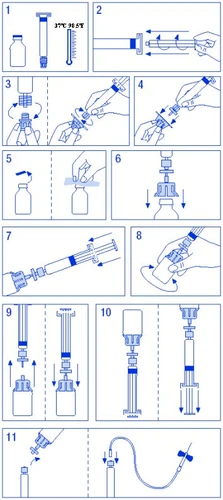
For reconstitution and administration of Factor IX Grifols, presentations of 250 IU/5 ml, 500 IU/10 ml, and 1000 IU/20 ml, where the solvent is supplied in pre-filled syringes, the preparation of the solution is as follows:
- Warm the vial and the solvent syringe without exceeding 37°C.
- Attach the plunger to the solvent syringe.
- Unseal the filter. Remove the cap from the hub of the solvent syringe and attach it to the filter.
- Unseal the vial adapter and attach it to the filter-syringe assembly.
- Unseal the vial, disinfecting the stopper with an alcohol swab.
- Insert the spike of the adapter into the vial.
- Transfer all the solvent from the syringe into the vial.
- Gently rotate the vial, avoiding foaming, until complete dissolution. Do not shake.
- Detach the filter-syringe assembly. Draw air into the syringe equal to the total volume of the solution. Reattach the filter-syringe assembly to the vial.
- Invert the vial and draw the solution into the syringe.
- Detach the syringe and administer slowly by intravenous route using the butterfly needle provided, at a rate of 3 ml/min.
It is important to use the injection equipment supplied with the medicine. If medical infusion systems are used, check compatibility of the system with the pre-filled syringe. To ensure proper administration of the product, an adapter may occasionally be required.
Reconstitution scheme for solvent in syringes
If you use more Factor IX Grifols than you should
Cases of overdose with human coagulation factor IX have not been reported. However, if you have used more Factor IX Grifols than you should, consult your doctor or pharmacist immediately.
In case of overdose or accidental administration, contact the Toxicology Information Service at telephone number 91 562 04 20.
If you forget to use Factor IX Grifols
-
Do not take a double dose to make up for missed doses.
-
Continue with the next scheduled dose and follow the regular dosing intervals as instructed by your doctor.
4. Possible adverse effects
Like all medicines, this medicine may cause adverse effects, although not everyone experiences them.
In rare cases, you may notice one of the following adverse effects after administration of Factor IX Grifols:
- Pruritus, local reactions at the injection site (e.g. transient burning sensation and redness)
- Allergic reactions (e.g. chest tightness/general feeling of discomfort, dizziness, nausea, and mild drop in blood pressure that may cause dizziness upon standing)
Anaphylactic shock cannot be completely ruled out either. If you notice any of the following symptoms during injection/perfusion:
- Chest tightness/general feeling of discomfort
- Dizziness
- Mild hypotension (slight decrease in blood pressure with dizziness upon standing)
- Nausea
these may be early signs of hypersensitivity and anaphylactic reaction. If an allergic or anaphylactic reaction occurs, the injection/perfusion must be stopped immediately and your doctor should be consulted without delay.
However, the possibility of allergic reactions to components of the product cannot be entirely excluded. The development of neutralizing antibodies to factor IX (inhibitors) is a known complication in the treatment of patients with haemophilia B. The development of inhibitors should be carefully monitored through appropriate laboratory tests and clinical examinations to detect the formation of such inhibitors.
There is a risk of thromboembolic complications with Factor IX Grifols, particularly if you have a risk of thrombosis and/or receive high-dose therapy.
- For information on viral safety, see section 2.
Reporting of adverse effects
If you experience any type of adverse effect, consult your doctor, pharmacist, or nurse, even if it is a possible adverse effect not listed in this leaflet. You can also report them directly via the Spanish Pharmacovigilance System for Human Medicinal Products: www.notificaRAM.es. By reporting adverse effects, you can help provide more information on the safety of this medicine.
5. Storage of Factor IX Grifols
Keep this medicine out of the sight and reach of children.
Do not use this medicine after the expiry date stated on the container following the abbreviation “EXP”. The expiration date refers to the last day of the month indicated.
Vial of lyophilized powder (human coagulation factor IX): store between 2 °C and 8 °C (in a refrigerator).
Vial or syringe of solvent (water for injections): store between 2 °C and 30 °C.
When outpatient administration is required, the product may be kept at room temperature (do not store above 25 °C) for a single period of up to 3 months.
The product must not be refrigerated again after it has been stored at room temperature.
Do not use this medicine if you notice that the solution is cloudy or contains particles. The solution is usually clear or slightly opalescent.
Once reconstituted, the solution must be discarded if particles or any discoloration are observed.
The reconstituted solution must be used immediately or within 3 hours.
Any unused product and waste material must be disposed of in accordance with local requirements.
Medicines must not be disposed of via wastewater or household waste. Ask your pharmacist how to dispose of medicines and containers you no longer need. This will help protect the environment.
6. Package contents and other information
Composition of Factor IX Grifols
The active substance is human coagulation factor IX.
Each vial of Factor IX Grifols contains a lyophilized powder with 250 IU, 500 IU, 1000 IU, or 1500 IU of human coagulation factor IX. After reconstitution, the concentration of human factor IX is 50 IU/ml (250 IU/5 ml, 500 IU/10 ml, 1000 IU/20 ml, or 1500 IU/30 ml).
The other components are lysine, glycine, sodium chloride, phosphate, and citrate.
Each solvent container contains 5 ml, 10 ml, 20 ml, or 30 ml of water for injections.
See section 2 for important information regarding some of these components.
Appearance of the product and contents of the pack
Vial containing white or pale yellow powder and vial/syringe with water for injections (solvent).
Each Factor IX Grifols vial in the presentations of 250 IU/5 ml, 500 IU/10 ml, and 1000 IU/20 ml is supplied with a pre-filled solvent syringe containing 5 ml, 10 ml, or 20 ml of water for injections, together with the necessary accessories for reconstitution and administration (vial adapter, filter, 2 alcohol wipes, and butterfly needle).
Each Factor IX Grifols vial in the 1500 IU/30 ml presentation is supplied with a solvent vial containing 30 ml of water for injections, together with the necessary accessories for reconstitution and administration (double-ended needle, filter, 2 alcohol wipes, butterfly needle, and syringe with needle).
Only certain pack sizes may be marketed.
Contents of the pack: 1 vial of lyophilisate, 1 pre-filled syringe/solvent vial, and accessories.
Marketing Authorization Holder and Manufacturer
Instituto Grifols, S.A.
Can Guasch, 2 - Parets del Vallès
08150 Barcelona - SPAIN
Date of the most recent review of this summary: April 2019
Detailed information on this medicine is available on the website of the Spanish Agency for Medicines and Health Products (AEMPS) (http://www.aemps.gob.es/).
……………………………………………………………………………………………………………
This information is intended for healthcare professionals only:
The following table may be used as a guide for dosing in bleeding episodes and surgery.
Severity of bleeding/ Type of surgery | Required factor IX level (%)(UI/dl) | Dosing frequency (hours)/ Duration of therapy (days) |
BLEEDING | ||
Minor hemarthrosis and muscle or oral bleeding | 20 – 40 | Repeat every 24 hours. For at least 1 day, until the hemorrhagic episode manifested by pain stops or until healing. |
Moderate hemarthrosis and muscle hemorrhage or hematoma | 30 – 60 | Repeat infusion every 24 hours for 3–4 days or more until acute pain and disability resolve. |
Life-threatening hemorrhages | 60 – 100 | Repeat infusion every 8–24 hours until the risk subsides. |
SURGERY | ||
Minor surgery including dental extractions Major surgery | 30 – 60 80 – 100 (pre- and postoperative) | Every 24 hours, for at least 1 day until healing. Repeat infusion every 8–24 hours until adequate wound healing, followed by treatment for a minimum of 7 days to maintain factor IX activity levels between 30% and 60% (UI/dl). |