Exocin 3 mg/ml eye drops solution
Spain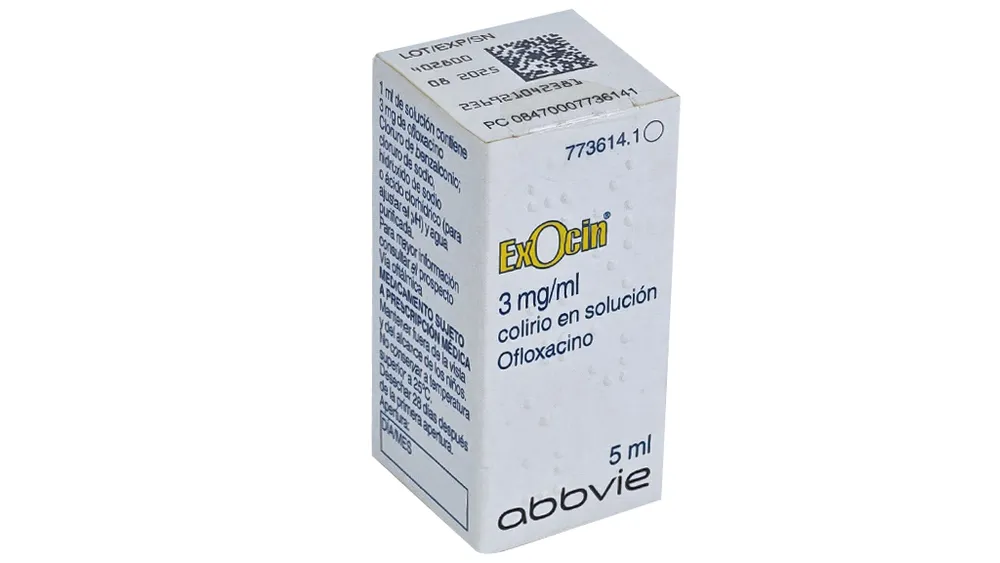
Table of Contents
Package leaflet: Information for the user
Introduction
Package leaflet: information for the user
EXOCIN 3 mg/ml eye drops solution
Ofloxacin
Read the entire leaflet carefully before you start using this medicine, as it contains important information for you.
- Keep this leaflet as you may need to read it again.
- If you have any questions, consult your doctor or pharmacist.
- This medicine has been prescribed for you only and must not be given to other people, even if they have the same symptoms as you, as it may harm them.
- If you experience any adverse effects, consult your doctor or pharmacist, even if they are effects not listed in this leaflet. See section 4.
Leaflet contents
- What Exocin is and what it is used for
- What you need to know before using Exocin
- How to use Exocin
- Possible side effects
- How to store Exocin
- Contents of the pack and other information
1. What Exocin is and what it is used for
Exocin belongs to a group of medicines called antibacterial agents of the 4-quinolone type.
Antibiotics are used to treat bacterial infections and are not effective against viral infections.
It is important that you follow your doctor's instructions regarding dosage, dosing interval, and duration of treatment.
Do not store or reuse this medicine. If you have any antibiotic left over after completing the treatment, return it to the pharmacy for proper disposal. Do not dispose of medicines down the drain or in household waste.
Exocin is an eye drop used to treat external ocular infections such as conjunctivitis and keratoconjunctivitis in adults and children over one year of age, when caused by organisms sensitive to this medicine. It is also used for the treatment of bacterial corneal ulceration in adults and children.
2. What you need to know before using Exocin
Do not use Exocin if:
You are allergic (hypersensitive) to ofloxacin, other quinolones, or to any of the other components of this medicine (listed in section 6).
Warnings and precautions:
This product should be used with caution in patients with allergy (hypersensitivity) to other antibacterial agents of the quinolone type. If a skin rash or any other sign of allergic reaction appears during treatment, stop treatment and consult your doctor.
This product should be used with caution in patients who have an abnormality or ulceration of the surface of the eye. If this applies to you, consult your doctor. Prolonged use of ofloxacin may lead to a new bacterial infection in the eye, which may not be effectively treated with Exocin.
Exocin may increase sensitivity to sunlight. Avoid direct exposure to sunlight while using Exocin.
Heart problems
Exercise caution when using this type of medicine if you were born with or have a family history of prolonged QT interval (detected on ECG, the electrical recording of the heart), if you have an imbalance of blood salts (particularly low levels of potassium or magnesium in the blood), if you have a very slow heart rate (called "bradycardia"), if you have weakened heart function (heart failure), if you have a history of heart attacks (myocardial infarction), if you are female or elderly, or if you are taking other medicines that cause abnormal changes in the ECG (see section on Use of other medicines).
Children and adolescents:
Use of Exocin is not recommended in children under one year of age. Use is not recommended in newborns.
Other medicines and Exocin
Inform your doctor or pharmacist if you are taking, or have recently taken, any other medicines, including those obtained without a prescription.
You must inform your doctor if you are taking other medicines that may affect heart rhythm: medicines belonging to the antiarrhythmic group (e.g. quinidine, hydroquinidine, disopyramide, amiodarone, sotalol, dofetilide, ibutilide), tricyclic antidepressants, some antibiotics (those belonging to the macrolide group), some antipsychotics.
Pregnancy and breastfeeding
Consult your doctor or pharmacist before using any medicine.
Use of Exocin is not recommended during pregnancy and breastfeeding. If use is necessary, your doctor will assess whether or not it is appropriate.
Driving and using machines
There are no studies on the effect of Exocin on the ability to drive and use machines. Because blurred vision may occur, wait until this symptom has disappeared before driving or operating machinery.
Exocin contains benzalkonium chloride
This medicine contains 0.05 mg of benzalkonium chloride per ml of solution.
Benzalkonium chloride may be absorbed by soft contact lenses, altering their color. Remove contact lenses before using this medicine and wait 15 minutes before reinserting them.
Benzalkonium chloride may cause eye irritation, particularly if you have dry eye or other corneal diseases (the transparent layer at the front of the eye). Consult your doctor if you experience a foreign body sensation, stinging, or pain in the eye after using this medicine.
3. How to use Exocin
Follow exactly the administration instructions for Exocin provided by your doctor. Consult your doctor or pharmacist if you have any doubts.
Exocin is administered by the ophthalmic route. The usual dose is:
For the treatment of external ocular infections in adults and children over one year of age: Instill one or two drops into the affected eye(s) every two to four hours during the first two days, then reduce to four times daily.
For the treatment of bacterial corneal ulceration in adults and children: During the first two days, instill one or two drops every 30 minutes while awake. At night, instill one or two drops four and six hours after going to bed. From day 3 to day 7 or 9, instill one or two drops every hour while awake. From day 7 or 9 onward, until the end of treatment, instill one or two drops four times daily.
Instructions for use
Do not use the product if the seal on the neck of the container is broken before first opening.
Apply the eye drops as follows:
1.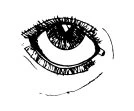 2.
2.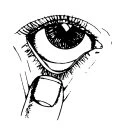 3.
3.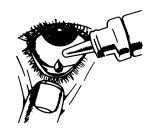 4.
4.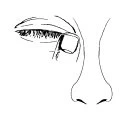
- Wash your hands before opening the container. Tilt your head backward and look upward.
- Gently pull down the lower eyelid to create a small pocket.
- Squeeze the inverted container so that one or two drops fall into each eye.
- While keeping the eye closed, press your finger against the inner corner (the part of the eye closest to the nose) and hold for 30 seconds.
- Repeat steps 2, 3, and 4 for the other eye if treatment is also needed in that eye.
If a drop misses the eye, repeat the procedure.
To avoid contamination, do not allow the dropper tip to touch the eye or any other surface. Return the container to an upright position, replace the cap, and tighten it to close the container. Wipe away any excess liquid from your cheek with a clean tissue.
After opening the container (breaking the seal), do not use the eye drops for longer than 28 days.
If you have any doubts, consult your doctor or pharmacist.
Use in children
There is very limited information available on the use of Exocin in children.
If your doctor has prescribed Exocin for your child and you wish to obtain further information about this medicine, please consult your doctor again. If your child becomes ill during treatment with Exocin, contact your doctor immediately.
If you use more Exocin than you should
If you have instilled too many drops into the eye(s), rinse your eyes with fresh water. Then continue using the eye drops according to the usual schedule.
In case of overdose or accidental ingestion, contact your doctor or pharmacist immediately, or call the Toxicology Information Service at: 91 562 04 20, indicating the medication and the amount ingested.
If you forget to use Exocin
If you forget to use Exocin, apply it as soon as you remember, unless it is almost time for your next dose. In that case, skip the missed dose. Apply your next dose at the usual time and continue with your regular schedule. Do not use a double dose to make up for a missed dose.
If you stop using Exocin
Do not stop treatment with Exocin or reduce the amount you are using unless your doctor tells you to do so. Otherwise, your symptoms may worsen.
If you have any further questions about using this product, ask your doctor or pharmacist.
Duration of treatment
Your doctor will advise you on how long to use Exocin. Do not stop treatment prematurely, as the medicine may not have the desired effect.
Treatment of external ocular infections should not exceed 10 days, unless otherwise directed by your doctor.
4. Possible adverse effects
Like all medicines, Exocin can have side effects, although not everyone experiences them. The following adverse effects are known to occur, but their exact frequency may vary.
Cases of skin rash (Stevens-Johnson syndrome, toxic epidermal necrolysis) have been reported with the use of Exocin, which can potentially be fatal. These reactions initially appear as red, target-shaped spots or circular patches, frequently with centrally located blisters, typically on the trunk.
Common (may affect up to 1 in every 10 people):
Eye-related: Ocular irritation; eye discomfort
Frequency not known (cannot be estimated from available data):
Eye-related: Blurred vision, light sensitivity, eye redness, itching, allergic reaction in the eye (including itching of the eye and eyelid), sensation of a foreign body in the eye, increased tearing, swelling around the eyes (including eyelid swelling), dry eyes, eye pain.
Body-related: Dizziness, nausea, allergic reactions (including swelling beneath the skin that may occur in areas such as the face, lips, or other parts of the body; rash, itching, or hives; swelling of the mouth, tongue, or throat that may block the airways and may cause wheezing, difficulty swallowing, difficulty breathing, or shortness of breath; sudden, severe, life-threatening allergic reaction), facial swelling.
Heart-related: Abnormally rapid heartbeat, life-threatening irregular heartbeat, disturbance in heart rhythm (known as "QT interval prolongation," detected on ECG, the electrical recording of the heart).
Reporting of adverse effects
If you experience any type of adverse effect, consult your doctor or pharmacist, even if it is a possible adverse effect not listed in this leaflet. You may also report them directly through the Spanish Pharmacovigilance System for Human Medicines: https://www.notificaRAM.es. By reporting adverse effects, you can help provide more information on the safety of this medicine.
5. Storage of Exocin
Keep this medicine out of sight and reach of children. Do not use this medicine after the expiry date stated on the container label and on the carton, after “EXP”. The expiry date refers to the last day of the month indicated.
Do not store above 25°C.
Do not use Exocin if you observe any change in colour or if cloudiness occurs in the solution.
Discard the medicine 28 days after opening, even if some solution remains. To help you remember, write the date of opening in the space provided for this purpose on the carton.
Medicines must not be disposed of via wastewater or household waste. Return unused medicines and their packaging to the SIGRE collection point at your pharmacy. If you have any doubts, ask your pharmacist how to dispose of medicines and packaging that you no longer need. This will help protect the environment.
6. Contents of the pack and other information
Composition of Exocin
-
The active substance is ofloxacin 3 mg/ml.
-
The other components are: benzalkonium chloride, sodium chloride, sodium hydroxide (to adjust pH), hydrochloric acid (to adjust pH), and purified water.
Appearance of Exocin and contents of the pack
Exocin is a solution in a plastic dropper bottle with a screw cap. Each bottle contains 5 ml of solution.
Marketing Authorization Holder and Manufacturer
Marketing Authorization Holder:
AbbVie Spain, S.L.U.
Avenida de Burgos 91,
28050 Madrid
Spain
Manufacturer:
Allergan Pharmaceuticals Ireland
Castlebar Road
Westport
County Mayo
Ireland
This leaflet was approved in November 2020
Detailed and up-to-date information on this medicinal product is available on the website of the Spanish Agency for Medicines and Health Products (AEMPS) http://www.aemps.es.