Exemestane Sandoz 25 mg film-coated tablets EFG
Spain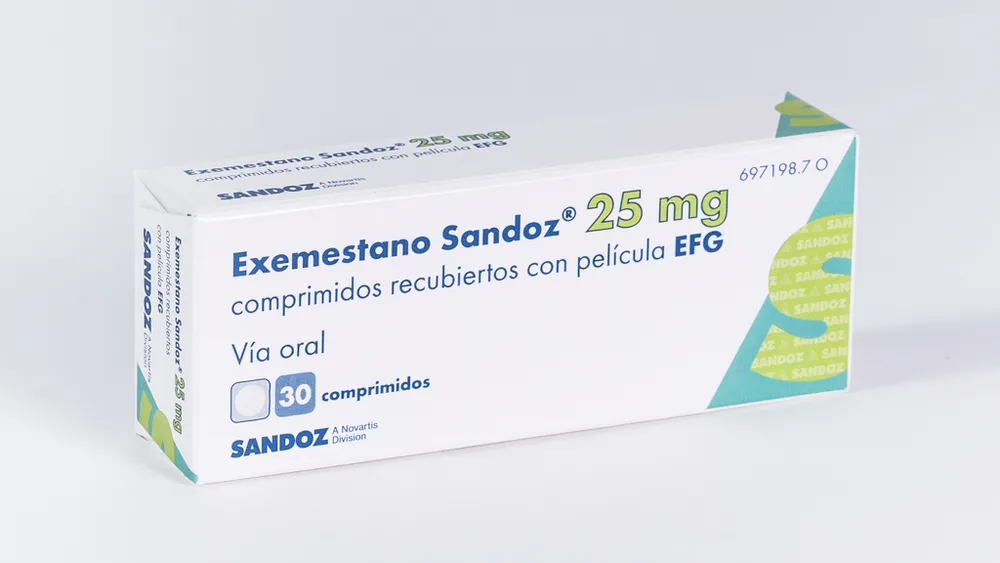
Instructions for Use
Package leaflet: Information for the user
Introduction
Package leaflet: information for the patient
Exemestano Sandoz 25 mg film-coated tablets EFG
Read all of this leaflet carefully before you start taking this medicine, because it contains important information for you.
- Keep this leaflet. You may need to read it again.
- If you have any further questions, ask your doctor or pharmacist.
- This medicine has been prescribed for you only and must not be given to other people, even if they have the same symptoms as you. It may harm them.
- If you experience any adverse effects, talk to your doctor or pharmacist, even if they are not listed in this leaflet. See section 4.
Contents of the leaflet
- What Exemestano Sandoz is and what it is used for
- What you need to know before taking Exemestano Sandoz
- How to take Exemestano Sandoz
- Possible side effects
- How to store Exemestano Sandoz
- Contents of the pack and other information
1. What Exemestano Sandoz is and what it is used for
Exemestane belongs to a group of medicines called aromatase inhibitors.
These medicines interfere with a substance called aromatase, which is necessary for producing female sex hormones, estrogens, particularly in postmenopausal women. Reducing estrogen levels in the body is a way of treating hormone-dependent breast cancer.
Exemestane is used to treat early-stage hormone-dependent breast cancer in postmenopausal women after they have completed 2–3 years of treatment with the medicine tamoxifen.
Exemestane is also used to treat advanced hormone-dependent breast cancer in postmenopausal women when another type of hormonal treatment has not been sufficiently effective.
2. What you need to know before taking Exemestano Sandoz
Do not take Exemestano Sandoz
- if you are or have previously been allergic to exemestane or to any of the other ingredients of this medicine (listed in section 6),
- if you have not yet reached menopause, that is, if you still have menstrual periods,
- if you are pregnant, think you may be pregnant, or are breastfeeding.
Warnings and precautions
Talk to your doctor or pharmacist before starting to take Exemestano Sandoz.
- before starting treatment with exemestane, your doctor may perform a blood test to confirm that you have reached menopause,
- your vitamin D levels will also be periodically checked before starting treatment, as they may be too low in the early stages of breast cancer. You will be given a vitamin D supplement if your levels are below normal,
- before taking exemestane, inform your doctor if you have any liver or kidney problems,
- inform your doctor if you have a history of, or currently suffer from, any condition affecting bone strength. Your doctor may assess your bone density before and during treatment with Exemestano Sandoz. This is because medicines in this class reduce levels of female hormones, which may lead to loss of bone mineral content and could decrease bone strength.
Important information for athletes
Athletes are advised that this medicine contains a component that may result in a positive analytical finding in doping control tests.
Other medicines and Exemestano Sandoz
Tell your doctor or pharmacist if you are taking, have recently taken, or might need to take any other medicines.
Exemestane must not be administered at the same time as hormone replacement therapy (HRT).
The following medicines should be used with caution if you are being treated with exemestane. Inform your doctor if you are taking any of these medicines:
- rifampicin (an antibiotic),
- carbamazepine or phenytoin (antiepileptics used to treat epilepsy),
- the herbal medicine St John’s wort (Hypericum perforatum), or preparations containing it.
Pregnancy and breastfeeding
Do not take Exemestano Sandoz if you are pregnant or breastfeeding.
Tell your doctor if you are pregnant or think you may be pregnant.
Talk to your doctor about contraceptive measures if there is any possibility of becoming pregnant.
Driving and use of machines
If you experience dizziness, drowsiness, or fatigue while being treated with Exemestano Sandoz, do not drive or operate machinery.
Exemestano Sandoz contains sodium
This medicine contains less than 1 mmol of sodium (23 mg) per film-coated tablet; i.e., essentially “sodium-free”.
3. How to take Exemestano Sandoz
Adult and elderly patients
Follow exactly the instructions given by your doctor for taking this medicine. If in doubt, consult your doctor again.
Exemestano Sandoz tablets should be taken orally after a meal, at approximately the same time each day. Your doctor will advise you on how to take Exemestano Sandoz and for how long.
The recommended dose is one 25 mg tablet daily.
If you need to go to hospital while being treated with Exemestano Sandoz, inform the medical staff about the medication you are taking.
Use in children
Exemestano Sandoz is not suitable for use in children.
If you take more Exemestano Sandoz than you should
If you accidentally take too many tablets, contact your doctor immediately or go straight to the nearest hospital emergency department. Show the Exemestano Sandoz packaging.
In case of overdose or accidental ingestion, consult your doctor or pharmacist immediately, go to the nearest hospital, or call the Toxicology Information Service at 91 562 04 20, stating the medication and the amount taken. It is recommended to bring the packaging and the leaflet to the healthcare professional.
If you forget to take Exemestano Sandoz
Do not take a double dose to make up for missed doses.
If you forget to take a tablet, take it as soon as you remember. If it is almost time for your next dose, take the next dose at your usual time.
If you stop taking Exemestano Sandoz
Do not stop taking the tablets even if you feel well, unless your doctor tells you to.
If you have any further questions about the use of this medicine, ask your doctor, pharmacist, or nurse.
4. Possible adverse effects
Like all medicines, this medicine may cause adverse effects, although not everyone experiences them.
Hypersensitivity, liver inflammation (hepatitis), and inflammation of the liver's bile ducts causing yellowing of the skin (cholestatic hepatitis) may occur. Symptoms include general malaise, nausea, jaundice (yellowing of the skin and eyes), itching, pain in the right side of the abdomen, and loss of appetite. Contact your doctor as soon as possible if you think you are experiencing any of these symptoms.
In general, exemestane is well tolerated, and the following adverse effects observed in patients treated with this medicine are mainly mild or moderate. Most of these adverse effects are associated with reduced estrogen levels (such as hot flashes).
Very common (may affect more than 1 in 10 people)
- Depression,
- difficulty sleeping,
- headache,
- hot flashes,
- dizziness,
- malaise,
- increased sweating,
- muscle and joint pain (including osteoarthritis, back pain, arthritis, and joint stiffness),
- fatigue,
- decreased number of white blood cells,
- abdominal pain,
- elevated liver enzymes,
- elevated breakdown products of hemoglobin in the blood,
- elevated blood enzyme levels due to liver damage,
- pain.
Common (may affect up to 1 in 10 people)
- Loss of appetite,
- carpal tunnel syndrome (a combination of tingling, numbness, and pain affecting the whole hand except the little finger) or skin tingling/tingling sensations,
- vomiting (nausea), constipation, indigestion, diarrhea,
- hair loss,
- skin rash, hives, and itching,
- decreased bone density, which may reduce bone strength (osteoporosis) and lead to fractures in some cases (breaks or cracks),
- swelling of hands and feet,
- reduced number of blood platelets,
- feeling of weakness.
Uncommon (may affect up to 1 in 100 people)
- Hypersensitivity.
Rare (may affect up to 1 in 1,000 people)
- Appearance of small blisters in a skin rash,
- numbness,
- liver inflammation,
- inflammation of the liver's bile ducts causing yellowing of the skin.
Frequency not known: cannot be estimated from available data
- Low levels of certain white blood cells in the blood.
There may also be changes in the levels of certain blood cells (lymphocytes) and platelets circulating in the blood, especially in patients with pre-existing lymphopenia (reduced lymphocytes in the blood).
Reporting of adverse effects
If you experience any type of adverse effect, consult your doctor or pharmacist, even if it is a possible adverse effect not listed in this leaflet. You may also report them directly through the national reporting system: Spanish Pharmacovigilance System for Human Medicines: https://www.notificaram.es.
By reporting adverse effects, you can help provide more information on the safety of this medicine.
5. Storage of Exemestane Sandoz
Keep this medicine out of the sight and reach of children.
Do not use this medicine after the expiry date stated on the packaging after CAD/EXP. The expiry date refers to the last day of the month indicated.
This medicine does not require any special storage conditions.
Medicines must not be disposed of via wastewater or household waste. Dispose of empty containers and unused medicines at the SIGRE collection point at your pharmacy. If in doubt, ask your pharmacist how to properly dispose of containers and medicines you no longer need. This will help protect the environment.
6. Contents of the pack and other information
Composition of Exemestane Sandoz
The active substance is exemestane. Each film-coated tablet contains 25 mg of exemestane.
The other components are:
- mannitol, microcrystalline cellulose, crospovidone, sodium carboxymethyl starch (Type A) from potato, hypromellose E5, polysorbate 80, colloidal anhydrous silica and magnesium stearate,
hypromellose 6cp (E 464), titanium dioxide (E 171) and macrogol 400.
Appearance of the product and contents of the pack
Exemestane Sandoz are film-coated, round, biconvex tablets, white or almost white, marked on one side with "E25" and plain on the other.
Exemestane Sandoz 25 mg is available in cardboard packs containing white opaque PVC/PVdC-Alu blisters of 15, 20, 28, 30, 90, 98, 100 and 120 tablets.
Only certain pack sizes may be marketed.
Marketing Authorization Holder and Manufacturer
Marketing Authorization Holder
Sandoz Farmacéutica, S.A.
Parque Norte Business Centre
Roble Building
C/Serrano Galvache, 56
28033 Madrid
Spain
Manufacturer
Cemelog BRSLtd
2040 Budaors,
Vasut u.13,
Hungary
or
Salutas Pharma GmbH
Otto-von-Guericke-Allee
1 39179 Barleben
Germany
or
Lek Pharmaceuticals d.d.
Verovškova ulica 57
Ljubljana 1526,
Slovenia
Date of the most recent revision of this leaflet: July 2025.
Detailed information on this medicine is available on the website of the Spanish Agency of Medicines and Health Products (AEMPS) http://www.aemps.gob.es/
Similar Medications
-
Aromasil 25 mg film-coated tablets
Form: tablets, film-coated
Active substance Dosage EXEMESTANE 25 mg Manufacturer: Pfizer S.L.
-
Exemestane Aurovitas Spain 25 mg film-coated tablets EFG
Form: tablets, film-coated
Active substance Dosage EXEMESTANE 25,00 mg Manufacturer: Aurovitas Spain, S.A.U.
-
Exemestane Cinfa 25 mg film-coated tablets EFG
Form: tablets, film-coated
Active substance Dosage EXEMESTANE 25 mg Manufacturer: Laboratorios Cinfa S.A.
-
Exemestane Desgen 25 mg film-coated tablets EFG
Form: tablets, film-coated
Active substance Dosage EXEMESTANE 25 mg Manufacturer: Laboratorio Generfarma S.L.
-
Exemestane Kern Pharma 25 mg film-coated tablets EFG
Form: tablets, film-coated
Active substance Dosage EXEMESTANE 25,00 mg Manufacturer: Kern Pharma S.L.
-
Exemestane Normon 25 mg film-coated tablets EFG
Form: tablets, film-coated
Active substance Dosage EXEMESTANE 25 mg Manufacturer: Laboratorios Normon S.A.
-
Exemestane STADA 25 mg film-coated tablets EFG
Form: tablets, film-coated
Active substance Dosage EXEMESTANE 25,00 mg Manufacturer: Laboratorio Stada S.L.
-
Exemestane Teva-Ratiopharm 25 mg film-coated tablets EFG
Form: tablets, film-coated
Active substance Dosage EXEMESTANE 25 mg Manufacturer: Teva Pharma S.L.U.
-
Exemestane Viatris 25 mg film-coated tablets EFG
Form: tablets, film-coated
Active substance Dosage EXEMESTANE 25 mg Manufacturer: Viatris Limited
-
Exemestane Winadol 25 mg film-coated tablets EFG
Form: tablets, film-coated
Active substance Dosage EXEMESTANE MG mg Manufacturer: Farmalider S.A.
-
GepeX 25 mg film-coated tablets EFG
Form: tablets, film-coated
Active substance Dosage EXEMESTANE 25 mg Manufacturer: Gp Pharm S.A.
This page has been machine-translated and may contain inaccuracies. The original data is available in the manufacturing country's language.
Last data check: May 18, 2026 · Data source: CIMA — AEMPS