Eulitop Retard 400 mg prolonged-release tablets
Spain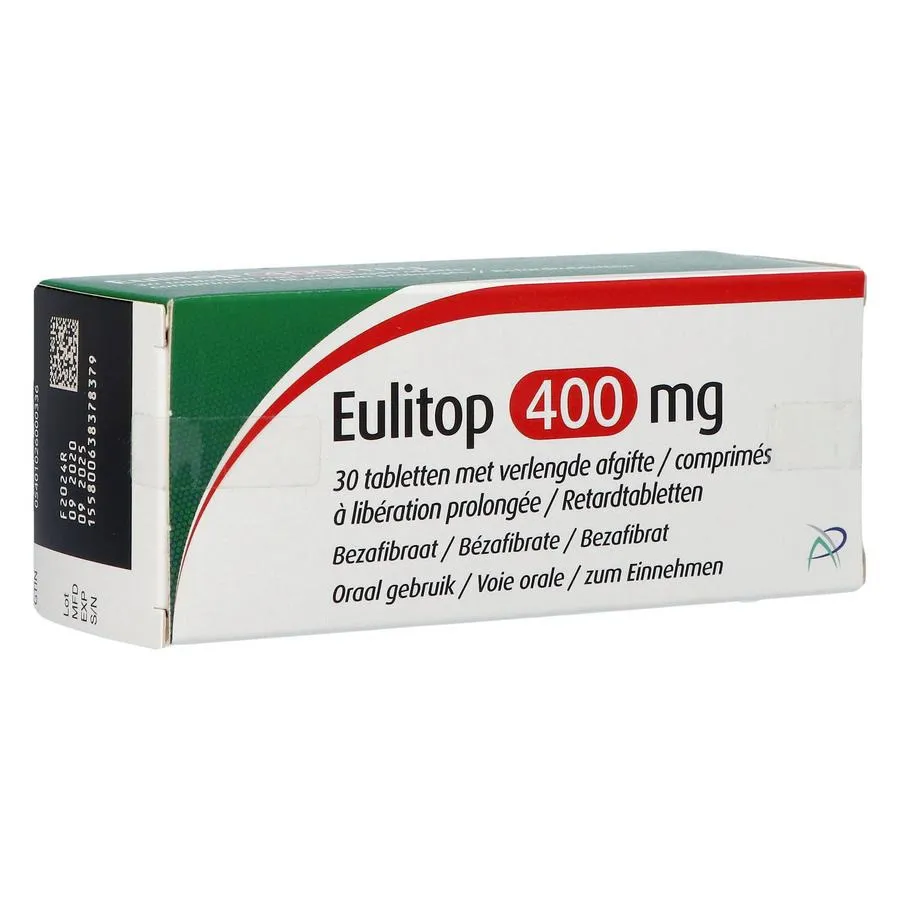
Table of Contents
- Package leaflet: Information for the user
- Introduction
- 1. What Eulitop Retard 400 mg tablets are and what they are used for
- 2. What you need to know before taking Eulitop Retard 400 mg tablets
- 3. How to take Eulitop Retard 400 mg tablets
- 4. Possible adverse effects
- 5. Storage of Eulitop Retard 400 mg Tablets
- 6. Contents of the pack and other information
Package leaflet: Information for the user
Introduction
Package leaflet: information for the patient
Eulitop Retard 400 mg prolonged-release tablets
Bezafibrate
Read the entire leaflet carefully before you start taking this medicine, because it contains important information for you.
- Keep this leaflet, as you may need to read it again.
- If you have any questions, ask your doctor or pharmacist.
- This medicine has been prescribed for you only, and you should not give it to other people, even if they have the same symptoms as you, because it may harm them.
- If you experience any adverse effects, consult your doctor or pharmacist, even if they are adverse effects not listed in this leaflet. See section 4.
Leaflet contents
- What Eulitop Retard 400 mg tablets are and what they are used for
- What you need to know before taking Eulitop Retard 400 mg tablets
- How to take Eulitop Retard 400 mg tablets
- Possible side effects
- How to store Eulitop Retard 400 mg tablets
- Contents of the pack and other information
1. What Eulitop Retard 400 mg tablets are and what they are used for
Eulitop Retard belongs to a group of medicines commonly known as fibrates. These medicines are used to reduce the level of fats (lipids) in the blood (for example, fats called triglycerides).
Eulitop Retard is used, together with a low-fat diet and other non-medical treatments such as exercise and weight loss, to reduce fat levels in the blood.
2. What you need to know before taking Eulitop Retard 400 mg tablets
Do not take Eulitop Retard
- If you are allergic to bezafibrate, to derivatives of clofibric acid, to fibrates in general, or to any of the other components of this medicine (listed in section 6).
- If fibrates (the class of medicines to which bezafibrate belongs) cause you allergic reactions when exposed to sunlight (photoallergy).
- If you are pregnant or breastfeeding.
- If you have severe or chronic kidney disease. Its use is contraindicated in dialyzed patients.
- If you have any liver disease (except fatty liver) or gallbladder disorders with or without gallstones (cholestasis).
- If you are being treated with medicines from the group of MAO inhibitors (for depression) or with HMG CoA reductase inhibitors (statins, for lowering cholesterol) in patients at risk of myopathy.
Do not take Eulitop Retard if any of the above conditions apply to you. If you are unsure, consult your doctor or pharmacist before taking this medicine.
Warnings and precautions
Consult your doctor or pharmacist before starting to take Eulitop Retard if:
- You are taking oral contraceptives containing estrogens.
- You are taking cholesterol-lowering medicines called statins or ion-exchange resins.
- You are being treated with coumarin anticoagulants.
- You have muscle weakness or mild kidney disease. The risk of muscle damage increases in patients with a history of hypoalbuminemia (high concentration of a protein called albumin in the blood) and kidney disease.
It is very important to follow the diet and other dietary measures prescribed by your doctor.
If you experience any symptoms indicating gallstones, such as severe abdominal pain, stop treatment and consult your doctor.
If you experience symptoms such as muscle weakness, muscle pain, or muscle cramps, consult your doctor, as in rare cases serious muscle damage (rhabdomyolysis) may occur. In case of rhabdomyolysis, treatment with this medicine must be stopped immediately.
As with other fibrates, pancreatitis has been reported with bezafibrate.
Your doctor will perform blood tests to monitor your response to the medicine, and more frequently if you are receiving prolonged treatment with Eulitop Retard.
Children
The use of Eulitop Retard is not recommended in children.
Other medicines and Eulitop Retard
Inform your doctor or pharmacist if you are taking, have recently taken, or might need to take any other medicines.
Some medicines may interact with Eulitop Retard. In such cases, it may be necessary to adjust the dose or discontinue treatment with one of the medicines.
It is important to inform your doctor if you are taking any of the following medicines:
-
Anticoagulants: Eulitop Retard enhances the effect of coumarin anticoagulants; therefore, your doctor will initially reduce the dose of the anticoagulant and monitor blood coagulation frequently during treatment with Eulitop Retard.
-
Medicines for diabetes: Eulitop Retard enhances the effect of medicines used to treat diabetes (medicines that lower blood sugar). If you are using or taking these medicines, your doctor may need to reduce their dose.
-
Colchicine (for the treatment of gout): the risk of myopathy and rhabdomyolysis increases when Eulitop Retard and colchicine are taken concomitantly.
-
Cyclosporine: if you have undergone an organ transplant and are taking medicines to prevent rejection, your doctor may recommend discontinuing treatment with Eulitop Retard.
-
Other medicines to control blood lipid levels: concomitant administration of medicines used to lower cholesterol and Eulitop Retard may increase the risk of muscle-related adverse effects. If you are taking ion-exchange resins (such as cholestyramine) to reduce cholesterol levels, you should leave at least 2 hours between taking each medicine.
-
Certain antidepressants: you must not take Eulitop Retard if you are taking MAO inhibitor medicines (a type of medicine for depression).
-
Contraceptives: there may be an increase in blood lipid levels caused by oral estrogens.
Pregnancy and breastfeeding
If you are pregnant or breastfeeding, think you may be pregnant, or plan to become pregnant, consult your doctor or pharmacist before using this medicine. Eulitop Retard is contraindicated during pregnancy and breastfeeding.
Driving and use of machines
Patients should be advised that bezafibrate may reduce reaction ability and the ability to drive or operate machinery. This is due to possible adverse effects such as dizziness, fatigue, and muscle weakness.
Eulitop Retard contains lactose
This medicine contains lactose. If your doctor has informed you that you have an intolerance to certain sugars, consult him before taking this medicine.
Eulitop Retard contains sodium
This medicine contains less than 1 mmol of sodium (23 mg) per prolonged-release tablet; hence, it is essentially "sodium-free".
3. How to take Eulitop Retard 400 mg tablets
Follow exactly the administration instructions for this medicine provided by your doctor or pharmacist. If in doubt, consult your doctor or pharmacist again.
Eulitop Retard should be taken orally. The recommended dose is one tablet daily.
The tablet should be swallowed whole and not chewed, preferably after dinner. Take the tablets with a sufficient amount of liquid (a glass of water).
Remember that, in addition to taking Eulitop Retard, it is also important to exercise regularly and follow a low-fat diet.
During treatment with this medicine, your doctor will regularly perform blood tests to monitor your blood lipid levels.
Use in children
The use of this medicine is not recommended in children.
If you take more Eulitop Retard than you should
If you have taken more Eulitop Retard tablets than prescribed, contact your doctor or pharmacist immediately. In case of overdose or accidental ingestion, contact the Toxicology Information Service immediately at telephone number 91 562 04 20, indicating the name of the medicine and the amount ingested.
If you forget to take Eulitop Retard
Do not take a double dose to make up for missed doses.
If you stop taking Eulitop Retard
Your doctor will determine the duration of your treatment with Eulitop Retard. Do not stop treatment prematurely, as this is usually a long-term treatment.
If you have any further questions about the use of this medicine, ask your doctor or pharmacist.
4. Possible adverse effects
Like all medicines, this medicine may cause adverse effects, although not everyone will experience them.
According to clinical data and post-marketing experience, the following adverse effects may occur:
Common (may affect up to 1 in 10 patients)
- Gastrointestinal disturbances, decreased appetite.
Uncommon (may affect up to 1 in 100 patients)
-
Abdominal pain, constipation, diarrhea, stomach heaviness, vomiting, nausea, which generally disappear without the need to discontinue treatment within 1 or 2 weeks.
-
Increased transaminases (values indicating liver function), biliary congestion (cholestasis), and enlargement of the liver (hepatomegaly).
-
Itching, urticaria, photosensitivity (allergy to sunlight), hair loss (alopecia), and rash.
-
Allergic reactions.
-
Muscle weakness, muscle pain, and muscle cramps.
-
Dizziness, headache.
-
Drowsiness.
-
Impotence, changes in libido.
-
Kidney function problems (acute renal failure), pain during urination (dysuria), reduced urine production (oliguria), presence of blood in the urine (hematuria), or excessive protein in the urine (proteinuria).
-
Increased blood levels of creatinine, creatine phosphokinase, and urea.
-
Increased or decreased blood alkaline phosphatase (values indicating kidney function).
-
Increased platelet count and decreased hematocrit (the portion of blood composed of red blood cells) and white blood cells.
-
Decreased gamma-glutamyl transferase (an enzyme primarily present in the liver).
Rare (may affect up to 1 in 1,000 patients)
- Inflammation of the pancreas (pancreatitis).
- Peripheral nerve disorders (nerves outside the brain and spinal cord), tingling or numbness in certain areas of the skin.
- Depression, insomnia (difficulty sleeping).
- Anemia (your blood is not carrying enough oxygen to the rest of your body), eosinophilia (increased eosinophils, a type of white blood cell), agranulocytosis (severe reduction in the number of white blood cells).
Very rare (may affect up to 1 in 10,000 patients)
-
Development of gallstones (gallbladder stones). If you experience any symptoms suggestive of gallstones, such as severe abdominal pain, discontinue treatment and consult your doctor.
-
Severe skin reactions.
-
Pancytopenia (reduction below normal levels of all three main types of blood cells: red blood cells, white blood cells, and platelets), leucopenia (reduction in white blood cells), thrombocytopenia (reduction in platelets).
-
Changes in heart rhythm.
- Acute muscle damage (rhabdomyolysis). If unexplained severe muscle pain occurs, medication should be discontinued.
- Interstitial lung disease (inflammation or scarring of the lungs).
- Decreased hemoglobin levels, increased platelet count in blood, decreased white blood cell count, increased gamma-glutamyl transferase (an enzyme primarily present in the liver), elevated transaminase levels (enzymes found in the liver).
- Lyell's syndrome (a severe skin disease with blisters and lesions affecting the skin and mucous membranes).
- Increased gamma-glutamyl transferase (an enzyme primarily present in the liver).
-
Generalized hypersensitivity reactions (exaggerated immune response) with chest tightness, dyspnea (difficulty breathing), tachycardia, skin symptoms, hypotension, edema (excess fluid in an organ or tissue), circulatory collapse (inability of the circulatory system to deliver oxygenated blood to body tissues), chills, or syncope (sudden, temporary loss of consciousness and postural tone).
Reporting of adverse effects
If you experience any type of adverse effect, consult your doctor or pharmacist, even if it is a possible adverse effect not listed in this leaflet. You may also report them directly via the Spanish Pharmacovigilance System for Human Medicines: https://www.notificaram.es. By reporting adverse effects, you can help provide more information on the safety of this medicine.
5. Storage of Eulitop Retard 400 mg Tablets
Keep this medicine out of the sight and reach of children.
Do not use this medicine after the expiry date which is stated on the carton after EXP. The expiry date is the last day of the month indicated.
Store below 30ºC.
Medicines should not be disposed of via wastewater or household waste. Dispose of unused medicines and their packaging at the SIGRE Point at your pharmacy. Ask your pharmacist how to dispose of medicines and packaging you no longer need. This will help protect the environment.
6. Contents of the pack and other information
Composition of Eulitop Retard 400 mg tablets
- The active substance is bezafibrate. Each tablet contains 400 mg of bezafibrate.
- The other components are: lactose, polyvinylpyrrolidone, sodium lauryl sulfate, hydroxypropylmethylcellulose, colloidal silicon dioxide, magnesium stearate, Eudragit NE30D, polyethylene glycol, talc, titanium dioxide, polysorbate 80, sodium citrate, and purified water.
Description of the product and contents of the pack
White, round, prolonged-release tablets, engraved with "D9" on one side. Eulitop Retard is available in cardboard boxes containing 30 tablets in blister packs.
Marketing Authorization Holder and Manufacturer
Marketing Authorization Holder
Aurovitas Spain, S.A.U.
Avda. de Burgos, 16-D
28036 Madrid
Spain
Tel.: 91 630 86 45
Fax: 91 630 26 64
Manufacturer
CENEXI SAS.
Rue Marcel et Jacques Gaucher, 52 (Fontenay-sous-Bois)
F-94120 France
Date of the most recent revision of this leaflet: April 2023
Detailed and up-to-date information on this medicinal product is available on the website of the Spanish Agency for Medicines and Health Products (AEMPS) (http://www.aemps.gob.es/)