Etoxisclerol 20 mg/ml solution for injection
Spain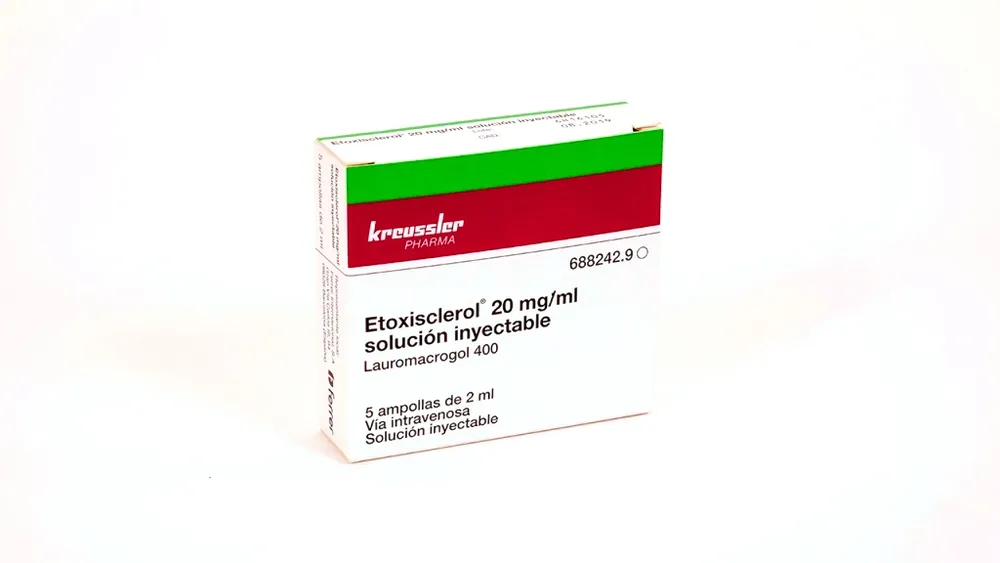
Table of Contents
Package leaflet: Information for the user
Introduction
Package leaflet: information for the user
Etoxisclerol 20 mg/ml injectable solution
Lauromacrogol 400
Read the entire leaflet carefully before you start using this medicine, because it contains important information for you.
- Keep this leaflet, as you may need to read it again.
- If you have any questions, ask your doctor, pharmacist or nurse.
- This medicine has been prescribed for you only and must not be given to other people, even if they have the same symptoms as you, because it may harm them.
- If you experience any adverse effects, consult your doctor, pharmacist or nurse, even if they are adverse effects not listed in this leaflet. See section 4.
Contents of the leaflet
- What Etoxisclerol is and what it is used for
- What you need to know before using Etoxisclerol
- How to use Etoxisclerol
- Possible side effects
- How to store Etoxisclerol
- Contents of the pack and other information
1. What Etoxisclerol is and what it is used for
Etoxisclerol is a sclerosing agent whose active ingredient is lauromacrogol 400.
Etoxisclerol 20 mg/ml is indicated for sclerotherapy or destruction of varicose veins and telangiectasias (spider veins).
2. What you need to know before using Etoxisclerol
Do not use Etoxisclerol for sclerotherapy of varicose veins
- If you are allergic to lauromacrogol 400 or to any of the other ingredients of this medicine (listed in section 6),
- If you have a severe acute systemic disease (affecting the whole body), especially in untreated patients,
- If you must remain in bed or are unable to walk,
- If you have severe arterial circulation disorders (arterial occlusive disease, Fontaine stages III and IV),
- If you have vascular occlusion due to a thrombus or blood clot (thromboembolic disorders),
- If you are at high risk of vascular occlusions (thrombosis), for example, patients with hereditary predisposition to form blood clots or with multiple risk factors such as:
use of hormonal contraceptives (e.g. the pill), hormone replacement therapy, overweight, smoking, prolonged periods of immobility, etc.
Do not use Etoxisclerol for sclerotherapy of varicose veins with microfoam
- If you have symptoms due to a known patent foramen ovale (known symptomatic patent foramen ovale).
Warnings and precautions
Etoxisclerol must be administered by a healthcare professional experienced in sclerotherapy techniques.
Consult your doctor, pharmacist, or nurse before starting to use Etoxisclerol
- If you have fever,
- If you suffer from respiratory distress attacks (bronchial asthma),
- If you have a strong predisposition to allergies,
- If your general health condition is poor,
- If you are to undergo sclerotherapy for spider veins: in patients with arterial circulation disorders (arterial occlusive diseases, Fontaine stage II),
- If you have swollen legs due to fluid accumulation (edema) that cannot be managed by compression,
- If you have inflammatory skin disease in the area to be treated,
- If you have symptoms of occlusion in the smallest blood vessels, for example due to diabetes (microangiopathy) and impaired sensitivity (neuropathy),
- If you have reduced mobility,
- If you suffer from frequent migraines.
Consult your doctor, pharmacist, or nurse before starting sclerotherapy with microfoam:
- If you have a known patent foramen ovale in the heart, even if it causes no signs of disease / is not accompanied by any symptoms (known as asymptomatic patent foramen ovale),
- If you have a history of visual disturbances (visual symptoms or neurological symptoms) after a previous sclerotherapy treatment with microfoam.
Other medicines and Etoxisclerol
Inform your doctor or pharmacist if you are taking, have recently taken, or might need to take any other medicines.
The use of Etoxisclerol together with anesthetics may increase the anesthetic effect on the cardiovascular system.
Pregnancy, breastfeeding, and fertility
If you are pregnant or breastfeeding, think you may be pregnant, or are planning to become pregnant, consult your doctor or pharmacist before using this medicine.
If you are pregnant, your doctor should not administer Etoxisclerol unless strictly necessary, as there is insufficient information on the use of Etoxisclerol in pregnant women. Animal studies showed no evidence of malformations.
If treatment with Etoxisclerol 20 mg/ml is necessary during breastfeeding, breastfeeding should be suspended for 2-3 days, as there are no human data available on the passage of lauromacrogol 400 into breast milk.
Driving and use of machines
No negative effects on the ability to drive and use machines due to the use of Etoxisclerol are known.
Etoxisclerol contains ethanol, potassium, and sodium
- This medicine contains 84.00 mg of alcohol (96% ethanol) in each 2 ml ampoule, equivalent to 5% (v/v). The amount in one ampoule of this medicine is equivalent to less than 3 ml of beer or 1 ml of wine.
It is unlikely that the amount of alcohol contained in this medicine will have any noticeable effect in adults or adolescents.
The amount of alcohol contained in this medicine may alter the effect of other medicines.
Consult your doctor or pharmacist if you are taking other medicines. If you are pregnant or breastfeeding, consult your doctor or pharmacist before taking this medicine.
If you are alcohol-dependent, consult your doctor or pharmacist before taking this medicine.
- This medicine contains less than 39 mg (1 mmol) of potassium per ampoule and is therefore considered essentially “potassium-free”.
- This medicine contains less than 23 mg (1 mmol) of sodium per ampoule and is therefore “sodium-free”.
3. How to use Etoxisclerol
Etoxisclerol is a medicine that must be administered by a physician; therefore, it is the physician's responsibility to determine and select the most appropriate dosage and technique for each individual case.
Etoxisclerol can be used either in liquid form or as microfoam (viscous, standardized, homogeneous microfoam with fine bubbles).
Depending on the size of the varicose vein to be treated and the individual patient's condition, your doctor will decide which treatment approach to use. In case of doubt, the lowest possible dose should be chosen. Generally, the dose of 2 mg/kg/day of lauromacrogol 400 should not be exceeded.
In routine cases, a maximum volume of 10 ml of microfoam per session is recommended (the volume of microfoam corresponds to the sum of the liquid and gas), regardless of the patient's body weight or the concentration of lauromacrogol 400.
To prevent a possible allergic reaction, especially in patients with a high predisposition to hypersensitivity reactions, it is recommended that only a small test dose of Etoxisclerol be administered for the first treatment. Depending on the response, additional injections may be given during subsequent treatment sessions, provided that the maximum dose is not exceeded.
Since the volume to be injected per session is limited, repeated sessions are usually required (typically 2 to 4 sessions on average).
After receiving Etoxisclerol treatment, you should follow your doctor's advice. You may be advised to wear a compression bandage or compression stockings to help reduce inflammation and skin pigmentation.
Use in children and adolescents
There is no relevant use of Etoxisclerol in the pediatric population.
If you use more Etoxisclerol than you should
In case of overdose or accidental ingestion, consult your doctor, pharmacist, or call the Toxicology Information Service immediately at telephone number 91 562 04 20, indicating the medicine and the amount ingested.
Overdose may cause local tissue death (necrosis), particularly following injection into tissue adjacent to the varicose vein.
4. Possible adverse effects
Like all medicines, this medicine can cause adverse effects, although not everyone will experience them.
This section provides information on adverse reactions reported in association with long-term use of the active substance. In some cases, these reactions were bothersome, but in most cases, they were only temporary. Since many of these reports were spontaneous, without a defined patient population or a reference group, it is not possible to accurately determine frequencies or establish a clear causal relationship to drug exposure in each case. However, a reasonable estimation can be made based on long-term experience.
Local adverse effects (e.g., necrosis) have been observed, particularly affecting the skin and surrounding tissue near the varicose vein (and, rarely, nerves), when treating leg varicose veins following accidental injection into adjacent tissue.
The risk increases with higher concentrations and larger volumes of Etoxisclerol.
The following adverse effects have been observed at the frequencies described below:
-
Frequent (may affect up to 1 in 10 people): appearance of blood vessels in the treated area not visible before treatment (neovascularization), bruising (hematoma), skin discoloration (hyperpigmentation), skin hemorrhage (ecchymosis), pain at the injection site (short-term), thrombosis at the injection site (local intravaricose blood clots).
-
Uncommon (may affect up to 1 in 100 people): venous inflammation (superficial thrombophlebitis, phlebitis), allergic skin inflammation (dermatitis), contact urticaria, skin reaction, redness of the skin (erythema), local tissue death (necrosis), tissue hardening, swelling, nerve injury.
-
Rare (may affect up to 1 in 1,000 people): deep vein thrombosis (possibly due to a concomitant medical condition), limb pain.
-
Very rare (may affect up to 1 in 10,000 people): anaphylactic shock (a severe and sudden allergic reaction, with symptoms such as difficulty breathing, dizziness, and drop in blood pressure), angioedema (symptoms include sudden swelling, especially in the face, e.g., eyelids, lips, or larynx), generalized urticaria, asthma (asthmatic attack), stroke (cerebrovascular accident), weakness causing loss of mobility in part of the body (hemiparesis), headache, migraine (rare when using sclerosing treatment with microfoam), local sensory disturbances (local paresthesia), reduced sensitivity or sensations in the mouth (oral hypoesthesia), loss of consciousness, confusion, central speech disorders (aphasia), difficulty controlling movements (ataxia), dizziness, visual disturbances (rare when using sclerosing treatment with microfoam), heart attack (cardiac arrest), broken heart syndrome (stress-induced cardiomyopathy), rapid or irregular heartbeat (palpitations), abnormal heart rate, blockage of the pulmonary artery (pulmonary embolism), fainting (vasovagal syncope), circulatory collapse, inflammation of blood vessel walls (vasculitis), difficulty breathing (dyspnea), chest tightness, cough, taste disturbances, nausea, vomiting, excessive hair growth (hypertrichosis) in the treated area, fever, hot flushes, unusual weakness (asthenia), general malaise, abnormal blood pressure.
Reporting of adverse effects
If you experience any adverse effect, consult your doctor or pharmacist, even if it is a possible adverse effect not listed in this leaflet. You may also report them directly via the Spanish Pharmacovigilance System for Human Medicines: https://www.notificaram.es. By reporting adverse effects, you can help provide more information on the safety of this medicine.
5. Storage of Etoxisclerol
This medicine does not require any special storage temperature.
Keep this medicine out of the sight and reach of children.
Do not use this medicine after the expiry date stated on the container, after EXP. The expiry date is the last day of the month indicated.
Medicines should not be disposed of via wastewater drains or household waste. Dispose of unused containers and medicines at the SIGRE collection point at your pharmacy. If you have any doubts, ask your pharmacist how to properly dispose of containers and medicines you no longer need. This will help protect the environment.
6. Contents of the container and additional information
Composition of Etoxisclerol
- The active substance is lauromacrogol 400.
- Each ml of injectable solution contains 20 mg of lauromacrogol 400.
Each 2 ml ampoule of injectable solution contains 40 mg of lauromacrogol 400.
- The other components (excipients) are: ethanol 96%, potassium dihydrogen phosphate, disodium hydrogen phosphate dihydrate, water for injections.
Appearance of the product and contents of the container
Etoxisclerol is a clear solution with a slight greenish-yellow tint. It is supplied as an injectable solution in a carton containing 5 ampoules of 2 ml each.
Other presentations
- Etoxisclerol 5 mg/ml injectable solution. Carton containing 5 ampoules of 2 ml each.
- Etoxisclerol 10 mg/ml injectable solution. Carton containing 5 ampoules of 2 ml each.
- Etoxisclerol 30 mg/ml injectable solution. Carton containing 5 ampoules of 2 ml each.
Marketing Authorization Holder and Manufacturer
Chemische Fabrik Kreussler & Co. GmbH
Rheingaustrasse 87-93
65203 Wiesbaden, Germany
tel.: +49 611 9271-0
fax: +49 611 9271-111
e-mail: [email protected]
Further information on this medicinal product can be requested from the local representative of the Marketing Authorization Holder:
FERRER FARMA, S.A.
Av. Diagonal 549, 5th Floor,
08029 Barcelona (Spain)
Date of the most recent review of this leaflet: June 2023
Detailed and up-to-date information on this medicinal product is available on the website of the Spanish Agency of Medicines and Health Products (AEMPS): http://www.aemps.gob.es/
This information is intended for healthcare professionals only
For further information, see the Summary of Product Characteristics.
Important precautions for use
- Etoxisclerol must be administered only by a healthcare professional experienced in venous anatomy and in the diagnosis and treatment of diseases affecting the venous system, and who is familiar with correct injection techniques.
- Prior to treatment, the healthcare professional must assess the patient's risk factors and inform them about the risks of this procedure. Sclerotherapy is particularly not recommended in patients with a history of thromboembolic events. However, if sclerotherapy is deemed necessary, preventive anticoagulation may be initiated.
- Due to the risk of circulation of product, bubbles, or particles into the right heart, the presence of a right-to-left shunt (e.g., patent foramen ovale) may increase the occurrence of serious arterial adverse events. In patients with a history of migraine with aura, severe cerebrovascular events, or pulmonary hypertension, it is recommended to investigate for a right-to-left shunt (e.g., patent foramen ovale) prior to sclerotherapy.
- In asymptomatic patients with a known right-to-left shunt (e.g., patent foramen ovale), it is recommended to use smaller volumes and to avoid the Valsalva maneuver in the minutes following injection.
- Use smaller volumes in patients with a history of migraine.
- Severe local adverse effects, such as tissue necrosis, may occur following extravasation; therefore, great care must be taken in placing the intravenous needle, and it is important to use the smallest effective volume at each injection site.
- Sclerosing agents must never be injected intra-arterially, as this may cause severe necrosis that could require amputation. In case of accidental intra-arterial injection, immediate vascular surgical treatment must be initiated.
- The use of any sclerosing agent in the facial area must be strictly evaluated, as intravascular injections may lead to negative pressure in the arteries and cause irreversible vision loss.
- In certain body areas, such as the feet or malleolar region, the risk of inadvertently injecting into an artery may be increased. Therefore, only small amounts and low concentrations should be used, with special care during this type of treatment.
- When treating great saphenous veins, the microfoam injection should be administered at a minimum distance of 8 to 10 cm from the saphenofemoral junction. If ultrasound monitoring reveals a foam bolus in the deep venous system, the patient should perform muscle activation, such as dorsiflexion of the ankle joint.
- When Etoxisclerol is used in the form of microfoam, it is recommended to use disposable syringes with low silicone content, as this ensures better foam quality.
Single and daily dosing
Adults and elderly
Generally, the dose of 2 mg/kg/day of lauromacrogol 400 should not be exceeded.
In routine cases, a maximum volume of 10 ml of microfoam (the volume of microfoam corresponds to the sum of liquid and gas) per session is recommended, regardless of the patient's body weight and the concentration of lauromacrogol 400. Larger volumes of microfoam may be used provided an individual benefit-risk assessment is performed. Injected microfoam volumes per session are generally kept below the maximum values, typically between 2 and 8 ml.
Concentration | Normal volume injected intravenously at appropriate puncture sites | Total maximum volume to inject per day in a 70 kg patient | Total maximum volume to inject per session (independent of patient's weight) | |
Liquid | Microfoam* | Liquid | Microfoam* | |
Etoxisclerol 20 mg/ml | up to 2 ml | up to 6 ml | 7 ml | 10 ml** |
- The volume is the sum of the liquid plus the gas.
** In routine cases.
When using Etoxisclerol 20 mg/ml in liquid form for sclerotherapy of medium-sized varicose veins, and depending on the length of the segment to be treated, several injections may be administered, with a maximum of 2 ml of liquid per injection.
When using Etoxisclerol 20 mg/ml as microfoam, for example for the treatment of perforator veins or tributary varicose veins, up to 2 ml of microfoam may be injected per puncture. For treatment of the small saphenous vein, up to 4 ml per puncture may be injected, and up to 6 ml for treatment of the great saphenous vein.
To avoid a possible allergic reaction, especially in patients with a high predisposition to hypersensitivity reactions, it is recommended that only a small test dose of Etoxisclerol be administered for the first treatment. Depending on the response, multiple injections may be given during subsequent treatment sessions, provided the maximum dose is not exceeded.
Since the volume to be injected per session is limited, repeated sessions are usually required (on average, 2 to 4 sessions).
Paediatric population
There is no relevant use of Etoxisclerol in the paediatric population.
Method of administration
All injections must be administered intravenously; the position of the needle must be verified (e.g., by blood aspiration).
Regardless of the venous puncture technique (in a standing patient with a single cannula or in a seated patient with a syringe ready for injection), injections are normally performed with the leg in a horizontal position. Smooth-action disposable syringes are recommended for sclerotherapy, along with needles of different gauges depending on the indication.
When using microfoam, the leg may be placed horizontally or elevated approximately 30–45° above horizontal for the injection. Injection of microfoam should ideally be performed under ultrasound guidance. Direct puncture and injection into non-visible veins should be guided by duplex ultrasound. The needle should not be smaller than 25G.
The sclerosing agent must be administered intravenously in small aliquots at multiple points along the vein to be treated, either in liquid form or as microfoam. In the treatment of perforator veins, direct injection into the target vein is not recommended. The goal is to achieve optimal destruction of the vessel wall with the lowest concentration of sclerosant necessary for a clinical effect. If the concentration is too high, necrosis or other adverse sequelae may occur.
Microfoam must be prepared immediately before use and administered by a physician adequately trained in the proper generation and administration of microfoam. The preparation of microfoam is described in section 6.6 of the Summary of Product Characteristics. Most techniques involve mixing the sclerosant with gas (e.g., sterile air) by repeated transfers between two syringes connected together.
Depending on the severity and extent of the varicose veins, several treatment sessions may be required.
Strict aseptic technique must be maintained during handling of Etoxisclerol.
Compression treatment following Etoxisclerol injection
After sclerotherapy with liquid Etoxisclerol, a compression bandage or elastic stocking should be applied.
After sclerotherapy with microfoam, the patient's leg should initially be kept immobilized for 2–5 minutes. The Valsalva maneuver and muscle activation should be avoided during this time, and compression should not be applied immediately, but rather 5–10 minutes after injection.
After this period, the patient should walk for 30 minutes, preferably within the clinic or office where the injection was performed.
Compression should be maintained for several days to several weeks, depending on the extent and severity of the varicose veins.
Occasionally, thrombi may appear and may require incision and evacuation.