Etoposide Teva 20 mg/ml concentrate for solution for infusion
Spain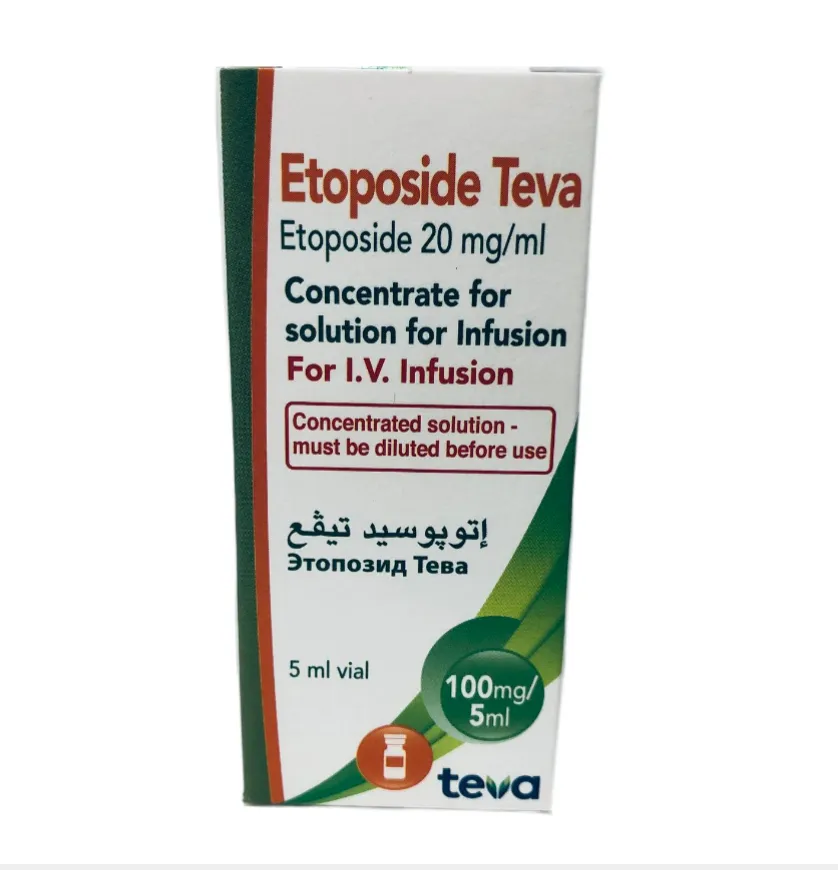
Table of Contents
Package leaflet: Information for the user
Introduction
Package leaflet: information for the patient
Etoposide Teva 20 mg/ml concentrate for solution for infusion
Etoposide
Read the entire leaflet carefully before you are given this medicine, because it contains important information for you
- Keep this leaflet, as you may need to read it again.
- If you have any questions, consult your doctor or pharmacist.
- If you experience any adverse reactions, consult your doctor or pharmacist, even if they are adverse reactions not listed in this leaflet. See section 4.
Leaflet contents
- What Etoposide Teva is and what it is used for
- What you need to know before receiving Etoposide Teva
- How to use Etoposide Teva
- Possible side effects
- How to store Etoposide Teva
- Contents of the pack and other information
1. What Etoposide Teva is and what it is used for
Etoposide belongs to a group of medicines called cytostatic agents, which are used in the treatment of cancer.
Etoposide is used for the treatment of certain types of cancer in adults:
- testicular cancer
- small cell lung cancer
- blood cancer (acute myeloid leukemia)
- tumors of the lymphatic system (Hodgkin lymphoma, non-Hodgkin lymphoma)
- reproductive system cancer (gestational trophoblastic neoplasia and ovarian cancer)
Etoposide is used for the treatment of certain types of cancer in children:
- blood cancer (acute myeloid leukemia)
- tumors of the lymphatic system (Hodgkin lymphoma, non-Hodgkin lymphoma)
You should discuss with your doctor the specific reason why Etoposide Teva has been prescribed for you.
2. What you need to know before using Etoposide Teva
Do not use Etoposide
- If you are allergic to etoposide or to any of the other ingredients of this medicine (listed in section 6)
- If you have recently received a live vaccine, including the yellow fever vaccine
- If you are breastfeeding or plan to breastfeed.
If any of the above apply to you, or if you are unsure whether they do, inform your doctor so they can provide advice.
Warnings and precautions
Talk to your doctor, pharmacist, or nurse before starting to use Etoposide Teva.
- If you have any infection.
- If you have recently received radiotherapy or chemotherapy.
- If you have low levels in the blood of a protein called albumin.
- If you have liver or kidney problems.
Effective cancer treatment can rapidly destroy large numbers of cancer cells. Very rarely, this may cause harmful amounts of substances from these cancer cells to be released into the blood. If this occurs, it may cause problems in the liver, kidneys, heart, or blood, which could lead to death if not treated.
To prevent this, your doctor will need to carry out regular blood tests to monitor the levels of these substances during treatment with this medicine.
This medicine may reduce the number of certain blood cells, which could lead to infections or may mean that your blood does not clot properly if you get a cut. To check that this does not happen, you will have blood tests at the start of treatment and before each dose you receive.
If you have reduced kidney or liver function, your doctor may also want to carry out periodic blood tests to monitor these levels.
Other medicines and Etoposide Teva
Tell your doctor or pharmacist if you are taking, have recently taken, or might need to take any other medicines.
This is especially important:
- If you are taking a medicine called cyclosporine (a medicine used to reduce the activity of the immune system).
- If you are being treated with cisplatin (a medicine used to treat cancer).
- If you are taking phenytoin or any other medicine used to treat epilepsy.
- If you are taking warfarin (a medicine used to prevent blood clots).
- If you have recently received vaccines containing live microorganisms.
- If you are taking phenylbutazone, sodium salicylate, or acetylsalicylic acid.
- If you are taking anthracyclines (a group of medicines used to treat cancer).
- If you are taking any medicine with a mechanism of action similar to etoposide.
Pregnancy, breastfeeding, and fertility
If you are pregnant or breastfeeding, think you may be pregnant, or plan to become pregnant, consult your doctor or pharmacist before using this medicine.
Etoposide must not be used during pregnancy unless clearly indicated by your doctor.
You must not breastfeed while receiving etoposide.
Patients, both men and women of reproductive age, should use an effective contraceptive method (such as barrier methods or condoms) during treatment and for 6 months after completion of etoposide treatment.
Male patients treated with etoposide are advised not to father a child during treatment and for up to 6 months after treatment. In addition, men are advised to seek counseling regarding sperm preservation before starting treatment.
Patients, both men and women, who are considering having a child after receiving etoposide treatment should discuss this with their doctor or nurse.
Driving and using machines
No studies have been conducted on the effects on the ability to drive or operate machinery. However, if you feel tired, nauseous, dizzy, or agitated, do not drive or operate machinery until you have discussed this with your doctor.
Etoposide Teva contains ethanol (alcohol)
One vial of this medicine contains 30% vol of alcohol (ethanol).
This medicine contains 1.2 g of alcohol (ethanol) in each 5 ml vial, 2.4 g of alcohol (ethanol) in each 10 ml vial, 4.8 g of alcohol (ethanol) in each 20 ml vial, 6 g of alcohol (ethanol) in each 25 ml vial, and 12 g of alcohol (ethanol) in each 50 ml vial, equivalent to a concentration of 241 mg/ml. The amount in 1 ml of this medicine is equivalent to 6 ml of beer or 2 ml of wine.
Adults
The amount of alcohol contained in this medicine is unlikely to have effects in adults.
The amount of alcohol contained in this medicine may alter the effect of other medicines. Consult your doctor or pharmacist if you are taking other medicines.
If you are pregnant, consult your doctor or pharmacist before taking this medicine.
If you have alcohol addiction, consult your doctor or pharmacist before taking this medicine.
Children and adolescents
The alcohol contained in this medicine may affect children weighing 17 kg (or less). Possible effects include changes in behavior and drowsiness. It may also affect their ability to concentrate and perform physical activities. If the child has epilepsy or liver problems, consult your doctor or pharmacist before taking this medicine.
Because this medicine is usually administered slowly over 30–60 minutes, the effects of alcohol may be reduced.
3. How to use Etoposide Teva
Etoposide will be administered to you by a doctor or nurse. It will be given as a slow intravenous infusion. This may last between 30 and 60 minutes.
The dose you receive will be specific to you and will be calculated by your doctor. The usual dose, based on etoposide, is 50 to 100 mg/m2 of body surface area per day for 5 consecutive days, or 100 to 120 mg/m2 of body surface area on days 1, 3, and 5. This treatment cycle may be repeated, depending on blood test results, but not earlier than 21 days after the first treatment cycle.
For children receiving treatment for blood or lymphatic system cancer, the dose used is 75 to 150 mg/m2 of body surface area per day for 2 to 5 days.
Your doctor may prescribe a different dose, especially if you are receiving or have previously received other cancer treatments, or if you have kidney problems.
If you receive more Etoposide Teva than you should
An overdose is unlikely, as the medicine is administered by a doctor or nurse. However, if it occurs, your doctor will treat any symptoms that appear.
In case of overdose or accidental ingestion, contact the Toxicology Information Service at 91-562 04 20, indicating the medication and the amount administered.
If you have any further questions about the use of this medicine, ask your doctor, pharmacist, or nurse.
4. Possible adverse effects
Like all medicines, this medicine can cause adverse effects, although not everyone experiences them.
Immediately inform your doctor or nurse if you experience any of the following symptoms: swelling of the tongue or throat, difficulty breathing, rapid heartbeat, skin redness or rash. These may be signs of a serious allergic reaction.
Occasionally, serious damage to the liver, kidneys, or heart has been observed due to a disorder called tumour lysis syndrome, which is caused by harmful amounts of substances from cancer cells entering the bloodstream when Etoposide Teva is administered together with other drugs used to treat cancer.
Possible adverse effects experienced with etoposide include:
Very common adverse effects (affect more than 1 in 10 people)
- blood disorders (for this reason, blood tests will be performed between treatment cycles)
- temporary hair loss
- nausea and vomiting
- abdominal pain
- loss of appetite
- changes in skin colour (pigmentation)
- constipation
- feeling of weakness (asthenia)
- general malaise
- liver damage (hepatotoxicity)
- increased liver enzymes
- jaundice (increased bilirubin)
Common adverse effects (affect between 1 in 10 and 1 in 100 people)
- acute leukaemia
- irregular heartbeat (arrhythmia), or heart attack (myocardial infarction)
- dizziness
- diarrhoea
- reactions at the infusion site
- severe allergic reactions
- high blood pressure
- low blood pressure
- painful lips, mouth or throat ulcers
- skin problems such as itching or rash
- inflammation of a vein
- infection (including infections observed in patients with weakened immune systems, e.g., a lung infection called Pneumocystis jirovecii pneumonia)
Uncommon adverse effects (affect between 1 in 100 and 1 in 1,000 people)
- tingling or numbness in hands and feet
- bleeding
Rare adverse effects (affect between 1 in 1,000 and 1 in 10,000 people)
- acid reflux
- flushing
- difficulty swallowing
- change in taste
- severe allergic reactions
- seizures
- fever
- drowsiness or tiredness
- breathing problems
- temporary blindness
- severe skin and/or mucous membrane reactions which may include painful blisters and fever, including extensive skin peeling (Stevens-Johnson syndrome and toxic epidermal necrolysis)
- a sunburn-like rash that may appear on skin previously exposed to radiotherapy and can be severe (radiation recall dermatitis)
- redness and swelling of the palms of the hands or soles of the feet which may cause the skin to peel (hand-foot syndrome)
Not known (frequency cannot be estimated from available data)
- tumour lysis syndrome (complications from substances released by treated cancer cells entering the blood)
- swelling of the face and tongue
- infertility
- difficulty breathing
- acute kidney failure
Reporting of adverse effects
If you experience any adverse effect, consult your doctor or pharmacist, even if it is a possible adverse effect not listed in this leaflet.
You can also report them directly via the Spanish Pharmacovigilance System for Human Medicines Website: www.notificaram.es. By reporting adverse effects, you can help provide more information on the safety of this medicine.
5. Storage of Etoposide Teva
Keep this medicine out of the sight and reach of children.
Do not use this medicine after the expiry date stated on the carton and vial after EXP. The expiry date refers to the last day of the month indicated.
Do not store above 25°C. Keep in the original packaging.
The diluted solution must be discarded 8 hours after preparation.
6. Contents of the pack and other information
Composition of Etoposide Teva
- The active substance is 20 mg of etoposide per ml of concentrate for solution for infusion.
- The other components are citric acid, polysorbate 80, ethanol, macrogol 300.
Appearance of the product and contents of the container
- Etoposide Teva concentrate for solution for infusion is a clear, yellow, slightly viscous solution in colorless transparent glass vials.
- Etoposide Teva concentrate for solution for infusion is available in vials of 5 ml, 10 ml, 20 ml, 25 ml, and 50 ml.
Only certain pack sizes may be marketed.
Marketing Authorization Holder
Teva Pharma, S.L.U.
C/ Anabel Segura, 11, Edificio Albatros B, 1st floor
28108 Alcobendas (Madrid)
Spain
Manufacturer:
Pharmachemie B.V.
2031 GA Haarlem
THE NETHERLANDS
or
TEVA PHARMA B.V.
Industrieweg 23, P.O. Box 217 (Michdrecht) - NL-2640 –
THE NETHERLANDS
This medicinal product is authorized in the member states of the European Economic Area under the following names:
Germany: Eto-Gry 20 mg/ml Konzentrat zur Herstellung einer Infusionslösung
Spain: Etopósido Teva 20 mg/ml concentrate for solution for infusion
Italy: Etoposide TEVA 20 mg/ml, concentrato per soluzione per infusione
Date of the most recent review of this leaflet: February 2024
Detailed information on this medicinal product is available on the website of the Spanish Agency of Medicines and Health Products (AEMPS) (http://www.aemps.gob.es/)
This information is intended for healthcare professionals only:
Preparation of the infusion solution
Procedures for the proper handling and disposal of anticancer drugs must be followed. All preparation steps must be carried out under laminar airflow conditions. Solutions must be prepared under aseptic conditions.
The required dose of etoposide concentrate must be diluted with 5% dextrose injection solution or 0.9% sodium chloride injection solution to achieve a final concentration of 0.2 mg/ml of etoposide.
Etoposide must not be physically mixed with any other medicinal product.
Use only clear solutions. Cloudy solutions or those with color changes must be discarded.
Do not use autoclave.
Disposal of unused medicinal product and all materials that have come into contact with it must be carried out in accordance with local regulations.
Administration and dosage
Etoposide is administered by slow intravenous infusion (usually over a period of 30 to 60 minutes), as hypotension has been reported as a possible adverse effect associated with rapid intravenous infusion. ETOPOSIDE MUST NOT BE ADMINISTERED BY RAPID INTRAVENOUS INJECTION.
The recommended dose of etoposide is 50 to 100 mg/m²/day on days 1 to 5 or 100 to 120 mg/m² on days 1, 3, and 5 every 3–4 weeks, in combination with other medicinal products indicated for the disease being treated. The dose should be adjusted considering the myelosuppressive effects of other drugs in the combination, or the effects of prior radiotherapy or chemotherapy that may have compromised bone marrow reserve.
Administration precautions: as with other potentially toxic compounds, caution must be exercised in the handling and preparation of etoposide solution. Adverse reactions may occur following accidental exposure to etoposide. The use of gloves is recommended. If etoposide solution comes into contact with the skin or mucous membranes, wash the skin immediately with soap and water and the mucous membranes with water.
Care must be taken to avoid extravasation.
Elderly patients
In elderly patients (over 65 years of age), no dose adjustment other than that based on renal function is required.
Paediatric use
In paediatric patients, etoposide has been used at doses of 75 to 150 mg/m²/day for 2 to 5 days in combination with other antineoplastic agents. The treatment regimen should be selected according to local standard of care.
Renal impairment
In patients with renal impairment, the following initial dose modifications should be considered based on creatinine clearance.
Creatinine clearance | Etoposide dose |
>50 ml/min | 100% of dose |
15-50 ml/min | 75% of dose |
Subsequent dosing should be based on patient tolerance and clinical effect. In patients with a creatinine clearance of less than 15 ml/min and those on dialysis, an additional dose reduction should be considered.