Etoposide Sandoz 20 mg/ml concentrate for solution for infusion EFG
Spain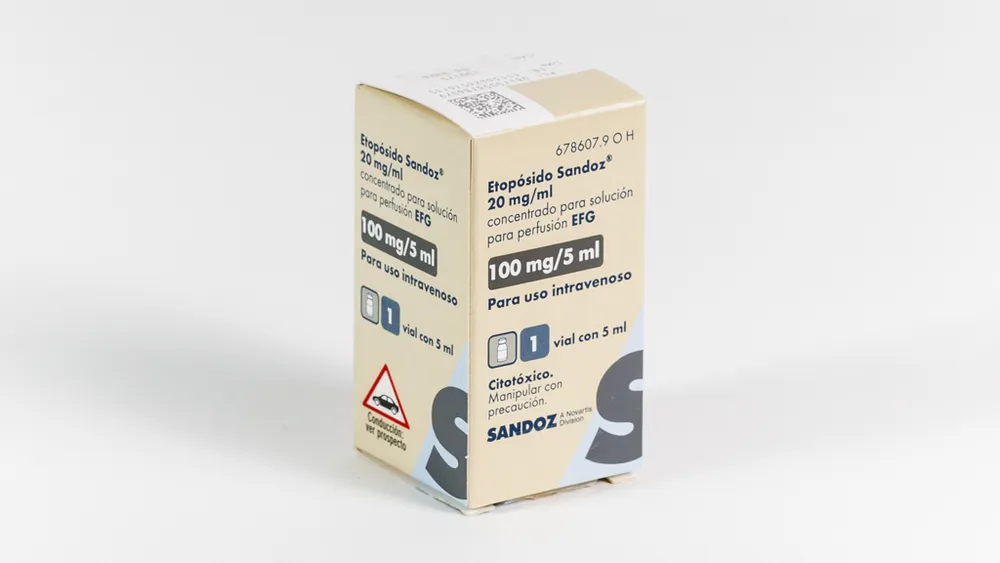
Table of Contents
- Patient Information Leaflet
- Introduction
- **Read the entire leaflet carefully before you start receiving this medication, as it contains important information for you.**
- **Package leaflet**
- 1. What Etopósido Sandoz is and what it is used for
- 2. What you need to know before you start receiving Etoposide Sandoz
- 3. How you will receive Etoposide Sandoz
- 4. Possible adverse effects
- **Reporting of adverse reactions**
- 5. Storage of Etoposide Sandoz
- 6. Contents of the pack and other information
- **Administration and dosage**
- ***Renal impairment***
Patient Information Leaflet
Introduction
Package leaflet: Information for the patient
Etoposide Sandoz 20 mg/ml concentrate for solution for infusion EFG
Read the entire leaflet carefully before you start receiving this medication, as it contains important information for you.
- Keep this leaflet, as you may need to read it again.
- If you have any questions, consult your doctor or pharmacist.
- This medication has been prescribed for you only, and you should not give it to others, even if they have the same symptoms as you, as it could harm them.
- If you experience any adverse effects, consult your doctor or pharmacist, even if they are adverse effects not listed in this leaflet. See section 4.
Package leaflet
- What Etopósido Sandoz is and what it is used for
- What you need to know before receiving Etopósido Sandoz
- How Etopósido Sandoz is administered
- Possible side effects
- How to store Etopósido Sandoz
- Contents of the pack and other information
1. What Etopósido Sandoz is and what it is used for
The name of this medicine is Etopósido Sandoz. Each vial contains 100 mg or 200 mg of etoposide as the active substance.
Etoposide belongs to a group of medicines called cytostatics, which are used in the treatment of cancer.
Etoposide is used in the treatment of certain types of cancer in adults:
- testicular cancer,
- small cell (microcytic) lung cancer,
- blood cancer (acute myeloid leukemia),
- tumors of the lymphatic system (Hodgkin's lymphoma, non-Hodgkin's lymphoma),
- reproductive system cancers (gestational trophoblastic neoplasia and ovarian cancer).
Etoposide is used in the treatment of certain types of cancer in children:
- blood cancer (acute myeloid leukemia),
- tumors of the lymphatic system (Hodgkin's lymphoma, non-Hodgkin's lymphoma).
You should discuss with your doctor the specific reason why etoposide has been prescribed for you.
2. What you need to know before you start receiving Etoposide Sandoz
Do not take Etoposide Sandoz:
- if you are allergic to etoposide or to any of the other ingredients of this medicine (listed in section 6),
- if you have recently received a vaccine containing live viruses, including the yellow fever vaccine,
- if you are breastfeeding or plan to breastfeed.
If any of the above applies to you, or if you are unsure whether it does, consult your doctor, who can advise you.
Warnings and precautions
Talk to your doctor, pharmacist, or nurse before starting Etoposide:
- if you have any infection,
- if you have recently received radiotherapy or chemotherapy,
- if you have low levels of a protein called albumin in the blood,
- if you have liver or kidney problems.
Effective anticancer treatment can rapidly destroy large numbers of cancer cells. Very rarely, this may cause harmful amounts of these cancer cells to be released into the blood. In such cases, this could lead to problems in the liver, kidneys, heart, or blood, which could be fatal if not treated.
To prevent this, your doctor must carry out regular blood tests to monitor the levels of these substances during treatment with this medicine.
This medicine may reduce the number of certain blood cells, which could make you more prone to infections or prevent your blood from clotting properly if you get a cut. To ensure this does not happen, you will have blood tests at the beginning of treatment and before each dose you receive.
If you have reduced liver or kidney function, your doctor may also want you to have regular blood tests to monitor these levels.
Other medicines and Etoposide Sandoz
Inform your doctor if you are taking, have recently taken, or might need to take any other medicines.
This is especially important:
- if you are taking a medicine called cyclosporine (used to reduce the activity of the immune system),
- if you are receiving treatment with cisplatin (a medicine used to treat cancer),
- if you are taking phenytoin or any other medicine used for epilepsy,
- if you are taking warfarin (a medicine used to prevent blood clots),
- if you have recently received any vaccine containing live microorganisms,
- if you are taking phenylbutazone, sodium salicylate, or acetylsalicylic acid,
- if you are taking any anthracycline (a group of medicines used to treat cancer),
- if you are taking any medicine with a mechanism of action similar to etoposide.
Pregnancy, breastfeeding, and fertility
Etoposide must not be used during pregnancy unless clearly indicated by your doctor.
You must not breastfeed while receiving etoposide.
Patients of both sexes, men and women, of childbearing age must use an effective contraceptive method (e.g., barrier method or condom) during treatment and for at least 6 months after completion of etoposide treatment.
Male patients treated with etoposide are advised not to father a child during treatment and for at least 6 months afterwards. In addition, men are advised to seek counseling regarding sperm preservation before starting treatment.
Patients of both sexes who are considering having a child after etoposide treatment should discuss this with their doctor or nurse.
Driving and using machines
No studies have been conducted on the effects on the ability to drive and use machines. However, if you feel tired, nauseous, dizzy, or drowsy, you should not drive or operate machinery until you have discussed this with your doctor.
Etoposide Sandoz contains benzyl alcohol and ethanol
Benzyl alcohol
Etoposide Sandoz contains 20 mg of benzyl alcohol per ml. Benzyl alcohol may cause allergic reactions.
Consult your doctor or pharmacist if you are pregnant or breastfeeding. This is because large amounts of benzyl alcohol may accumulate in your body and cause adverse effects (metabolic acidosis).
Consult your doctor or pharmacist if you have liver or kidney disease. This is because large amounts of benzyl alcohol may accumulate in your body and cause adverse effects (metabolic acidosis).
Benzyl alcohol has been associated with the risk of serious adverse effects, including breathing problems ("gasping syndrome") in children.
Do not administer this medicine to your newborn (up to 4 weeks of age) unless your doctor has specifically recommended it.
This medicine must not be used for longer than one week in children under 3 years of age unless directed by your doctor or pharmacist.
Ethanol
This medicine contains 26% ethanol (alcohol), corresponding to 260.60 mg of ethanol per ml. With a dose of 100 mg/m² of etoposide, a patient with a body surface area of 1.6 m² would receive 2.1 g of ethanol, equivalent to 52 ml of beer or 21.5 ml of wine.
It is unlikely that the amount of alcohol contained in this medicine will have any noticeable effect in adults or adolescents. However, it may have some effects in young children, such as drowsiness.
The amount of alcohol in this medicine may alter the effect of other medicines. Consult your doctor or pharmacist if you are taking other medicines.
If you are pregnant or breastfeeding, consult your doctor or pharmacist before taking this medicine.
If you are alcohol-dependent, consult your doctor or pharmacist before taking this medicine.
3. How you will receive Etoposide Sandoz
Etoposide will be administered to you by a doctor or nurse. It will be given as an intravenous infusion into a vein. This may take between 30 and 60 minutes.
The dose you will receive is specific to you and will be calculated by your doctor. The usual dose, based on etoposide, is 50 to 100 mg/m2 of body surface area, administered daily for 5 consecutive days, or 100 to 120 mg/m2 of body surface area on days 1, 3, and 5. This treatment cycle may be repeated later depending on the results of blood tests, but not earlier than 21 days after the first treatment cycle.
In children treated for cancer of the blood or lymphatic system, the dose used is 75 to 150 mg/m2 of body surface area administered daily for 2 to 5 days.
On some occasions, your doctor may prescribe a different dose, especially if you are receiving or have previously received other cancer treatments, or if you have kidney problems.
If you receive more Etoposide Sandoz than you should
Since etoposide is administered by a doctor or nurse, overdose is unlikely. However, if an overdose occurs, the doctor will treat any symptoms that arise.
If you have received more etoposide than you should, contact your doctor, pharmacist, or call the Toxicology Information Service immediately at telephone number: 91 562 04 20, stating the medication and the amount used.
If you have any further questions about the use of this medicine, ask your doctor, pharmacist, or nurse.
4. Possible adverse effects
Like all medicines, this medicine can cause adverse effects, although not everyone experiences them.
Immediately inform your doctor or nurse if you experience any of the following symptoms: swelling of the tongue or throat, difficulty breathing, rapid heartbeat, skin flushing, or rash. These could be signs of a severe allergic reaction.
Occasionally, serious damage to the liver, kidneys, or heart has been observed due to a disorder called tumor lysis syndrome, which is caused by the release of harmful amounts of substances from cancer cells into the bloodstream when etoposide is administered together with other drugs used to treat cancer.
Possible adverse effects experienced with etoposide include:
Very common side effects (may affect more than 1 in 10 people)
|
|
|
|
|
|
|
|
|
|
|
Common side effects (may affect up to 1 in 10 people)
|
|
|
|
|
|
|
|
|
|
Uncommon side effects (may affect up to 1 in 100 people)
- tingling or numbness in the hands and feet
- bleeding
Rare side effects (may affect up to 1 in 1,000 people)
|
|
|
|
|
|
Frequency not known (cannot be estimated from the available data)
- tumour lysis syndrome (complications arising from substances released into the blood by treated cancer cells)
- swelling of the face and tongue,
- infertility
- difficulty breathing
Reporting of adverse reactions
If you experience any adverse reactions, consult your doctor or pharmacist, even if they are not listed in this leaflet. You can also report them directly through the Spanish Pharmacovigilance System for Human Medicines: https://www.notificaram.es. By reporting adverse reactions, you can help provide more information on the safety of this medicine.
5. Storage of Etoposide Sandoz
Do not store above 25°C.
Keep the vial in the outer packaging to protect it from light.
Dilutions of etoposide at final concentrations of 0.2 or 0.4 mg/ml are stable for 96 or 24 hours, respectively, at temperatures not exceeding 25°C.
Before using Etoposide Sandoz, inspect the solution visually for foreign particles and discoloration, whenever solution and container permit.
Expiry
Do not use this medicine after the expiry date stated on the packaging after EXP. The expiry date refers to the last day of the month indicated.
Medicines should not be disposed of via wastewater or household waste. Ask your pharmacist how to properly dispose of unused medicines and their packaging. This will help protect the environment.
6. Contents of the pack and other information
Composition of Etoposide Sandoz
- The active substance is etoposide.
- The other components are: benzyl alcohol (20 mg/ml), anhydrous citric acid, ethanol 96.7%, macrogol 300, polysorbate 80, and nitrogen.
Appearance of the product and contents of the container
Glass vials packed in a box.
Etoposide Sandoz is available in:
-
Packs containing 1 and 10 vials of 5 ml with 100 mg of etoposide, with or without plastic protection (e.g. Sleeving, OncoSafe).
-
Packs containing 1 vial of 10 ml with 200 mg of etoposide, with or without plastic protection (e.g. Sleeving, OncoSafe).
Marketing Authorization Holder and Manufacturer
Marketing Authorization Holder
Sandoz Farmacéutica, S.A.
Parque Norte Business Center
Roble Building
C/ Serrano Galvache, 56
28033 Madrid
Spain
Manufacturer
EBEWE Pharma Ges.m.b.H. Nfg. KG
Mondseestrasse, 11
A-4866 Unterach
Austria
Or
Fareva Unterach GmbH
Mondseestrasse, 11
A-4866 Unterach
Austria
Date of the most recent revision of this leaflet: January 2024.
Detailed and up-to-date information on this medicinal product is available on the website of the Spanish Agency of Medicines and Health Products (AEMPS) http://www.aemps.gob.es/
This information is intended for healthcare professionals only:
Procedures for the proper handling and disposal of cytotoxic drugs must be followed.
Pregnant women must not handle or administer this medicinal product.
As with all cytostatic agents, etoposide must be handled with caution. Dilutions must be prepared under aseptic conditions by experienced personnel in a designated area. The use of protective gloves is recommended. Precautions should be taken to avoid any contact with skin and mucous membranes. In case of contact with skin or mucous membranes, wash immediately with copious amounts of water and soap.
Preparation for intravenous administration
Before administration, etoposide must be diluted with 5% glucose solution or 0.9% sodium chloride solution to a final concentration of 0.2 or 0.4 mg/ml of etoposide.
If the etoposide solution is diluted to a concentration higher than 0.4 mg/ml, precipitation may occur.
Etoposide must not be diluted in buffer solutions with a pH >8, due to the risk of precipitate formation.
Disposal of unused medication and of all materials that have come into contact with it must be carried out in accordance with local regulations.
Incompatibilities
This product must not be mixed with other medicinal products except those mentioned above.
It has been observed that acrylic or ABS plastic materials may crack or perforate when undiluted etoposide is used. This does not occur with diluted etoposide.
Administration and dosage
Etoposide Sandoz must be administered intravenously only.
Etoposide is administered by slow intravenous infusion, (usually over a period of 30 to 60 minutes). Depending on patient tolerance, longer infusion times may be required (see section 4.4 of the Summary of Product Characteristics). ETOPOSIDE SANDOZ MUST NOT BE ADMINISTERED BY RAPID INTRAVENOUS INJECTION. Cases of hypotension have been reported following rapid administration of the preparation.
All dosages are expressed in mg/m² of body surface area calculated according to height and weight.
The recommended dose of injectable etoposide is 50 to 100 mg/m²/day on days 1 to 5 consecutively, or 100 mg/m² on days 1, 3, and 5 of each cycle every 3–4 weeks, when administered in combination with other medicinal products used for the treatment of the disease.
Dosage should be adjusted to account for the myelosuppressive effects of other combination drugs or the effects of prior radiotherapy or chemotherapy that may have compromised bone marrow reserve.
Administration precautions: As with other potentially toxic compounds, caution should be exercised when handling and preparing the etoposide solution. Skin reactions may occur following accidental exposure to etoposide. The use of gloves is recommended. If the etoposide solution comes into contact with skin or mucous membranes, wash the skin immediately with soap and water and rinse mucous membranes with water.
Care should be taken to avoid extravasation.
Etoposide may only be administered by a specialist in cancer treatment or under their supervision.
Before use, Etoposide Sandoz should be visually inspected for foreign particles and discoloration, whenever the solution and container permit.
Elderly patients
Dosage adjustment in elderly patients (age > 65 years) is not required, except based on renal function.
Paediatric use
Etoposide in paediatric patients has been used at doses ranging from 75 to 150 mg/m²/day (etoposide equivalent) for 2–5 days in combination with other antineoplastic agents. Current specialized protocols and guidelines should be consulted to determine appropriate treatment.
Renal impairment
In patients with renal impairment, the following initial dose adjustment should be considered based on measured creatinine clearance:
Measured creatinine clearance | Etoposide dose |
> 50 ml/min | 100% of dose |
15-50 ml/min | 75% of dose |
Dosing should be based on patient tolerance and clinical effect. In patients with creatinine clearance below 15 ml/min and undergoing dialysis, further dose reduction should be considered.
Shelf life
3 years
Special storage precautions
Do not store above 25°C.
Keep the vial in the outer packaging to protect it from light.
Once diluted at a concentration of 0.2 or 0.4 mg/ml as recommended, the product is physically and chemically stable for 96 and 24 hours, respectively, at temperatures not exceeding 25°C under normal fluorescent light. However, from a microbiological standpoint, the product should be used immediately. If not used immediately, storage times and conditions prior to use are the responsibility of the user and should generally not exceed 24 hours at a temperature between 2°C and 8°C, unless the dilution has been carried out under controlled, validated aseptic conditions.