Etacortilen 1.5 mg/ml eye drops solution
Spain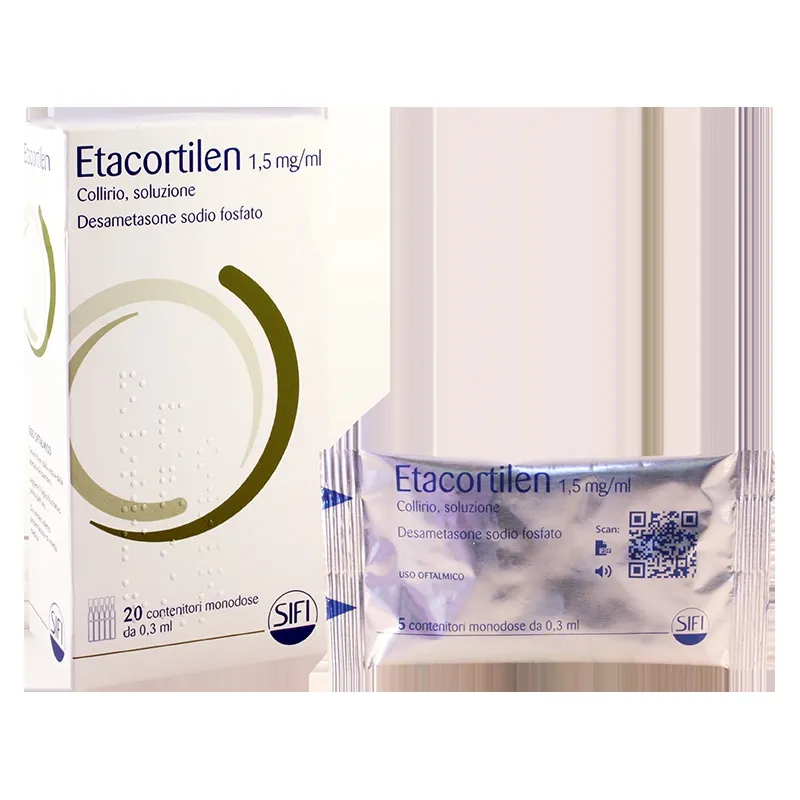
Table of Contents
Patient Information Leaflet
Introduction
Patient Information Leaflet
Etacortilen 1.5 mg/ml eye drops, solution
sodium dexamethasone phosphate
Read the entire leaflet carefully before you start using this medicine, as it contains important information for you.
-
Keep this leaflet, as you may need to read it again.
-
If you have any questions, ask your doctor or pharmacist.
-
This medicine has been prescribed for you only, and you should not give it to others, even if they have the same symptoms as you, because it could harm them.
- If you experience any adverse effects, consult your doctor or pharmacist, even if they are effects not listed in this leaflet. See section 4.
Leaflet Contents
- What Etacortilen is and what it is used for
- What you need to know before using Etacortilen
- How to use Etacortilen
- Possible adverse effects
- How to store Etacortilen
- Contents of the pack and other information
1. What Etacortilen is and what it is used for
Etacortilen contains a substance called dexamethasone. It is a corticosteroid that suppresses inflammatory symptoms.
It is indicated for the treatment of non-infectious eye inflammations, such as inflammation of the conjunctiva, eyelid, and/or the white part of the eye.
Inform your doctor if the condition does not improve or worsens after the prescribed duration of treatment.
2. What you need to know before using Etacortilen
Do not use Etacortilen:
- If you are allergic to the active substance or to any of the other ingredients of this medicine (listed in section 6).
- If you have high pressure inside the eye (ocular hypertension).
- If you have an eye infection such as Herpes simplex, viral corneal infections in the ulcerative stage, tuberculosis or fungal infections of the eye, acute purulent ophthalmia, purulent conjunctivitis, purulent herpetic blepharitis, or stye.
- If you have conjunctivitis with inflammation and ulcers on the surface of the eye's cornea (keratitis), even if it is in an early stage.
- If you have corneal damage (corneal lesions and abrasions).
Warnings and precautions
Talk to your doctor or pharmacist before starting to use this medicine.
Close monitoring of the eyes is necessary during treatment with this medicine, particularly:
- If treatment lasts for two weeks or more, due to the risk of increased intraocular pressure.
- If ophthalmic corticosteroids are used long-term (1–4 years), especially at high doses, as they may cause lens clouding (see section 4).
- If you have a viral infection, as corticosteroid use may worsen/exacerbate the condition, potentially leading to irreversible corneal clouding.
- If you have a disorder associated with corneal thinning.
- In cases of corneal inflammation caused by herpes (herpetic keratitis). The use of corticosteroids may delay healing of damaged tissue and increase the incidence and spread of infections.
- In cases of bacterial, viral, or fungal conjunctivitis, as topical corticosteroid administration may mask signs of infection progression.
- If you are using other eye drops containing phosphate (see section 4).
Contact your doctor if you experience blurred vision or other visual disturbances.
Consult your doctor if you develop swelling and weight gain around the trunk and face, as these are typically the first signs of a condition called Cushing's syndrome. Adrenal gland function suppression may occur after discontinuing intensive or long-term treatment with this medicine. Consult your doctor before stopping treatment on your own. These risks are particularly important in children and patients taking a medicine called ritonavir or cobicistat.
In all the cases listed above and in case of hypersensitivity to any component of the medicine, your doctor will discontinue the use of the eye drops and initiate appropriate treatment.
Contact lenses
Your doctor will instruct you to remove your contact lenses before applying the eye drops. There is no information available on the effect of this product on contact lenses. Therefore, do not wear contact lenses until the effects of the eye drops have completely subsided.
Children and adolescents
The safety and efficacy of this medicine have not been established in children.
In any case, prolonged long-term use of corticosteroids should be avoided in children.
Other medicines and Etacortilen
Tell your doctor or pharmacist if you are taking, have recently taken, or might need to take any other medicines, including those obtained without a prescription.
You must inform your doctor if you are taking other medicines containing phosphates. Your ophthalmologist will closely monitor your cornea at regular intervals.
The following medicines may reduce the effects of Etacortilen:
- Medicines used to treat epilepsy (barbiturates, phenytoin)
- Medicines used to help you sleep or reduce anxiety (sedative hypnotics)
- Medicines used to treat various bacterial infections (rifampicin)
- Medicines used to treat low blood pressure or nasal congestion (epinephrine)
Etacortilen may reduce the effects of:
- Medicines such as anticholinesterases (used for reduced intestinal motility and myasthenia gravis (a disease causing muscle weakness))
- Medicines used to treat viral eye infections
- Medicines similar to aspirin called salicylates (used for inflammation, pain, fever, and prevention of blood clot formation)
Inform your doctor if you are taking ritonavir or cobicistat, as this may increase the amount of dexamethasone in the blood and its effects, such as Cushing's syndrome.
Inform your doctor if you are taking atropine or related products, as their combined use may increase eye pressure.
This medicine may be used together with other ophthalmic medicines, but it is important to follow the instructions provided in section 3.
Pregnancy, breastfeeding, and fertility
If you are pregnant or breastfeeding, think you may be pregnant, or plan to become pregnant, consult your doctor before using this medicine.
Use during pregnancy
Use of this medicine during pregnancy is not recommended, except if considered necessary by your doctor and under strict medical supervision.
Use of this medicine during breastfeeding
Use of this medicine is not recommended during breastfeeding.
Driving and using machines
As with all eye drops, you may experience blurred vision after instillation. Wait until your vision clears before driving or operating machinery.
Etacortilen contains phosphates
This medicine contains 0.13 mg of phosphates per drop, equivalent to 3.66 mg/mL.
If you have severe corneal damage (the transparent layer at the front of the eye), treatment with phosphates may, in very rare cases, cause blurred vision due to calcium accumulation.
3. How to use Etacortilen
Follow exactly the instructions for administration of this medicine as given by your doctor or pharmacist. If in doubt, consult your doctor or pharmacist again.
The recommended dose is one drop in the affected eye or eyes three or four times a day, or as directed by your physician.
Instructions for use
- Wash your hands thoroughly before applying the eye drops.
- Make sure the single-dose container is intact.
- Detach a single-dose container from the strip.
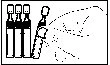
- To open, twist the tab of the container without stretching.

- Sit or lie down and tilt your head backward, looking upward. Gently and carefully pull the lower eyelid downward with your thumb and index finger.
- Do not allow the tip of the single-dose container to touch the eye, eyelids, or any other surface to avoid possible contamination.

Since sterility cannot be maintained once the individual single-dose container has been opened, any remaining contents must be discarded after administration.
Use in children and adolescents
The use of this medicine is not recommended in children.
If you use more Etacortilen than you should
No cases of overdose have been reported with the use of this medicine.
If you accidentally instill more drops than prescribed, rinse thoroughly. Apply the next dose as usual.
If the product is accidentally ingested, your doctor may consider gastric lavage.
In case of overdose or accidental ingestion, contact your doctor or pharmacist immediately, or call the Toxicology Information Service at telephone number 91 562 04 20, indicating the medicine and the amount ingested.
If you forget to use Etacortilen
Do not apply a double dose to make up for the missed dose.
If you stop treatment with Etacortilen
Patients with pre-existing severe corneal damage, a condition threatening vision, should not discontinue treatment without consulting their doctor. Always inform your doctor if you intend to stop treatment.
If you have any further questions about the use of this medicine, ask your doctor or pharmacist.
If you use Etacortilen with other ophthalmic medicines
If you are using any other ophthalmic medicine, you should wait 5 minutes between the use of each medicine.
Ophthalmic ointments should be used last.
4. Possible adverse effects
Like all medicines, this medicine can cause adverse effects, although not everyone experiences them. Most people treated with this eye drop do not experience any adverse effects.
The possible unwanted effects due to the use of corticosteroids are as follows:
Very common: may affect more than 1 in 10 people
- increased intraocular pressure after 15–20 days of topical administration in predisposed subjects and in patients with glaucoma.
Common: may affect up to 1 in 10 people
- discomfort, irritation, burning, stinging, itching, and blurred vision after application. Generally, these symptoms are mild and of short duration.
Uncommon: may affect up to 1 in 100 people
- lens opacification (cataract formation) following long-term use of corticosteroids;
- worsening/exacerbation of infections caused by Herpes simplex or fungal infections;
- delayed wound healing.
Very rare: may affect up to 1 in 10,000 people
- corneal perforation;
- corneal calcification.
Frequency not known: frequency cannot be estimated from the available data.
- Hormonal problems: excessive body hair growth (particularly in women), muscle weakness and wasting, purple stretch marks on the skin, increased blood pressure, irregular or absent menstrual periods, changes in body protein and calcium levels, growth retardation in children and adolescents, and swelling and weight gain in the body and face (known as ‘Cushing’s syndrome’) (see section “Warnings and precautions”).
In all the cases listed above, patients should discontinue the use of the eye drops and start appropriate treatment.
Reporting of adverse effects
If you experience any type of adverse effect, consult your doctor or pharmacist, even if it is a possible adverse effect not listed in this leaflet. You can also report them directly via the Spanish Pharmacovigilance System for Human Medicinal Products: https://www.notificaram.es. By reporting adverse effects, you can help provide more information on the safety of this medicine.
5. Storage of Etacortilen
Keep this medicine out of the sight and reach of children.
Do not use this medicine after the expiry date stated on the bottom of each container, on the outer packaging, and on the box after "EXP". The expiry date refers to the last day of the month indicated, provided the product remains unopened and properly stored.
This medicine does not require any special storage conditions.
The eye drops are for single use and are supplied in single-dose containers. After opening the single-dose container, use immediately and discard any remaining unused portion.
After the first opening of the aluminum pouch, any remaining single-dose containers inside the pouch should be used within 28 days; after this period, any unused single-dose containers must be discarded.
Medicines must not be disposed of via wastewater or household waste. Dispose of containers and unused medicines at the SIGRE collection point at your pharmacy. If in doubt, ask your pharmacist how to properly dispose of unused medicines and their containers. This will help protect the environment.
6. Contents of the pack and other information
Composition of Etacortilen
- The active substance is dexamethasone sodium phosphate. 1 ml of solution contains 1.5 mg of dexamethasone sodium phosphate.
- The other components are sodium citrate, monobasic monohydrate sodium phosphate, dibasic sodium phosphate dodecahydrate, purified water.
Appearance of the medicine and contents of the pack
Etacortilen 1.5 mg/ml eye drops solution is a colourless solution supplied in 5 single-dose units containing 0.3 ml of eye drops in an aluminium pouch, packed in a carton. Each single-dose unit contains 0.45 mg of dexamethasone sodium phosphate in 0.3 ml of solution.
The carton contains 2 or 4 aluminium pouches.
Each carton contains 10 or 20 single-dose units.
Only certain pack sizes may be marketed.
Marketing Authorisation Holder and Manufacturer
SIFI S.p.A.
Via Ercole Patti 36
95025 Aci Sant'Antonio (CT)
Italy
Local representative:
Faes Farma, S.A.
Autonomia Etorbidea, 10
48940 Leioa (Bizkaia)
Spain
Date of the most recent revision of this leaflet: November 2021.
Detailed and up-to-date information on this medicine is available on the website of the Spanish Agency of Medicines and Health Products (AEMPS) www.aemps.gob.es